3 Days in Aarhus: A Solo Traveler's Journal
3 Days in Aarhus: A Solo Traveler's Journal
Aarhus lands on the itinerary for a practical reason: a flight to Billund runs 80 euros cheaper than Copenhagen, the kind of math budget travelers love. Three days later, canceling Copenhagen altogether starts to feel like a serious option.
Day 1: Arrival and the Latin Quarter
6:30 PM — Checked into the hostel
Danhostel Aarhus sits right by the harbor. 250 DKK gets you a dorm bed — clean sheets, a locker that actually works, and a common room facing the water. Not glamorous, but this isn't a thread-count kind of trip.
7:15 PM — First walk through the Latin Quarter
Mejlgade and the streets around Volden deliver cobblestones, independent boutiques, and vintage shops that smell like old leather. A cafe with a cat asleep in the window. A record store playing Dexter Gordon at a volume that spills into the street.
Duck into La Cabra, the coffee shop locals will insist you visit. A pour-over runs 55 DKK and ranks among the best cups of coffee in Europe — and that's not a claim worth making lightly.
8:30 PM — Dinner at the Street Food Market
A converted bus garage near the train station packs in 30+ food stalls. The energy echoes the food markets of Bangkok, only colder and steeped in more hygge. Order a smoked salmon open sandwich (85 DKK) and a local craft beer (65 DKK), then take a communal table — where two Danish university students might explain the rules of cycling in Aarhus with the gravity of someone explaining air traffic control.
10:45 PM — Harbor walk
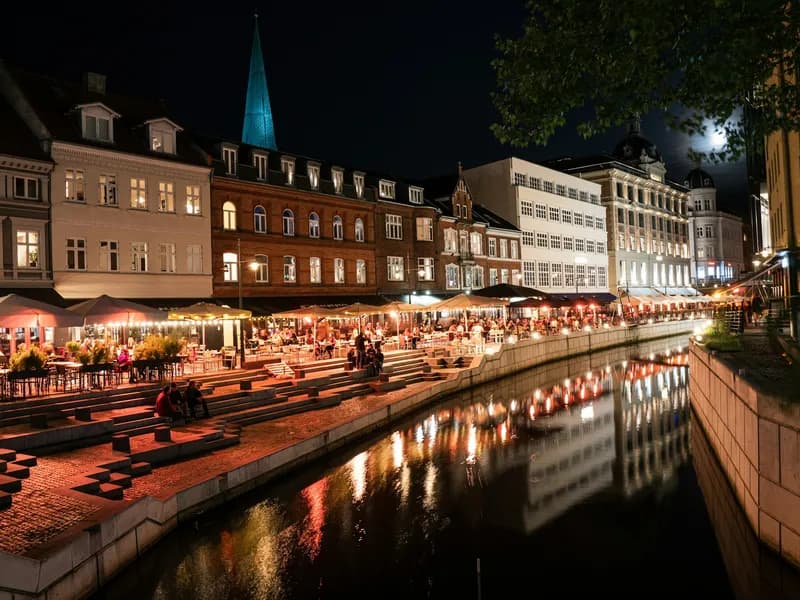
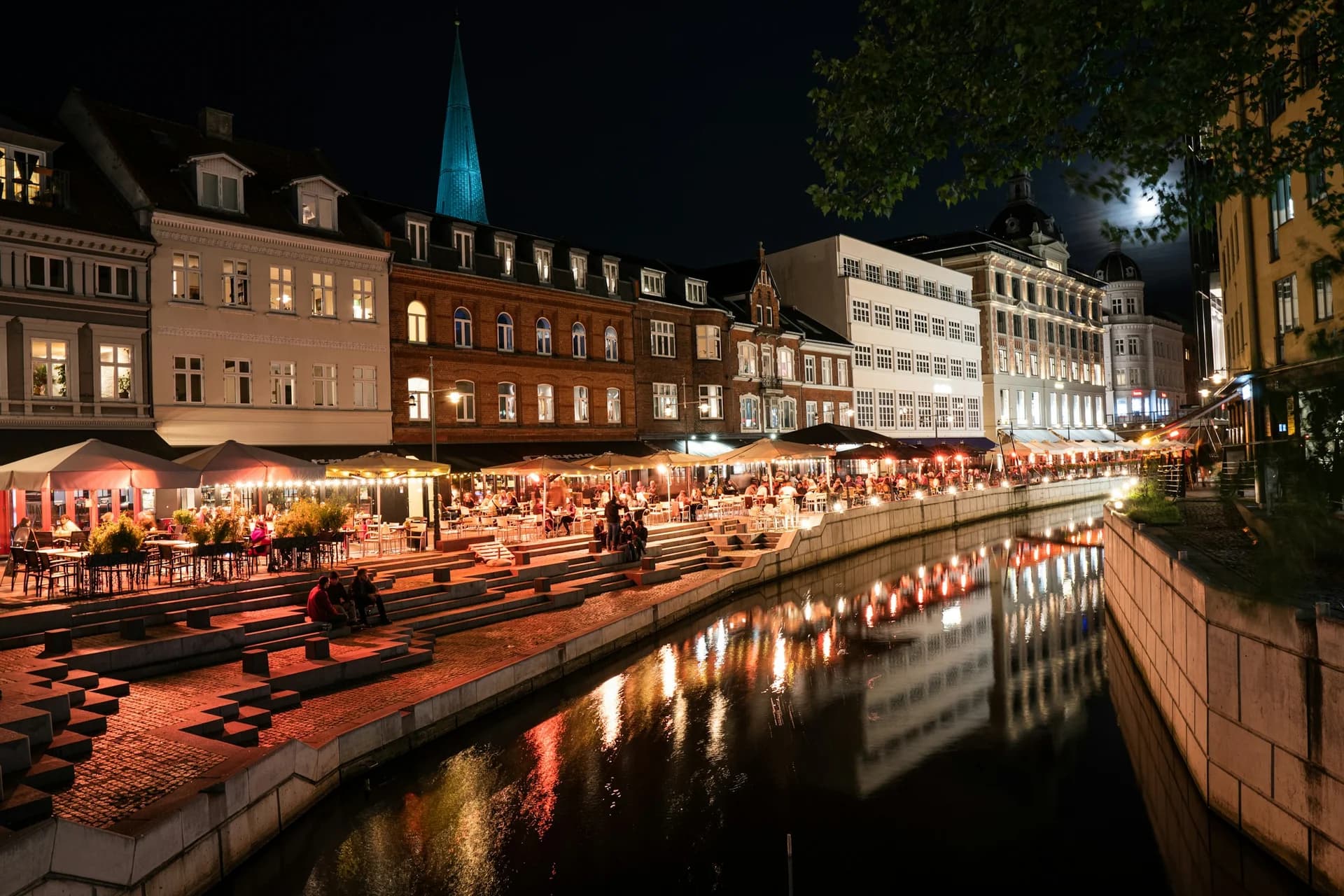
The sun is still setting at nearly 11 PM — a reminder of just how far north Denmark sits. The harbor turns to soft light and still water. A couple slips into the harbor bath for a midnight swim. Find a bench and watch the sky shift from pink to purple to a blue that doesn't have a name.
Day 2: Museums Day
8:00 AM — Bike rental
Grab a bike through the Donkey Republic app — 60 DKK for the day. The bike lanes in Aarhus are wide, well-marked, and used by absolutely everyone: businesspeople in suits, kids on their way to school, elderly couples riding side by side. A rental bike fits right in.
9:30 AM — ARoS Aarhus Art Museum
The Rainbow Panorama is everything the photos promise and then some. Walk through Olafur Eliasson's circular corridor of colored glass and the entire city shifts through the spectrum — red Aarhus, orange Aarhus, green Aarhus. Each color makes it look like a different place.
The museum below the panorama is just as substantial. The 'Boy' sculpture — a 5-meter-tall crouching figure in the lobby — stops visitors mid-step. There's something arresting about it: not scary, just enormous and human and quietly affecting.
Entry: 160 DKK. Budget 2.5 hours, and expect to want more.
1:00 PM — Den Gamle By
The Old Town museum gathers seventy-five historical buildings relocated from across Denmark and arranged to recreate different eras. Here's what nobody tells you: the 1970s section is the real star. An apartment with shag carpet, an avocado kitchen, a record player loaded with actual vinyl, and a faux TV playing period Danish television.
Linger twenty minutes in that apartment and a strange nostalgia takes hold — for a decade you may never have lived through.
The jazz bar recreation is convincing enough to feel like a real bar. The attention to detail — the sticky table surfaces, the half-drunk glasses — borders on pathological.
Entry: 175 DKK. Budget 3 hours.
5:00 PM — Biking to Marselisborg Deer Park
A 3 km ride south along the coast follows a beautiful bike path. The deer park is free, and the deer are tame enough that one may wander within arm's reach while you sit on a bench with a pastry. Count at least 30 in the meadow — it plays like a Disney movie with better lighting.
7:30 PM — Dinner in Frederiksbjerg
The neighborhood south of center is where locals eat. Seek out a small restaurant with a handwritten menu and order the frikadeller (Danish meatballs) with potatoes and red cabbage for 125 DKK — the kind of meal that explains why comfort food became a concept.
Day 3: MOMU and Farewell
9:00 AM — Bus 18 to Moesgaard Museum
The building alone is worth the 10 km trip south: a modernist structure with a grass-covered roof that slopes at such an angle you can walk up it. Locals picnic on the roof in summer and ski down it in winter. Only in Denmark.
The reason to come is the Grauballe Man — a 2,000-year-old Iron Age bog body, preserved in peat, with facial features and hair still visible. Behind the display case, his expression reads as peaceful, as if simply asleep for two millennia. It's a quietly powerful encounter, the rare museum piece that stays with you.
Entry: 170 DKK. Budget 2 hours.
12:30 PM — Back to the harbor
Wander through the Dokk1 library — a massive angular building that feels designed by someone who truly loved geometry. Free entry, and the rooftop opens onto panoramic harbor views.
2:00 PM — Last coffee at La Cabra
Same pour-over, same seat by the window. It becomes a small ritual after just three days — that's how quickly Aarhus gets under your skin.
4:00 PM — Train to Copenhagen
Three hours through the Danish countryside roll past mostly flat farmland and wind turbines. Watch Copenhagen approach through the window and the feeling is genuinely conflicted — not because Copenhagen isn't great (it is), but because Aarhus reveals something Copenhagen can't: a city that isn't performing for tourists, a city simply being itself.
Worth Going Back?
Without question. Three days isn't enough. A week would be better — enough time to cycle the coast, visit during Aarhus Festival in late August, and work through more of the restaurants in Frederiksbjerg. Enough time to catch the Infinite Bridge at sunset, and to return to that deer park with a thermos of coffee and nowhere to be.
Aarhus is the rare city that doesn't try to impress you. It simply is what it is. And what it is, quietly, is one of the best small cities in Europe.