
Your Ashgabat and Turkmenistan Questions Answered: Visas, Safety, and the Door to Hell
Your Ashgabat and Turkmenistan Questions Answered: Visas, Safety, and the Door to Hell
Turkmenistan is the most asked-about, least-visited country in Central Asia. The questions never change: Can you actually go there? Is it safe? Is it as strange as everyone claims? Here are the honest answers.
Visas & Entry
Q: Can you just show up?
No. Turkmenistan runs one of the world's most restrictive visa regimes. Most visitors need a Letter of Invitation (LOI) from a licensed Turkmen tour operator, then apply at a Turkmen embassy with the LOI in hand. Cost: $35-155 depending on nationality. Processing: 2-4 weeks.
Q: What about a transit visa?
Transit visas (5 days, land border to land border) are easier to obtain and don't require an organized tour. You must enter and exit from different borders. The popular route: enter from Iran, exit to Uzbekistan (or vice versa). Apply at a Turkmen embassy with proof of onward travel.
Q: How far in advance should you apply?
At least 6 weeks. The LOI from the tour operator takes 1-2 weeks, then embassy visa processing takes another 2-4 weeks. Rejection does happen, and the government never explains why. Keep a backup plan.
Safety
Q: Is Turkmenistan safe?
Crime against tourists is virtually nonexistent. Ashgabat may be the safest capital you'll ever set foot in. The government maintains heavy security — police and plainclothes officers are everywhere. You will not be robbed, mugged, or harassed.
The trade-off: that security apparatus can feel heavy. Keep political talk — the president, human rights — out of public conversation. Carry your passport at all times. Expect your camera roll to be checked at the airport on departure.
Q: Is it really as controlled as people say?
Yes. Internet is heavily censored (VPNs may not work). International media access is limited. Public gatherings are restricted. Photography of government buildings, military, and police is prohibited. This is an authoritarian state, and visitors do best when they respect the constraints — the same mindset serves travelers heading to Lhasa, another destination where permits and rules shape the whole trip.
Within those constraints, though, daily life runs orderly and visitors are treated well. Tour guides are professional and genuinely proud of their country.
Ashgabat
Q: Is Ashgabat really all white marble?
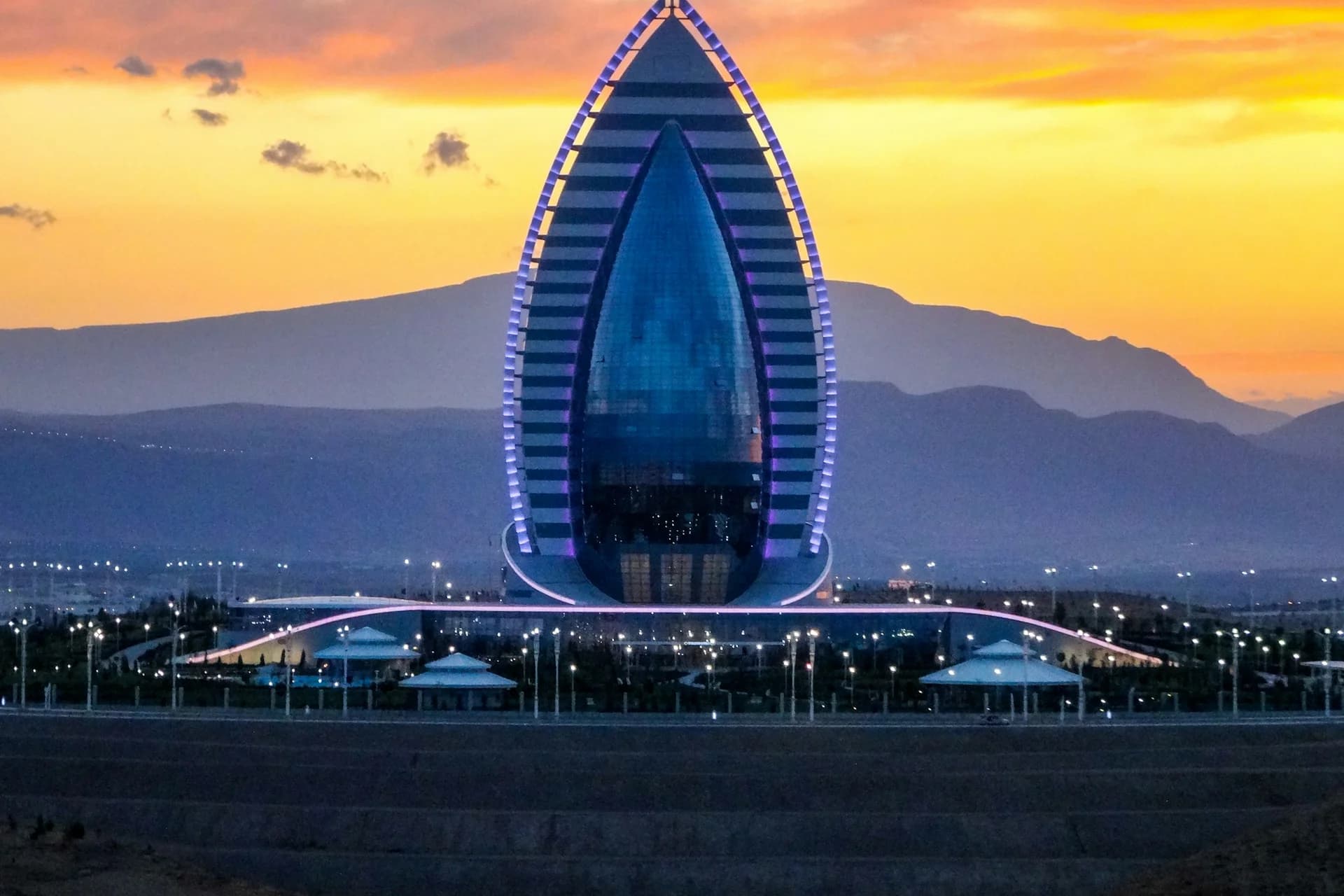
Yes. 543 white marble-clad buildings. A Guinness World Record. The boulevards run wide, clean, and largely empty. It reads like a city designed by an AI told to make everything impressive but forgetting to add people. The visual impact is real — this is unlike any other city on earth.
Q: What's worth seeing in Ashgabat?
- The white marble cityscape itself (free to walk, 2-3 hours)
- Turkmen Carpet Museum (50 TMT, world-class collection)
- Nisa UNESCO ruins (30 TMT, Parthian Empire, 18km away)
- Tolkuchka Bazaar (weekends only, carpets and crafts)
- Alem Ferris Wheel (10 TMT, world's largest enclosed)
- National Museum of Turkmenistan (a strong overview of history and carpets)
Give the city 1-2 days. The Darvaza Crater needs an additional 2.
Darvaza Gas Crater
Q: Is the Door to Hell worth the trip?
Absolutely. It sits 270km north (4-5 hours each way) through featureless desert. By day, it's a moderately interesting burning hole. By night, it's transcendent — a 70m-wide inferno glowing orange in the absolute darkness of the Karakum Desert.
Camp overnight at the rim. There are zero facilities, so bring everything. Tours from Ashgabat run $150-300/person.
Q: Is it still burning?
Yes, since 1971. The government has periodically floated closing it, but as of 2026 it keeps burning.
Money
Q: What's the deal with the dual exchange rate?
Turkmenistan runs an official rate (1 USD = 3.5 TMT) and a black market rate (roughly 1 USD = 18-20+ TMT). That makes prices in TMT misleading — at the official rate, a 50 TMT museum entry is ~$14; at the black market rate, it's ~$2.50. Your tour operator handles most expenses. Bring USD cash in good condition.
Q: Do ATMs and cards work?
ATMs are unreliable. Cards are rarely accepted. Bring USD cash.
Practical
Q: What about getting carpets out of the country?
Any carpet purchase requires an export certificate from the Carpet Museum. Without it, customs will confiscate the carpet at the airport. The process takes 1-2 days and costs vary. Buy carpets early in the trip.
Q: Best time to visit?
March to May and September to November (20-30°C). Summers are brutal (45°C+). Winter is mild (5-15°C). The Darvaza Crater is spectacular in any season — nighttime is the point.
Q: Can you extend beyond Ashgabat?
With a tour, yes: Merv (UNESCO Silk Road city), Konye-Urgench (medieval ruins), and the Karakum Desert are all within reach. A 5-7 day tour covers the highlights. The Caspian coast and Awaza resort hold less appeal for international visitors.
Quick Reference
| Item | Detail |
|---|---|
| Visa | LOI + embassy, 6+ weeks lead time |
| Safety | Extremely safe, heavily controlled |
| Currency | TMT (dual exchange rate, bring USD) |
| Best time | Mar-May, Sep-Nov |
| Ashgabat time | 1-2 days |
| Darvaza Crater | +2 days (overnight essential) |
| Airport | ASB, 10km from center |
Turkmenistan isn't for everyone. It's expensive to arrange, restrictive in ways that can feel uncomfortable, and logistically demanding. But for travelers who want to see something genuinely unlike anything else — a marble city in the desert, a crater that's been burning for 55 years, and a country that time forgot — it delivers an experience no amount of Instagram scrolling can replicate.
Q: Should you visit Turkmenistan on a transit visa or a full tour?
Both work, but they're different experiences. A transit visa (5 days, enter and exit from different borders) is cheaper and allows independent movement, though it limits you to the land corridor between two borders. Most transit travelers run Iran-Ashgabat-Darvaza-Uzbekistan.
A full tour (via LOI) buys more time, more flexibility, and access to Merv and Konye-Urgench. It costs more and keeps a guide with you throughout. For first-timers focused mainly on Ashgabat and Darvaza, the transit visa is often plenty.
Q: Is the food good?
Turkmen food is hearty, meat-heavy, and satisfying. Plov, shashlik, manty (large steamed dumplings), and the local flatbread (chorek) all deliver. The cuisine isn't as complex as Uzbek or as varied as Turkish, but it's honest and filling. Melon season (August-September) produces extraordinary fruit — Turkmen melons are famous across Central Asia.


