
Living in Cappadocia's Caves: A Conversation with Yusuf, Goreme Local of 40 Years
Living in Cappadocia's Caves: A Conversation with Yusuf, Goreme Local of 40 Years
Yusuf Ozdemir is 52, and Goreme has been home for every one of those years. He grew up in a cave house carved into the tufa rock — not a "cave hotel" styled for Instagram, but a real family home, where the kitchen was a carved-out room and the pantry stayed naturally cool through every season. Today he runs a small carpet shop on the main street, explaining natural dyes to visitors and quietly watching his hometown change.
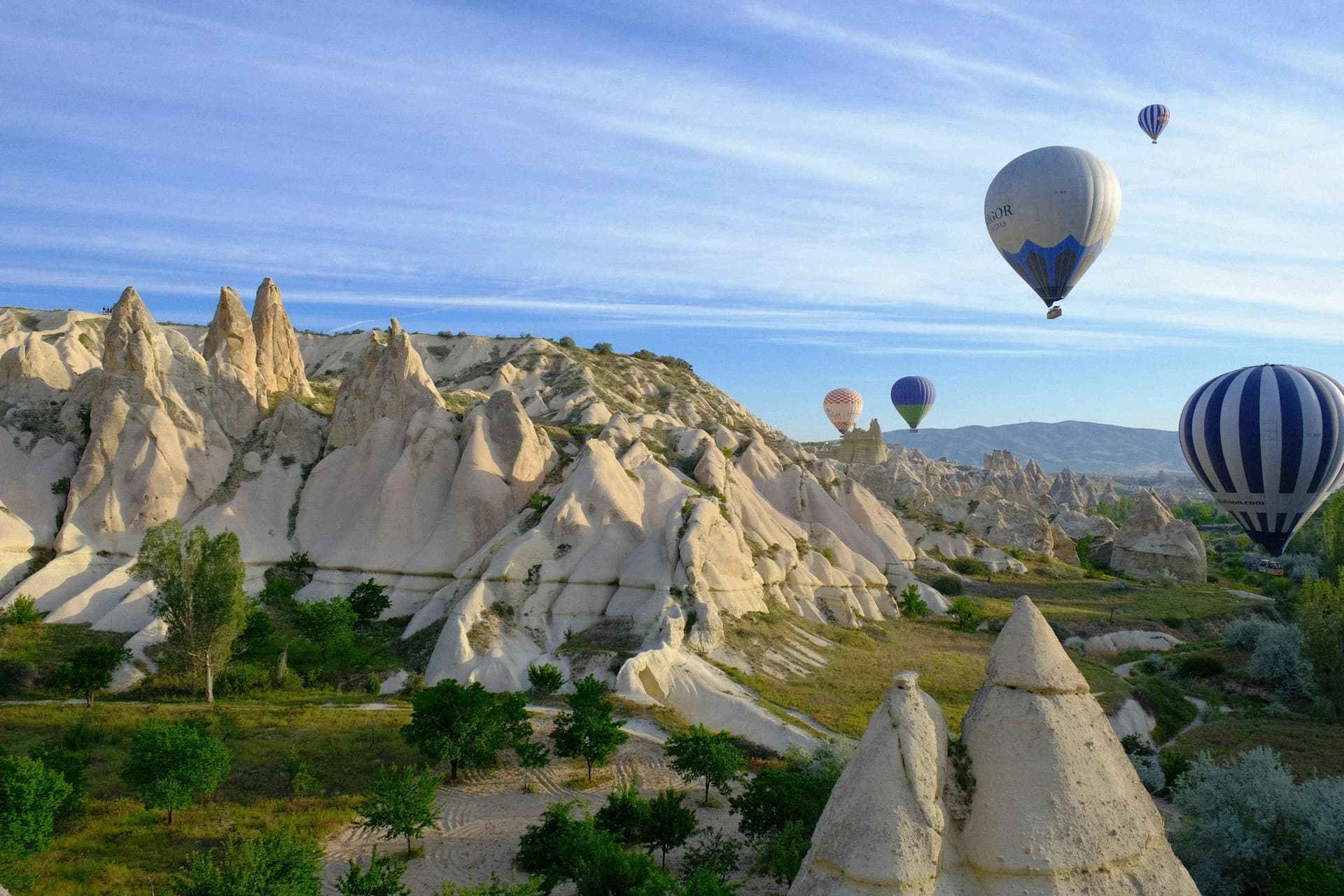
Settle onto the terrace of his shop with a glass of tea, the valley spread out below and a few balloons still drifting down from the morning flight, and the Goreme behind the postcards begins to come into focus.
What was Goreme like before the tourists came?
In the 1980s, Goreme was a village of maybe 2,000 people, and nearly everyone lived in cave houses — not for the romance of it, but because it made sense. The volcanic rock is easy to carve, cool in summer and warm in winter, and it had been shaped into homes for a thousand years, generation after generation.
There were no hotels. No balloon rides — those began in the 1990s. No Instagram. Visitors came occasionally — archaeologists, the odd European backpacker — but tourism, as an industry, simply didn't exist.
Families grew grapes, raised animals, and made wine in the cellars. Yusuf's father kept pigeons in a dovecote carved into the cliff behind the house, and the droppings became fertilizer — the reason so many carved pigeon houses still dot the valleys. Not decoration. Agriculture.
When did everything change?
The balloons changed everything. When the first commercial balloon company launched in the late 1990s, the whole world suddenly saw those sunrise photographs. The UNESCO designation for the Open-Air Museum brought government attention and funding close behind. Hotels began appearing in the 2000s. Cave houses became cave hotels. A neighbor sold his family home for what seemed an impossible price at the time — today it's a boutique hotel charging EUR 200 a night.
The pace over the last 15 years has been dizzying. Yusuf's daughter works a hotel reception desk and speaks four languages; his father spoke Turkish and a little Arabic. In a single generation, Goreme went from farming village to international destination.
Do you resent the tourism?
Ask a local and the answer comes with both gratitude and complexity. Tourism opened doors that an earlier generation never had. The money flowing into Goreme improved roads, healthcare, and schools. Carpet shops like Yusuf's do well because visitors buy carpets.
There's a quieter side, too. Property prices have climbed so steeply that some young families now settle in nearby Nevsehir or Urgup, and the old rhythm of donkeys-on-the-street village life has given way to ATVs in the valleys and a busier, more international pace. It's a real tension, and one worth understanding as a visitor. But the fairy chimneys are indifferent to all of it — they've stood for millions of years, and they'll outlast every trend. Arrive with that perspective and Goreme rewards you generously.
What do tourists get wrong about Cappadocia?
The most common mistake is treating Cappadocia as a 24-hour stop: one night, one balloon, one museum, gone. This is not a place you can read in a day. The valleys take time. The underground cities take time. Even sitting on a terrace watching the light shift across the fairy chimneys takes time — and none of it is wasted. That, in fact, is Cappadocia.
Most visitors also see only Goreme and perhaps the Open-Air Museum, when dozens of valleys go all but unentered. Soganli Valley, to the south, hides cave churches with frescoes that rival the Open-Air Museum — and almost no one is there. Ihlara Valley is a 14 km gorge threaded by a river and lined with Byzantine churches, skipped by most because it sits 80 km away.
Then there are the underground cities — Derinkuyu, Kaymakli — which too many travelers rush in 45 minutes. These places sheltered 20,000 people for months during invasions. Consider what that required: the ventilation shafts, the great stone rolling doors, the wine presses built deep underground. Give it an hour. Read the panels. It ranks among the most remarkable engineering feats in human history — worth far more than a selfie on the way out.
What's your favorite spot in Cappadocia?
Pasabag — what the tour groups call "Monks Valley" — is the local favorite. Its multi-headed fairy chimneys rise like pillars capped with balanced stone hats, and a hermit monk carved a chapel inside one of them centuries ago; you can still climb up to see it.
Pasabag is free, open around the clock, and most tour buses pause for only 20 minutes. Arrive early morning or late afternoon, once the buses have gone, and you can stand among the chimneys in near silence and feel the sheer age of the place. Millions of years of erosion shaped these forms. People have lived among them for millennia. And for a few minutes, it's just you and the rock.
What about the cave hotels — are they authentic?
Some are entirely genuine; others are concrete dressed in a stone veneer to look the part. Authentic cave rooms are carved directly into the tufa — you can read the marks of hand tools and feel the natural texture of the stone. The walls are thick, which keeps them cool in summer and warm in winter, and real rooms carry slightly uneven floors and low ceilings in places.
The best cave hotels kept the original carved structure and added modern plumbing and electricity. Sultan Cave Suites, Museum Hotel, and Koza are expensive, but the cave rooms are the real thing.
Before you book, ask whether the room is carved rock or built, and look for photos showing raw stone walls. If the surfaces look too smooth and uniform, it's probably not a true cave.
Tell me about the pottery tradition.
Avanos, 10 km from Goreme, has shaped pottery for 5,000 years. The Kizilirmak — the Red River — lays down the iron-rich red clay that potters have worked since the Hittites, and the technique of throwing on the wheel has barely changed since.
Chez Galip is the most famous workshop — a little theatrical for the crowds, but the pottery is real and the demonstrations genuine. Smaller workshops along the Avanos main street are quieter, and you can often try the wheel yourself. A simple bowl runs TRY 30-50; a decorative piece, TRY 100-500 depending on size and detail.
Buy your pottery here rather than in the souvenir shops of Goreme — the quality is higher and the prices lower, because you're buying straight from the maker.
Is there anything about Cappadocia that still surprises you after 40 years?
The morning light, every single day. As the sun crests the eastern ridge and strikes the fairy chimneys, the whole valley turns from grey to gold to pink in about ten minutes. Even after thousands of mornings, it still stops a lifelong local in his tracks.
And the stars. On cold, dry winter nights, with the tourists gone, the sky over Cappadocia turns extraordinary — the towns are small enough that there's no light pollution, and the Milky Way stretches from horizon to horizon. Children brought out to see it can hardly believe that many stars are real.
Quick Recommendations from Yusuf
- Best time: September-October (warm days, cool nights, harvest season)
- Minimum stay: 3 nights
- Best free experience: Sunrise over Love Valley, watching the balloons from below
- Best meal: Testi kebab at Dibek in Goreme
- Best-kept secret: Soganli Valley, 50 km south — cave churches without the crowds
- Most overrated: The Instagram terrace breakfast photos (the food is average; the view is the point)
- One thing to understand: "These rocks have been here for 30 million years. The balloons have been here for 30 years. Come for the rocks."
For planning your Cappadocia trip, read our 23 essential tips and our autumn travel guide. Pair Cappadocia with Istanbul for the complete Turkey journey. If ancient carved cities fascinate you, Petra is the natural comparison.


