Rhodes for History Lovers: Knights, Temples, and 3,000 Years of Layers
Rhodes for History Lovers: Knights, Temples, and 3,000 Years of Layers
Most destinations have history. Rhodes is history. Layer upon layer of it, compressed into a single island where you can walk from a 4th-century BC Greek acropolis through a 14th-century Crusader fortress past an Ottoman mosque and into an Italian art deco building — all within 20 minutes.
If you're the kind of traveler who gets excited about old stones, Rhodes is your island. Here's how to see it through a history-focused lens.
The Ancient Greek Layer
Rhodes was a major power in the ancient Greek world. The city was founded in 408 BC using a revolutionary grid plan designed by Hippodamos of Miletus — essentially the world's first urban planner. At its peak, the Rhodian navy controlled Eastern Mediterranean trade.
And then there was the Colossus. One of the Seven Wonders of the Ancient World — a 33-meter bronze statue of Helios at the harbor entrance, built in 280 BC and toppled by an earthquake in 226 BC. It lay in ruins for 800 years before being sold as scrap metal to a Syrian dealer who reportedly needed 900 camels to cart it away.
Nothing of the Colossus survives. The deer statues at the harbor mouth are modern. But the ambition it represented — a 33-meter statue in an age of hand tools — tells you everything about ancient Rhodes's confidence.
Lindos Acropolis
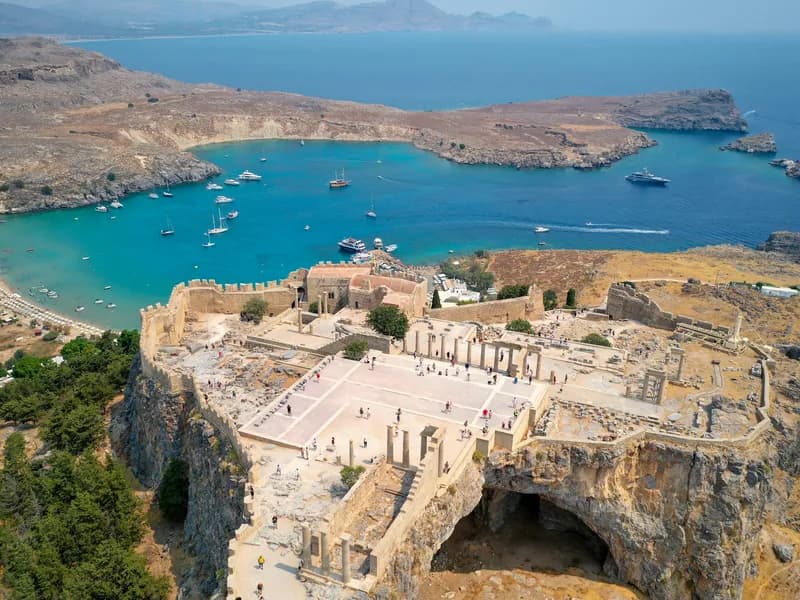
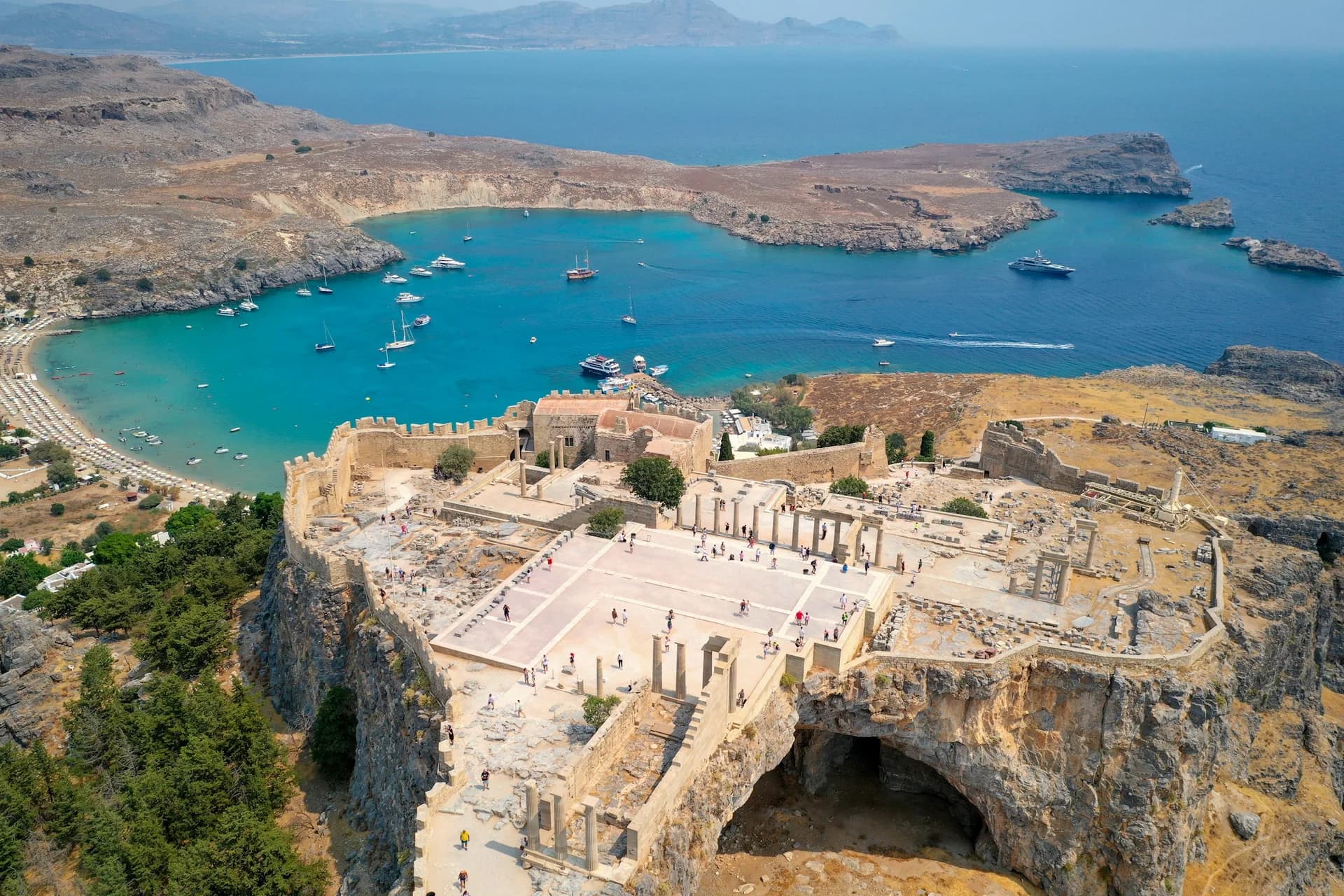
The must-see ancient site. The 4th-century BC Temple of Athena Lindia sits on a rocky promontory 116 meters above the sea, surrounded by later Crusader fortifications. Entry: 12 EUR. The carved relief of a warship on the staircase rock face dates to 180 BC — it's easy to miss, so look for it on the left as you climb.
The site was sacred for a millennium before the Greeks — Mycenaean artifacts from 1500 BC have been found here. Standing in the temple ruins with two turquoise bays below, you understand why people worshipped here. Some places just feel sacred, regardless of your beliefs.
Ancient Kamiros
A hidden gem Hellenistic city on the west coast, 34 km from Rhodes Town. Entry about 6 EUR. Far less visited than Lindos, Kamiros preserves the grid layout of a Greek city — houses, a marketplace (agora), temples, and a sophisticated water supply system. Allow 1-2 hours. The view over the Aegean to the islands beyond adds atmosphere.
The Crusader Layer
The Knights Hospitaller — an order of warrior-monks from the Crusades — controlled Rhodes from 1309 to 1522. They turned it into the most fortified city in the Eastern Mediterranean, building walls that still define the Old Town today.
The Street of the Knights
The most intact medieval street in Europe. The seven Inns (auberges) of the different languages of the Order line both sides — the Inn of France, Inn of England, Inn of Spain, and so on. Each was a residence and meeting hall for knights from that region.
The stone is honey-colored, the archways are gothic, and at 7AM (before the tour groups) or 7PM (after they leave), you can walk this street in near-silence. Your footsteps echo off 700-year-old walls. It's extraordinary.
Palace of the Grand Master
The headquarters of the Knights, rebuilt by the Italians in the 1930s after an 1856 ammunition explosion destroyed much of the original. Entry: 8 EUR (combo with Archaeological Museum: 10 EUR). The mosaic floors from Kos are beautiful if controversial (Kos wants them back). The medieval exhibition halls provide essential context.
Open 8AM-8PM summer, 8:30AM-3PM winter, closed Mondays.
The Ottoman Layer
The Ottomans conquered Rhodes in 1522 after a six-month siege. Sultan Suleiman the Magnificent personally led the army. The Knights retreated to Malta (where they built Valletta).
The Ottomans added mosques, baths, and a souk to the medieval fabric. The Suleiman Mosque near the top of the Old Town (identifiable by its minaret) dates to the original conquest. The Ottoman Library nearby contains rare manuscripts. The Turkish Quarter in the southeast of the Old Town still has a distinct character — narrower streets, overhanging balconies, and a quieter atmosphere.
The Hamam (Turkish bath) on Plateia Arionos has been restored and offers bathing sessions. It's one of the few surviving Ottoman bathhouses in the Aegean.
The Italian Layer
Italy controlled Rhodes from 1912 to 1947. They rebuilt the Palace of the Grand Master, renovated the Old Town (controversially — some say they "medievalized" it beyond historical accuracy), and built the New Town in an art deco style that's now being appreciated.
The Mandraki Harbor area has Italian administrative buildings, a post office, and a market hall in rationalist architecture. The Aquarium at the northern tip (6 EUR) is housed in a beautiful art deco building.
Experiencing the Layers
The magic of Rhodes history isn't any single layer — it's the juxtaposition. A Byzantine church door reused in a Crusader wall. An Ottoman fountain inside a medieval courtyard. An Italian restoration of a Greek column base.
To experience this properly:
- Start at the Archaeological Museum (in the Old Town, combo ticket 10 EUR). Get context for 3,000 years of history before walking the streets.
- Walk the Street of the Knights early morning. Stand in front of each Inn and read the plaques.
- Visit the Palace of the Grand Master mid-morning.
- Wander the Turkish Quarter after lunch — the southeastern lanes between the Palace and the Suleiman Mosque.
- Walk the city moat (exterior, free) to appreciate the scale of the medieval fortifications.
- Drive to Lindos Acropolis the next day — go at 8AM opening to beat the heat and crowds.
- Explore Kamiros on day three — the quiet western coast counterpart to Lindos.
The Timeline on Your Wall
| Period | Years | What Remains |
|---|---|---|
| Mycenaean | 1500-1100 BC | Artifacts at Lindos |
| Ancient Greek | 408 BC onwards | Lindos Acropolis, Kamiros, city grid plan |
| Hellenistic | 3rd-1st century BC | Colossus (nothing visible), harbor |
| Roman | 1st century BC-4th century AD | Scattered remains |
| Byzantine | 4th-14th century AD | Churches, icons |
| Knights Hospitaller | 1309-1522 | Old Town walls, Palace, Street of the Knights |
| Ottoman | 1522-1912 | Mosques, baths, library, Turkish Quarter |
| Italian | 1912-1947 | Palace reconstruction, New Town, Aquarium |
| Greek | 1947-present | Modern Rhodes Town |
Three thousand years. One island. And you can walk through all of it in a single afternoon, if you know where to look.
That's Rhodes. Not a museum — a living city that refuses to forget anything. For another island where millennia of history are compressed into walkable distances, Malta layers megalithic temples, Crusader fortresses, and Baroque cathedrals across just 316 square kilometers.