
11 Unforgettable Things to Do in Ashgabat (and the Karakum Beyond)
11 Unforgettable Things to Do in Ashgabat (and the Karakum Beyond)
Ashgabat doesn't ease you in. One minute you're gliding down a six-lane boulevard so clean it squeaks, flanked by white marble towers that throw the desert sun straight back at you. The next, you're standing at the lip of a crater that has been on fire since before most of the buildings here existed. This is a capital that holds a Guinness World Record for the highest concentration of white marble buildings on the planet — and once you see it, you understand why nobody who visits ever shuts up about it.
Here's the practical part. Turkmenistan is one of the hardest countries on Earth to enter independently — a world away from the easy e-visa welcome of Central Asian capitals like Dushanbe — so you'll almost certainly arrive on a guided tour or a three-day transit visa with a driver. That actually works in your favor for a list like this — nearly everything below slots neatly into a two- or three-day run with a car and a local guide. Do them roughly in this order.
1. Camp overnight at the Darvaza Gas Crater
Start with the big one. The Darvaza Gas Crater — the Door to Hell — sits about 270 km north of the city, a three-to-four-hour drive across the Karakum Desert. A Soviet drilling rig collapsed here in 1971, the engineers set the escaping gas alight to burn it off, and it simply never stopped. The pit is roughly 70 metres across and 30 metres deep, a roaring orange bowl in the middle of flat black sand — the kind of elemental fire spectacle that also draws travelers across the Caspian to the flaming hillsides of Baku.
Don't do this as a rushed day trip. The smart move is to time your arrival for late afternoon, watch the desert sky drain to navy, and let the crater do its thing after dark — that's when the glow turns properly otherworldly. Tour operators set up yurt or tent camps a safe distance away. Bring a windproof jacket; the desert turns cold fast once the sun drops.
2. Cross Independence Park on foot
Back in the capital, give yourself an hour to walk through Independence Park. The centrepiece is the Independence Monument, a 118-metre column topped with a golden crescent that locals nickname "the plunger" (you'll see why). Gold statues of national heroes line the approach, and the whole thing is ringed by fountains that run even in the desert heat. Go early — the marble bounces midday sun like a mirror, and shade is in short supply.
3. Decode the Turkmen Carpet Museum
Carpets aren't a souvenir here — they're a national treasure with their own holiday. The Turkmen Carpet Museum holds one of the largest handwoven carpets in the world, a single piece stretching over 300 square metres that took weavers more than a year to complete. Each tribe's pattern, or gül, is distinct, and a good guide will teach you to read them like a map of the country — the same Silk Road weaving traditions you'll browse in the carpet bazaars of Bukhara, just over the Uzbek border. Entry is nominal (a few dollars), and photography sometimes carries a small extra fee. Allow 45 minutes.
4. Climb the ruins of Old Nisa
For a complete change of texture, head about 18 km west to the village of Bagir and the UNESCO-listed Parthian Fortresses of Nisa. This was a royal capital of the Parthian Empire more than 2,000 years ago, and the eroded mud-brick walls and ramparts feel like the polar opposite of the marble city behind you. The site is open daytime hours and rarely crowded. Wear proper shoes — the ground is uneven and dusty.
5. Ride the Alem Ferris wheel
The Alem Entertainment Center is home to the world's largest enclosed Ferris wheel, a 47.6-metre machine that earned its own Guinness record. The cabins are fully glassed and air-conditioned — a real mercy in summer — and the slow rotation gives you the single best overview of how relentlessly white and geometric this city is from above. Best at dusk, when the marble glows and the boulevards light up.
6. Haggle for a camel at Altyn Asyr Bazaar
If you can be here on a Saturday or Sunday, do not miss the Altyn Asyr Bazaar — most travelers still call it by its old name, Tolkuchka. It sprawls across the desert edge outside town, and it's where the marble fantasy gives way to real Turkmen life: pyramids of spices, stacks of handwoven carpets, sheepskin telpek hats the size of beach balls, and yes, a livestock section where you can watch camels and Akhal-Teke horses change hands. Bring small cash, expect to barter, and keep your camera low-key around traders who'd rather not be photographed.
7. Stand under the Arch of Neutrality
Peak Ashgabat surrealism: a tripod-shaped arch once crowned by a 12-metre gold statue of the country's first president that rotated to face the sun. The whole monument was later dismantled and rebuilt on the southern edge of the city — statue and all — with a glass elevator running up one leg to a viewing deck. It's still one of the strangest landmarks you'll ever photograph; ride to the top as much for the panorama as for the sheer audacity of the thing — the same build-it-from-nothing ambition you'll find in Kazakhstan's surreal showcase capital, Astana, a few countries to the north.
8. Photograph the Wedding Palace
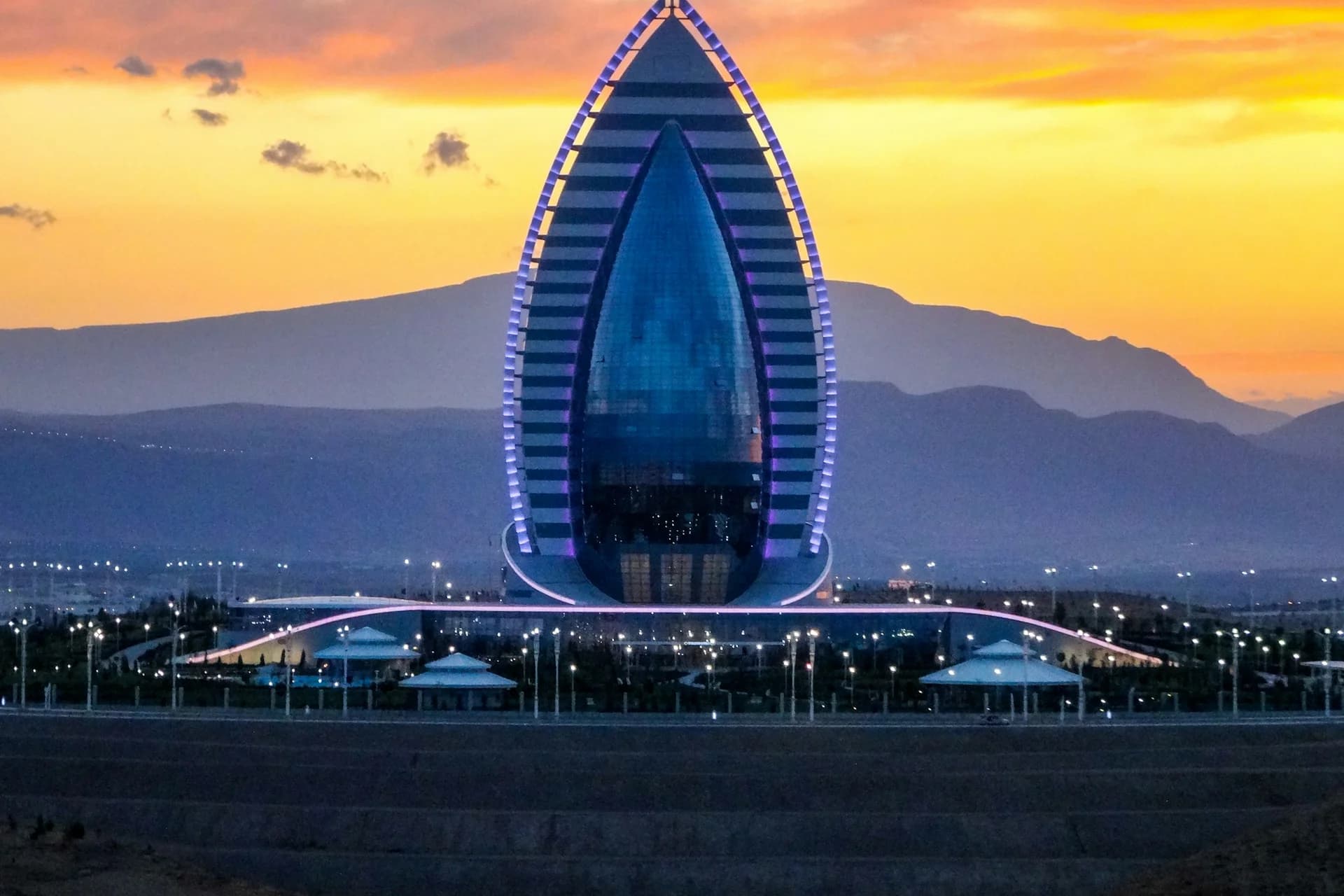
The Bagt Köşgi, or Wedding Palace, is an 11-storey building shaped like a faceted star, crowned by an enormous golden globe with a map of Turkmenistan on it. It's an actual functioning marriage registry, and at weekends you'll spot bridal parties posing on the steps. You can't always go inside, but the exterior alone is worth the short drive. It's especially photogenic lit up after dark.
9. Step inside the Türkmenbaşy Ruhy Mosque
About 20 km outside the city, near the village of Gypjak, stands the Türkmenbaşy Ruhy Mosque — one of the largest mosques in Central Asia, built to hold around 10,000 worshippers under four 91-metre minarets. The white marble and gold dome are staggering in scale, and the interior is almost always near-empty, which makes it feel even bigger. Dress modestly, cover shoulders and knees, and remove your shoes before entering.
10. Meet an Akhal-Teke horse
The Akhal-Teke is Turkmenistan's pride — a slender, ancient breed with a metallic golden sheen that genuinely looks unreal in sunlight. The horse appears on the national emblem, and the country celebrates it with its own holiday. Ask your guide to arrange a visit to a stud farm or the hippodrome; if you ride at all, a short outing across the steppe is a memory that'll outlast every marble selfie.
11. Browse the National Museum of Turkmenistan
Finish at the National Museum, the best place to connect the dots between ancient Nisa and the modern marble capital. The standout pieces are the ivory drinking horns (rhytons) excavated from Nisa — exquisitely carved, world-class artifacts. Add the gold and the archaeology and you'll leave with real context for everything else you've seen. Budget 60–90 minutes.
Pro Tips Before You Go
- Carry US dollars in cash. Turkmenistan runs a dual exchange rate, and foreign cards rarely work. Crisp, clean USD bills are your safest currency — change small amounts as you need them.
- Mind the camera. Don't photograph government buildings, palaces, police, or military checkpoints. When in doubt, ask your guide first.
- You need a plan to enter. Independent travel barely exists here — line up a tour with a letter of invitation or a three-day transit visa well in advance.
- Go in spring or autumn. April–May and September–October are ideal. Summer routinely tops 40°C, and the desert around Darvaza is brutal at midday.
- Dress on the modest side, especially at mosques. Alcohol is available but mostly confined to hotel bars and restaurants.
Ashgabat rewards travelers who lean into the weirdness instead of fighting it. Come for the Door to Hell, stay for the gold horses and the marble skyline — and you'll go home with a story almost nobody else can tell.


