
The Sound of Silence: Three Days on the Bazaruto Archipelago
The Sound of Silence: Three Days on the Bazaruto Archipelago
The speedboat from Vilankulo takes 45 minutes across the Mozambique Channel, and with every minute the mainland shrinks behind you, the world goes quieter. Not metaphorically. Actually quieter. By the time you reach Bazaruto, the only sounds are the engine cutting out, the hull sliding onto sand, and a fish eagle calling from somewhere you can't quite place.
The route runs from Cape Town via Johannesburg to Vilankulo, then onto this boat. Three flights and a transfer to reach an island most travelers have never heard of. And the moment your feet hit that sand, with the Indian Ocean an impossible shade of turquoise in every direction, the effort makes perfect sense.
Day 1: Arrival and the Reef
10:30 AM — The lodge
The lodges here go unnamed on purpose — a review of any single one would read like an advertisement, and Bazaruto deserves better than that. Expect this much: a thatched room, open on three sides to the ocean breeze, a bed built from recovered dhow wood. Lunch is grilled langoustine caught that morning. The staff will know your name before you've unpacked.
All-inclusive lodge rates in Bazaruto run $400-1,500+ per person per night. That covers meals, most activities, and transfers. It's not a budget trip. But the meaning of "value" shifts when you're on an island with 50 guests and a reef system that holds more fish than people.
2:00 PM — Two Mile Reef snorkeling
A short boat ride reaches Two Mile Reef, home to 100+ coral species and more marine life than almost anywhere outside of Raja Ampat. Reef sharks cruise below. A hawksbill turtle surfaces 10 meters from your mask. And then, in the seagrass beds on the way back, the guide points down.
Dugong.
A three-meter sea cow, grazing the seagrass like an underwater lawnmower. Bazaruto holds one of the last viable populations of dugongs in the Indian Ocean — gentle, slow, completely indifferent to snorkelers. Float above one for five minutes, watch it eat, and your heart rate drops to something close to meditation.
6:00 PM — Sunset dhow cruise
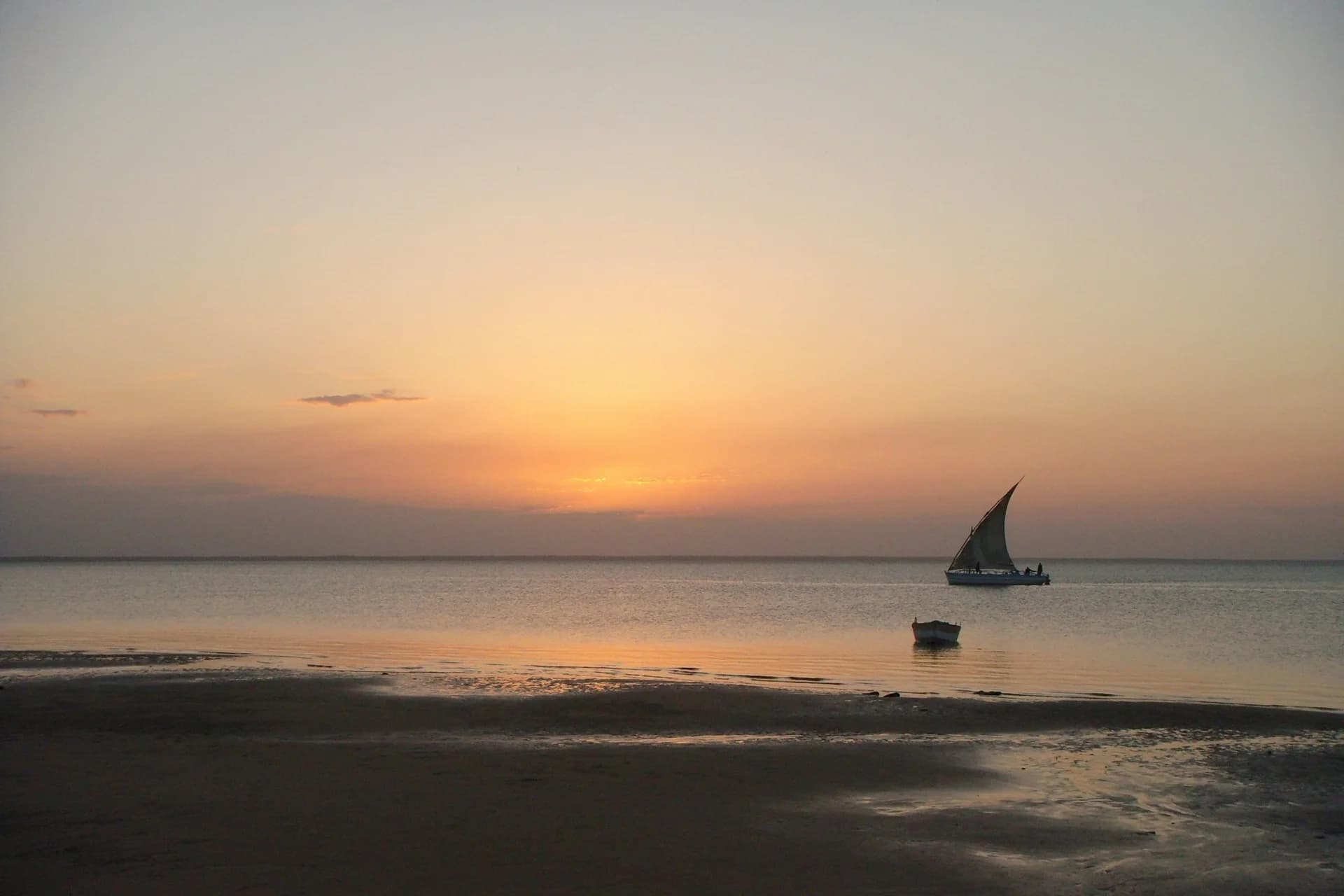
A traditional dhow, lateen sail, no engine. The crew hands you a gin and tonic and the boat tilts into the wind. The sun drops below the mainland coast in shades of pink and copper. Nobody speaks for 20 minutes. Not because anyone says to. Because there's nothing to add.
Day 2: Benguerra Island and the Dunes
8:00 AM — Dhow to Benguerra
Bazaruto's second-largest island sits 45 minutes away by dhow. Freshwater lakes in the interior (with crocodiles — stay on the trails), towering sand dunes, and a 12 km eastern beach with no footprints on it. None. Walk for 30 minutes and the only marks in the sand will be your own.
The dunes on Bazaruto Island proper are even more dramatic — up to 100 meters, the highest coastal dunes in the Western Indian Ocean. Guided 4x4 excursions through them to the wild western coast take 2-3 hours ($60-90). At the summit, the view spans the entire archipelago.
1:00 PM — Village visit
A guided visit to a fishing village ($20-30 arranged through the lodge). The Tsonga families here have lived on these islands for centuries, fishing and farming. The cooking demonstration — fresh fish grilled over coals with coconut and cassava — is both delicious and instructive. The local music, played on homemade instruments, is infectious.
This is the human side of Bazaruto that luxury travel sometimes obscures. The archipelago isn't just a marine park — it's someone's home.
4:00 PM — The sandbank
Low tide exposes a sandbank between Bazaruto and Benguerra you can walk right onto. White sand, turquoise water on both sides, and the curved horizon of the Indian Ocean in every direction. The guide sets up chairs and a cooler box. Sit there for two hours doing absolutely nothing, and it becomes the highlight of the trip.
Day 3: Deep Sea and Departure
6:00 AM — Fishing charter
Bazaruto is legendary for marlin fishing. Black, blue, and striped marlin run through these waters, and sailfish season peaks November to March. Even for non-anglers, the boat ride through the channel is spectacular — dolphins riding the bow wave, flying fish scattering ahead.
Half-day charters run $400-600 for the boat. Most lodges practice tag-and-release. Record catches include black marlin over 500 kg.
11:00 AM — Last swim
At low tide the reef flat in front of the lodge becomes a natural swimming pool — knee-deep, warm, crystal clear, small fish darting around your ankles. Lie in it for an hour with a book, looking up at the horizon now and then as if to confirm it's all still real.
2:00 PM — Speedboat back to Vilankulo
The mainland noise returns like a switch. Engines, voices, the hum of a small airport. After three days of nothing but water, wind, and fish eagles, Vilankulo feels like Manhattan.
Worth the Journey
Without hesitation. Bazaruto is expensive and hard to reach and worth every cent and every flight. It's not a beach holiday — beach holidays have pool bars and DJs. This is something older and quieter. The Indian Ocean in its most uncorrupted form, a handful of dhow sails on the horizon, and a silence so complete it rearranges your priorities.
Practical Notes
- Visa: Most nationalities need a Mozambique e-visa (~$50, apply at evisa.gov.mz)
- Malaria: Prophylaxis essential. DEET repellent. Mosquito nets provided.
- Cash: Bring USD or MZN for village visits, tips, and Vilankulo purchases. No ATMs on the islands.
- Best time: May-October for calm seas and best visibility. January-March for marlin season (but weather is unpredictable).
- Tips: Guide $5-10/day, boat crew $3-5/trip.
- Marine safety: Never swim in channels between islands. Wear reef shoes. Follow dive guides' instructions.


