
Three Sunsets, One Blowhole, and the Night I Accidentally Joined a Ceremony on Nusa Lembongan
Three Sunsets, One Blowhole, and the Night Nusa Lembongan Pulls You Into a Ceremony
The speedboat from Sanur hits a wave and the entire cabin goes airborne. Not metaphorically — actual air between seat and body. The woman across the aisle grabs her bag, the man beside her grabs the armrest, and the crew member at the back doesn't flinch. Twenty-five minutes of this, and then the boat slows and there it is — Nusa Lembongan, a flat green island in water so blue it looks oversaturated.
Come for three days. Arrive with no plan. On Lembongan, that turns out to be exactly the right approach.
The Blowhole That Almost Takes Your Camera
First afternoon: Devil's Tears. You've read about it. You've seen the photos. Nothing quite prepares you.
Devil's Tears is a section of Lembongan's southwest coast where the Indian Ocean hits limestone cliffs and absolutely loses its mind. The swells funnel into a narrow crack in the rock and explode upward — 15, 20 meters of white spray against a blue sky, with a sound like a cannon shot.
Stand five meters from the edge, filming with your phone, feeling safe and clever, and a rogue wave — bigger than the others, coming from a slightly different angle — will send a wall of spray straight at you. Soaked in half a second. (A waterproof case earns its keep here.) The 15 Lembongan tips include standing well back from Devil's Tears — advice worth taking on the first swell, not the third.
A Balinese man selling coconuts from a cart behind you might laugh so hard he has to sit down. "Happens every day," he says, handing over a coconut — IDR 20,000 (~$1.30). "The tears get everyone."
Seaweed Farmers at Dawn
Morning starts at 5:30 AM whether you plan it or not — the roosters on Nusa Lembongan keep their own schedule, and it begins before the sun.
Walk to the east coast near Jungut Batu and find the seaweed farms. The shallows here are gridded with wooden frames just below the surface, draped in bright green seaweed that moves with the current like underwater curtains. At low tide, farmers — mostly women — wade in to tend the crop, tying new growth to the frames, harvesting mature seaweed, and laying it on the beach to dry.
Stand on the shore and watch for an hour. The water is knee-deep and impossibly clear. The seaweed catches the early morning light and glows. A woman might notice you watching and wave you over, then show you how to tie the seaweed to the frame — a simple motion she's clearly done ten thousand times.
Her name is Wayan (about 40% of Balinese women are named Wayan — it means "firstborn"). She's farmed seaweed since she was fourteen. The harvest goes to factories on the mainland for cosmetics and food products, earning about IDR 50,000/day (~$3.25). She seems content.
The Yellow Bridge and Nusa Ceningan
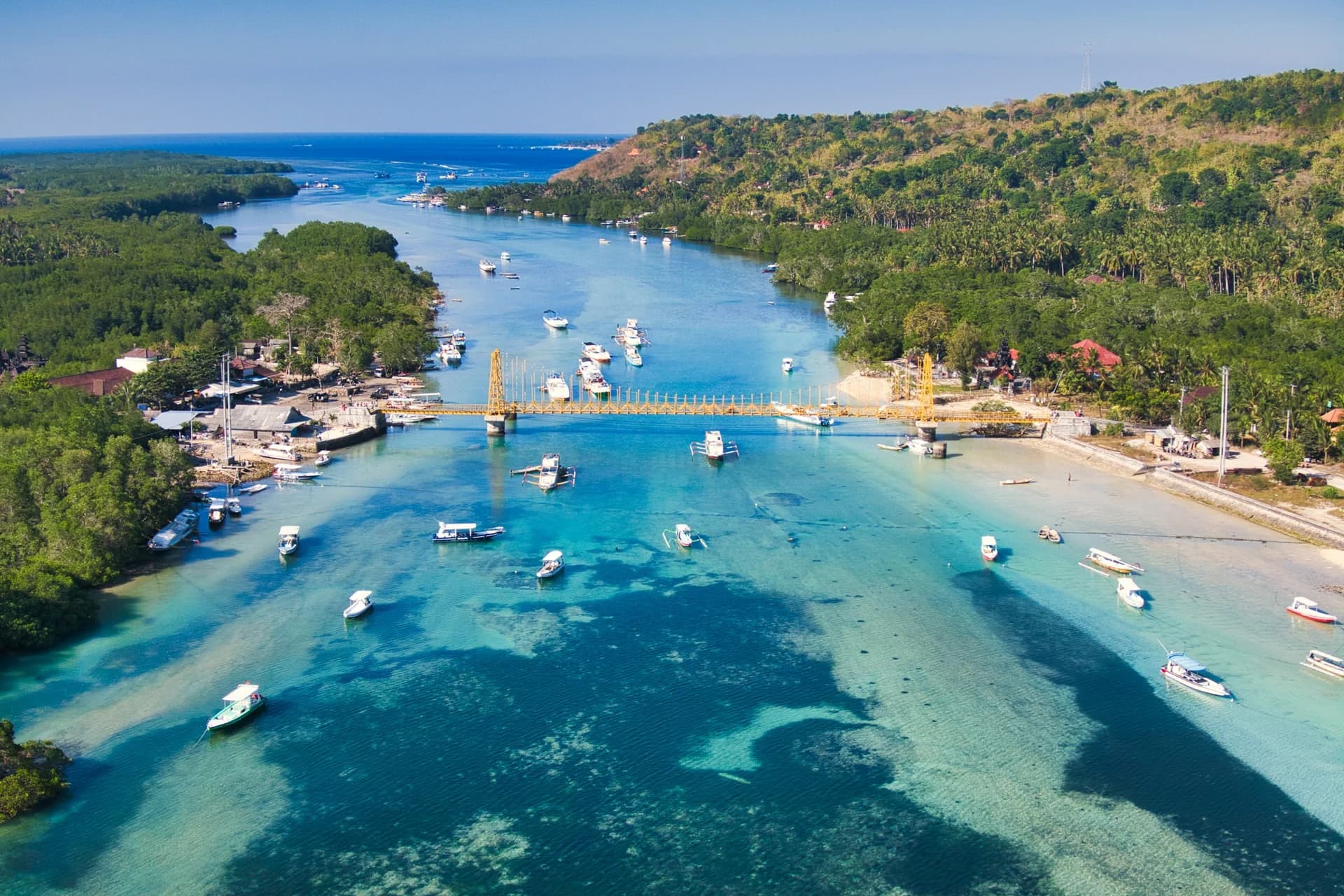
Afternoon: scoot across the Yellow Bridge to Nusa Ceningan, Lembongan's smaller, wilder neighbor. The bridge is narrow — one lane each way, scooters weaving around pedestrians — and crosses a channel of water so turquoise it looks artificial.
Ceningan is rougher than Lembongan. The roads are unpaved in places, the cliffs are dramatic, and the crowds thin out. Ride to the Blue Lagoon (not the famous one in Iceland — this is a cliff-enclosed cove where the water runs a deep, almost neon blue). People cliff-jump here. The drop looks like ten meters, and watching from the clifftop is a perfectly respectable option.
Ride further to Secret Point, a surf break on the south coast. You don't have to surf to be mesmerized by the locals riding the break from above — clean, powerful waves peeling along a rocky point.
Then back to Lembongan for sunset at Devil's Tears. This time, stand further back.
The Ceremony
This is the part no one plans for. On a last evening, walking back to the guesthouse from dinner (grilled fish at a warung near Mushroom Bay, IDR 65,000 / ~$4.20), gamelan music drifts across the lanes — the metallic, layered percussion that's the soundtrack of Balinese life.
Follow the sound to a temple compound near Jungut Batu. The courtyard is lit with oil lamps. Maybe a hundred people in full ceremonial dress — women in kebaya blouses and sarongs, men in white shirts with udeng headwraps. A gamelan orchestra plays. Offerings — towers of fruit, flowers, rice — are arranged on the ground.
Stand outside the gate, watching, trying to be respectful, and a woman may notice you, smile, and walk over. "You want to join? Come. Come."
She hands you a sarong (temple visits require one) and leads you inside. Sit cross-legged on a mat at the back of the ceremony. A priest performs rituals — sprinkling holy water, chanting. The gamelan rises and falls. Incense smoke twists in the lamplight.
After maybe forty minutes, the ceremonial part ends and the social part begins. People eat, talk, laugh. Children run around. Someone hands you a plate of rice with chicken satay and a small banana leaf of offerings. This, the woman explains, is a temple anniversary celebration, held every 210 days (the Balinese ceremonial calendar runs on a different cycle than the Western one).
Sit with her family. Her husband works at one of the dive shops. Her daughter, maybe twelve, wants to practice English and asks about snow (it doesn't snow on Nusa Lembongan, obviously, and the concept clearly fascinates her).
Walk back to the guesthouse at 10 PM, through dark lanes lit only by the glow of a few warungs and the stars above the rice fields. The gamelan is still playing. You can hear it from the room as you fall asleep.
What You Can Leave for Next Time
Skip the mangrove tour if you must (though it's reportedly beautiful). Save a dive at Crystal Bay for a return trip — the mola mola arrive in September, a season the Nusa Lembongan Q&A breaks down. Dream Beach's currents can run strong depending on the day. And the sunrise from Mushroom Bay is easy to sleep through — twice, even.
Nusa Lembongan is small enough that three days feels unhurried — no need to pack it. The island rewards wandering. Ride the scooter with no destination. Stop where something catches your eye. Talk to the seaweed farmers. Accept the coconut from the man at Devil's Tears.
And if you hear gamelan music coming from a temple, walk toward it. The invitation might be waiting.
For more Southeast Asian diving, Koh Tao in Thailand rivals Lembongan for reef quality at lower prices.
Or stay close and explore Bali itself for temples and rice terraces.


