Your 14 Most Common Reunion Island Questions, Answered Honestly
Your 14 Most Common Reunion Island Questions, Answered Honestly
Reunion Island confuses people. It sits in the Indian Ocean near Madagascar and Mauritius, yet it's a fully integrated department of France. It uses the Euro, has French highways, and its supermarkets are Leclerc and Carrefour. But the food is Creole, the landscape is volcanic, and the culture blends French, African, Indian, Chinese, and Malagasy traditions.
Here are the questions travelers ask most, with the straight answers.
The Basics
Q: Is Reunion Island really part of France?
Yes. Fully. It's not a territory or a dependency — it's a French department, the same legal status as Normandy or Provence. EU citizens can visit with an ID card. French law, French healthcare, French schools, French prices. The Euro is the currency. Road signs are in French. The gendarmes drive Peugeots.
But it doesn't feel like metropolitan France. The Creole culture — a fusion of every population that's ever settled here — gives the island a character that's entirely its own.
Q: Do you need a visa?
Same rules as mainland France. EU/EEA citizens: ID card only. US, UK, Canadian, and Australian citizens: visa-free for up to 90 days. Non-Schengen visitors may need a specific "DOM-TOM" mention on their visa — confirm with the French consulate before booking.
Q: Where is it exactly?
In the Indian Ocean, about 700 km east of Madagascar, 200 km southwest of Mauritius. The flight from Paris is roughly 11 hours nonstop (Air France, Air Austral, French Bee). From Mauritius, it's a 45-minute hop.
The Volcano
Q: Is Piton de la Fournaise dangerous?
It's one of the world's most active volcanoes, erupting roughly every 9 months. But the eruptions are typically effusive (flowing lava), not explosive. The lava generally flows toward the uninhabited southeast flank (the Grand Brule) and into the ocean.
When the volcano is actively erupting, the summit trail is closed. When it's not erupting, you can hike to the crater rim — a 5-6 hour round trip across the otherworldly Plaine des Sables (a moonscape of black and red volcanic terrain). Check the OVPF observatory website before going. The trail starts from Pas de Bellecombe at dawn. Bring warm layers — it's 2,600 meters altitude.
Time your visit during an eruption and the lava flows are visible from designated viewing points (safely distant). At night, the glow against the sky is spectacular.
Q: Can you see the volcano without hiking?
Yes. Drive to Pas de Bellecombe (paved road) and look into the caldera from the viewpoint. The Plaine des Sables drive alone is one of the most surreal road trips on the island — 30 minutes through a landscape that looks like Mars. You can also see the lava fields along the coast road near Saint-Philippe.
The Cirques
Q: What are the three cirques?
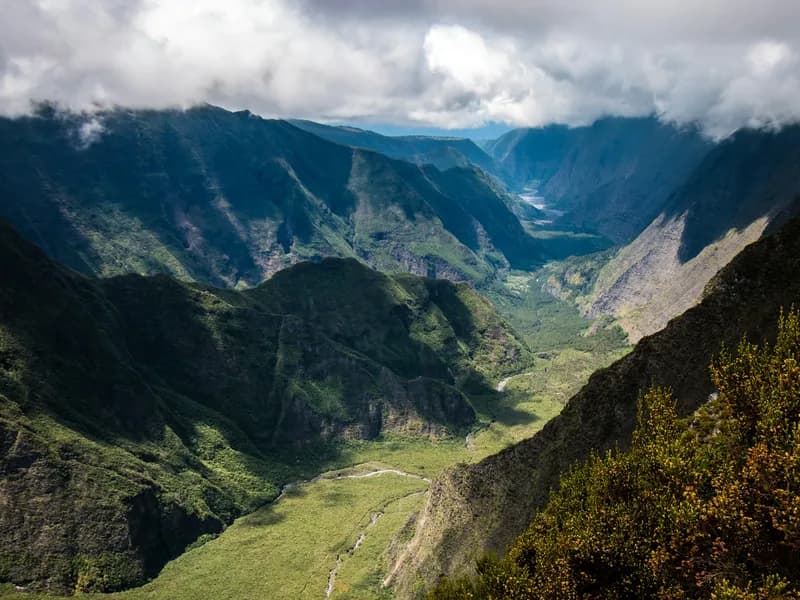
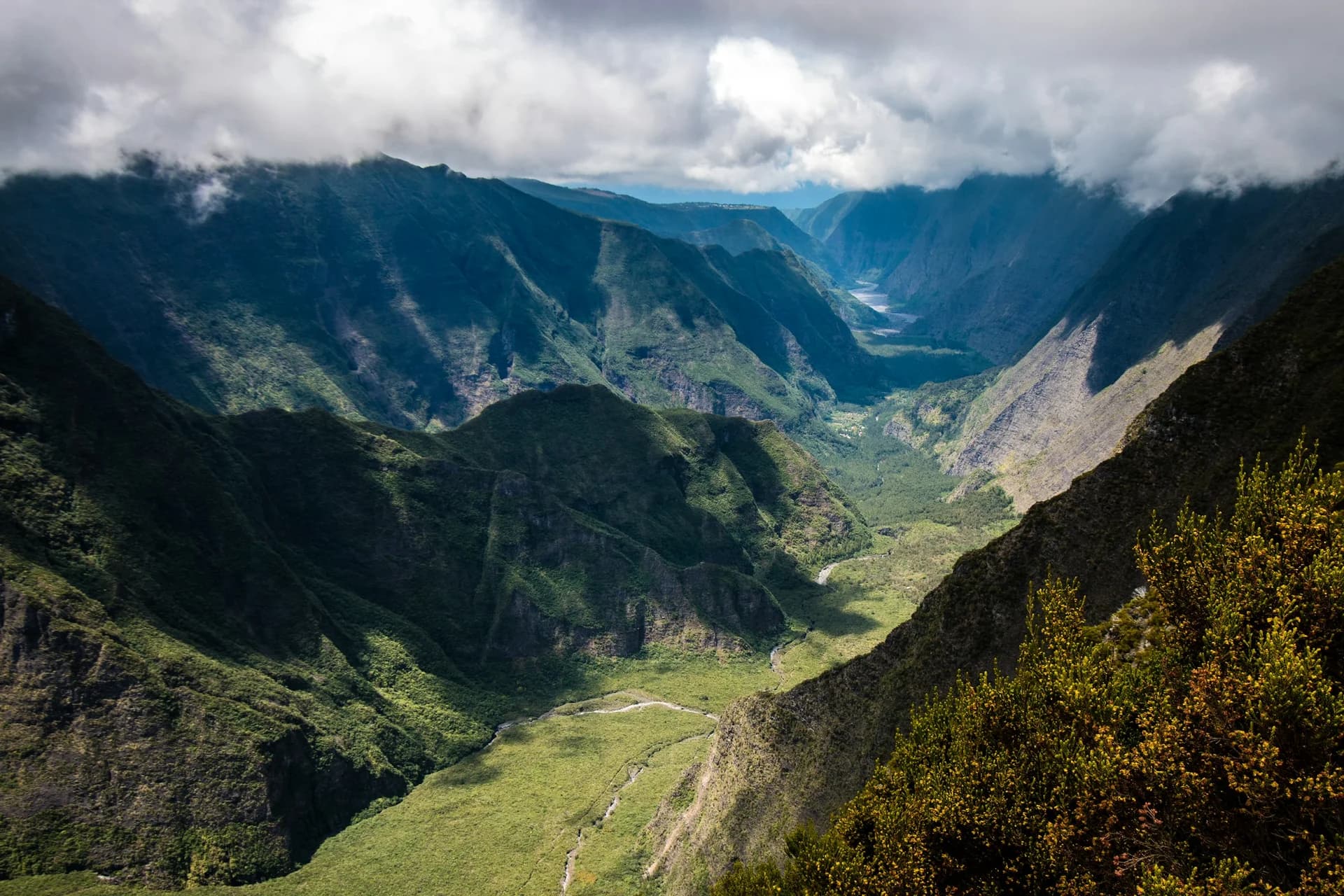
Three enormous natural amphitheaters carved into the volcanic massif of Piton des Neiges (Reunion's highest peak, 3,070 m):
- Mafate: The most remote. No roads, no cars. Accessible only on foot or by helicopter. Tiny hamlets (ilets) connected by hiking trails. 3-5 day traversal via GR R2.
- Cilaos: Reached by a winding road with 400 hairpin turns. The town of Cilaos has thermal spas, excellent lentils, and the trailhead for the Piton des Neiges summit hike. Canyoning here is world-class.
- Salazie: The lushest. Waterfalls everywhere. The village of Hell-Bourg (gorgeous despite the name) is a Creole heritage town. The Trou de Fer — a 300 m waterfall plunging into a vertical gorge — is viewable via a 3-hour hike.
Q: Do you need a helicopter tour?
You don't need one, but it's the iconic Reunion experience. A 45-minute flight over all three cirques, the volcano, and the waterfalls costs 250-350 EUR per person. The scale of the cirques from above is genuinely staggering — they're so vast that ground-level hiking can't convey the full picture.
Morning flights have the clearest conditions. Book days in advance, especially in peak season. Helilagon and Corail Helicopteres are the main operators.
Swimming & Beaches
Q: Can you swim in the ocean?
Only in specific places. Reunion has experienced a series of bull shark attacks since 2011. Swimming and surfing are banned on most beaches outside the lagoon-protected areas on the west coast: Saint-Gilles, l'Hermitage, and Boucan Canot (with shark nets).
Obey the flags. Red means no entry. The lagoon beaches are safe and beautiful — l'Hermitage has a gorgeous lagoon with calm, warm water.
But this is not a beach destination. The mountains are the star. If you want beach-centric, go to nearby Mauritius instead.
Food
Q: What's Creole food like?
Extraordinary. A fusion of French, Indian, Chinese, African, and Malagasy cuisines:
- Cari poulet — Chicken curry with rice, lentils, and rougail (chili-tomato sauce)
- Rougail saucisse — Spicy sausage stew. Comfort food perfected.
- Bouchons — Steamed Chinese dumplings (like dim sum). Found everywhere.
- Samosas — The Indian influence. Filled with meat, vegetables, or cheese.
- Bonbon piment — Fried chili fritters. Addictive.
Local restaurants and roulottes (food trucks) serve meals for 10-18 EUR. The Sunday market in Saint-Paul is a food lover's paradise — 500 meters of stalls selling spices, tropical fruits, Creole prepared foods, and rum.
Practical
Q: Is it expensive?
Yes. French prices, sometimes 10-20% higher due to import costs. Gites (mountain lodges): 40-60 EUR/night with dinner. Hotels: 60-150 EUR. Budget travelers should plan for 60-100 EUR/day. Self-catering with supermarket shopping saves significantly.
Q: Do you need a car?
Absolutely. Public transport (Car Jaune buses) covers main coastal towns but not the cirques or the volcano. Rental cars start at 25-40 EUR/day from Roland Garros Airport (RUN). Roads are excellent French-standard tarmac, but mountain roads are narrow and winding.
Q: What language do you need?
French. English is spoken at tourist offices and some hotels, but daily life operates entirely in French and Reunion Creole. Basic French is essential for restaurants, shops, and gite bookings. A phrasebook or Google Translate with offline French goes a long way.
Q: What's the best souvenir?
Vanilla and rum. Reunion produces some of the world's finest Bourbon vanilla — buy pods directly from plantations (10-15 EUR for a tube of 5, cheaper than export prices). Rhum arrange (rum infused with fruits, vanilla, or spices) is found everywhere, from supermarkets (5-15 EUR) to artisanal producers.
Quick Reference
| Item | Detail |
|---|---|
| Currency | Euro (EUR) |
| Language | French, Reunion Creole |
| Time zone | UTC+4 |
| Airport | Roland Garros (RUN), near Saint-Denis |
| Best months | May-November (dry season, ideal hiking) |
| Power | 230V, European 2-pin plugs |
| Driving | Right-hand side (it's France) |
| Emergency | 15 (medical), 17 (police), 18 (fire) |
For the hiking perspective, read the 6-day trail journal. And hear from a local in the interview with Marie-Ange, a gite owner in Cilaos who has strong opinions about the 400 hairpin turns.