
The Complete Guide to Tahiti: Everything Beyond the Bora Bora Stopover
The Complete Guide to Tahiti: Everything Beyond the Bora Bora Stopover
Tahiti is the largest island in French Polynesia and the gateway to the South Pacific. It's shaped like a figure-8: Tahiti Nui (the big circle) and Tahiti Iti (the small peninsula). Most travelers treat it as a transit point — a night before connecting to Bora Bora or Moorea. That's a waste of what might be French Polynesia's most interesting island.
Overview
Papeete, the capital (population 130,000 metro), sits on Tahiti Nui's northwest coast. It's the only real city in French Polynesia — government buildings, a working port, traffic, and a nightlife scene that doesn't exist on any other island. Outside Papeete, the coastal road circles Tahiti Nui through small villages, black sand beaches, and waterfall valleys.
Tahiti Iti is wilder — fewer roads, fewer people, and the famous Teahupo'o surf break on its southwest coast. The interior of both sections is mountainous, jungled, and almost entirely uninhabited.
Best Time to Visit
May to October (dry season): 24-28°C, low humidity, clear skies. Peak season with highest prices but best conditions for everything. July brings the Heiva cultural festival.
November to April (wet season): 28-32°C, humid, afternoon storms. Dramatic waterfalls, lower prices, fewer tourists. Cyclone risk is low but exists.
Getting There
Fa'a'a International Airport (PPT) has direct flights from:
- Los Angeles (8 hours, Air Tahiti Nui, Air France)
- Auckland (5 hours, Air Tahiti Nui, Air New Zealand)
- Tokyo (11 hours, Air Tahiti Nui)
- Paris (via a stop in LAX or NZ, Air France)
Getting Around
Rent a car ($50-80/day). Le Truck (local bus) circles Tahiti Nui but is slow and runs mainly mornings. The full coastal circuit of Tahiti Nui takes 3-4 hours with stops. Roads are paved and drive on the right.
Key distances from Papeete:
- Taharuu Beach (south coast): 40 km, 45 min
- Fautaua Waterfall trailhead: 5 km, 15 min
- Paul Gauguin Museum: 51 km, 1 hour
- Teahupo'o village: 75 km, 1.5 hours
Where to Stay
Papeete: Walking distance to the market, roulottes, and port. Mid-range hotels $120-200/night. Best for food lovers and market culture.
West coast (Punaauia): Resort area with the InterContinental and Manava Suite Resort. Overwater bungalows from $300-600/night. Moorea views.
Pensions around the island: Family-run guesthouses from $80-150/night. The east and south coast pensions are quieter and closer to nature.
What to Do
In Papeete
- Papeete Market (free entry): The island's soul. Tropical fruits, fish, vanilla, pearls, woven crafts. Upper floor food stalls. Open Mon-Sat 5 AM-5 PM, Sun 4-8 AM.
- Les Roulottes at Place Vai'ete ($9-18 per meal): Food trucks every evening from 6 PM. The best budget dining in French Polynesia.
- Robert Wan Pearl Museum (free): Learn about Tahitian black pearl grading before you buy.
- Papeete Cathedral (free): Notre-Dame de Papeete, 19th-century coral stone church.
Beaches & Nature
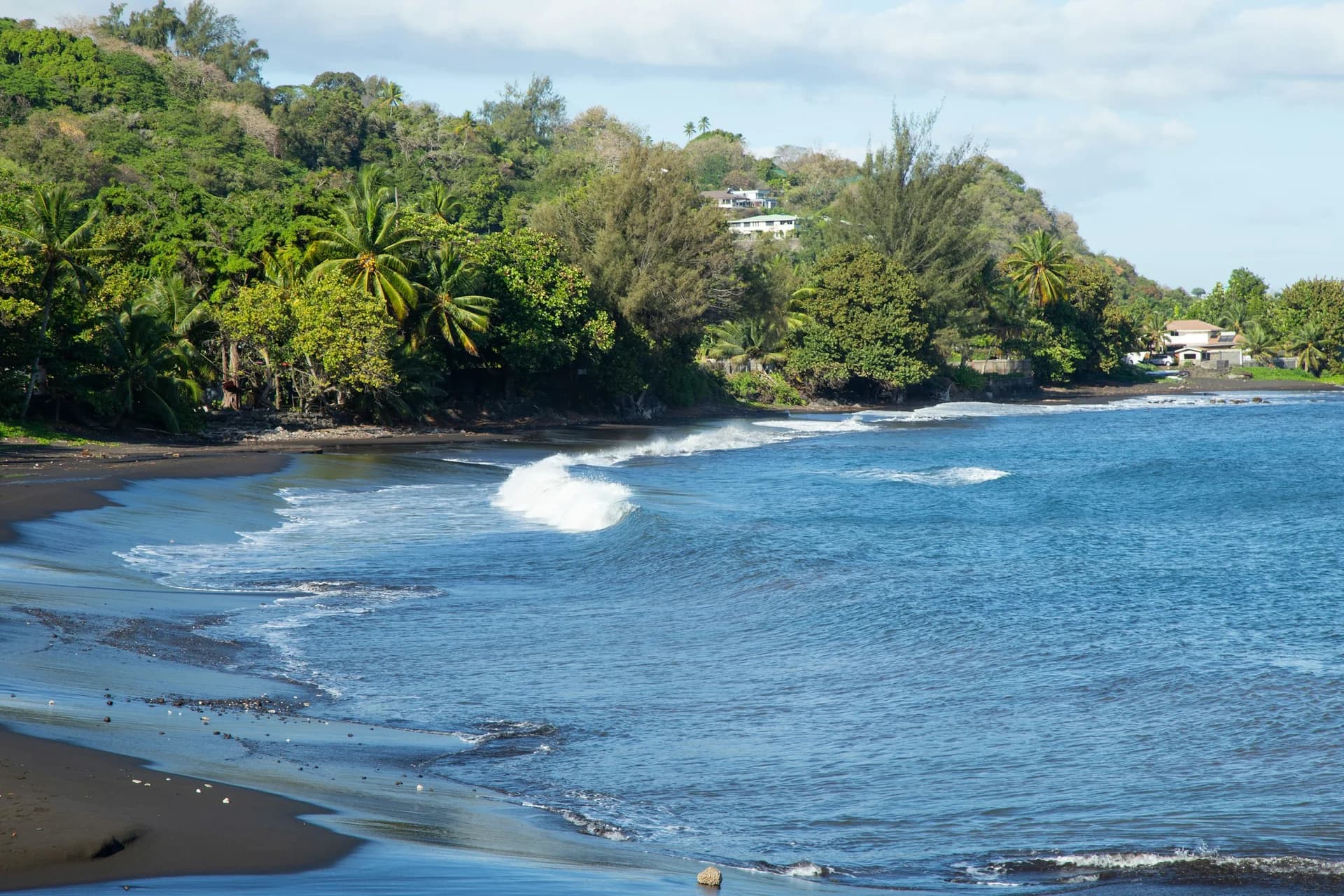
- Black sand beaches: Papenoo (north, surf), Taharuu (south, calmer). Both free. The black sand, green palms, blue water contrast is striking.
- Fautaua Waterfall: 133-meter fall, 4-5 hour round-trip hike through bamboo forest. Free permit from Mairie. Bring water shoes for stream crossings.
- Three Waterfalls of Faarumai: Three cascading falls accessed by a 20-minute walk from the road. East coast, free. Easier than Fautaua.
- Vaipahi Gardens: Botanical garden with waterfall, tropical plants. Free entry. East coast, 53 km from Papeete.
Culture
- Paul Gauguin Museum (~600 XPF/$5): Where the painter lived 1891-1893. Reproductions and biography (originals in global museums). Adjacent Harrison Smith Botanical Garden.
- Museum of Tahiti and Her Islands (~600 XPF/$5): Natural history and Polynesian culture. Punaauia, west coast.
- Vanilla farm tour: East coast plantations offer tours with hand-pollination demonstrations and tasting. 3,000-5,000 XPF ($27-45).
Adventure
- Teahupo'o surf watching: Boat trip from the village, $50-80. One of the world's heaviest waves, Olympic venue. For spectating unless you're an expert.
- 4WD interior tours: Papenoo Valley to Lake Vaihiria, ancient marae sites, remote waterfalls. $80-120 half day.
- Moorea day trip: 30-minute ferry ($15 each way). Rent a scooter on Moorea and circle the island. Better beaches than Tahiti.
Food
Tahiti has French Polynesia's best food scene — which makes sense, since it has the only actual city.
Poisson cru: Raw tuna in lime juice and coconut milk. Available everywhere from $7 (market) to $30 (restaurant). The national dish and one of the best things you'll eat in the Pacific.
Les roulottes: Food trucks at Place Vai'ete. Grilled mahi-mahi, chow mein, crepes, poisson cru. $9-18 per plate. Cash. Every evening from 6 PM.
The Market upstairs: Lunch stalls with local workers eating poisson cru, grilled fish, and stir-fry. $7-11. The freshest, cheapest food in Papeete.
Sit-down: Le Coco's (French-Tahitian, $40-60), Le Lotus (overwater, $80-120), Les 3 Brasseurs (craft beer and French brasserie, $20-35).
Vanilla: Tahitian vanilla is exceptional. Buy beans at the market ($8-15 per bundle) rather than airport duty-free ($25-40). They last months in an airtight container.
Budget
| Category | Budget | Mid-range | Comfortable |
|---|---|---|---|
| Accommodation | $80-120/night | $120-200 | $200-600 |
| Food | $20-35/day | $35-60 | $60-120 |
| Transport | $15-25 (bus/taxi) | $50-80 (car rental) | $80-120 (car + tours) |
| Activities | $0-30 | $50-100 | $100-200 |
| Daily total | $115-210 | $255-440 | $440-1,040 |
Safety
- Petty crime exists in Papeete — secure valuables, don't leave bags unattended
- Mosquitoes carry dengue — use DEET repellent, especially dawn and dusk
- Tap water is safe in Papeete, uncertain in rural areas (use bottled)
- Healthcare follows French standards; pharmacies are well-stocked
- The ocean is generally safe — no dangerous jellyfish or sharks near swimming areas
Useful Phrases
French is the administrative language. Tahitian is spoken locally. English is understood at tourist businesses but not universally.
- Ia orana — Hello
- Mauruuru — Thank you
- Nana — Goodbye
- E aha te huru? — How are you?
- Maita'i — Good/fine
For a similar experience in a different setting, Fiji offers a compelling alternative.
For deeper Polynesian immersion without the French influence, Samoa offers authentic fa'a Samoa culture.
For a similar experience in a different setting, Hawaii offers a compelling alternative.
Black Pearls: A Quick Guide
Tahitian black pearls are significantly cheaper in Papeete than in Bora Bora's resort shops. The Robert Wan Pearl Museum (free) teaches you about quality grading. Key factors: luster (shine), surface (fewer blemishes = better), shape (round is most valuable), and size.
A quality loose pearl: 5,000-15,000 XPF ($45-135). Mounted jewelry: 10,000-100,000 XPF+ ($90-900+). The market has good deals; compare several vendors. Certificates of authenticity matter for export.
Don't skip Tahiti. It's not a terminal. It's the heart of French Polynesia — and it beats loudest at a roulotte at sunset with a plate of poisson cru and a Hinano beer.


