The Ocean Trench, the Blowholes, and the Silence: My Week in Samoa
The Ocean Trench, the Blowholes, and the Silence: A Week in Samoa
The Air New Zealand flight from Auckland to Apia takes 3.5 hours. In that short window you cross an international date line, gain a day, and land in a country where the immigration officer greets first-time arrivals with "welcome home."
That sets the tone for everything that follows.
Apia: The Capital That Isn't
Apia is Samoa's capital, but calling it a city feels generous. Population 37,000. A clock tower. A harbour. A few blocks of shops selling lavalava fabric and tinned corned beef (pisupo, a Samoan staple). The Samoa Cultural Village near the harbour offers free cultural shows — fire knife dance, siapo (bark cloth) making, coconut husking — on Tuesdays through Thursdays. Watch closely and you'll see a fire knife dancer barely out of his teens spin a flaming machete above his head at a speed that makes the whole crowd's stomach clench.
The Robert Louis Stevenson Museum sits on a hilltop above Apia — the beautifully restored home where the Treasure Island author spent his last years. Samoans called him Tusitala — Teller of Tales. His tomb is atop Mount Vaea behind the house, a 30-minute hike through tropical forest. Entry: 20 WST (~$7).
But Apia isn't why you come to Samoa. Apia is where you rent a car (150-250 WST/$55-91 per day, left-hand driving) and leave.
To Sua Ocean Trench: The Photograph That Doesn't Lie
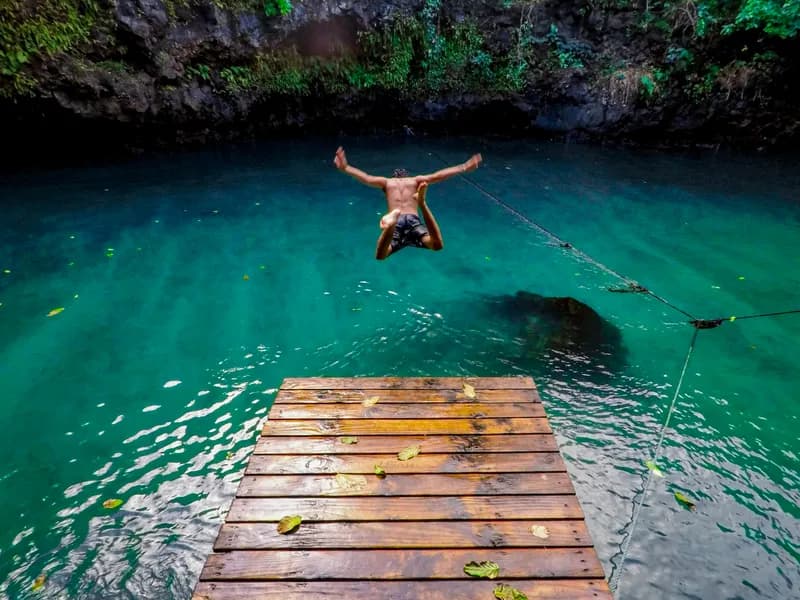
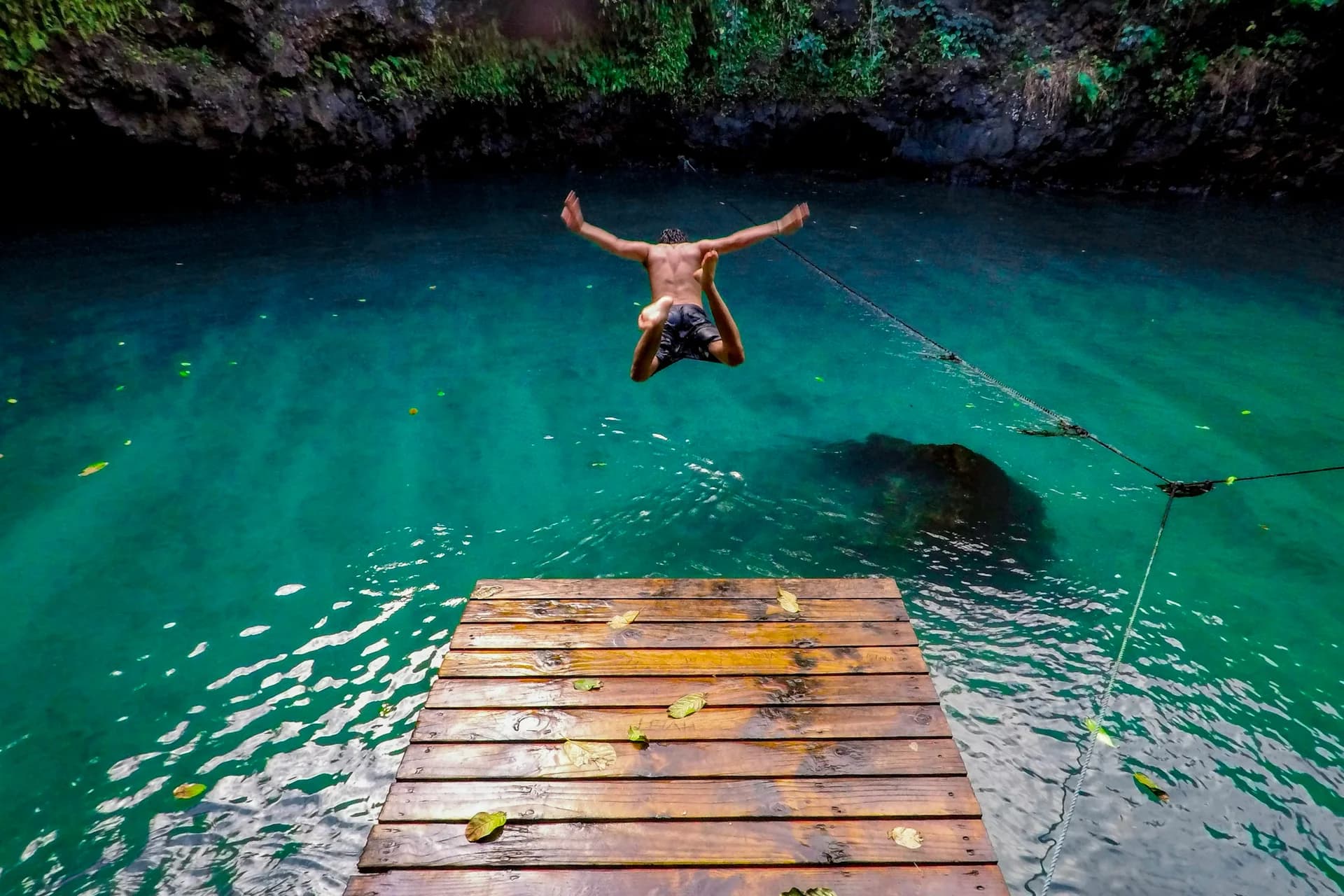
You've seen the photos. A turquoise swimming hole carved into rock, surrounded by tropical gardens, accessed by a steep ladder descending into the earth. Surely they're edited. Over-saturated. Angles playing tricks.
They aren't.
To Sua is 55 km south of Apia on Upolu's south coast. Entry: 20 WST ($7). Arrive by 8:30 AM — before the cruise ship passengers, as every local will tell you.
The trench is 30 meters deep. The water is connected to the ocean by a lava tube, so it rises and falls with the tide. The color — and "turquoise" is the only word that works — comes from the limestone and the way light enters the cavern.
Climb down the ladder into warm water. Float on your back and look up at the rock walls, the tropical plants growing from the edges, the sky framed in a rough circle above. Fish swim around your legs. The only sounds are water dripping and birds.
Stay for an hour. Maybe longer. Time does something different in Samoa.
The Beach Fale at Lalomanu
Lalomanu Beach — consistently rated the most beautiful in the South Pacific — is a 40-minute drive from To Sua. A long curve of white sand backed by coconut palms with views of the Nu'utele Islands offshore.
Book a traditional beach fale at Taufua Beach Fales — 120 WST ($44) per person including dinner and breakfast. The fale is a wooden platform with a thatched roof, a mattress, a mosquito net, and no walls.
No walls. The ocean breeze comes straight through. The sound of waves is constant. At night, lying under the net, you can see stars through the gaps in the thatch.
Dinner is served on the sand: grilled fish caught that afternoon, coconut cream vegetables, taro, breadfruit, and pineapple sweeter than seems possible. Everyone eats together — guests and staff — sitting on mats. There's no menu because there are no choices. You eat what the ocean and the garden provided.
You'll sleep better in that wall-less fale on the sand than in any hotel all year — even when a rooster positions itself 3 meters from your head and starts up at 4:45 AM. Still better.
Piula Cave Pool
On Upolu's north coast, 25 km east of Apia, the Piula Methodist Theological College sits on a hillside above the ocean. Behind the college, a freshwater spring feeds a cave pool that's open to visitors by donation (5-10 WST).
Wade into the cave opening and swim through a rocky passage into an underground pool of crystal-clear freshwater. Small fish swim around you. Light filters through the rock above. The water is cool and clean — spring-fed from the mountain.
Swim through the cave twice if you can. Odds are you'll share it with a family of Samoan kids shrieking and splashing. One of them, maybe seven years old, might swim up, say very seriously, "The fish like you because you're quiet," then splash you and swim away laughing.
Savai'i: The Bigger, Wilder Brother
The ferry from Upolu to Savai'i takes 2 hours (12 WST for passengers). Savai'i is geographically larger but has a fraction of the population. The road circles the coast; the interior is volcanic jungle — the same raw, untamed island wild we went chasing in our face-to-face with a wild Komodo dragon. Bring the rental car on the ferry (extra 100 WST).
The Alofaaga Blowholes on Savai'i's southern coast are violent and beautiful. Seawater forces through lava tubes and shoots 20+ meters into the air. Locals throw coconuts into the holes to demonstrate the force — the coconut launches skyward like a cannon ball, the same raw Pacific drama that draws travellers to the famous blowholes of neighbouring Tonga.
There are no safety barriers. None. You stand on wet lava rock next to holes that shoot pressurized seawater with enough force to lift a coconut 20 meters. It's exhilarating and terrifying in equal measure. Entry: 5-10 WST ($2-4). Most dramatic during high tide and swell.
Drive the rest of Savai'i's south coast through villages that feel untouched by tourism. Kids wave from the road. Say "talofa" (hello) before asking the price at a roadside coconut stand and you may well be handed one for free.
The lava fields from the 1905-1911 eruption cover a large section of the north coast — black, jagged rock stretching from the road to the ocean. A church spire pokes out of the solidified lava. The village of Saleaula was buried. Now trees grow through the rock, slowly reclaiming what the volcano took.
Sunday
People will tell you about Sunday. Nothing quite prepares you for it.
Samoa on Sunday is the quietest place you'll experience while sober. Shops are closed. Cars are rare. The villages observe sa from approximately 6-7 PM — a prayer curfew where everyone stops. If you're driving through a village during sa, you stop. If you're walking, you stop.
So you stop. Sit on a rock by the road. The church bells ring. Hymns float from the fale next door — a family singing together, voices harmonizing in Samoan. The sound is so beautiful and so unexpected that you simply sit and listen until the singing stops and a child emerges to wave.
Sunday in Samoa isn't a day of rest. It's a day of community. Families cook umu together (earth oven — taro, pork, chicken on hot stones). They eat together. They sing together. If you're invited — and you might be — go.
French Polynesia's main island, Tahiti, offers black sand beaches and the Pacific's best food trucks.
What Samoa Gives You
Come for the Instagram photo of To Sua. You'll get it. It'll live on your phone.
But Samoa gives you something else: a week of sleeping without walls, eating without menus, swimming in caves and ocean trenches, watching blowholes launch coconuts, and sitting still during a Sunday sa while a family sings hymns.
Samoa doesn't have the resort infrastructure of Fiji. It doesn't have the luxury of Bora Bora. It doesn't have the adventure activities of New Zealand.
What it has is fa'a Samoa — the Samoan way. And the Samoan way is warm, generous, unhurried, and completely uninterested in impressing anyone.
It impresses you anyway.
Total cost for 7 days: Approximately $600 USD excluding flights. That covers accommodation (beach fales and a pension), food (included with most stays), rental car, ferry, and entry fees. Six hundred dollars for one of the most peaceful weeks you'll ever spend.