
Your Tahiti Questions Answered: 14 Things First-Timers Need to Know
Your Tahiti Questions Answered: 14 Things First-Timers Need to Know
Tahiti has an identity problem. Most travelers treat it as a stopover — the airport you pass through on the way to Bora Bora. Skip it and you miss the best part of the country. Tahiti has black sand beaches, thundering waterfalls, the best food trucks in the Pacific, and one of the heaviest surf breaks on the planet. Here are the answers to every question you're asking.
Getting There
Q: How do you get to Tahiti?
All international flights land at Fa'a'a International Airport in Papeete (PPT), Tahiti's capital. Direct flights from Los Angeles (8 hours), Auckland (5 hours), Tokyo (11 hours), and Paris (via a stop). Air Tahiti Nui, Air France, LATAM, and Hawaiian Airlines are the main carriers.
From Papeete, Air Tahiti inter-island flights connect to Bora Bora (50 min), Moorea (10 min), and other islands. The Moorea ferry (30 min, $15 each way) is the cheapest way off the main island.
Q: Do you need a visa?
French Polynesia is a French overseas territory but NOT in the Schengen Area — a Schengen visa won't work. US, EU, UK, Canadian, and Australian citizens stay 90 days without a visa. Passport must have 6+ months validity.
Q: Should you spend time here or just connect to Bora Bora?
Spend time here. At minimum 2-3 days. Tahiti has soul that Bora Bora's resorts don't — the Papeete market, les roulottes food trucks, black sand beaches, and interior valley waterfalls are experiences you can't replicate on an overwater deck. Tahiti is where French Polynesian culture actually lives.
Money & Budget
Q: How expensive is Tahiti?
Significantly cheaper than Bora Bora, but still pricier than Southeast Asia or South America.
Pensions (guesthouses) from $80-150/night. Les roulottes meals for $9-18. Rental cars from $50/day. A full day with lunch, transport, and an activity: $80-120.
Daily budget estimates:
- Budget: $80-120
- Mid-range: $120-200
- Comfortable: $200-350
The CFP Franc (XPF) is the currency. Roughly 119 XPF = $1 USD. Most ATMs accept international cards. Credit cards work at hotels and restaurants but not always at markets and food trucks.
Q: Is everything imported?
Yes, and it shows in prices. A bottle of water at a convenience store: $2-3. A restaurant beer: $6-8. The exceptions: fresh fish (locally caught, excellent, reasonably priced) and tropical fruit (abundant and cheap at the market).
What to Do
Q: What's the one must-do in Tahiti?
Papeete Market (Marche de Papeete). This two-story covered market is the beating heart of Tahitian life. Ground floor: tropical fruits (mangoes, papayas, starfruit), fresh fish, vanilla beans, monoi oil, woven hats, and black pearls. Upper floor: food stalls serving poisson cru and chow mein for $7-11.
Open Mon-Sat 5 AM-5 PM, Sunday 4-8 AM (Sunday is the busiest morning — locals shop early). Allow 1-2 hours. Buy vanilla beans here — far cheaper than airport duty-free.
Q: Can you surf Teahupo'o?
If you're an expert big wave surfer with reef break experience, yes. If you're asking this question, probably no. Teahupo'o is one of the heaviest waves in the world — it breaks over an extremely shallow reef and has caused serious injuries and deaths. It was the Olympic surfing venue for Paris 2024.
But you can WATCH from a boat. Boat trips from the village of Teahupo'o cost $50-80 per person and put you close enough to feel the spray from the lip. The wave's power is extraordinary even from a boat. The village is a 1.5-hour drive from Papeete plus a short boat ride.
Q: Are the black sand beaches worth visiting?
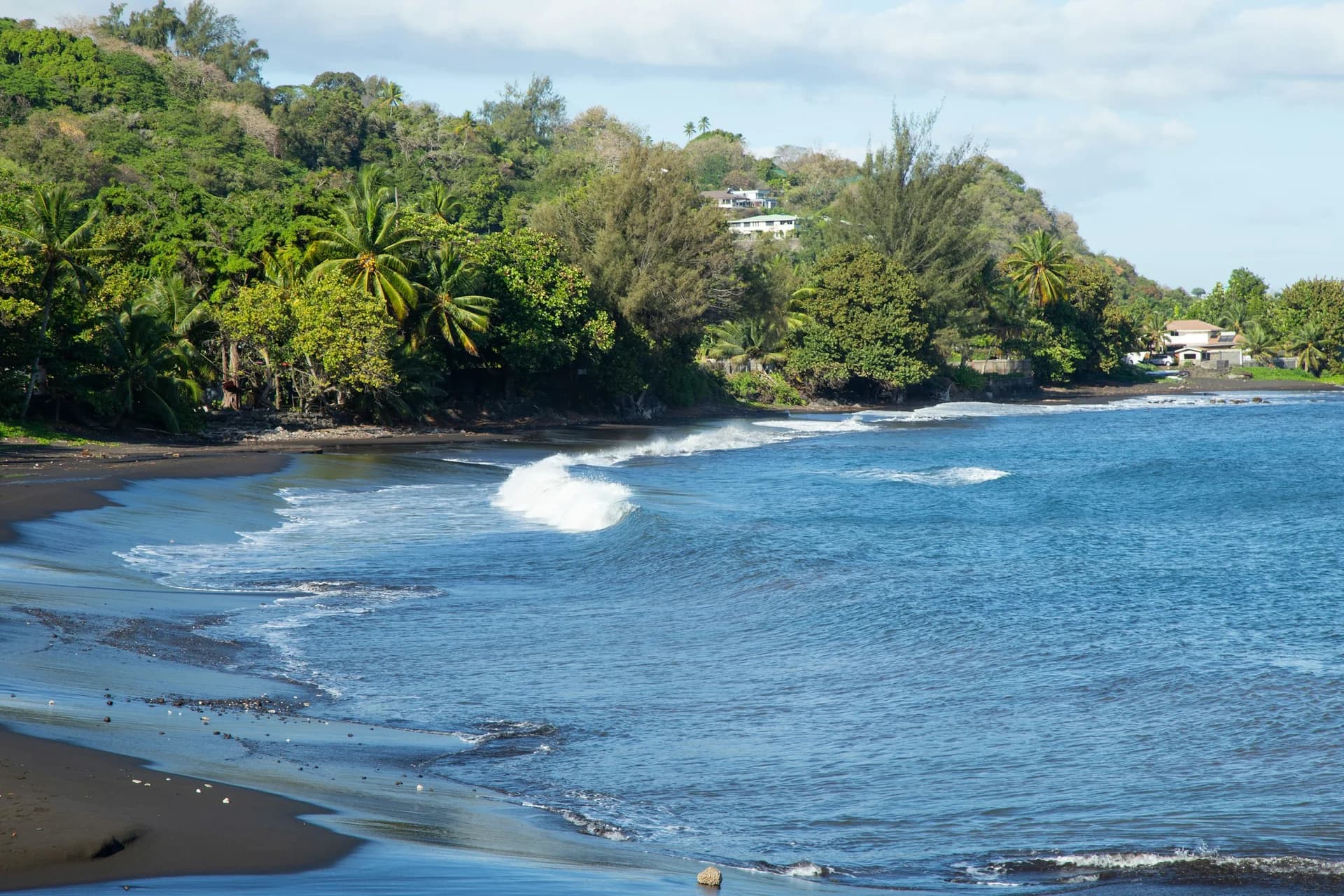
Absolutely. Tahiti's volcanic origin creates dramatic black sand beaches that contrast stunningly with green palms and blue ocean. Papenoo Beach (north coast) has good bodyboarding waves. Taharuu Beach (south coast) is calmer and popular with families.
Both are free. The photography opportunities — black sand, green palms, blue water — are exceptional at any time of day.
Q: What about the interior of the island?
Tahiti Nui's interior is wild, mountainous, and almost never visited by tourists. The Fautaua Waterfall hike — 133 meters, the tallest on the island — is a 4-5 hour round trip through bamboo forest with river crossings. You need a free permit from the Mairie (town hall). Bring water shoes.
The Papenoo Valley offers 4WD tours through the interior to ancient marae (temples) and remote waterfalls. Half-day tours from $80-120.
Food
Q: Where should you eat in Papeete?
Les Roulottes at Place Vai'ete — every evening from 6 PM, the waterfront fills with food trucks serving everything from poisson cru and grilled mahi-mahi to Chinese stir-fry and crepes. A full meal: $9-18. This is the best value dining in French Polynesia. Bring cash.
Papeete Market food stalls — upper floor, lunch only. Poisson cru with rice for $7-11. Local workers eat here daily. If the locals eat here, you should too.
For a sit-down meal: Le Lotus (upscale, overwater, $80-120/head) or Le Coco's (French-Tahitian fusion, $40-60/head).
Q: What's the deal with Tahitian vanilla?
Tahitian vanilla (Vanilla tahitensis) is a different species from Madagascar vanilla. Richer, more complex, with fruity and floral notes. It's hand-pollinated because the natural pollinators don't exist here.
Buy beans at the Papeete Market ($8-15 for a bundle) or visit a vanilla farm on the east coast ($27-45 for a tour with tasting). The Robert Wan Pearl Museum in Papeete is free and helps you understand pearl quality before buying.
Practical
Q: How do you get around Tahiti?
Rent a car ($50-80/day). Le Truck (local bus) runs around Tahiti Nui but is slow and infrequent — fine for getting to beaches, impractical for interior exploration. Drive on the right. Gas stations are scarce on the east coast — fill up in Papeete.
The full circle of Tahiti Nui by car takes 3-4 hours with stops. Tahiti Iti (the smaller peninsula) adds 2-3 hours.
Q: Is Tahiti safe?
Generally safe. Petty crime exists in Papeete (keep valuables secure), but violent crime is rare. The biggest health concern is mosquitoes — dengue fever outbreaks occur periodically. Use DEET-based repellent, especially at dawn and dusk. No malaria.
Tap water is safe in Papeete but not always in rural areas. Pharmacies follow French standards and are well-stocked.
For a similar experience in a different setting, Fiji offers a compelling alternative.
For deeper Polynesian immersion without the French influence, Samoa offers authentic fa'a Samoa culture.
Quick Reference
| Detail | Info |
|---|---|
| Language | French, Tahitian; English at tourist businesses |
| Currency | CFP Franc (XPF); ~119 XPF = $1 USD |
| Best time | May-October (dry season, 24-28°C) |
| Avoid | January-March (wettest, cyclone risk) |
| Time zone | UTC-10 (same as Hawaii) |
| Driving | Right-hand side |
| Tipping | Not expected or traditional |
| Sunday | Most businesses closed; very quiet |
| SIM card | Vini or Vodafone at airport, ~$15-20 for data |


