The Morning I Understood Why Athens Matters
Why Athens Matters — and the Morning It Finally Clicks
It's tempting to skip Athens entirely. The classic plan flies you from Rome straight to Santorini for a week of caldera sunsets and beach bars, with Athens reduced to a layover — one night, the Acropolis in the morning, then an afternoon ferry out.
Let the ferry sell out. You'll be glad it did.
The Accidental Extended Stay
A sold-out ferry buys you three unplanned days, and Athens rewards every one of them. Ignore the blogs that call the city dirty, gritty, overwhelming, and something you can "do" in a day. Check into a cheap hotel in Monastiraki with zero expectations and let the place go to work on you.
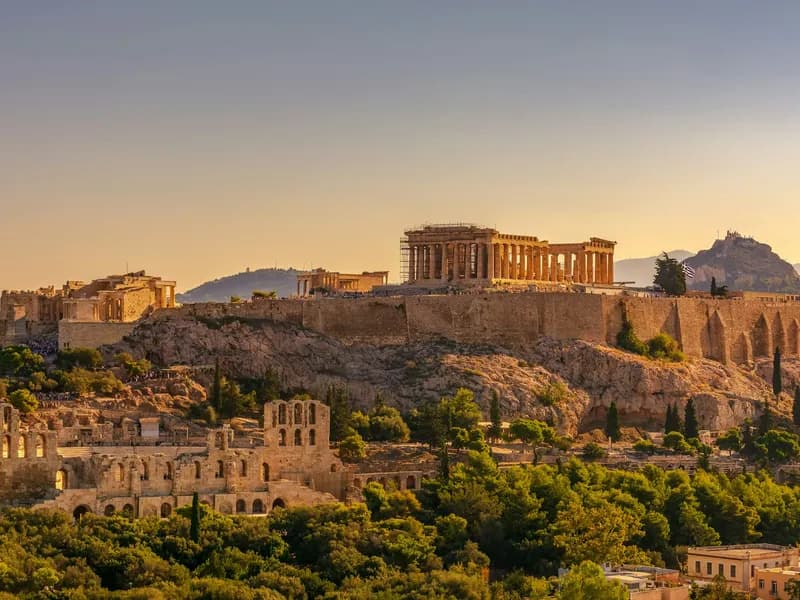
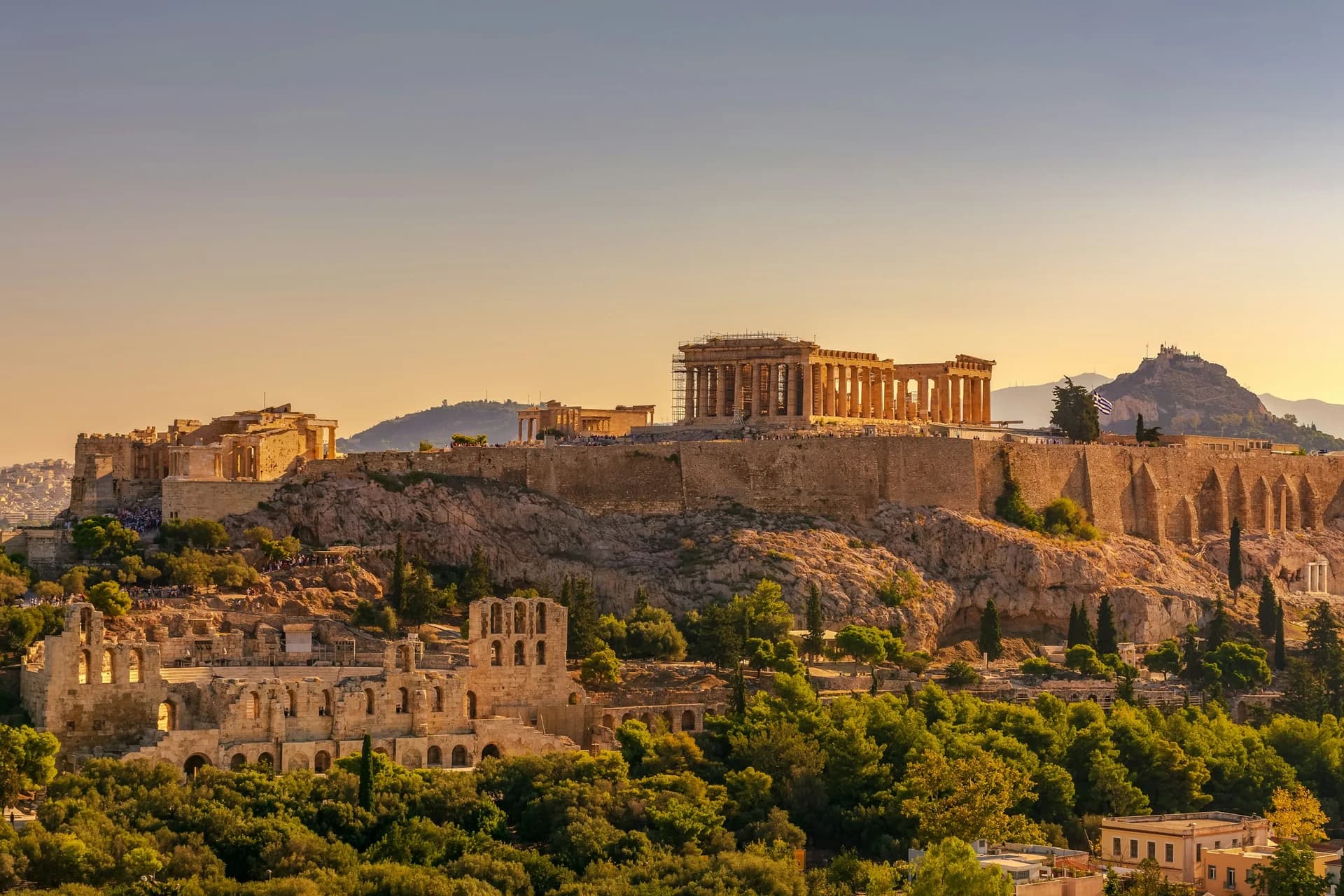
The rooms here often come with a tiny balcony, and on that balcony you'll find it — the Parthenon, lit on its hill, glowing against the dark sky as if it were placed there specifically for your view. You've seen photos of the Acropolis your entire life. Photos don't prepare you for how it dominates the city. It isn't just visible from everywhere — it's watching you.
8AM at the South Slope
Buy the €30 combo ticket the afternoon before, at the Roman Agora entrance where there's no line. Seven archaeological sites, five days. You'll think you only need it for one. You'll be wrong.
The south slope entrance to the Acropolis is nearly empty at 8AM. The main west entrance already has a line forming, but the south side — past the Theatre of Dionysus, where drama was literally invented — belongs to you and a handful of early German tourists.
The Theatre of Dionysus will stop you. Not for a photo — for a moment of sitting on those stone seats and absorbing the fact that Sophocles premiered Oedipus Rex here, that Euripides debuted Medea on this stage. The idea of actors performing stories for an audience, the one that leads to every play, every film, every streaming show — it started in this semicircle of stone.
The marble under your hands has been worn smooth by 2,500 years of people sitting in the same spot. Stay 20 minutes. The German tourists leave, new groups arrive, and the marble doesn't care.
The Propylaea and the Reveal
The walk up to the Acropolis passes through the Propylaea — the monumental gateway built in 437 BC. The columns are massive, and they frame the sky in a way that makes you look up. That's the point. The ancient architects understood sight lines. They knew that after climbing the sacred hill, exhausted and expectant, you'd pass through these columns and need something extraordinary on the other side.
And then the Parthenon appears.
You'll have seen it from every angle already — from the balcony, from street level, from textbook photos. But standing on the Acropolis, at the same level, close enough to read the individual drums of the columns, the weathering on the marble, the subtle curve of the stylobate (the floor curves slightly upward to create an optical illusion of perfect straightness) — that's when the scale lands.
This building is 2,500 years old. It survived earthquakes, wars, an explosion when the Venetians shelled it in 1687 (it was being used as a gunpowder store), and a British ambassador carving off half the sculptures. And it's still standing there, insisting on beauty.
Most people put the phone away here. Not for a philosophical reason. You simply forget you're holding it.
The Acropolis Museum
Walk straight down to the Acropolis Museum (€15) afterward. The glass floor in the entrance hall reveals active excavations below — you're literally walking over an ancient neighborhood. The Caryatids on the first floor, the original maiden columns from the Erechtheion, stand at eye level. Five originals are here; the sixth is in the British Museum. The empty space where she should be is more powerful than the five that remain.
The top floor is oriented exactly parallel to the Parthenon. You can see it through the windows while studying the original frieze panels. The absent panels — the ones in London — are represented by white plaster casts. The museum is making an argument without saying a word.
Two hours go fast here. You could give it four.
Diporto Agoras
By noon you'll be hungry and emotionally spent. Ask around — locals will point you to Diporto Agoras, under the Central Market, no sign, just go down the stairs.
Find the stairs. Narrow, stone, descending into what looks like a basement. At the bottom: a room with barrel wine, checked tablecloths, an old man grilling fish, and a pot of chickpea soup. No menu. No English. No sign. Point at the fish, nod, and out comes grilled sea bass with lemon, a bowl of chickpeas, bread, and a glass of wine poured from a barrel.
€11. Cash only.
You'll sit among construction workers and elderly Greek men who clearly eat here every day. The fish is perfect. The wine is rough and honest. Nobody looks at a phone.
The Ancient Agora
Spend the afternoon at the Ancient Agora, covered by the combo ticket. This is where Socrates actually walked, taught, and debated, and where Athenian democracy was practiced. The Temple of Hephaestus is the best-preserved Greek temple in the world — more complete than the Parthenon, less famous, and barely crowded.
Sit under an olive tree and read the plaque about the Stoa of Attalos, now reconstructed as a museum. Inside: ostracism shards. Actual pottery pieces from 2,500 years ago, where Athenians scratched the names of citizens they wanted exiled. Ancient ballot papers. Look closely and you'll spot one with Themistocles' name on it.
The specificity of it — holding a piece of pottery where a real Athenian scratched a real name to cast a real vote — that's what gets you in Athens. Not the grandeur. The specificity.
Areopagus Hill at Sunset
The rocky outcrop just below the Acropolis entrance. Free. Slippery marble surface — wear shoes with grip. Climb up at golden hour with a takeaway Greek coffee (€3 from a cart near Monastiraki).
The Parthenon glows golden above you. The city sprawls below in every direction. Mount Lycabettus sits to the northeast with its tiny chapel on top. The Saronic Gulf shimmers in the distance.
And it clicks. Not intellectually — you've always known Athens was important. But sitting on that rock, watching the same sunset Pericles watched, that Plato watched, that Paul the Apostle preached from on this exact rock, the continuity of it breaks something open.
This city has been continuously inhabited for over 3,400 years. Every major concept that shaped Western civilization — democracy, philosophy, theatre, trial by jury, competitive athletics — was developed here, in this valley, by people who walked these same paths.
The moment lands quietly, somewhere into that €3 coffee, as the Parthenon turns from gold to pink. The German tourists from the morning are usually there too. You nod at each other.
What Three Unplanned Days Teach You
You'll end up using every site on the combo ticket. Hadrian's Library, Kerameikos Cemetery (the most peaceful of all the sites — barely anyone there), the Roman Agora with its Tower of the Winds (an ancient weather station from 50 BC). Walk through Exarchia's street art, eat souvlaki at Kostas (€3.50, since 1950, open 11AM-3PM only), and spend an evening on the rooftop at A for Athens watching the Acropolis lit up over €12 cocktails.
Give the National Archaeological Museum three hours and you'll barely scratch its surface. The Mask of Agamemnon. The Antikythera Mechanism. Bronze statues pulled from the sea floor.
Athens isn't a city you "do" in a day. It's not a layover. It's not a checkbox before the islands.
It's the place where everything started. And standing among those ruins, eating grilled fish in unmarked basements, and watching sunsets from 2,500-year-old rocks — that's not tourism. That's something else entirely.
For more on Athens, check out our The Complete Athens Travel Guide.
Book the return flight before you leave. Next time, hike Lycabettus at sunrise.