
Your Top 12 Questions About South Africa's Cape Winelands, Answered
Your Top 12 Questions About South Africa's Cape Winelands, Answered
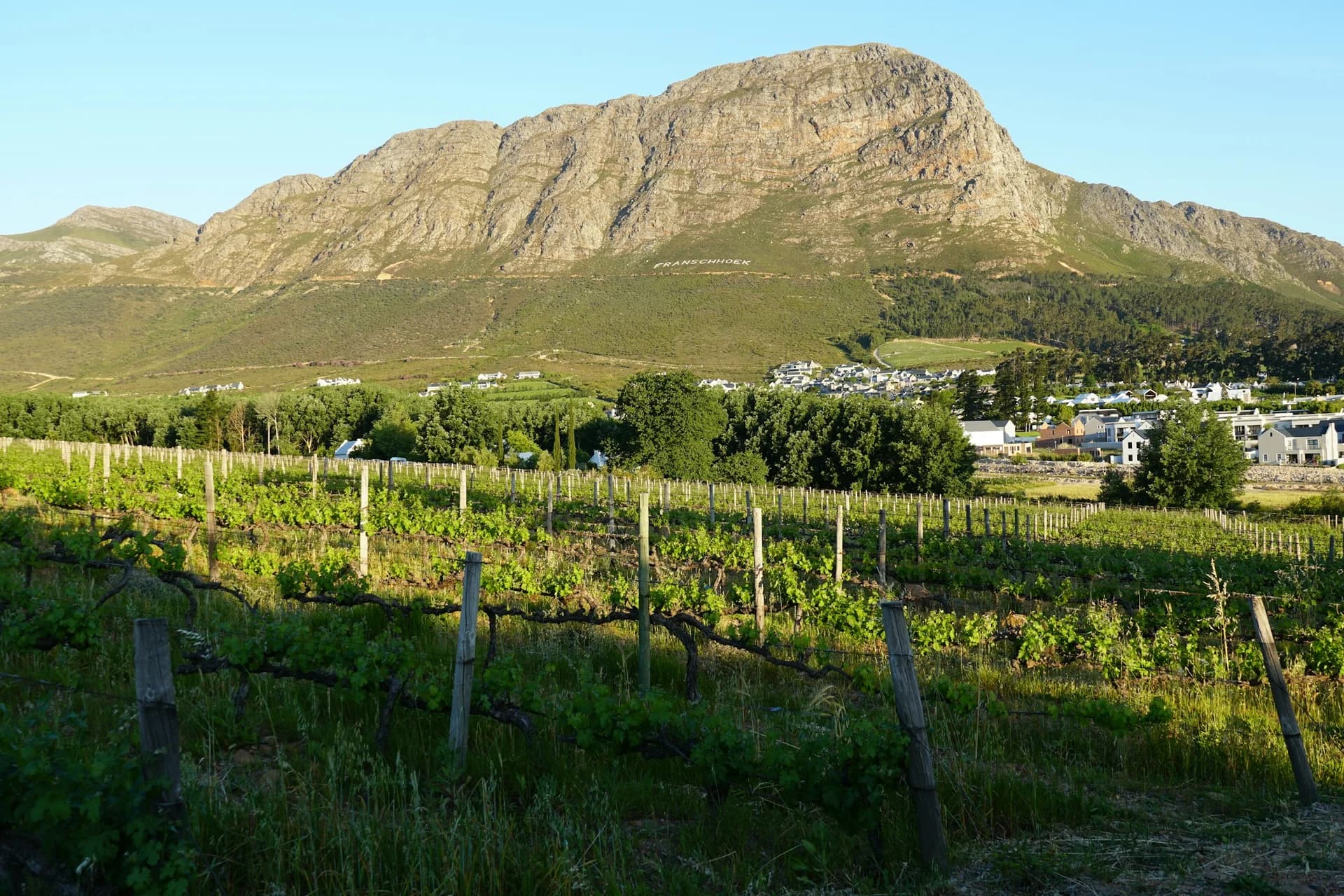
The Cape Winelands — Stellenbosch, Franschhoek, and Paarl — are South Africa's premier wine region and one of the world's great food-and-wine destinations. First-time visitors always arrive with questions. Here are the honest answers.
Q: How do you get there?
Fly into Cape Town International Airport (CPT). Stellenbosch is 30 minutes east by car. Franschhoek is 50 minutes. Paarl is 40 minutes. There's no public transport worth mentioning between Cape Town and the Winelands — rent a car ($40-60/day) or book a wine tour with a driver.
Drive on the left. Roads are well-maintained and scenic. The N2/R44 to Stellenbosch passes through Somerset West with mountain views the whole way.
Q: Is it safe?
The wine estates and town centers of Stellenbosch and Franschhoek are very safe. For a broader South Africa trip, add Kruger National Park for safari (Level 1). You'll feel comfortable walking Dorp Street in Stellenbosch or Huguenot Street in Franschhoek at any time of day.
Standard urban precautions apply in Cape Town proper — don't leave valuables visible in your car, and don't walk isolated areas at night. The Winelands themselves are relaxed and tourist-friendly.
Q: What is Pinotage?
South Africa's signature grape — a cross between Pinot Noir and Cinsaut, created in 1925 by Professor Abraham Izak Perold at Stellenbosch University. It's found almost exclusively in South Africa.
Good Pinotage: smoky, earthy, with dark fruit and a distinctive character. Bad Pinotage: burnt rubber and acetone. The quality range is wide. Kanonkop's estate Pinotage (R250-400 at the cellar door) is world-class. Beyerskloof is the accessible entry point.
Don't leave without trying it. Love it or hate it, Pinotage is uniquely South African.
Q: How expensive is wine tasting?
Remarkably affordable by global standards. Tasting fees: R50-200 ($3-11) for 5-8 wines. Many estates waive the tasting fee if you buy a bottle. Bottles at the cellar door: R80-500 ($4.50-28) for award-winning wines that would cost 3x in Europe or the US.
A full day of tasting at 3-4 estates, including lunch, runs about R800-1,500 ($44-83). In Napa Valley, the same experience would cost $200-400.
Q: What about Chenin Blanc?
South Africa has the world's oldest Chenin Blanc vines and produces arguably the best Chenin outside the Loire Valley. The Winelands' warm climate gives the wine tropical fruit character — guava, pineapple, honey — that French Chenin doesn't have.
Standout producers: Ken Forrester (the "Chenin King"), Raats Family Wines, and De Trafford. Try old-vine Chenin — wines from vines 30-50+ years old have a concentration and complexity that will change how you think about white wine.
Q: Can you drink and drive between estates?
No. South Africa's legal blood alcohol limit is 0.05% — roughly 1-2 glasses. Police roadblocks are common on Winelands roads Friday through Sunday. Penalties include arrest and vehicle impoundment.
Your options: use the spit bucket at tastings (no judgment — it's expected), designate a driver, book a wine tour with a driver ($60-120 per person for a full day), or ride the Franschhoek Wine Tram (R280), which handles transport between estates.
Uber works in Stellenbosch and Franschhoek, but coverage outside town centers is spotty.
Q: What's the Franschhoek Wine Tram?
A hop-on/hop-off circuit using a vintage tram and open-air bus that visits 6-8 estates over a half-day. R280 (~$15). Multiple lines cover different parts of the valley. La Motte, Boschendal, and Grande Provence are highlights.
Book online in advance during peak season (December-March). Winter schedules are reduced but still operate.
This is some of the best wine tourism infrastructure anywhere in the world — and it solves the drunk-driving problem completely.
Q: Do you need to book restaurants?
The top restaurants — The Tasting Room (Franschhoek, multi-course tasting menu R1,200+), La Petite Colombe, Overture, and Babel at Babylonstoren — book out 1-2 weeks ahead, especially weekends and holidays.
Sunday lunch at a wine estate is a Cape tradition. Book by Thursday.
Walk-in options exist: Stellenbosch's Dorp Street cafes and Franschhoek's Huguenot Street bistros usually have space midweek.
Q: What about Babylonstoren?
A 17th-century Cape Dutch farm in Paarl with 3.5 hectares of edible gardens (entry R20 / ~$1.10), the farm-to-table restaurant Babel (mains R180-280), and wine tastings (R65). The gardens are modeled after the Company's Garden in Cape Town — 300+ edible plant varieties laid out in geometric beds.
Arrive early — it gets busy, even midweek. The gardens alone take 1-2 hours. Combine them with lunch at Babel.
If you visit one place in the entire Winelands, make it Babylonstoren.
Q: What about cheese and chocolate pairings?
The Winelands do pairings that go far beyond wine-and-wine. Fairview in Paarl is famous — the goat tower is an icon, and the wine-and-cheese pairing (R100 / ~$5.50) uses their own goat and cow cheeses. The goat cheeses are some of the best in the country.
Muratie in Stellenbosch does rustic cheese boards in a 300-year-old tasting room. Several estates pair wine with chocolate, biltong (dried cured meat), or nougat.
Q: What's load shedding, and will it affect you?
Load shedding is South Africa's scheduled power cuts, driven by the national electricity utility's capacity problems. It can affect restaurants (no power = no cooking), traffic lights, and ATMs.
Most wine estates and quality restaurants have generators or solar backup. Download the EskomSePush app to check schedules. Carry cash as backup when card machines go down.
It's a minor inconvenience, and an easily managed one — locals are entirely used to it.
Q: How long should you spend?
3-4 days is ideal. Day 1: Stellenbosch (3-4 estates + dinner on Dorp Street). Day 2: Franschhoek (Wine Tram + lunch at a top restaurant). Day 3: Paarl (Babylonstoren + Fairview + Spice Route). Day 4: hiking Jonkershoek Nature Reserve in the morning, a final tasting in the afternoon.
A day trip from Cape Town is possible but rushed. Overnight in Stellenbosch or Franschhoek for the full experience.
Q: What's the one bottle you should bring home?
Old-vine Chenin Blanc. Specifically, Ken Forrester The FMC or Raats Original Chenin. R200-400 at the cellar door (~$11-22). These wines compete with the best whites in the world and cost a fraction of an equivalent Burgundy or Napa bottle.
Or Kanonkop estate Pinotage if you prefer red. R250-400. You won't find it outside South Africa easily.
Pack it in your checked luggage. Wrap it in a hoodie. It's worth the small risk. For the full narrative experience, read our love letter to Stellenbosch.


