12 Incredible Things to See in Etosha National Park
12 Incredible Things to See in Etosha National Park
Etosha is 22,000 square kilometers of salt pan, grassland, and bush in northern Namibia. It's one of Africa's greatest wildlife reserves, and unlike the Serengeti or Kruger, you can explore the entire thing in your own car without a guide. Here's what to look for.
1. Black Rhinos at the Floodlit Waterholes
Etosha has 300-400 black rhinos — one of the largest populations of this critically endangered species in any national park. The best viewing: Okaukuejo Rest Camp's floodlit waterhole after dark. The rhinos come to drink between 9-10PM most nights during the dry season. You sit on stone seating 30 meters away and watch a 1,200kg animal walk out of the darkness. It's prehistoric and humbling.
No camera flash. No noise. Just watching.
2. The Etosha Pan
A vast white salt flat stretching 130km across the park — 4,800 sq km of blinding white nothingness. It's so large it's visible from space. In the dry season (May-October), it's a cracked, alien landscape. Mirages shimmer at the edges. Animals on the pan margin appear to float above the ground.
After good rains (January-March), the pan fills with shallow water and transforms into a massive flamingo feeding ground. Thousands of lesser and greater flamingos turn the white surface pink.
3. Elephant Herds at Namutoni
Namutoni Rest Camp's waterhole attracts the largest elephant gatherings in the park. During the dry season, herds of 40-50 elephants arrive at dusk. The matriarchs lead the way. The calves stumble between adult legs. The sound of that many elephants drinking and splashing simultaneously is genuinely moving.
Watch from the elevated tower platform for the best vantage point. Bring binoculars.
4. Sunrise on the Pan Edge
Drive to the pan's edge at dawn. The sun rises over the flat white surface and the sky goes through every color — pink, orange, gold, white. If there's been overnight dew, the pan reflects the sky like a mirror. Animals silhouetted on the horizon — gemsbok, springbok, giraffe — look like shadow puppets.
The Etosha Lookout point near Halali is the most accessible sunrise spot.
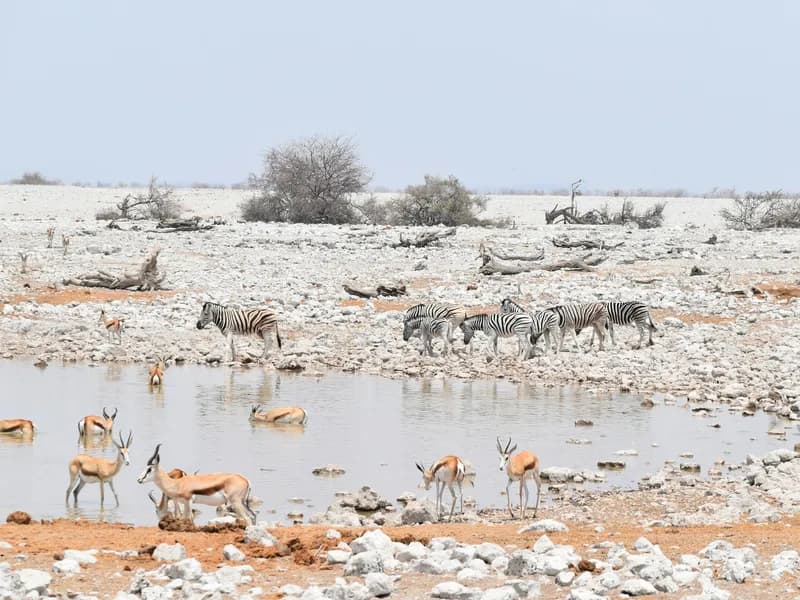
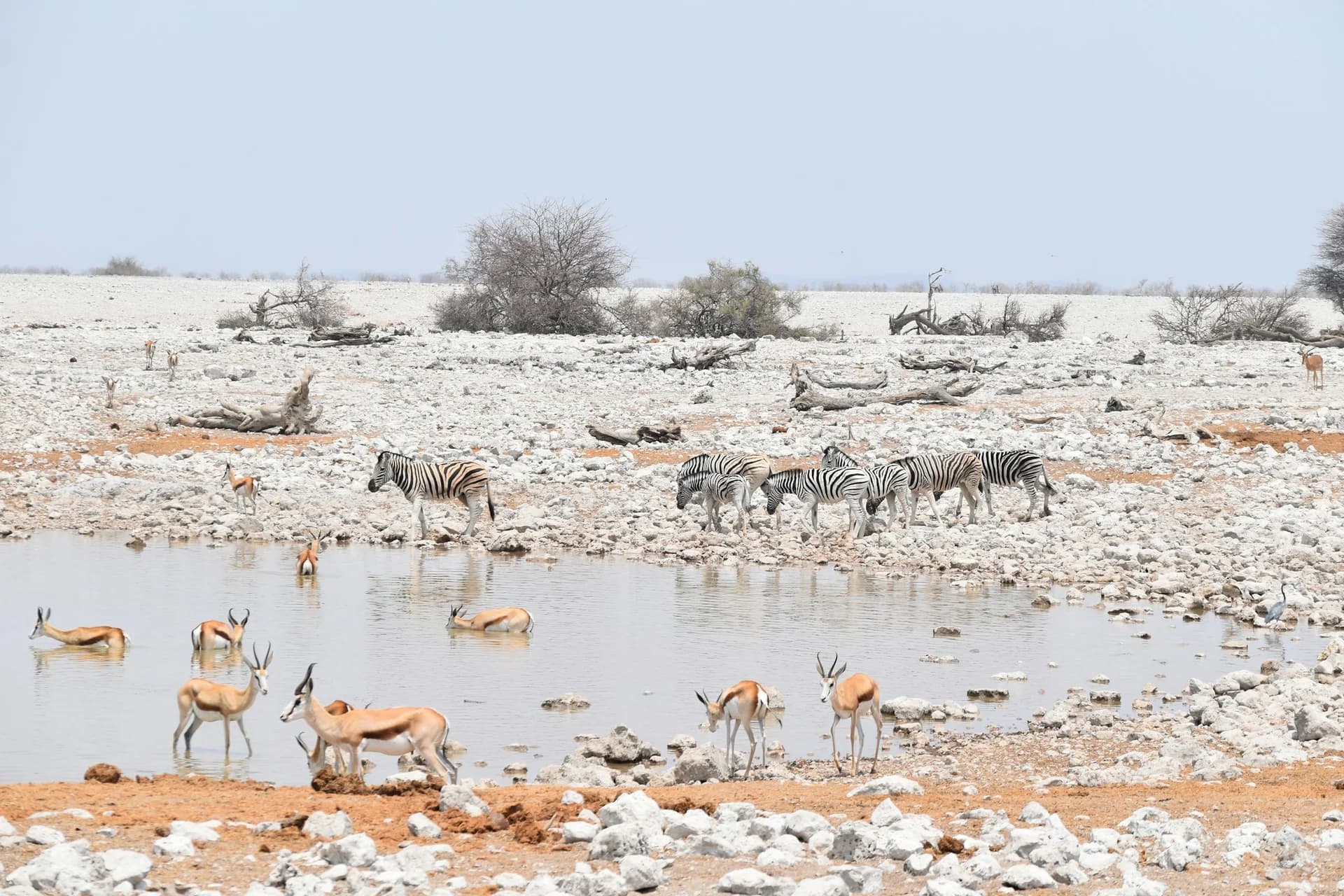
5. Springbok Herds by the Hundreds
The open grasslands around the pan edge host springbok herds that regularly number in the hundreds. During the dry season, herds of 500-1,000 gather near waterholes in the Fischer's Pan area and along the road between Halali and Namutoni.
When spooked, springbok perform their signature pronk — a stiff-legged vertical leap of up to 2 meters. Seeing a hundred springbok pronking simultaneously is one of Etosha's most exhilarating sights.
6. Lions Napping Under Camel Thorn Trees
Etosha's lion population is healthy and, during the dry season, relatively visible. Prides rest under the shade of camel thorn trees near waterholes, waiting for prey to come to them. The road between Okaukuejo and Halali is prime lion territory.
You'll often spot them by the cluster of parked cars. Pull up, turn off the engine, and wait. A lion sleeping 15 meters from your car is surreal. A lion waking up and yawning, showing teeth the size of your thumb, is unforgettable.
7. Gemsbok Against the Pan
The gemsbok (oryx) is Etosha's most photogenic animal. Two straight horns, a meter long, with a black-and-white face mask. They stand in groups of 10-30 against the white pan backdrop like they're aware of the composition.
The road between Okaukuejo and the pan edge is the best gemsbok viewing route. Early morning when the light is low and the pan is pink.
8. Cheetah on the Eastern Plains
Harder to find than lions but worth the search. Etosha's eastern section (between Namutoni and the Von Lindequist Gate) has open grasslands that cheetahs favor. They're often seen in the early morning, either on the road itself or perched on termite mounds scanning for prey.
A cheetah crossing the road 15 minutes from Anderson Gate at first light can become the highlight of a seven-day trip. Keep your eyes on the shoulder — this is where patience pays off.
9. Giraffe at Waterholes
Watching a giraffe drink is comedy and engineering combined. They have to splay their front legs impossibly wide to reach the water, leaving them vulnerable — they know it, and the approach is cautious, full of false starts and nervous head-raises.
Nebrownii and Chudop waterholes are reliable giraffe spots. Early morning visits of 2-3 giraffes are common.
10. The Okaukuejo Rest Camp Waterhole at Midnight
Yes, the waterhole earns a second place on this list. It deserves it. The daytime visitors have gone to bed. The stone seating is empty except for the committed. The floodlights illuminate the water and maybe 30 meters of bush. Everything beyond is darkness.
And then something walks out of it. A rhino. An elephant. A hyena. On the rarest nights, even a leopard — a sighting worth every hour of waiting. The uncertainty is the point. You don't know what's coming. You just sit and wait.
11. Martial Eagles and Secretary Birds
Etosha is exceptional for raptor viewing. Martial eagles — Africa's largest eagle, with a 2.6m wingspan — are seen perched on dead trees near the pan edge. Secretary birds stalk through the grass on their long legs, stomping snakes. Pale chanting goshawks sit on fence posts along the road.
Bring a bird book. Etosha has over 340 species. The raptors are the stars.
12. The Silence
This isn't a thing you see. It's something you experience. Park at a waterhole in the middle of the day. Turn off the engine. Open the windows. And listen.
Nothing. Wind, maybe. A distant bird call. The creak of your car cooling. But fundamentally, silence. The kind of silence that cities have completely erased from modern life. Etosha's 22,000 sq km acts as a buffer against human noise. No aircraft. No roads beyond the park's gravel tracks. No machinery.
Sit in it for five minutes. It recalibrates something.
Getting there: Fly to Windhoek (WDH). Rent a 2WD car. Drive 4.5 hours north on the B1/B2 highway. Anderson Gate is the main southern entrance.
When: June-November (dry season). September-October is peak game viewing. Animals concentrate at waterholes as vegetation dries out.
Cost: Park entry NAD 150/person ($8) + NAD 50/vehicle. Campsites NAD 350/night ($19). Budget two people: $40-50/day excluding car rental.
Visa: Most Western, Indian, and ASEAN nationalities enter Namibia visa-free for 90 days.