21 Tips for Visiting Samoa That Nobody Else Will Tell You
21 Tips for Visiting Samoa That Nobody Else Will Tell You
Samoa isn't like other Pacific islands. There's no resort-heavy infrastructure. No all-inclusive buffets. No tourist bubble separating you from the culture. You're IN it from the moment you land. That's the appeal — and it means you need to know a few things.
Cultural Essentials
1. Sunday sa is real — and you must observe it
Most villages have a sa (prayer curfew) on Sunday, typically from 6-7 PM. You must stop what you're doing — if driving, pull over and wait. If walking, stop and sit. It lasts about 30 minutes. This is not optional and not flexible. Plan your Sunday evening accordingly.
2. Cover your knees and shoulders in villages
Outside your accommodation or the beach, cover up. A lavalava (sarong) wrapped around your waist covers your knees and shows cultural awareness. You can buy one at any market for 15-30 WST ($5-11). Men wear them too — it's unisex.
3. Village fees are not negotiable — pay them cheerfully
Almost every natural attraction (beach, waterfall, cave, ocean trench) is on communal village land. Fees of 5-20 WST ($2-7) are standard. This isn't a tourist tax — it's how communities fund maintenance, toilets, and pathways. Pay without complaint. It's their land.
4. Remove shoes before entering any fale
Fales (traditional houses) have no shoes allowed inside. This applies to your accommodation, restaurants, and especially meeting houses. Place them neatly outside.
5. If offered kava (ava), sip slowly
Kava is a mild sedative drink made from the root of the pepper plant. It tastes like muddy water and numbs your tongue. When offered in a ceremonial context, accept the cup, take a sip, don't gulp. It's a sign of welcome and respect.
6. Don't eat while walking through a village
Considered disrespectful. Sit down to eat and drink. Similarly, don't point at people or their houses.
Accommodation
7. Beach fales are the entire point of Samoa
Open-air thatched huts on the beach with mattresses, mosquito nets, and no walls. 80-200 WST ($29-73) per person including dinner and breakfast. This is authentic Samoan accommodation and the best value in the South Pacific.
Taufua Beach Fales at Lalomanu is legendary. Others on the south coast and around Savai'i are equally good. Book by phone or just show up — outside peak season (June-August), there's usually space.
8. Bring earplugs for the roosters
Roosters start at 4:30 AM. Dogs bark at everything. The ocean is constant. If you're a light sleeper, earplugs are essential. The sounds are part of the experience — but the first morning rooster-alarm is a shock.
9. Nothing gets stolen from open fales
I was nervous about sleeping with no walls and no locks. Don't be. Samoan communities are self-policing through the matai (chief) system. Theft from visitors is essentially unheard of. Leave your valuables in a dry bag under your pillow if it makes you feel better, but the risk is near zero.
Getting Around
10. Rent a car — buses stop by mid-afternoon
Public buses (colorful converted trucks) run along main roads but stop around 2-3 PM. They're an experience in themselves — music blasting, passengers singing along, chickens in the aisle — but not reliable for getting to attractions.
Rental cars: 150-250 WST ($55-91) per day. Drive on the LEFT (Samoa switched from right to left in 2009). Roads are paved on main routes but narrow. Watch for dogs, pigs, and children on the road.
11. The Upolu-Savai'i ferry is straightforward
Samoa Shipping Corporation ferries run 2-4 times daily between Mulifanua Wharf (Upolu) and Salelologa (Savai'i). About 2 hours. 12 WST per passenger, ~100 WST for a car. You don't need to book ahead for foot passengers. For cars, book on the day — show up 1 hour early.
12. GPS doesn't work well — ask locals
Google Maps has major gaps in Samoa. Roads that show on the map don't exist. Roads that exist aren't on the map. Ask at your accommodation for directions. Everyone knows where everything is — Samoa is small enough for that.
Money
13. Carry cash — cards don't work everywhere
ATMs exist in Apia and a few larger towns. Outside Apia, cash is king. Beach fales, village attractions, and roulottes (food trucks) are cash only. Bring enough WST (or USD, which is accepted at some places at a rough rate) for your time outside the capital.
14. Budget $50-80 USD per day and live comfortably
A beach fale with meals: $36-73. Car rental: $55-91/day (split with travel companions). Entry fees: $2-7 per attraction. Extra meals: $5-10. Samoa is genuinely affordable.
Food
15. Oka is the dish you need to find
Samoan oka is similar to Tahitian poisson cru — raw fish in coconut cream with lime, onion, and salt. It's served at most beach fales and at the Apia fish market. Fresh, simple, and perfect.
16. Accept the umu invitation if it comes
The Sunday earth oven — taro, breadfruit, banana, pork, chicken cooked on heated stones buried underground — is Samoa's most important meal. If a local family invites you to their Sunday umu, say yes immediately. It's a genuine honor and the food is extraordinary.
17. Coconut cream is in everything, and that's correct
Palusami (taro leaves in coconut cream), fa'alifu (vegetables in coconut cream), desserts in coconut cream. If you're allergic to coconut, Samoa will be challenging.
Activities
18. To Sua Ocean Trench before 10 AM or after 3 PM
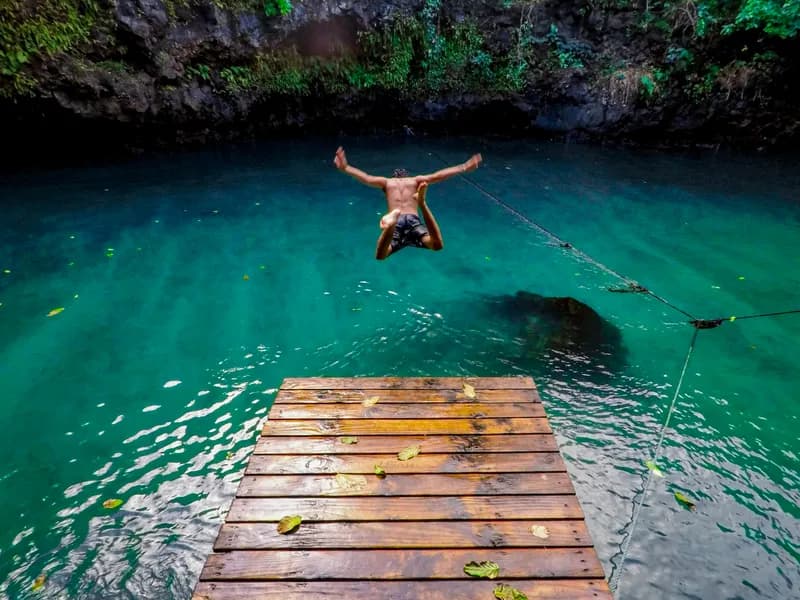
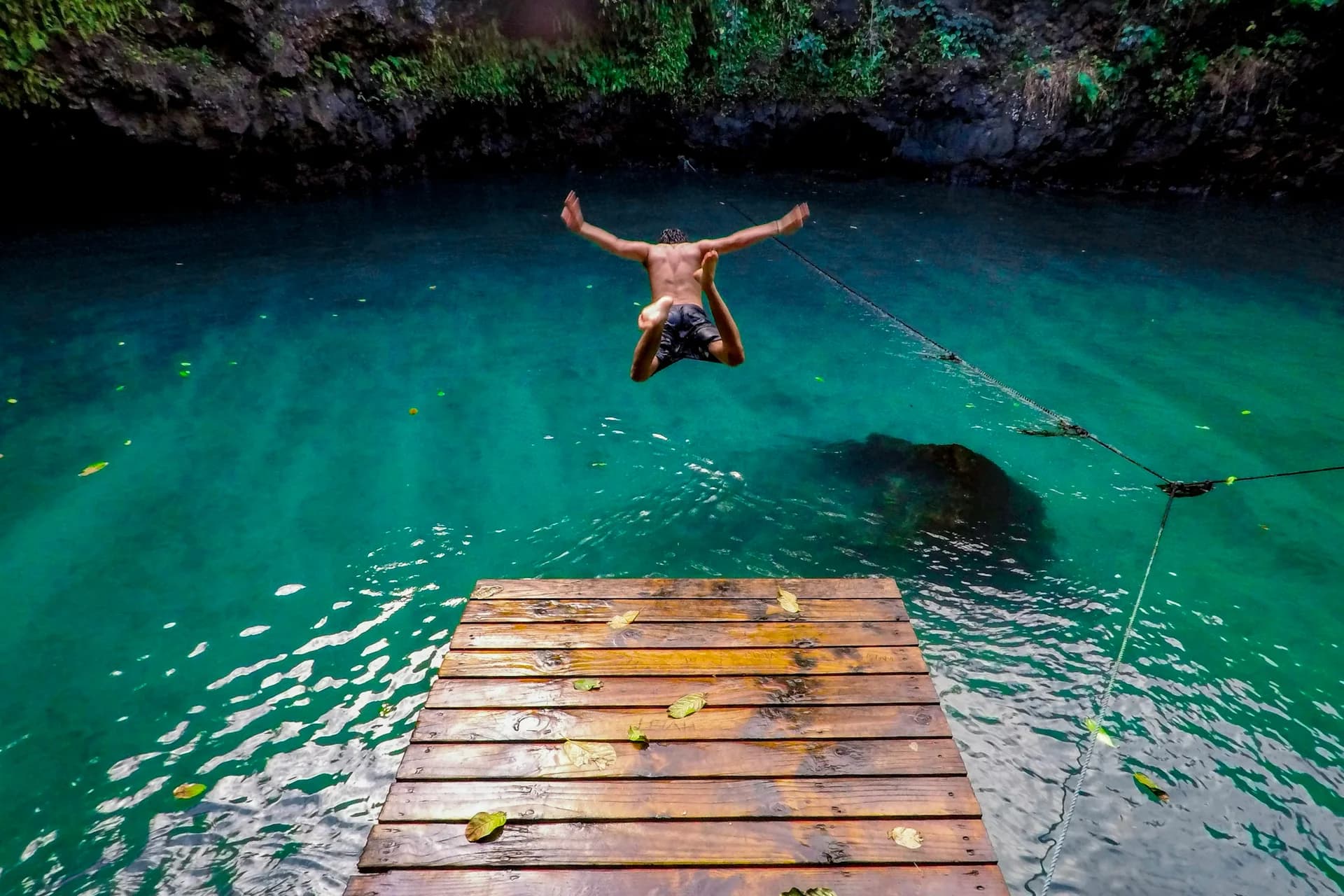
Cruise ships dock in Apia and shuttle passengers to To Sua between 10 AM and 3 PM. The experience is dramatically different with 5 people versus 50. Go early morning or late afternoon. Entry: 20 WST ($7). The trench is 55 km south of Apia.
19. Savai'i is worth at least 2 nights
Most tourists stay on Upolu and miss Savai'i entirely. The larger island is wilder, less visited, and has the Alofaaga Blowholes, lava fields, and some of the best beach fales in Samoa. Take the ferry. Bring your car. Stay 2-3 nights.
20. The Samoa Cultural Village in Apia is free
Free shows Tuesday-Thursday. Fire knife dance, traditional weaving, coconut husking, kava ceremony demonstrations. Run by the tourism authority with genuine cultural practitioners. Don't miss the fire knife — Samoa invented it, and seeing it here is seeing it at its source.
21. Don't confuse Samoa with American Samoa
Samoa (independent country, capital Apia, currency WST, free visa for 60 days) and American Samoa (US territory, capital Pago Pago, currency USD, different entry requirements) are separate nations 100 km apart. You need different paperwork for each. Most tourists visit Samoa (the independent country), which has more tourism infrastructure and is more welcoming to visitors.
Travelers exploring the South Pacific often combine Samoa with Fiji, which offers more resort infrastructure.
For a splurge after Samoa's simplicity, the lagoons of Bora Bora are a stunning counterpoint.
French Polynesia's main island, Tahiti, offers black sand beaches and the Pacific's best food trucks.
For a similar experience in a different setting, Auckland offers a compelling alternative.
Packing Essentials
- Lavalava/sarong (buy locally for $5-11 if you forget)
- Insect repellent with DEET (mosquitoes are aggressive)
- Reef-safe sunscreen SPF 50+
- Waterproof dry bag for fale storage
- Earplugs for roosters
- Water shoes for rocky beaches and To Sua ladder
- Cash (WST, enough for 3-5 days outside Apia)
- A sense of timing for island pace (everything is slower, and that's the point)