Inside the Walls: A Rhodes Local on What Tourists Miss About the Old Town
Inside the Walls: A Rhodes Local on What Tourists Miss About the Old Town
Dimitris Papadopoulos has lived inside the walls of Rhodes Old Town since he was a teenager. He runs a small ceramics workshop on a side street off Sokratous, plays backgammon at the same kafenio every evening, and has watched his medieval neighborhood shift from a quiet residential quarter to a UNESCO-listed destination. Over mountain tea and loukoumades near Agiou Fanouriou, his read on the place comes through — the kind locals only share once the cruise crowds have thinned.
What's it actually like to live inside the medieval walls?
It's like living inside a museum where nobody asked the residents to move out. The buildings date to the 15th century, the walls a meter thick — which means they stay cool through summer without air conditioning. The trade-off is the crowds. From April to October, tour groups file past the doorways from 9AM to 10PM, and a small private courtyard becomes a sanity-saver.
But ask anyone who stays, and they wouldn't trade it. At 6AM, before the shops open, the Old Town belongs to no one and everyone. The light hits the stone and the whole quarter turns golden. The cats come out — there must be 500 of them inside the walls. Church bells, then nothing else. That's the real Rhodes.
The first thing to do? Skip the Colossus.
Forget the Colossus. Everyone asks where the Colossus of Rhodes once stood, and the honest answer is that nobody knows. It fell in an earthquake in 226 BC and was sold for scrap metal some 800 years later. There's nothing to see. The bronze deer at the harbor mouth are handsome, but they're modern.
Instead, walk the Street of the Knights. It's the most intact medieval street in Europe — built by the Knights Hospitaller in the 14th century, their inns lining both sides. Go at 7AM or 7PM, when it empties out. By day it's shoulder-to-shoulder; at dawn you'll have it to yourself, your own footsteps echoing off 700-year-old cobblestones. That sound, ringing off centuries of stone — that's the Old Town.
What about the Palace of the Grand Master?
Visit it. Entry is 8 EUR, or 10 EUR combined with the Archaeological Museum. Open 8AM–8PM in summer, closed Mondays. The Italian reconstruction from the 1930s stirs debate — some of the mosaic floors were lifted from Kos, which still irritates people from Kos — but the building impresses, and the medieval exhibition halls give context to everything waiting outside the door.
Just don't surrender the whole day to it. The Old Town has 200 streets; tourists use maybe 10. Walk Agiou Fanouriou, Omirou, the back lanes behind the Ottoman Library. That's where the quarter still lives — laundry strung from balconies, small workshops, a cobbler working a doorway. The real rhythm of a place continuously inhabited for 2,400 years.
Where should you eat?
Not Sokratous Street — plainly. It's the main tourist run, and every restaurant there is built to catch people who don't know better. Identical menus, average food, prices 30–50% higher than two streets over.
Walk the lanes around Agiou Fanouriou instead. The tavernas there write the menu on a whiteboard and change it daily with whatever's at the market. Moussaka for 10 EUR. Grilled octopus for 12 EUR. Horiatiki salad made with actual local tomatoes instead of imported ones.
For fish, head to Lindos village — but skip the restaurants on the main square; those are the trap. Climb the back lanes toward the acropolis and you'll find family-run places where the catch came off a boat that morning. Main courses run 12–18 EUR.
Is the Lindos acropolis worth the climb?
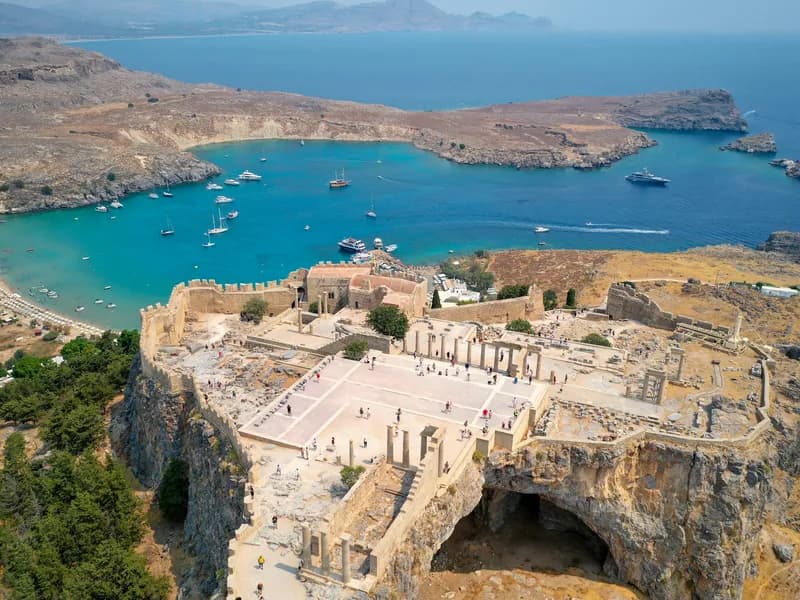
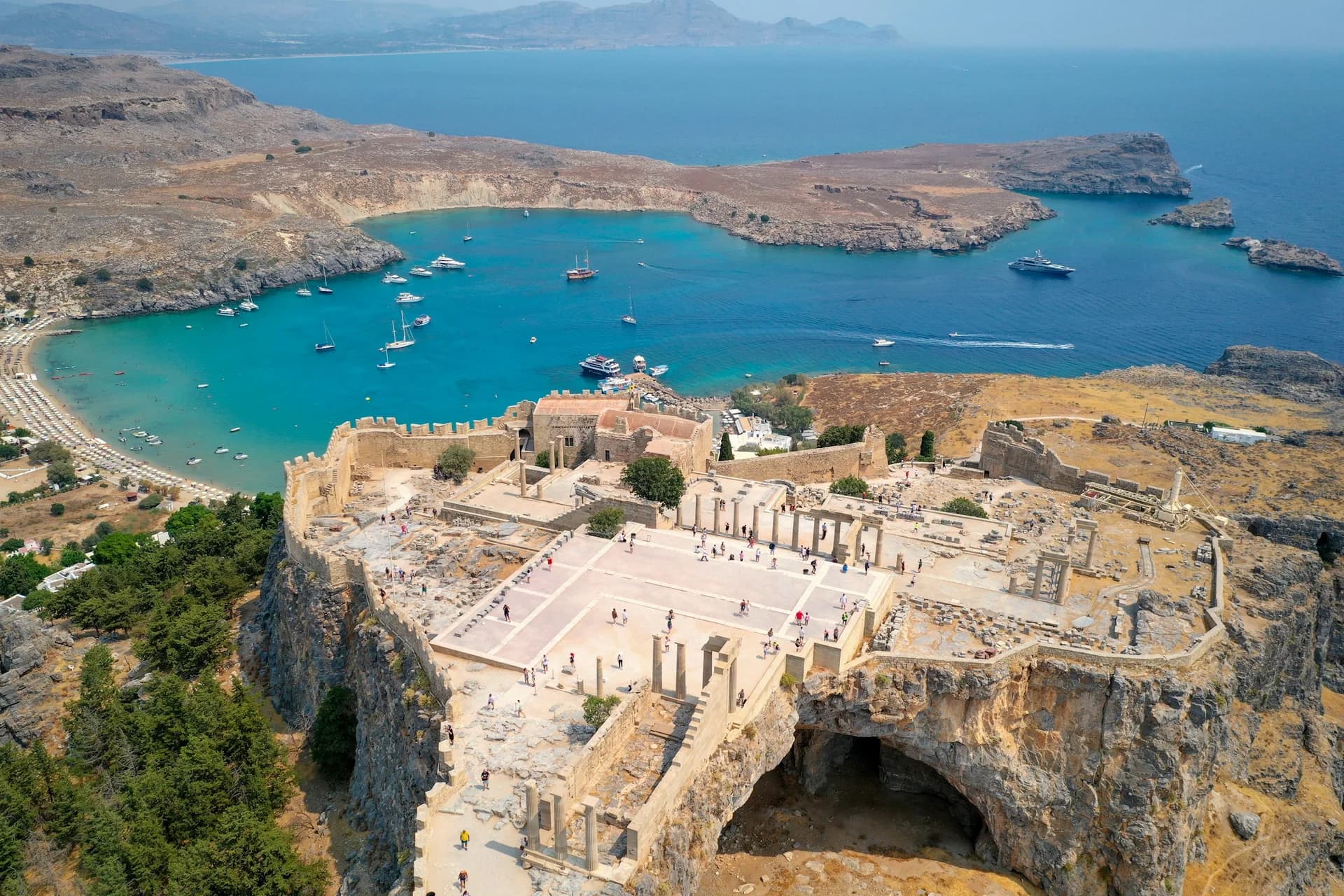
Absolutely — though people make it harder than it needs to be. The Lindos Acropolis (12 EUR entry) sits 116 meters above the village, a steep 20-minute climb with no shade. The mistake is going at noon. In July, that ascent in full sun turns genuinely dangerous; heat exhaustion is common.
Go before 9AM, or after 5PM. The 4th-century BC Temple of Athena Lindia inside a Crusader castle, two turquoise bays below — that view earns the sweat. Just go early.
Donkey rides up cost about 7 EUR, though the donkey situation deserves a second thought: the animals work in extreme heat. If you can walk, walk.
The island's most underrated stop
The Valley of the Butterflies — Petaloudes, 25 km from Rhodes Town. In summer, millions of Jersey tiger moths gather on the Oriental sweetgum trees, and a shaded walk along wooden bridges and streams takes about an hour. Entry is 5 EUR in summer.
One thing to carry in: do not clap or make noise to startle the moths into flight. It's harmful — it disrupts their rest cycle and can kill them. The signs say so everywhere, and they're easy to honor.
Then there's Prasonisi, at the southern tip — a sand isthmus tethered to a small island, the Aegean on one side and the Mediterranean on the other. One of Europe's top windsurfing spots (equipment rental 50–70 EUR/day). It's 90 km from Rhodes Town, which is exactly why most tourists never reach it. That's the reward.
The one custom worth knowing
Coffee is not something to rush. When a Greek invites you for coffee, it's a one-hour commitment, minimum. You sit, you talk, you watch the world go by. Ordering a freddo espresso and downing it in five minutes while standing reads as offensive. Sit down. Order a Greek coffee or a frappe. Let it take 45 minutes — nobody's timing you. This isn't Starbucks.
And always say "Kalimera" (good morning) when you enter a shop. It costs nothing, and it changes how people treat you.
What tourists get most wrong about Rhodes
They stay for a single day. A cruise ship docks, 3,000 people pour into the Old Town, walk Sokratous, photograph the Palace, and leave. No one understands a place in four hours — you can barely find the good streets in four hours.
Stay three days, minimum. One for the Old Town, done properly. One for Lindos and the east-coast beaches — Tsambika Beach is stunning, golden sand, shallow water, sunbed and umbrella for 8–10 EUR. One for the south or west coast. Then, maybe, Rhodes starts to make sense.
The island banks 300 sunny days a year. For another sun-soaked Mediterranean island heavy with history, Malta offers 7,000-year-old temples and a UNESCO fortress capital, inhabited for 3,000 years. A single cruise stop shortchanges all of it.
By evening, Dimitris's mountain tea had gone cold and he hadn't noticed. A cat had claimed the chair beside him; the loukoumades were long gone. The call to prayer from the Ottoman mosque drifted over the rooftops — a reminder that Rhodes has been, in turn, Greek, Roman, Byzantine, Crusader, Ottoman, and Italian, and carries all of those histories at once.
And the 6AM light he kept describing? Go see for yourself. The Street of the Knights empties out, the cats come up to meet the day, and the stone really does turn gold.