Island-Hopping Cape Verde: From Sal's Beaches to the Rim of a Live Volcano
Island-Hopping Cape Verde: From Sal's Beaches to the Rim of a Live Volcano
Your first view of Cape Verde isn't the postcard. The plane banks over the open Atlantic, the cloud thins, and what rises to meet you is rust-brown rock with barely a tree on it. Sal — the name literally means "salt" — looks like a piece of Mars that someone dropped a runway onto. If your stomach sinks a little, that's normal. Hold that feeling. Because by the end of two weeks you'll understand that the flat, sun-bleached island where every flight lands is the least interesting thing this archipelago has up its sleeve.
Start in Santa Maria anyway. It earns the hype. The beach unrolls eight kilometers of white sand into water that sits at bathwater temperature most of the year, and the old wooden pier still works as a fish market — show up around 4pm and you'll watch crews haul in wahoo and tuna while a committee of stray cats riots underneath. A plate of grilled fish with rice and beans at a beachfront spot runs about 900 escudos (roughly $9), and the kitesurfers offshore turn the bay into a sky full of nylon wings — the steady Atlantic trade winds draw the same boardsport crowd you'll find in the Canary Islands further north. Give it two days. Three if you've stepped off a long-haul flight and need the sun to reset your clock.
Then comes the friction. And on these islands, the friction is the whole point.
Cape Verde is ten islands flung across a wide patch of ocean, and island-hopping between them is its own small expedition. There's no single ferry that stitches the whole country together. The boats run reliably only on a couple of routes; everywhere else you're flying on the domestic carrier, and those hops aren't cheap — budget $80 to $150 each way and book early, because seats vanish and schedules slip without much apology. Here's the move that saves the trip: build slack into your plan. Don't pin a sunrise volcano climb to the morning after a connecting flight. Leave a buffer day, treat the delays as part of the rhythm, and the whole country opens up instead of fighting you.
Point that patience at Fogo first.
You fly into São Filipe, a cliff-top town of cobblestone lanes and faded colonial mansions called sobrados, the black-sand beach pounding away below. It's handsome and worth a wander, but it's the warm-up. The real destination is two hours uphill by aluguer — the shared minibuses that are the bloodstream of local transport. They climb until the road tips over a rim and drops you into Chã das Caldeiras, a village living inside a volcanic crater. Look up and the cone of Pico do Fogo fills the windscreen, 2,829 meters of it, the highest point in the country and very much still alive. It last erupted in 2014 and buried part of the village under lava. People moved back and rebuilt on top of the cooled flow, which tells you something about the temperament here.
Stay the night with a family in the caldera — guesthouses are simple and the welcome is not. Dinner is likely cachupa, the slow-cooked corn-and-bean stew that counts as the national dish, washed down with the local Chã wine, grown in vines that root straight into black lava and somehow produce something you'll want a second glass of. Then sleep early, because the climb starts before dawn.
A guide is mandatory and worth every escudo — figure around 4,000 CVE (about $40). You'll go up loose volcanic scree in the cool dark, the lights of the village shrinking below you, and reach the rim as the sun cracks over the Atlantic and floods the crater gold. The descent is the reward nobody warns you about: you half-run, half-surf back down the soft cinder slope in a fraction of the time it took to climb. Your shoes will be full of black grit for the rest of the trip. You won't care.
From here the country keeps getting better, which by now should not surprise you.
Hop to São Vicente and its harbor town of Mindelo, and the whole mood shifts from raw rock to music. This is the home of morna, the aching, blue-toned song that Cape Verde sent out into the world, and the town that raised Cesária Évora, the barefoot diva who carried it. You don't need to chase a schedule — just settle into a bar in the old center after dark and wait. A guitar appears, then a cavaquinho, then a voice, and the room goes quiet on its own. Order a grogue, the fierce sugarcane spirit, and let the evening run long. Mindelo rewards people who don't rush it.
Then catch the ferry. This is the easy water crossing the rest of the country lacks — CV Interilhas runs the hour-long boat from Mindelo to Porto Novo on Santo Antão for around 800 escudos (about $8) each way. Take it, and brace for the best surprise of the trip.
Because Santo Antão is green.
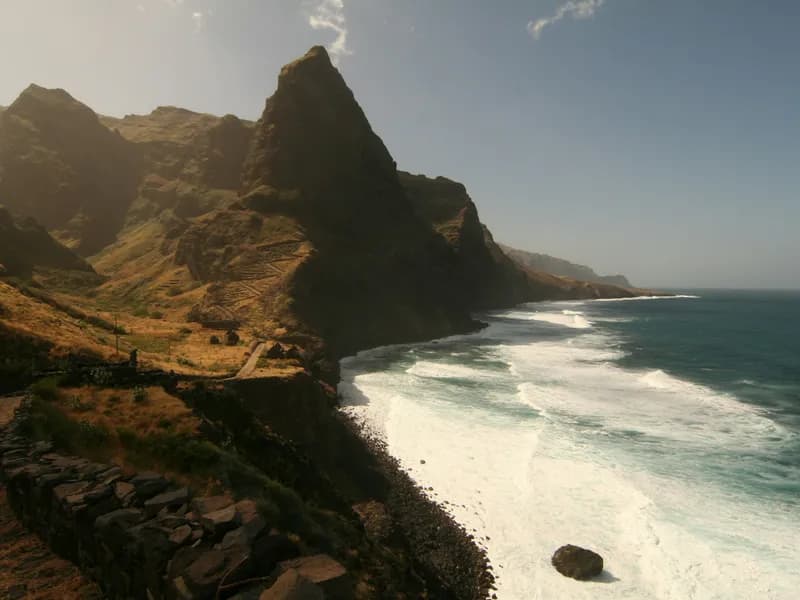
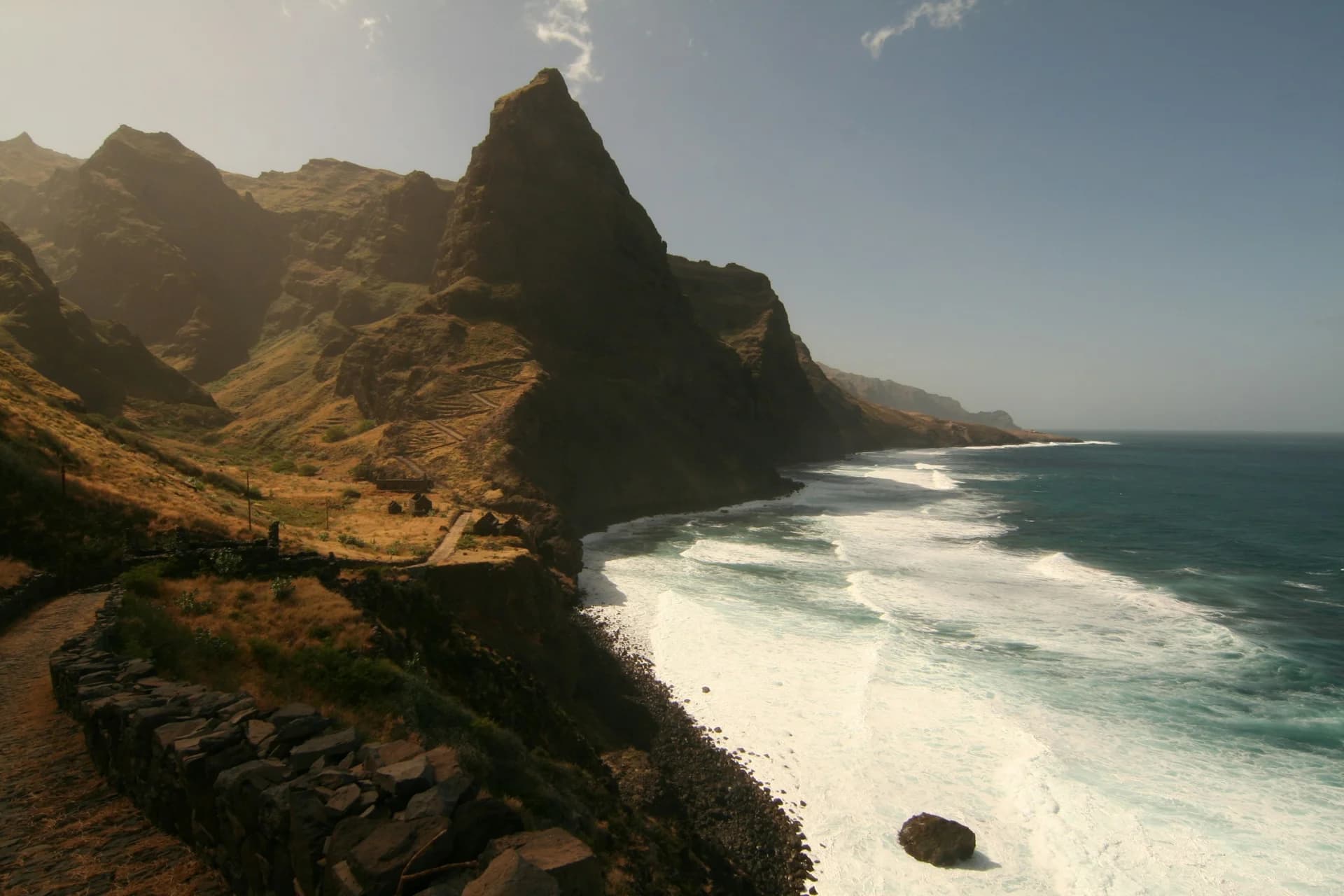
After a week of lava and salt and sun-baked stone, the island climbs into mist and the world turns lush. An aluguer grinds up to the Cova crater, an old volcanic bowl now quilted with farm plots, and from the rim you walk down into the Paúl Valley along a stone path that's been there for generations. Sugarcane and banana terraces drop away beneath you, the ocean glittering at the bottom, the ridges so sharp they look drawn by hand. It's a three-to-four-hour descent and one of the great walks in the Atlantic, the kind of green, crater-rim hiking that draws walkers all the way to Portugal's Azores — no chains, no crowds, no gift shop at the end. Just a small distillery turning that cane into grogue, and a road back to the coast.
Stand at the bottom of that valley and think back to the plane window over Sal — the brown rock, the doubt, the sinking feeling. That contrast is the gift. Cape Verde makes you earn its best islands with a little patience and a few rearranged plans, and it pays you back in volcanoes you can climb by sunrise, music you stumble into by accident, and a green valley that feels like a reward you were never promised.
A few things to carry with you. Bring cash, because cards get spotty the moment you leave Sal and Boa Vista. Learn three words of Cape Verdean Kriolu and watch faces open up. And whatever you do, don't fly home from the same flat island you landed on without seeing what's out there — the country you doubted from the air is waiting on the other islands, and it's far better than the brochure ever let on.