
The Two Faces of Koh Phangan: One Island, Two Very Different Nights
The Two Faces of Koh Phangan: One Island, Two Very Different Nights
Come round the headland into Haad Rin after dark and the sound reaches you before the light does. A wall of bass from a dozen competing systems, none of them playing the same song, rolls up the beach at Haad Rin Nok — the strip locals call Sunrise Beach. Bodies streaked in UV paint. A limbo bar wrapped in flame. Buckets of Sang Som and Red Bull passed hand to hand for 250 to 400 baht a go — the kind of night we break down hazard by hazard in our Koh Phangan survival guide. On the night of the full moon, thirty thousand people pour onto a beach that holds fifteen thousand residents on an ordinary Tuesday.
This is the Koh Phangan the world knows. It is loud, it is chaotic, and it is only half the story.
The night the island sells
The Full Moon Party has been running here since the late 1980s, and it still sets the rhythm of the whole island. Wristbands cost 200 baht (about $5.60) at the beach entrances. The music starts around nine and does not stop until the sky over the Gulf turns grey. Somewhere near dawn, the crowd thins, the paint smears, and the sea catches the first light — which is, if you time it right, genuinely beautiful.
But here's what nobody tells you on the flyers. The road down into Haad Rin is so steep and so slick with spilled drinks and sand that islanders call it Death Hill. Take a songthaew down (150 to 250 baht), not a scooter — travel insurance rarely covers a rented bike, and the clinic here is basic. Wear shoes, real ones, because the sand hides broken glass by 2AM. Agree a meeting point with your group before you go in, because phone signal collapses the moment the crowd swells.
Do all that and the party is a rite of passage. Ignore it and it's a cautionary tale.
Cross the island and the volume drops to zero
Now drive twenty minutes west, to Sri Thanu, and the island performs a quiet magic trick. The bass is gone. In its place, on Zen Beach, a loose circle of travellers taps out a rhythm on hand drums while the sun sinks behind tiny Koh Ma. Nobody is selling you anything. Somebody hands you a coconut. The sky does the work.
This is the other Koh Phangan — the barefoot, unhurried one that has quietly become Southeast Asia's capital of yoga and wellness — the same slow, shala-and-smoothie pull that first drew the crowds to Bali. Around Sri Thanu and Haad Chao Phao you'll find dozens of shalas, ecstatic-dance nights, vegan kitchens, and healing centres where people come for a weekend and leave three weeks later. A drop-in class at Orion Healing Centre or Agama Yoga runs 300 to 500 baht. The mangroves glow at dusk. And the loudest sound is the drums.
The two halves barely acknowledge each other, and that's the point. One island, two entirely separate holidays, sharing the same ferry pier.
The middle ground most people miss
Here's the move: don't pick a side. Base yourself on the quiet west coast and dip into the noise on your own terms.
Start a morning in the interior. The trail to Phaeng Waterfall begins off the central cross-island road — a short jungle walk, free, with the strongest flow between November and January. Push on and up (steep, roped in places, 30 to 40 minutes of boulder-scrambling) to Domsila Viewpoint, where the whole forested spine of the island unrolls beneath you and Koh Samui floats on the horizon. Carry water. Go early, before the heat turns the climb into a slog.
Spend another day on the wild north coast. Chaloklum is a working fishing village where squid-drying racks line the lanes and longtails still land the morning catch. From its pier, boats run to Bottle Beach (Haad Khuad) for 150 to 200 baht each way — a road-free crescent of white sand you can only reach by boat or a sweaty jungle trek. Confirm the last return leaves around 4PM. Bring cash; there's not an ATM in sight. Come back to Chaloklum at dusk and eat whole grilled snapper on the water for 300 to 400 baht while the squid fleet heads out under its bright lamps.
The east coast keeps the island's secrets
The rough east coast hides the two things that best capture the split personality of this place.
First, Than Sadet Waterfall — a royal cascade so treasured that four Thai kings carved their initials into the boulders here between 1888 and 2004. Entry is free. The pools are cool and deep after rain. The access road is a brutal 4km, so take a songthaew or a 4x4 rather than risk it on two wheels.
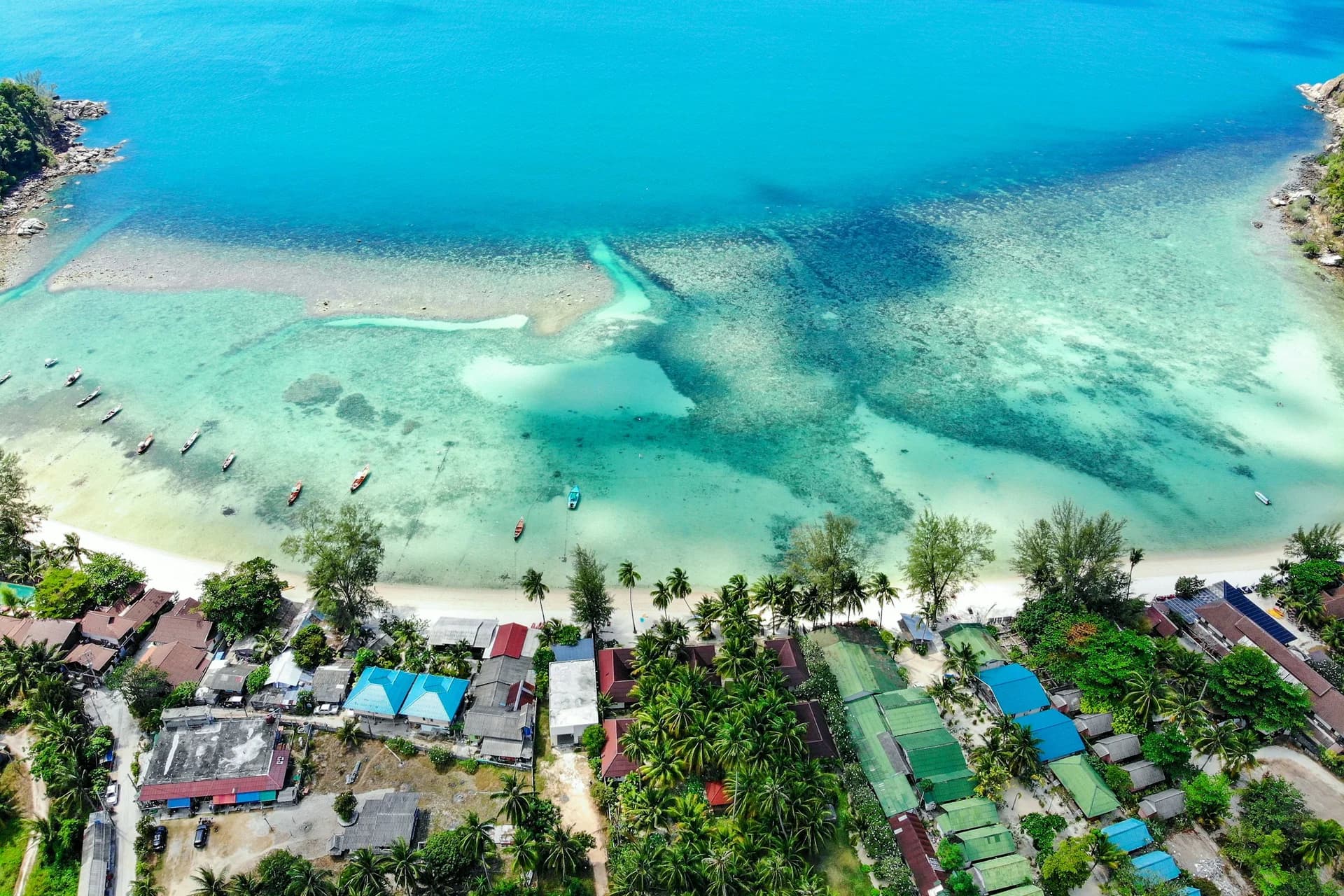
Then the twin bays of Thong Nai Pan — soft, calm, and far emptier than anywhere on the west. This is where you understand what the island was before the parties. Behind the sand at Thong Nai Pan Noi, simple warungs serve massaman curry and fresh coconut for 120 to 180 baht. You could lose an afternoon here and count it a win.
The temple that watches over both
Above Thong Sala harbour sits Wat Phu Khao Noi, the oldest temple on the island, a white chedi on a low hill. Come at sunset, when the monks chant evening prayers and the light goes gold over the water. Cover your shoulders and knees. Entry is free, though a small donation is the decent thing.
Stand up there and you can see it all at once — the ferries at Thong Sala, the jungle running down to the sea, and somewhere south, the beach that will roar again tonight. A large local Thai-Muslim community lives across this island, and the party is just one bright, brief corner of it. Keep the hedonism on the party beach; drugs are illegal and undercover stings run hard around full-moon nights.
So which Koh Phangan is yours?
Both, if you plan it right. Chase the full moon for one unforgettable night, then retreat west and let the drums and the mangroves put you back together — the full barefoot playbook lives in our Sri Thanu wellness guide. The island has been running this two-speed rhythm for decades. Match your trip to it and you'll leave with the rarest thing a famous party island can offer — the feeling that you saw the real one.
The smart move is to book your full-moon accommodation weeks ahead (rates double or triple, with 3-to-5-night minimums), and let the quiet coast be your home base. Then you get the best of both faces, and the ferry back to Samui feels like leaving two holidays at once.


