Namibia for Stargazers: The Darkest Skies You'll Ever See
Namibia for Stargazers: The Darkest Skies You'll Ever See
Chase dark skies long enough and a hierarchy forms. Atacama. The Scottish Highlands. Rural Montana. Outback Australia. Then there is the night sky over NamibRand Nature Reserve in Namibia, which belongs in a category by itself.
The Milky Way here doesn't simply appear. It detonates — a river of light so dense and three-dimensional that your brain refuses to read it as a flat ceiling. Dust lanes. Dark nebulae. The galactic center bulge, all of it visible to the naked eye. No telescope. No binoculars. Just your eyes, and a silence so complete you can hear your own heartbeat.
Africa's first International Dark Sky Reserve has virtually zero light pollution. The nearest town is hours away. And between May and September, when Namibian winter nights run long, cloudless, and cold, this is arguably the best place on Earth to look up.
Why Namibia?
Several factors converge to make Namibia a stargazing paradise:
Minimal light pollution. Namibia has 2.6 million people spread across 824,000 square kilometers — roughly twice the size of California with less than 1% of its population. Most of the country is desert or semi-desert with no urban centers outside Windhoek.
Dry air. The Namib Desert receives less than 50mm of rain annually. Between May and September (winter), cloud cover is almost nonexistent. The air is dry enough that atmospheric moisture — the enemy of sharp star views — barely registers.
Altitude. NamibRand sits at roughly 1,000 meters above sea level. Not extreme altitude, but enough to reduce atmospheric interference compared to sea-level observing.
Southern hemisphere advantage. From Namibia, you can see the Magellanic Clouds (dwarf galaxies invisible from the Northern Hemisphere), the Southern Cross, Alpha Centauri, and the center of the Milky Way passing nearly overhead.
The NamibRand Dark Sky Reserve
Designated in 2012, NamibRand Nature Reserve covers 2,150 square kilometers of private land between the Naukluft Mountains and the Namib Sand Sea. It enforces strict lighting regulations — all outdoor lights at lodges use shielded, downward-facing fixtures, and guests are asked to keep cabin lights off when not needed.
The result is a sky with a Bortle Scale rating of 1 — as dark as it gets. For context, most suburban areas are Bortle 5-7. A good rural location might hit Bortle 3-4. NamibRand is functionally as dark as any place humans have access to.
What you'll see with naked eyes:
- The zodiacal light (a cone of light along the ecliptic)
- Gegenschein (counter-glow opposite the sun)
- Individual Milky Way star clouds and dust lanes
- The Magellanic Clouds as distinct, three-dimensional objects
- Satellites crossing every few minutes
- The faint glow of nearby galaxies
What you'll see with binoculars:
- Omega Centauri (the brightest globular cluster, like spilled sugar)
- The Carina Nebula
- Star clusters scattered along the Milky Way
- Jupiter's Galilean moons
Where to Stay in NamibRand
Several lodges within the reserve offer guided astronomy sessions:
Sossusvlei Desert Lodge — Has its own observatory dome with a 12-inch Meade telescope and a resident astronomer. Nightly stargazing sessions included. From ~$600/night per person. This is the serious astronomy option.
Wolwedans Dunes Lodge — Luxury tented camp with extraordinary views. No dedicated observatory but guided sky tours with binoculars. The lack of walls means you fall asleep watching the sky. From ~$450/night.
NamibRand Family Hideout — More affordable self-catering option. Bring your own telescope or binoculars. From ~$200/night.
Beyond NamibRand: Other Stargazing Spots
Spitzkoppe — The granite inselberg rising from the desert floor, 700 meters high. Community campsite at 200 NAD/person. No facilities whatsoever — no electricity, no lights. Bring everything, including a headlamp. The lack of any infrastructure means the sky is extraordinary, and the rock formations create dramatic foregrounds for astrophotography.
Sossusvlei area — The lodges outside Sesriem gate offer dark skies, though not quite as pristine as NamibRand. Advantage: you can combine stargazing with the iconic red dune sunrise.
Fish River Canyon — The campsite at Hobas has very dark skies and the canyon rim provides a dramatic horizon. Entry is 80 NAD.
Etosha National Park — The floodlit waterholes at camps like Okaukuejo create light nearby, but walk 100 meters from camp (carefully — wildlife!) and the sky opens up. The salt pan creates a ghostly reflected glow under starlight that's unique.
Planning Your Stargazing Trip
Best months: May through September. Longer nights (12-13 hours of darkness), clear skies, no summer thunderstorms. The galactic center is ideally positioned in June-August. New moon periods are critical — check the lunar calendar and plan your NamibRand nights around new moon.
What to bring:
- Binoculars (10x50 are ideal for astronomy — sharp, wide field)
- Warm layers — desert nights drop to 0-5°C in winter, even when daytime is 20-25°C
- A headlamp with a red filter (white light destroys night vision for 20 minutes)
- A reclining camp chair or yoga mat for comfortable upward viewing
- Star chart app (SkySafari or Stellarium, loaded offline)
- Camera with manual mode and a sturdy tripod for astrophotography
What NOT to bring: Expectations of sleeping. You won't want to.
Combining Stars with Namibia's Other Highlights
A stargazing trip doesn't have to be stargazing-only. Namibia's daytime attractions are world-class:
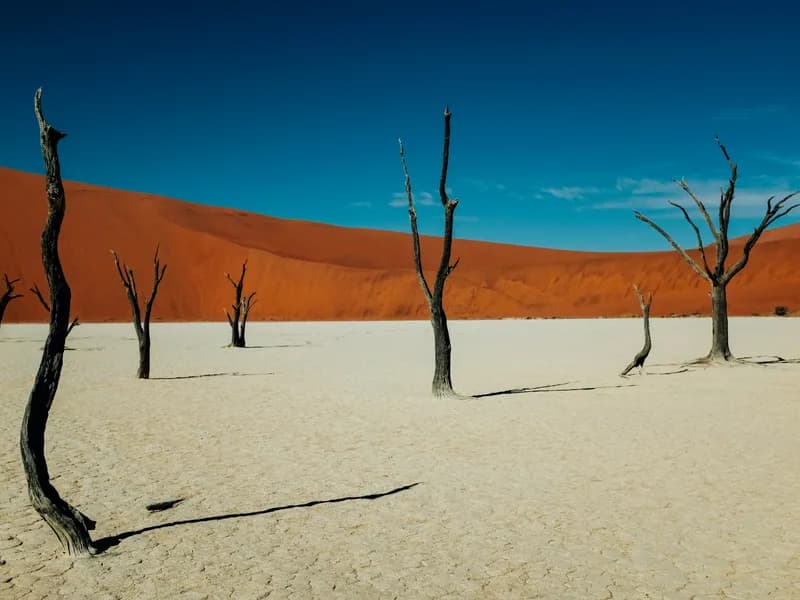
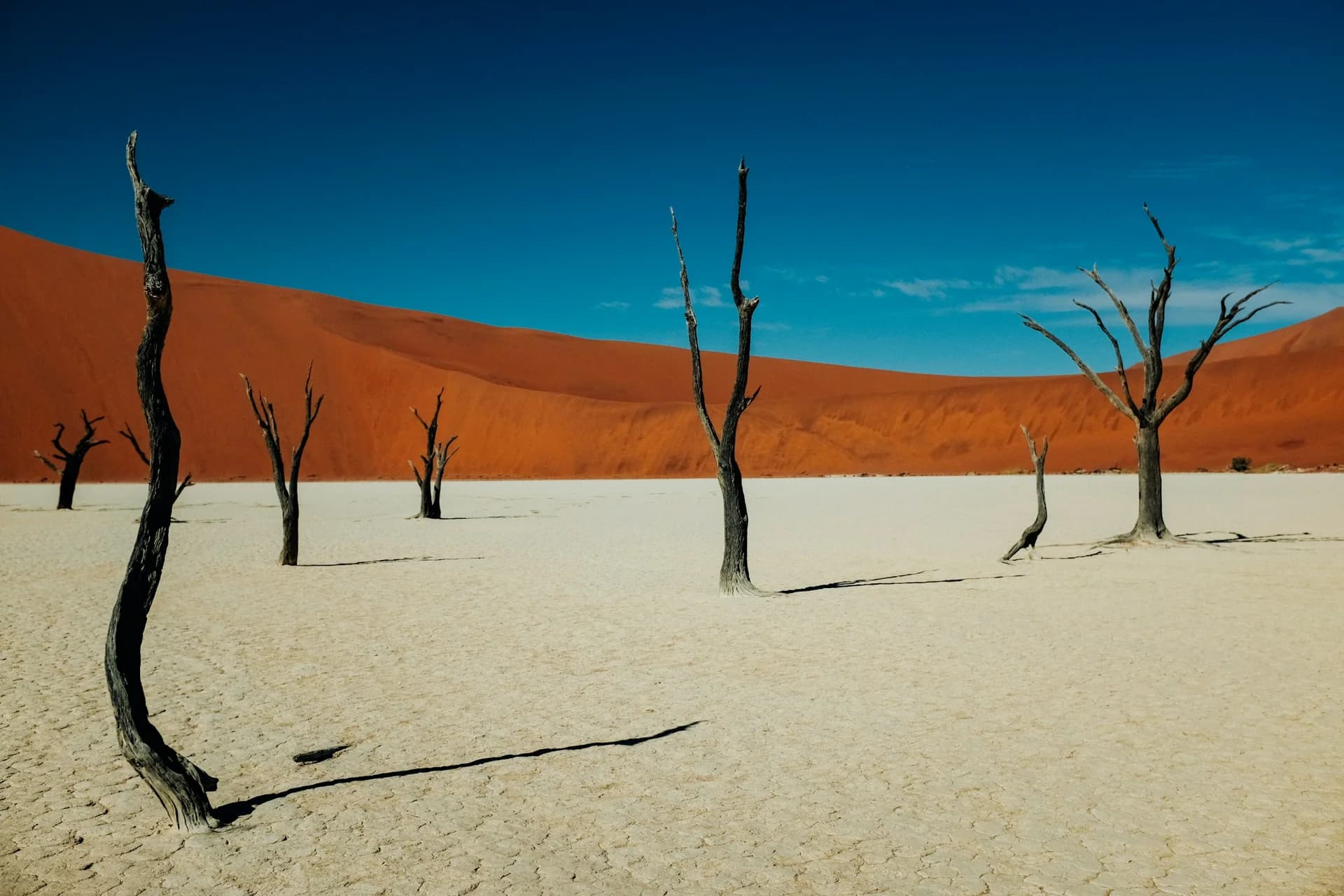
Sossusvlei & Dead Vlei — The world's tallest red sand dunes, 20 minutes from NamibRand. Arrive at sunrise to climb Dune 45 or Big Daddy. Entry: 80 NAD plus 10 NAD per vehicle. The contrast between a dawn dune climb and a midnight sky session is surreal — you get both extremes of light.
Etosha National Park — Self-drive safari with elephants, lions, and rhinos. The floodlit waterholes at night reveal nocturnal wildlife. Entry: 150 NAD/day.
Skeleton Coast — Shipwrecks and 200,000+ fur seals at Cape Cross. The fog that rolls in from the Atlantic creates eerie morning conditions before clearing for afternoon sun.
Himba villages — Cultural visits near Opuwo. Always go with a local guide and bring practical gifts (maize meal, not candy).
Astrophotography Tips for Namibia
A Sony A7III paired with a 14mm f/1.8 lens is a proven NamibRand setup. Settings: ISO 3200, 20-second exposure, manual focus on a bright star using live view zoom. The frames that come back make ordinary astrophotography look like it was shot through a dirty window.
The key advantage here isn't just the darkness — it's the stability. No wind most winter nights. No humidity fogging your lens. No clouds interrupting a two-hour timelapse. You set up, focus, and shoot. The sky does the rest.
For landscape astrophotography, Spitzkoppe's rock arch is the money shot. The arch frames the Milky Way perfectly in June-July. Get there by sunset, compose in daylight, then wait.
The Cost of Dark Skies
Namibia is a mid-range to expensive destination. Here's a realistic stargazing trip budget for 10 days:
| Item | Budget Option | Comfort Option |
|---|---|---|
| Rental 4x4, 10 days | $600-900 | $900-1,200 |
| Fuel | $200-300 | $200-300 |
| Accommodation | $400-600 (camping) | $2,000-4,000 (lodges) |
| Park fees | $50-80 | $50-80 |
| Food | $200-300 (self-catering) | $400-600 |
| Total | $1,450-2,180 | $3,550-6,180 |
The camping route gives you darker skies (no lodge lights) but less comfort. The lodge route gives you guided sessions and warm beds. Both work.
One Last Thing
Show someone a NamibRand sky photo and the first assumption is heavy editing. It isn't. That's simply what the sky looks like once you remove 8,000 years of accumulated human light pollution.
Namibia's skies are a reminder of what every human saw when they looked up, for most of human history. Going there feels less like travel and more like time travel. Back to when the sky was the biggest, most obvious, most humbling thing in the world.
It still is. You just need to go somewhere dark enough to remember.
Namibia's dark skies are just one piece of the puzzle. Our top 10 things to do beyond Sossusvlei covers the daytime adventures, and a local Windhoek resident shares her insider tips. Consider extending your trip to the Okavango Delta in Botswana or starting in Cape Town.