Nara for Temple Lovers: Japan's Most Underrated Sacred City
Nara for Temple Lovers: Japan's Most Underrated Sacred City
Kyoto gets all the attention. And I get it — Kyoto is extraordinary. But here's a number that should make temple lovers reconsider their itinerary: Nara has eight UNESCO World Heritage Sites within a city of 354,000 people.
Eight.
Kyoto has seventeen, but Kyoto also has 1.46 million residents and ten times the tourist volume. Nara's temples aren't smaller or less significant. They're just quieter. And for anyone who wants to experience Japanese sacred architecture without competing for space with tour bus crowds, that's the whole point.
Why Nara Matters to Temple Architecture
Nara was Japan's first permanent capital (710-784 CE). Before Nara, the capital moved every time an emperor died (death was considered to pollute the location). The Nara period introduced the idea that a capital could be permanent — and with permanence came monumental architecture.
The temples built during this era represent the earliest flowering of Japanese Buddhist architecture. They borrowed heavily from Tang Dynasty China and the Korean peninsula — the same Buddhist building tradition that shaped ancient temple capitals like Gyeongju — but adapted the forms to Japanese aesthetics: more wood, more natural integration with landscape, more restraint in ornamentation compared to their Chinese counterparts.
What makes Nara special for temple lovers isn't just age — it's variety. Within a 30-minute walk, you move from the colossal scale of Todai-ji to the intimate forest shrines of Kasuga-taisha to the austere elegance of Toshodai-ji — a restraint that later Japanese sacred sites like the gilded shrine complexes at Nikko would eventually abandon for pure ornamental spectacle. No other city in Japan offers that range in such a compact area.
The Must-See Temples
Todai-ji: The Big Buddha's House
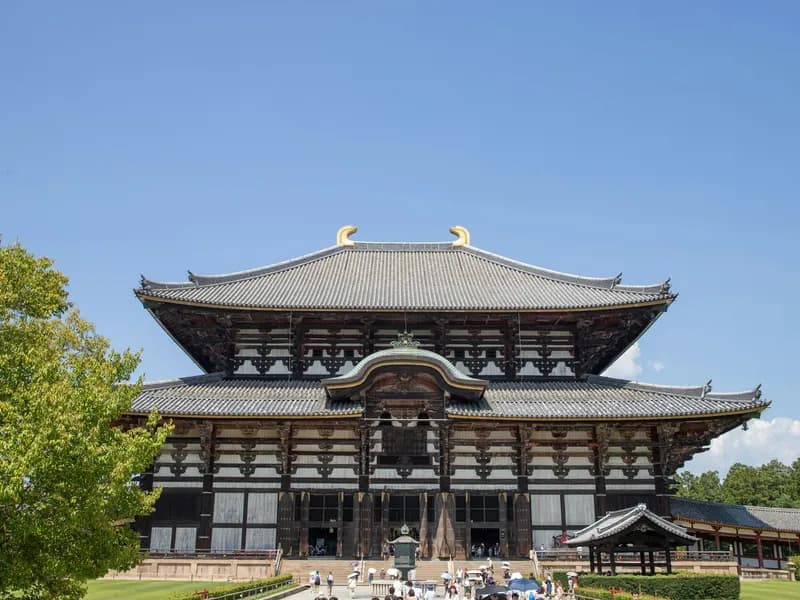
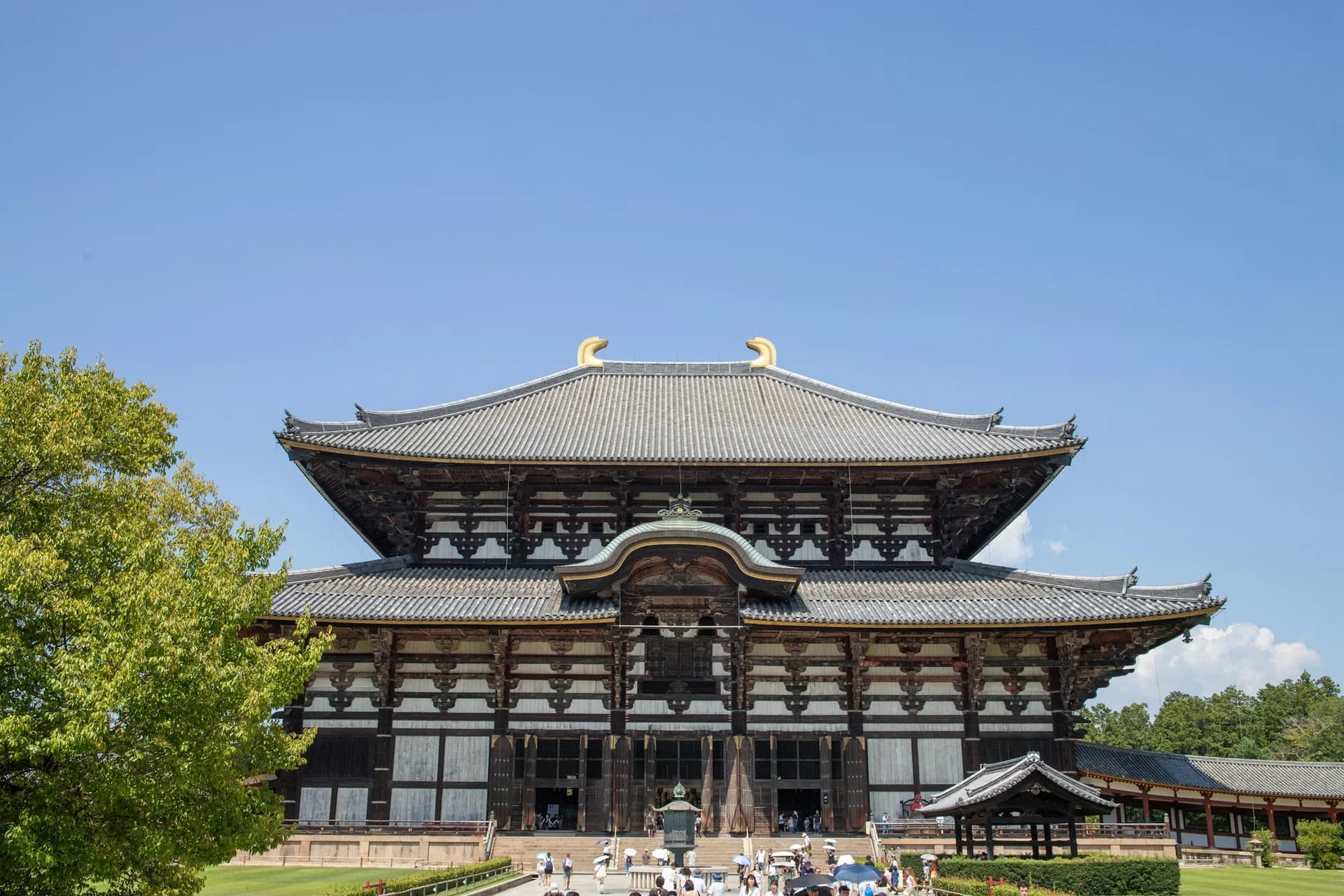
Let's start with the headliner. Todai-ji's Great Buddha Hall (Daibutsuden) is the largest wooden building in the world. Not the tallest — the largest by floor area. And it's only two-thirds the size of the original 8th-century version, which was destroyed and rebuilt twice.
Inside sits the Daibutsu — a 15-meter-tall bronze Buddha weighing 500 tons, larger even than the more famous Great Buddha of Kamakura near Tokyo. The casting took over two years and nearly bankrupted the Japanese government of 752 CE. Standing in front of it, you understand why. The scale isn't just impressive — it's disorienting. Your brain doesn't process that something this large exists indoors.
The pillar near the back right corner has a hole at its base the same size as the Daibutsu's nostril. If you can crawl through it, tradition says you're guaranteed enlightenment in your next life. The queue for the nostril crawl is mostly kids and very flexible adults.
Entry: 600 JPY ($4). Hours: 7:30AM-5:30PM (April-October), 8AM-5PM (November-March).
Pro tip: Go at 7:30AM when the doors open. By 10AM, school trip buses start arriving and the hall fills with uniformed students. The early morning light through the front windows hits the Buddha's face in a way that doesn't happen later in the day.
Kasuga-taisha: 3,000 Lanterns in a Primeval Forest
Kasuga Grand Shrine sits at the base of Mount Kasuga, surrounded by a forest that has been protected from logging since 841 CE. The mountain itself is holy ground — part of the same reverence for sacred peaks that makes climbing Mount Fuji a pilgrimage rather than a hike. The trees are massive — cedars and camphor trees that create a canopy so dense the shrine feels like it exists in permanent twilight.
The shrine's signature feature is its lanterns. Three thousand of them — bronze lanterns lining the pathways and stone lanterns scattered through the grounds. Twice a year (February 2-4 during Setsubun and August 14-15 during Obon), all 3,000 are lit simultaneously. If you can time your visit for either festival, do it. The effect is otherworldly.
The inner shrine requires a 500 JPY ($3.35) special entry fee. The botanical garden adjacent to the shrine (Kasuga-taisha Shin'en) is exceptional in April-May when the wisteria blooms — enormous purple clusters that hang from ancient trellises.
Main shrine entry: free (inner area 500 JPY). Hours: 6:30AM-5:30PM (March-October), 7AM-5PM (November-February).
Horyu-ji: The Oldest Wooden Buildings on Earth
12km southwest of central Nara, Horyu-ji is less visited than Todai-ji but arguably more historically significant. Its Western Precinct contains the oldest surviving wooden structures in the world — the five-story pagoda and the main hall (Kondo) date to around 607 CE.
Thirteen hundred years of standing. Wood. In an earthquake zone. The engineering is remarkable. The pagoda uses a central pillar (shinbashira) that hangs from the top and swings independently during earthquakes, acting as a damper. Tokyo Skytree's earthquake resistance system is based on the same principle.
The Yumedono (Hall of Dreams) in the Eastern Precinct houses a secret Buddha statue that was sealed for centuries. It's only displayed during two brief periods each year (April 11-May 18 and October 22-November 22) — Japan has a long habit of keeping its most important sacred objects out of view, and the hidden-Christian relics of Nagasaki are the other famous case.
Entry: 1,500 JPY ($10.05). This includes the museum, which has some of the finest Buddhist art in Japan. Take JR Yamatoji Line from Nara Station to Horyuji Station (12 minutes, 220 JPY / $1.47), then walk 20 minutes or take the bus.
Toshodai-ji: Zen Before Zen Existed
Toshodai-ji was founded in 759 CE by Jianzhen, a Chinese monk who attempted to cross the sea to Japan six times over twelve years, going blind in the process, before finally succeeding. His story is one of the most remarkable in Buddhist history.
The main hall (Kondo) is considered the finest surviving example of Nara-period architecture. The proportions are mathematically precise. The wooden columns — 14 of them across the front — have a slight entasis (outward curve) that's a hallmark of Greek temple design, suggesting the technique traveled along the Silk Road through Tang-dynasty Xi'an before reaching Japan.
This temple doesn't draw crowds. On a Tuesday morning in October, I was alone in the main hall for 20 minutes. Just me and a 1,266-year-old building.
Entry: 1,000 JPY ($6.70). Hours: 8:30AM-5PM.
Yakushi-ji: The Frozen Music Temple
Yakushi-ji's East Pagoda has been called "frozen music" by art historian Ernest Fenollosa — the alternating layers of large and small roofs create a visual rhythm that resembles a musical composition. The pagoda dates to 730 CE and is the only original structure remaining (the rest was rebuilt after fires).
The West Pagoda was reconstructed in 1981 using traditional techniques and is noticeably brighter — vermillion paint, gilded fixtures. Standing between the two pagodas, one ancient and weathered, one modern and bright, is a striking lesson in how Japanese temple architecture actually looked when new: much closer to the vividly painted temple halls of Tainan than to the muted browns most visitors picture.
Entry: 800 JPY ($5.36) (increases to 1,100 JPY during special exhibitions). 15-minute walk from Toshodai-ji — do them together.
Beyond Temples: The Deer and the Gardens
You can't talk about Nara without the deer. Over 1,200 sika deer roam freely through Nara Park and the surrounding areas — the same sacred, free-roaming deer you'll meet on the shrine island of Miyajima down near Hiroshima. They're considered divine messengers of the Kasuga Shrine gods. They bow for deer crackers (shika senbei, 200 JPY / $1.34 from park vendors) — literally bow. It's a learned behavior passed down through generations.
Fair warning: the deer are not gentle. They will surround you if you hold up a cracker. They will headbutt your pockets. They will eat maps, paper bags, and anything else that looks remotely edible. Hold the crackers behind your back and distribute them quickly.
Isuien Garden (650 JPY / $4.35) is a masterpiece of borrowed-scenery design (shakkei), a technique Japanese gardeners adapted from the Chinese landscape tradition you can still walk through around Hangzhou's West Lake. The garden uses Todai-ji's Nandaimon gate and the hills behind it as its backdrop — literally incorporating the temple into the garden's visual composition. The east garden has a strolling path around a pond; the west garden is more intimate. Combined, it's maybe the most underrated garden in the Kansai region.
How to Structure Your Temple Visit
Day 1: Todai-ji at 7:30AM opening → Nigatsu-do (hillside hall with panoramic views, free) → Kasuga-taisha → Naramachi (old merchant district, afternoon)
Day 2: Horyu-ji (morning, take the 8:15AM train) → Return to Nara → Kofuku-ji five-story pagoda at sunset
Day 3: Yakushi-ji and Toshodai-ji (morning, combine them) → Isuien Garden (afternoon) → Free evening in Naramachi
This sequence moves from the most crowded sites to the least crowded, and from the most famous to the most architecturally refined. By Day 3, you'll have the context to appreciate Toshodai-ji's subtlety.
Practical Details
Getting to Nara: From Kyoto, take the Kintetsu Nara Line (35 minutes, 640 JPY / $4.29 limited express). From Osaka, take the Kintetsu Nara Line from Namba (40 minutes, 680 JPY / $4.55). JR Rail Pass holders can use the JR Nara Line from Kyoto (45 minutes, covered by pass).
Accommodation: Most visitors day-trip from Kyoto or Osaka. Don't. Stay at least two nights. Nara Hotel (opened 1909, from 15,000 JPY / $100.50/night) is a historic property with Todai-ji views. Budget options on Sanjo-dori start at 4,000 JPY ($26.80).
Nara Park Pass: Not necessary. Most temple entries are 500-1,500 JPY individually. There's no meaningful discount pass for Nara's temples.
The Bottom Line
Nara doesn't compete with Kyoto on volume. But it doesn't need to — it's the same kind of choice we walked through in our Fes vs. Marrakech breakdown, where the quieter city kept turning out to be the better week. The temples here are older, the deer add a surreal charm, the crowds are manageable, and the compact geography means you're never more than a 20-minute walk from something extraordinary.
If you love temple architecture — not just as a tourist checkbox but as an art form — Nara is the deeper cut. Kyoto is the greatest hits album. Nara is the B-side that the real fans prefer.