
Rotterdam Architecture: A Design Lover's Guide to Europe's Boldest Skyline
Rotterdam doesn't trade on the past. On 14 May 1940 the bombing flattened its medieval heart in under an hour, and rather than rebuild a copy of what was lost, the city looked forward. What grew back is the most daring skyline in the Netherlands. A library that wears its ventilation pipes on the outside. An art museum shaped like a mirrored bowl that throws the clouds back at you. And 38 bright-yellow houses tilted at 45 degrees, perched over a main road like a small forest of tree-homes.
Amsterdam has the canals and the crowds. Rotterdam has the cranes, the concrete, and the nerve. Here's the best part: you can walk the entire architectural greatest-hits list in a single day, and most of it costs nothing to admire from the street.
Why Rotterdam Wins for Design
This is a working port city — home to Europe's largest seaport — and that industrial DNA runs through everything. Buildings here are allowed to be strange. City planners handed the skyline to architects like Rem Koolhaas (a Rotterdam native), Piet Blom, and MVRDV and told them to experiment. They did.
The result reads like a timeline of postwar and 21st-century design, all packed into a compact, flat, bikeable center. You don't need a car. You barely need the metro. Give yourself two days and comfortable shoes.
The smart move: don't try to "do" Rotterdam like a checklist. Pick a district, walk it slowly, and look up. The details reward it.
Top 10 Architecture Experiences
- Cube Houses (Kubuswoningen) — Piet Blom's 1980s cluster of 38 tilted yellow homes near Blaak station. Free to see from outside. The 'Show Cube' museum-apartment costs about €3 (~$3.25) and takes 20 minutes to see how anyone actually lives at a 45-degree angle.
- Depot Boijmans Van Beuningen — The world's first fully accessible art-storage depot, a mirrored bowl you wander through to see an entire museum collection at once. Entry
€20 ($22), includes the rooftop forest and restaurant. Book a timed slot. - Markthal — A giant horseshoe-shaped market hall with apartments wrapped around it and an 11,000 sq m ceiling mural called the 'Horn of Plenty'. Free to enter.
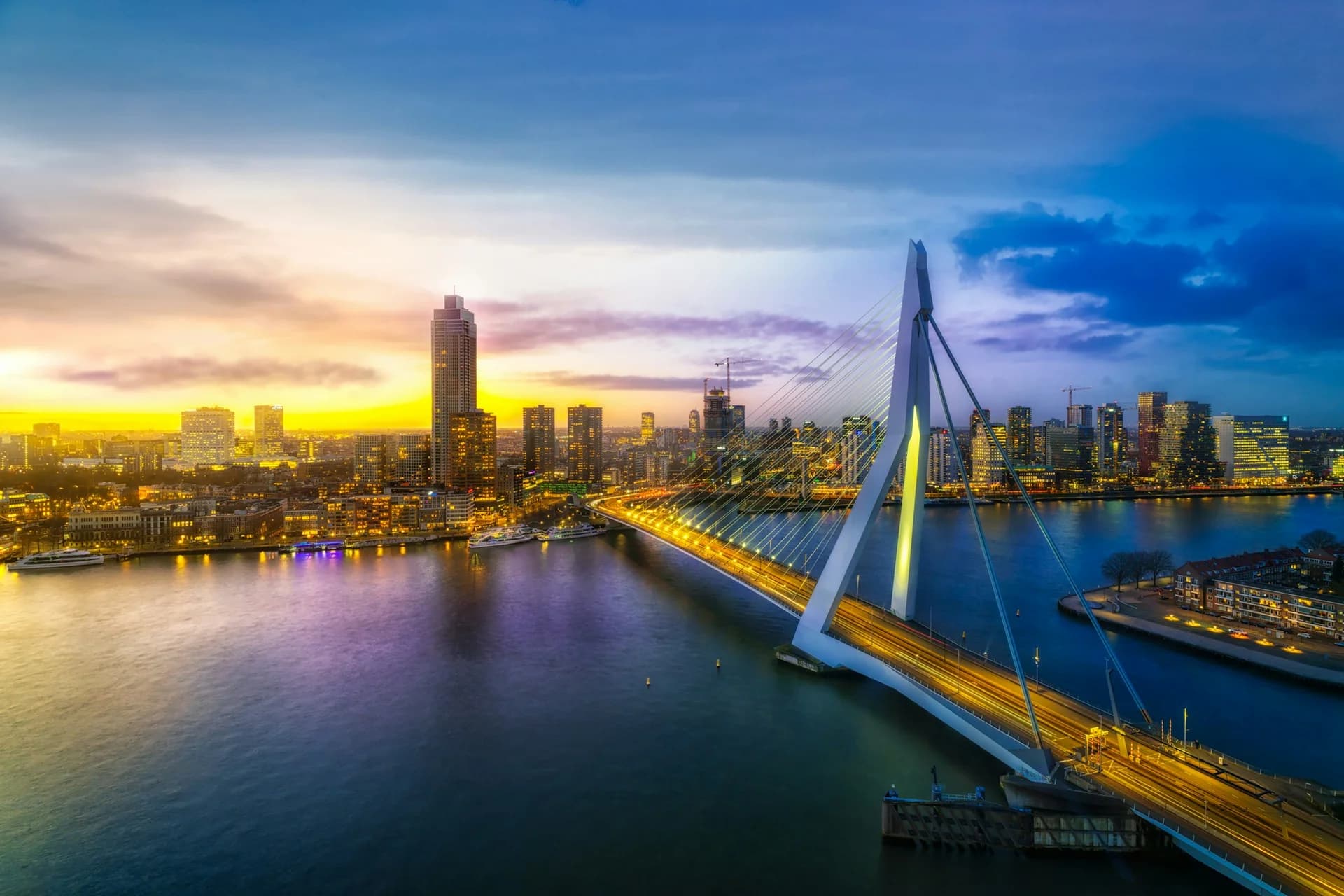
- Erasmusbrug (Erasmus Bridge) — The 802m cable-stayed 'Swan' over the Maas. Free to walk or cycle. Shoot it from the Kop van Zuid side at dusk when the lights come up.
- Rotterdam Centraal — The 2014 station's soaring stainless-steel canopy points like a wedge toward the center. Your first sight off the train, and a statement of intent.
- Centrale Bibliotheek — The pipe-clad central library near Blaak, all yellow tubing and glass, an obvious nod to Paris's Pompidou.
- Het Potlood (The Pencil) — The sharp-topped tower right beside the Cube Houses. You'll photograph it whether you mean to or not.
- De Rotterdam — Koolhaas/OMA's 'vertical city' of stacked, shifted towers on the Wilhelminapier. Best seen whole from across the river.
- Kunsthal Rotterdam — Another Koolhaas building, a low-slung exhibition hall in the Museumpark with rotating design and photography shows,
€16 ($17). - Euromast — The 185m observation tower with a rotating 'Euroscoop' glass pod. Entry
€16.50 ($18). Go on a clear day for views out to the coast.
The Standout Spots (If You Only See Three)
Short on time? Prioritize these.
Depot Boijmans Van Beuningen. Nothing else looks like it. The mirrored exterior alone is worth the walk into the Museumpark, and inside you're wandering storage racks holding thousands of works — a museum turned inside out. Two hours, easy.
The Cube Houses. Endlessly photographed, still worth it in person. Pay the €3 for the Show Cube so you understand how the geometry actually functions as a home.
Erasmusbrug at dusk. Free, unforgettable. Cross on foot toward the south bank, then turn back for the skyline. Bring a jacket — the wind funnels off the river.
Best Time for an Architecture Trip
May through September gives you warm, long days and the best light for photography — golden hour drags on late into a Dutch summer evening. Late summer also brings festivals.
The honest tip: this is a maritime climate, so pack a light rain jacket whatever the month. Weather turns fast. The upside for architecture buffs — nearly every landmark has an indoor fallback (Markthal, Depot, Kunsthal, the library), so a gray, wet day barely dents the plan.
What It Costs
Most of the icons are free to see from the outside — the Cube Houses, Markthal, Erasmusbrug, Centraal, De Rotterdam, the library. Your spending is on the paid interiors:
- Show Cube:
€3 ($3.25) - Kunsthal:
€16 ($17) - Euromast:
€16.50 ($18) - Depot Boijmans Van Beuningen:
€20 ($22)
If you're hitting two or more paid sights plus riding the RET metro and trams, the Rotterdam Welcome Card bundles unlimited transit (1-3 days) with up to 25% off many attractions. Buy it at the tourist office or online. It usually pays for itself, and we compare it against pay-as-you-go fares in our Rotterdam travel Q&A.
For getting around, skip the paper tickets. Just tap in and out with any contactless bank card or phone via OVpay on every metro, tram, and bus. Tap out every single time or you'll be charged the maximum fare — the same contactless setup we walk through step by step in our complete Rotterdam travel guide.
A Two-Day Architecture Itinerary
Day 1 — The Centrum. Start at Blaak station. Cube Houses and the Pencil first, then the pipe-clad library, then into the Markthal for lunch under the mural (grab fresh haring or Surinamese roti). Walk down through Blaak to the river and cross the Erasmusbrug. Time it for late afternoon so you catch the bridge lit at dusk. End with rooftop small plates at Op het Dak, the rooftop-farm cafe atop the Schieblock (~€6-12 / ~$6.50-13).
Day 2 — Museumpark and the South Bank. Open with a booked slot at the Depot Boijmans Van Beuningen, then the Kunsthal next door. Lunch on a broodje at a park-edge cafe (~€8-14 / ~$8.50-15). Afternoon: ride metro line D or E across to Wilhelminaplein and walk the Wilhelminapier beneath De Rotterdam. Finish at the Euromast on a clear afternoon for the whole city laid out below you, port cranes to the horizon.
Two days. One rebuilt city that decided the future was more interesting than the past. Rotterdam proves it on every corner — you just have to look up.


