
Uyuni After Dark: A Night on the World's Largest Mirror
Uyuni After Dark: A Night on the World's Largest Mirror
The driver kills the headlights, and the horizon vanishes.
It happens all at once — the boundary between earth and sky dissolves into a single dark field pricked with stars. Beneath your boots, the thin layer of rainy-season water on the salt flat reflects the sky so perfectly that up and down stop meaning anything. Stars above, stars below. You're standing on the edge of the universe in every direction.
Most travelers come to Salar de Uyuni for the daytime photos — the mirror effect, the perspective shots with toy dinosaurs, the white-on-blue postcard images. Almost nobody plans for the night. Nobody warns you about the night.
The Drive Out
Tours leave Uyuni town around 3PM — four passengers plus a driver in a Toyota Land Cruiser that has clearly lived several hard lives. The first stop is the train cemetery, 3 kilometers from town: rusting steam locomotives from the 1940s sitting in the desert like forgotten props from a movie nobody finished filming. Twenty minutes there is plenty — the salar is where the day is really headed.
Then the road turns onto the salt.
The transition is abrupt. One moment it's a dirt track with scrub brush and distant mountains. The next, everything is white. Blinding, flat, infinite white. The salt crust stretches 10,582 square kilometers — roughly the size of Jamaica — and from ground level there's no visible end to it in any direction.
The drivers move fast. There are no roads, no markers, no lanes. They navigate by the position of Incahuasi Island on the horizon and by what one driver, Carlos, calls "feeling the salt" — reading the vehicle's vibration to know whether the crust is thick enough to carry the weight or whether it's drifting toward the softer sections where cars have broken through.
Ask how many times he's made this drive and he holds up both hands, all fingers extended: "multiplicado por cien." A thousand times. At least.
The Island in the White
Incahuasi Island rises from the salt flat like a hallucination — a rocky outcrop covered in giant cacti, some 12 meters tall and over 1,200 years old, surrounded by an ocean of white. Entry runs about $4 USD, collected by a park ranger in a small hut who seems genuinely surprised to see anyone at 4:30PM.
The hike to the summit takes 30 minutes, and the altitude (3,656m) turns every step into a cardiovascular event. But from the top, the view justifies every gasping breath — 360 degrees of salt flat, the distant Andes on the western horizon, and the late afternoon sun painting everything in amber.
From up there you can read the hexagonal salt patterns covering the flat — natural polygon shapes formed by evaporation and thermal expansion, each one about a meter across, tessellating to the horizon like tiles laid by a perfectionist with infinite patience.
Sunset on the Mirror
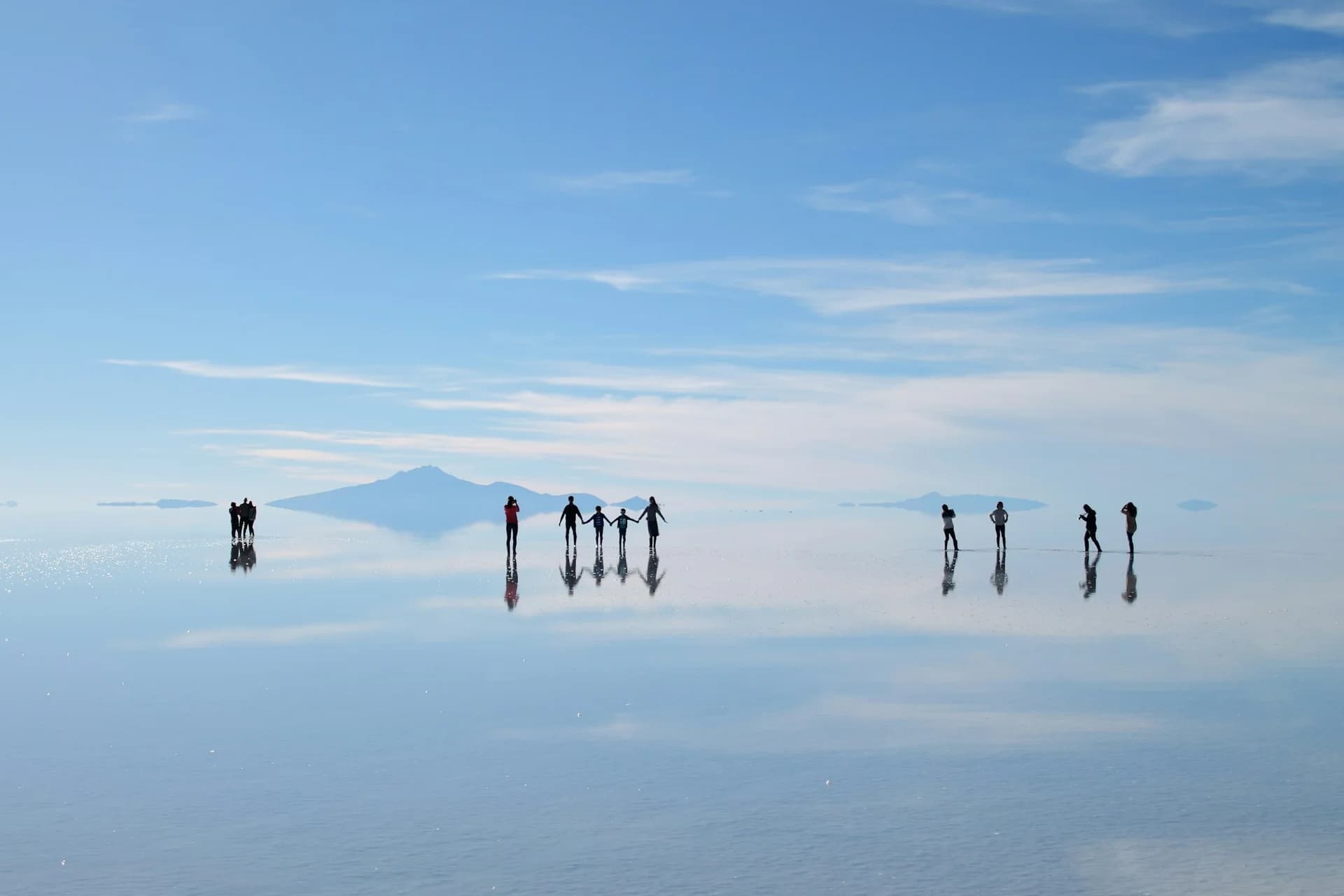
The route bends toward a section where late-season rain has left a thin layer of water — maybe 5 centimeters deep — over the salt. The Land Cruiser parks, you step out into… nothing. The water is perfectly still. The sky reflects so precisely that the mountains on the horizon appear both above and below you, and the clouds hang in both directions.
You've seen photos of this. You've watched the YouTube videos, the drone footage. None of it — not a single frame — captures the disorientation of standing inside the actual mirror.
Sunset happens in two places at once. The sun descends toward the western mountains while its reflection rises to meet it from below. The colors — orange, pink, purple, deep red — exist in perfect symmetry above and below. Your shadow stretches across the water in both directions. Lift a foot, and the ripple breaks the reflection for a moment before it reforms, pixel-perfect.
Someone in the group goes quiet, eyes wet, standing perfectly still so as not to disturb the water. The impulse makes complete sense.
The Dark
After sunset, the convoy moves to a dry section for the night. Camp is simple — mattresses in the back of the Land Cruiser, sleeping bags rated to -15°C (the temperature drops to about -8°C by midnight), and a small gas stove for hot soup and coca tea.
Then the stars come.
Stargaze in the Sahara, take in the southern sky from the Atacama Desert, stand on a remote Pacific island where the nearest electric light is 200 kilometers away — Salar de Uyuni at night is different from all of them.
The altitude (3,656m), the zero light pollution (the nearest town is 50+ kilometers away), and the perfectly dry air create conditions where stars don't just appear — they crowd the sky. The Milky Way isn't a faint band. It's a thick, granular river of white, cutting the sky in half with enough brightness to cast a shadow.
The Magellanic Clouds — satellite galaxies of the Milky Way — show as distinct fuzzy patches. The dark nebulae within the Milky Way band stand out, the dust lanes blocking background starlight. Jupiter burns bright enough to throw a visible reflection on the salt crust.
The driver kills every light. The dashboard goes dark. Even the cigarette goes out.
And in the total darkness, the distinction between salt flat and sky disappears again. This time, instead of the daytime mirror — blue above, blue below — it's stars above and stars below. You stand on a tiny island of solidity in the center of the universe.
You lose track of how long you've been standing there. Twenty minutes, maybe. Maybe an hour. Time does strange things when the brain has no reference frame, no horizon, no sense of direction. Just stars.
3 AM
The cold wakes you at 3AM, penetrating the sleeping bag. The thermometer reads -9°C. Unzip the Land Cruiser's rear hatch and look out.
Orion has rotated significantly. The Milky Way has shifted. And across the salt flat, in every direction, there is nothing. No lights, no sound, no movement. The silence is the kind that makes your ears ring because they're searching for input and finding none.
Pull on a jacket and walk 50 meters from the vehicle. The salt crunches underfoot — the only sound in 10,000 square kilometers. Look up, look down at the faintly reflective crust, and the reason this place draws people back becomes obvious.
It's not the photos. Not the mirror effect or the perspective tricks or the Instagram content. It's the feeling of being genuinely, completely, undeniably small. Standing on a salt flat in the dark in Bolivia at 3AM, freezing, surrounded by stars in every direction — including below your feet — you land on your correct size relative to the universe.
It's about as peaceful as a feeling gets.
Morning
Sunrise reverses the process — stars fade, the eastern sky turns orange, Illimani's peak catches the first light 200 kilometers to the north. Coffee goes on the gas stove. The salt flat turns from gray to white to blinding in the space of 20 minutes.
The drive back to Uyuni meets the day tourists heading out. Their Land Cruisers pass in a stream of white dust and diesel. They'll see the mirror, take the photos, buy the souvenirs. They'll have a great time.
But they'll miss the night.
Most Uyuni trips start or end in the thin-air streets of La Paz, and the abrupt jump in altitude there is decent preparation for what the salt flat does to your lungs.
If it's the desert itself that pulled you south, the desert oasis of Huacachina over in Peru scratches a similar itch — different sand, same sense of standing somewhere the rules of normal landscape don't apply.
And if it's the people as much as the places that stay with you afterward, our conversation with a Santa Marta local about life inside Tayrona lives in the same register as this night on the salt.
And if what draws you is a place that makes you work before it rewards you, Bogotá pulls the same trick in its first twelve hours — a chaotic Andean capital rather than an empty flat, but the same bargain for anyone who stays.
If you go to Uyuni, stay overnight on the flat. Ask your tour operator specifically about camping or overnight options. Some include it in the 3-day tour, others offer it as an add-on. It will be cold. The sleeping arrangements will be basic. The toilet will be a spot 100 meters from the vehicle.
And you'll stand between two skies and understand something about yourself that you didn't know needed understanding.


