
A Week in Nha Trang: Mud Baths, Island Hopping, and 8th-Century Temples
A Week in Nha Trang: Mud Baths, Island Hopping, and 8th-Century Temples
Day 1-2: Beach and Mud
Fly into Cam Ranh Airport (CXR), 35 km south of Nha Trang. A Grab taxi to the hotel runs about 250,000 VND ($10). Base yourself on Tran Phu, the beachfront boulevard, where a mid-range room with a sea-view balcony goes for around 600,000 VND/night ($24) — the kind of address that puts the bay outside your window before breakfast.
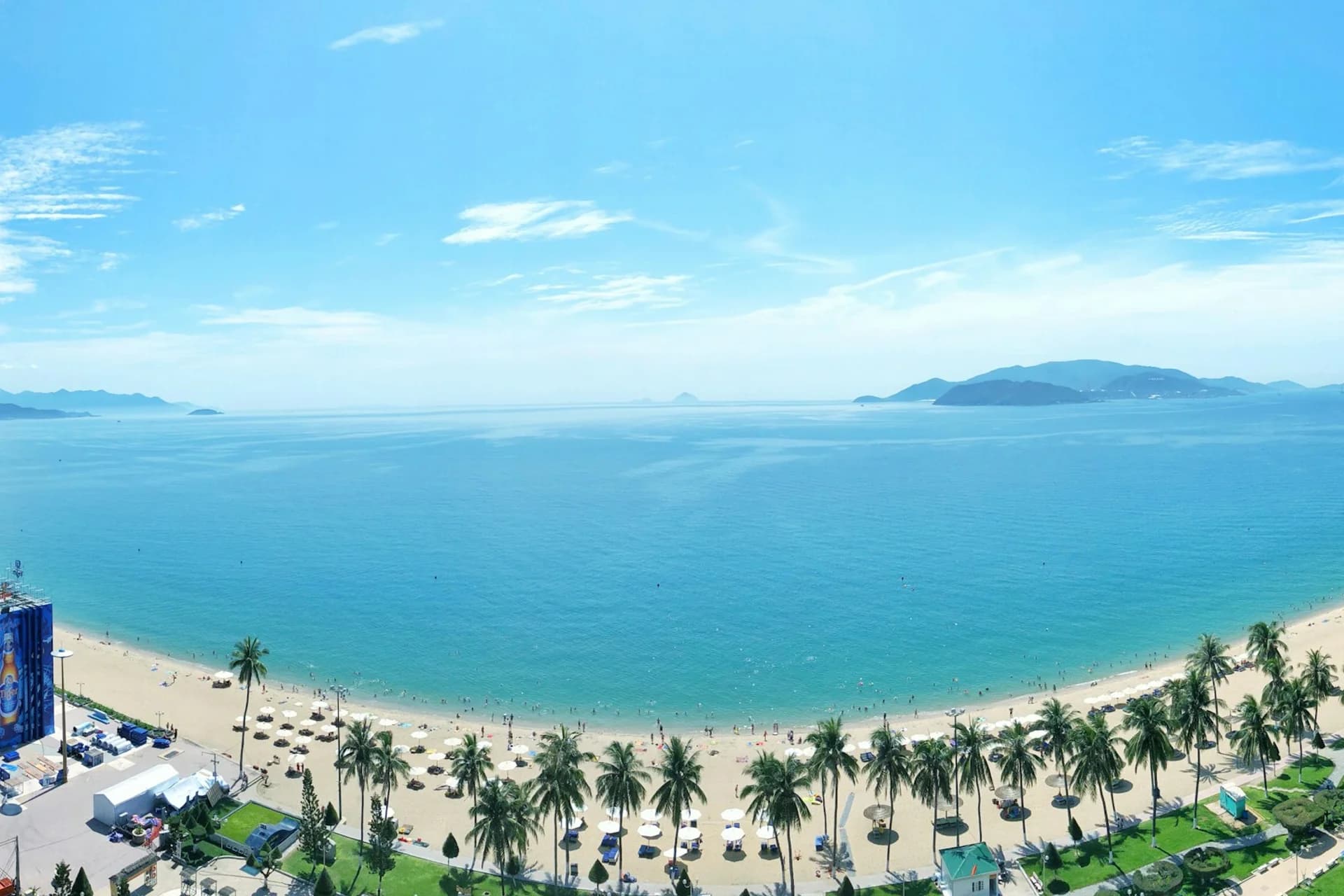
The beach is right there: six kilometers of golden sand curving along the water, islands floating on the horizon. Rent a sunbed (80,000 VND), claim three hours, and do gloriously nothing. The water sits at 28°C, the sky stays cloudless, and within an afternoon it's obvious why this is Vietnam's beach city.
Save Day 2 for Thap Ba Hot Spring. The mud bath here is distinctly Vietnamese: you settle into a tub of warm mineral mud (250,000 VND for an individual bath, 600,000 VND for a VIP couples tub) and let the sodium-silicate-rich sludge coat every inch. It's warm, heavy, and faintly mineral-scented. After 20 minutes you rinse off and drift into the hot spring pools.
The mud delivers real, documented benefits for skin — not just spa marketing — and the effect lingers for days. Book the first morning slot (7 AM) for the cleanest mud.
Day 3-4: Islands
The four-island boat tour departs at 8:30 AM from Cau Da port. The budget version (250,000 VND / ~$10) is unapologetically rowdy — music blaring, a floating bar party at one stop, karaoke on the boat. But the snorkeling at Hon Mun is the real reward: clear water, healthy coral, and schools of tropical fish that make the party soundtrack easy to forgive.
For Day 4, return to Hon Mun with a quieter dive operator (800,000 VND / ~$32 for two dives) — a completely different experience. A Vietnamese dive master named Hung leads the way to a coral wall at 18 meters, thick with soft corals and anemones, where a resident turtle cruises past like it owns the reef.
Hon Mun's status as Vietnam's first marine protected area is clearly paying off. The reefs here are healthier than much of what you'll find snorkeling in Thailand or the Philippines.
Day 5: Po Nagar and the Pagoda
The Po Nagar Cham Towers, 2 km north of the city center, are Hindu temples built between the 7th and 12th centuries by the Cham civilization. Entry is 22,000 VND (~$0.90). The four surviving towers carry intricate stone carvings and remain active places of worship — expect to see women in traditional dress laying offerings. Sarongs are provided for visitors in shorts.
Standing in a temple older than Notre-Dame, watching incense smoke drift through carved stone doorways, transports you somewhere closer to Cambodia than to a beach resort. This Cham heritage is Nha Trang's most underappreciated cultural layer, and it rewards a slow, attentive visit.
Spend the afternoon at Long Son Pagoda. The 24m white Buddha crowns 152 steps with panoramic city views, and entry is free (donations welcome). Climb at 5 PM and the sunset over the bay is yours almost entirely.
Day 6: VinWonders
The 3,320-meter cable car ride over the bay to Hon Tre Island is spectacular no matter what waits at the other end. VinWonders is a full-blown theme park — water slides, aquarium, rides, a private beach — with a combo ticket at 880,000 VND (~$35), reached by one of the world's longest over-sea cable cars.
Even if theme parks aren't your scene, the aquarium is genuinely excellent and the cable car alone justifies the ticket. The view of Nha Trang Bay from mid-air — the islands scattered across the blue, the city curving along the coast — is the kind of panorama that stays with you.
Day 7: Food Day
Give the final day entirely to eating. Start with banh canh cha ca for breakfast at a stall on Nguyen Thi Minh Khai street (35,000 VND). Move to bun cha ca for lunch on Lan Ong Street (40,000 VND). Take dinner as nem nuong at Yen's Restaurant (55,000 VND per set), then circle back for night market seafood as a late snack — grilled prawns and squid, 150,000 VND.
Total food spend for the day: about 280,000 VND (~$11), for four outstanding meals.
Nha Trang's food doesn't draw the attention of Hanoi or Ho Chi Minh City, yet its seafood-forward local cuisine is excellent and extraordinarily cheap. The bun cha ca — rice noodles with grilled fish in a complex broth — is among the finest things you'll eat in all of Vietnam.
For the seasonal guide, read Nha Trang in dry season. For beach comparisons, see Nha Trang vs Da Nang. If you're traveling Vietnam's coast, Hoi An and Da Nang are the natural next stops heading north.


