
Antwerp

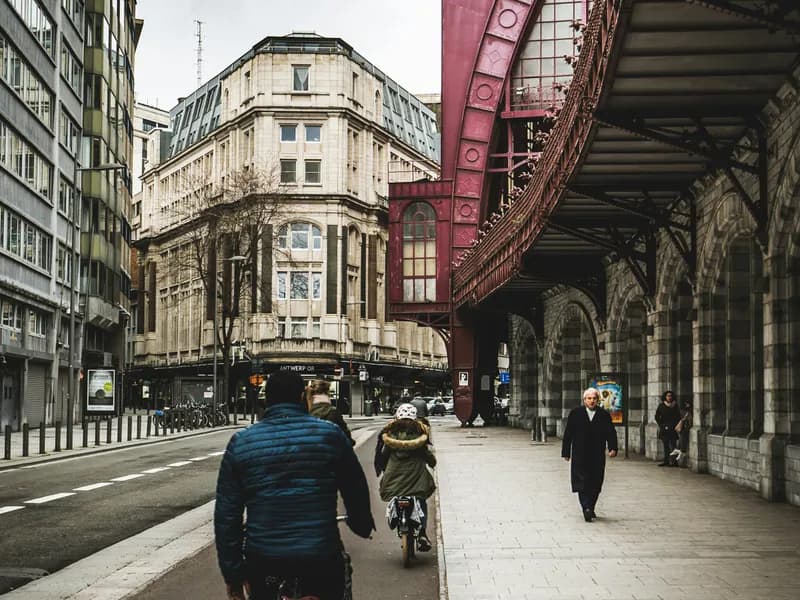
Photo: Ezgi Deliklitas / Unsplash
Key Facts
Best Time to Visit
May to September; December for the Christmas market on Grote Markt
Language
Dutch (Flemish) — English widely spoken; French is not the local language
Currency
Euro (EUR)
Time Zone
CET (UTC+1), CEST (UTC+2) in summer
Airport
Brussels Airport (BRU), 45 km south — direct train to Antwerpen-Centraal in ~45 min; Antwerp International (ANR), 7 km, limited routes
Population
545,000 (city proper), 1.2 million (metro area) — Belgium's largest city
Climate
Oceanic — mild summers (17-23°C), cool wet winters (1-7°C), rain in every month
Safety Rating
Generally Safe (Level 1)
Trade Facts
Europe's second-largest port; the diamond district handles roughly 84% of the world's rough diamonds
Top Highlights

Antwerpen-Centraal Station
The 'Railway Cathedral' of 1905 — a stone palace facade, an iron-and-glass train vault and a gilded dome over four stacked track levels. Free, always open. Allow 20 min. Routinely voted among the world's most beautiful stations; go up to the balcony above the ticket hall and look down the length of it.
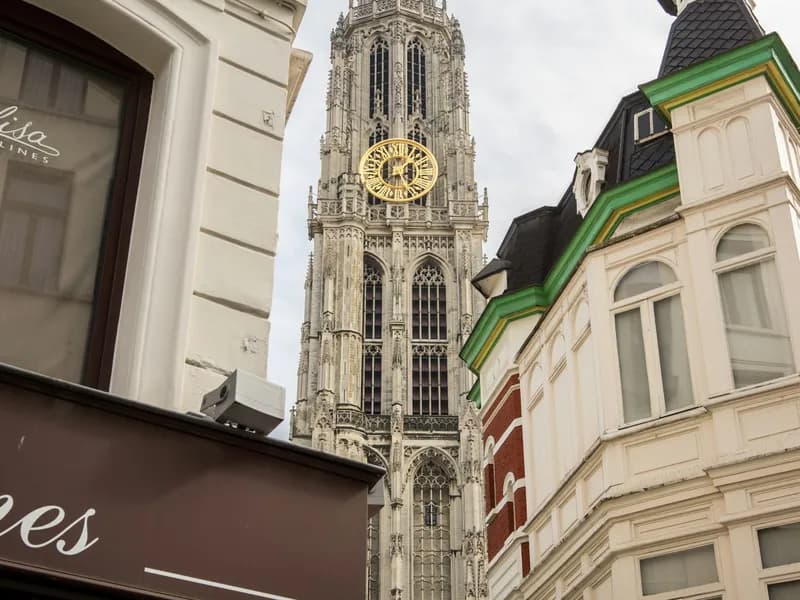
Cathedral of Our Lady
The tallest Gothic church in the Low Countries at 123m, and effectively a Rubens gallery — four of his masterpieces, including 'The Descent from the Cross', hang in the building they were painted for. Entry ~€12. Mon-Fri 10AM-5PM, shorter at weekends around services. Allow 1h.
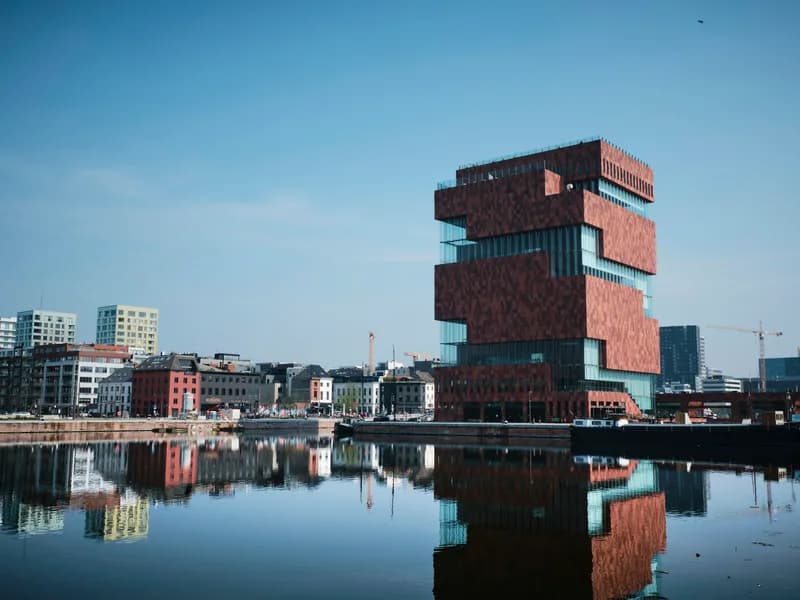
MAS (Museum aan de Stroom)
A stacked red sandstone tower in the old docks. The 10th-floor rooftop panorama is FREE and stays open late — until midnight in summer — reached by escalators spiralling up through the building. Museum entry ~€12. Allow 1h for the roof alone; it is the best free view in the city.
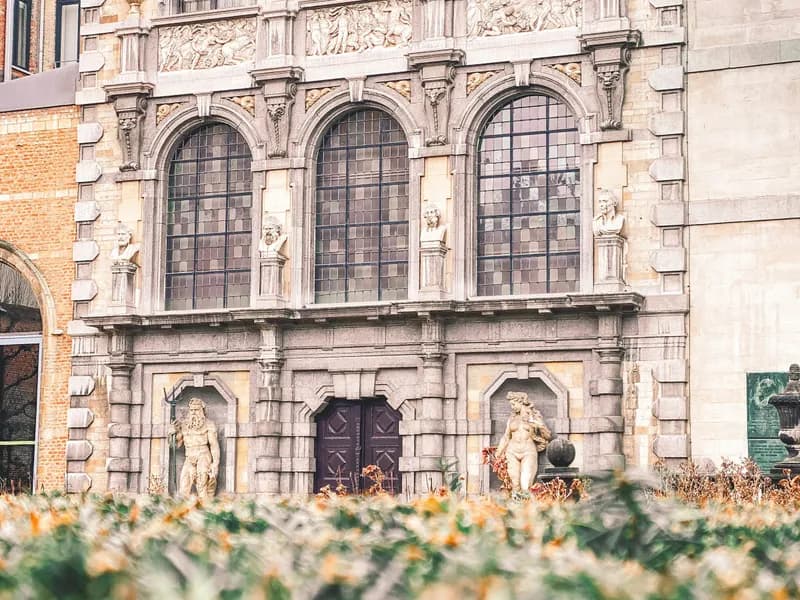
Rubenshuis
Rubens' own home and studio. IMPORTANT: the historic residence has been closed for renovation since January 2023 and is not expected to reopen before 2030. However, the new Hopland 13 entrance building, the Rubens Experience, the library and the restored Baroque garden opened in August 2024 and can be visited — check the current offer and pricing before going.
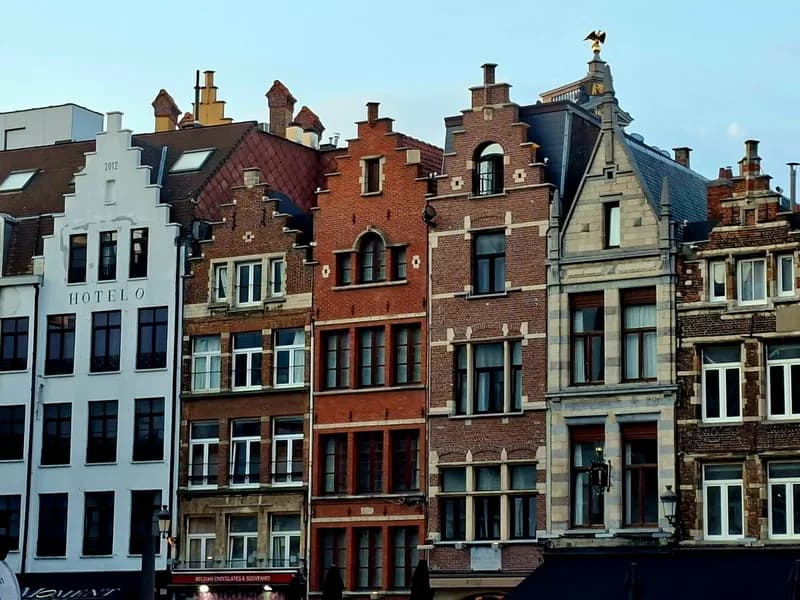
Plantin-Moretus Museum
The world's oldest surviving printing works, home to the two oldest printing presses in existence, and the only museum inscribed on the UNESCO list in its own right. Entry ~€12, closed Mondays. Allow 2h. The family lived and printed here for three centuries and left everything in place.

Sint-Annatunnel
A 572m pedestrian tunnel running 24m under the Scheldt since 1933, reached by the original wooden escalators — which still work and still creak. Free, open 24/7. Allow 30 min round trip. Walk through and turn around: the Left Bank gives the classic skyline view back at the city.
Diamond District
Four streets behind Centraal Station where roughly 84% of the world's rough diamonds change hands, largely on handshake and the Yiddish-Hebrew phrase 'mazel und broche'. Free to wander. Buy only against a GIA or HRD certificate. DIVA, the diamond museum, explains the trade (~€12).

Grote Markt & Brabo Fountain
Guildhalls with gilded facades around the fountain of the founding legend: the giant Antigoon cut off the hands of sailors who would not pay his toll, until Brabo cut off his and threw it in the river — 'hand werpen', hence Antwerpen. Free. Allow 30 min.
Planned Itinerary
7-Day Antwerp Itinerary
Arrival at the Railway Cathedral & Grote Markt
Land at Brussels Airport (BRU) and take the train straight into Antwerpen-Centraal — a station so extravagant you will walk out of it slower than you walked in. Drop bags, then ease into the old town for a first bolleke on Grote Markt. Note the language: this is Flanders, so Dutch or English only. 'Dank u wel' goes a long way; opening in French does not.
Train from Brussels Airport to Antwerpen-Centraal(45 minutes)
The station is directly under the BRU terminal — follow signs to 'Trains/Treinen', 2-3 departures an hour, ~€12 second class plus the €7 Diabolo airport surcharge that is baked into the fare. Skip Brussels South Charleroi (CRL) if you are still booking; it is 130km away and costs you two hours each way.
Antwerpen-Centraal Station itself(20 minutes)
Do not just walk out. Delacenserie's 1905 'Railway Cathedral' stacks four track levels under an iron-and-glass vault, with a gilded dome over the ticket hall. Go up to the balcony above the ticket hall and look down the full length of it — that is the shot. Free, always open.
Check in — historic centre or Zuid(1 hour)
Hotel Julien (Korte Nieuwstraat 24) and Hotel Franq are the discreet mid-luxury picks a few minutes from the cathedral; Botanic Sanctuary (Leopoldstraat 26) is the 2022 five-star in a former monastery; Pulcinella (Bogaardeplein 1) is the well-run hostel. Anything inside the Leien ring is walkable to everything.
Grote Markt & the Brabo Fountain(45 minutes)
Gilded guildhall facades around Lambeaux's 1887 fountain of the founding legend: the giant Antigoon cut off the hands of sailors who would not pay his toll, until Brabo cut off Antigoon's and threw it in the river — 'hand werpen', hence Antwerpen. Free. The Renaissance Stadhuis on the west side reopened in 2021 after restoration.
Dinner at Den Engel, Grote Markt 3(1.5 hours)
The definitive Antwerp brown café, right on the square. Order a 'bolleke' — De Koninck amber ale in its round glass, ~€3.20 — and a plate of stoofvlees. If it is full, Elfde Gebod (Torfbrug 10) around the corner is packed floor to ceiling with religious statues and serves the same beer.
Cathedral Rubens, Het Steen & Under the Scheldt
The single densest day in Antwerp: four Rubens masterpieces hanging in the building they were painted for, a hidden 16th-century alley, then the riverfront and a walk under the Scheldt through 1933 wooden escalators to the Left Bank for the classic skyline view at sunset. All of it inside a 1.5km radius.
Cathedral of Our Lady at opening(1.5 hours)
Entrance on Handschoenmarkt, ~€12, Mon-Fri 10AM-5PM with shorter weekend hours around services. Be there at 10AM. The tallest Gothic church in the Low Countries (123m) is effectively a Rubens gallery: 'The Raising of the Cross' and 'The Descent from the Cross' face each other across the transept, with 'The Assumption of the Virgin' on the high altar. Stand back from the Descent — Rubens built it to be read from the nave, not from a metre away.
Vlaeykensgang, Oude Koornmarkt 16(20 minutes)
An unmarked door on Oude Koornmarkt opens into a cobbled 1591 alley that the traffic noise simply does not reach. Free. Locals come here on summer Monday evenings to sit on the stones and listen to the cathedral carillon.
Lunch at Paters Vaetje, Blauwmoezelstraat 1(1 hour)
Literally in the cathedral's shadow, with a long Belgian beer list and a decent croque. About €18-25 for lunch with a beer.
DIVA diamond museum, Suikerrui 17-19(1 hour)
~€12. The best 60 minutes you can spend before you go anywhere near the diamond district itself — it explains cutting, grading and why the trade landed here. It also drills in the rule: never buy a stone without an independent GIA or HRD certificate.
Het Steen & the Scheldt quays(1 hour)
The city's oldest building, now the visitor centre with 'The Antwerp Story' inside. The riverside itself is free, and the raised quay walk gives you the working Scheldt: this is Europe's second-largest port and the ships prove it.
Sint-Annatunnel to the Left Bank at golden hour(1 hour)
Entrance at Sint-Jansvliet. Free, open 24/7. The original 1933 wooden escalators still run and still creak, dropping you into a 572m white-tiled tube 24m under the river. Walk across, climb out on the Left Bank, and turn around — that is the postcard: cathedral spire, Het Steen, the whole skyline across the water. Aim to surface 30-40 minutes before sunset.
Dinner at Zuiderterras, Ernest Van Dijckkaai 37(1.5 hours)
bOb Van Reeth's 1991 black modernist ship of a café sits right on the quay wall. Not the city's best cooking, but the window table over the river at dusk earns its keep. Mains ~€25-30.
The Oldest Printing Press & the Rubens Trail
West to east across the old town: start at the only museum on the UNESCO list in its own right, then track Rubens from his workshop to his grave. Note that Plantin-Moretus, like most Antwerp museums, is closed Mondays — if today is a Monday, swap this day with day 5.
Plantin-Moretus Museum, Vrijdagmarkt 22(2.5 hours)
~€12, closed Mondays. The world's oldest surviving printing works and home to the two oldest printing presses in existence. The Plantin-Moretus family lived and printed here for three centuries and then left everything exactly in place — the type foundry, the proofreaders' room, the punches, the courtyard garden. Rubens designed title pages for them and his portraits of the family still hang on the walls. Give it the full two hours; the rush jobs miss the point.
Vrijdagmarkt square(20 minutes)
The square outside still runs a genuine second-hand auction on Friday mornings — old-school, fast, in Dutch, and free to watch from the edge.
Walk Nationalestraat to the Meir, lunch at Frites Atelier(1 hour)
A 1km stroll east through the fashion quarter to Korte Gasthuisstraat 32, where Sergio Herman does Belgian fries properly — ~€6-9 a cone with real mayonnaise. They are Belgian, not French, and the joke about that has worn thin locally.
Rubenshuis — the Hopland 13 entrance(1.5 hours)
Important: the historic residence on the Wapper has been closed for renovation since January 2023 and is not expected back before 2030. What opened in August 2024 is the new Hopland 13 entrance building, the Rubens Experience, the research library and the restored Baroque garden and portico — genuinely worth it, but check the current offer and pricing before you go, because the scope keeps shifting.
Sint-Jacobskerk, Lange Nieuwstraat 73(45 minutes)
Rubens is buried here, in his own family chapel behind the high altar, under an altarpiece he painted for the purpose ('Our Lady Surrounded by Saints') in which he almost certainly painted himself as St George. Modest entry (~€5-8). Restoration work has been rolling through for years; check it is open.
Snijders&Rockoxhuis, Keizerstraat 10-12(1 hour)
~€10-12. The house of Nicolaas Rockox, Antwerp's mayor and Rubens' patron and friend — a 17th-century collector's home restored to how it was hung. Quiet, uncrowded, and the best sense you will get of the world Rubens actually moved in.
Dinner at Bistrot du Nord, Lange Dijkstraat 36(2 hours)
Old-school Belgian bistro doing offal and classics with total conviction — the kind of place where the chef comes out to check you finished. Book ahead; ~€45-60 a head.
Eilandje: Emigrants, the MAS Roof & the Old Docks
North to the Eilandje, the 19th-century dock district that the city spent 20 years rebuilding. Two excellent museums, a Zaha Hadid diamond dropped on a fire station, and the best free view in Antwerp — saved for last, after dark.
Sint-Pauluskerk, Veemarkt 14(45 minutes)
On the walk north. Free, usually open afternoons roughly 2PM-5PM April-October. A Gothic church with a Baroque interior, Rubens' 'Disputation of the Holy Sacrament', and part of the Fifteen Mysteries of the Rosary cycle he painted alongside Van Dyck and Jordaens. Out back is the Calvary garden: a bizarre rockery crowded with life-size statues, purgatory and all.
Red Star Line Museum, Montevideostraat 3(2 hours)
~€12, closed Mondays. Two million people sailed from these sheds to America between 1873 and 1934 — Irving Berlin among them, Einstein too. The museum is built in the actual disinfection and inspection buildings where they were checked for trachoma before boarding. It is quietly devastating and it is the reason Antwerp exists as it does.
Lunch at Bar Paniek, Kattendijkdok-Oostkaai 5(1 hour)
Big warehouse canteen on the dock edge, good salads and bowls, ~€15-20, with the water right there.
MAS — Museum aan de Stroom(2 hours)
Hanzestedenplaats 1. Museum entry ~€12, closed Mondays. A stacked tower of Indian red sandstone with a spiral of escalators running up through it, each floor turned 90 degrees from the last so the wavy glass keeps handing you a new slice of the city.
Port House exterior, Zaha Hadidplein 1(45 minutes)
A 20-minute walk or 8-minute Velo ride north. Zaha Hadid's faceted glass hull balanced on top of a disused 1922 fire station — half ship, half rough diamond, depending on who is telling it. Free to walk around; interiors are tour-only and rarely available.
Dinner at Het Pomphuis, Siberiastraat 2(2 hours)
The old dry-dock pump house, gutted and turned into a cathedral-scale restaurant with the original machinery still standing in it. Book ahead. Mains ~€28-38.
MAS rooftop panorama after dark(45 minutes)
Ride the escalators back up — the 10th-floor roof is FREE and stays open late, until midnight in summer. Port cranes to the north, the cathedral floodlit to the south, the Scheldt bending away west. The best free thing in the city, and better at night than by day.
Slow Morning, Then the Zuid Museum Quarter
Your rest day. Nothing before 11AM, a bakery, a bike ride along the river, and then one great museum done properly rather than three done badly. The Zuid is the 19th-century grid south of the centre — galleries, terraces and Antwerp's best square for doing nothing.
Late breakfast — Goossens bakery, Korte Gasthuisstraat 31(1 hour)
Baking since 1884 in a shopfront that has barely changed. Get the rozijnenbrood (raisin bread) — it is the thing people queue for, ~€3 — and take it round the corner to Normo (Minderbroedersrui 30) or Caffènation (Hopland 46) for the coffee, since Goossens is bread only.
Velo ride down the Scheldekaaien(45 minutes)
Velo Antwerpen day pass ~€5 at any of the 300+ stations. Ride the rebuilt river quays south from Het Steen to the Zuid — flat, car-free, and the fastest way to feel the scale of the river.
KMSKA, Leopold de Waelplaats 2(3 hours)
~€20, closed Mondays, open until 10PM on Thursdays. Reopened in September 2022 after eleven years shut, with a stark white contemporary wing dropped into the courtyards of the old palace. It holds the largest James Ensor collection on earth, Fouquet's unnerving 'Madonna Surrounded by Seraphim and Cherubim', Van Eyck's 'Saint Barbara', and Rubens at full altarpiece scale. Do the Ensor floors last; they are the reason to come.
Terrace on Marnixplaats(1 hour)
The Zuid's roundabout square, ringed with cafés. Sit outside, order a Seef Bier — a 19th-century Antwerp style revived by the Antwerpse Brouw Compagnie a few streets away on Vlaamsekaai — and watch the neighbourhood come home.
Dinner at Fiskebar, Marnixplaats 12(2 hours)
North Sea fish, no fuss, sold off the counter — the plateau or whatever came in that morning. Book, or eat at the bar. ~€40-55 a head.
Diamonds, the Antwerp Six & a Beer Crawl
A clean east-to-west line across the city: start behind Centraal Station in the four streets that move most of the world's rough diamonds, walk the Meir, then finish in the fashion quarter and the beer bars. One scheduling rule — the diamond district is largely shut on Saturdays for the Jewish Sabbath and dead on Sundays. Come on a weekday.
Breakfast at Kleinblatt, Provinciestraat 206(45 minutes)
Kosher bakery running since 1903 in the Jewish quarter behind the station. Take a chocolate babka or a pletzel to eat on the hoof, a few euros. Closed Saturdays.
The Diamond District — Hoveniersstraat, Schupstraat, Rijfstraat, Pelikaanstraat(1.5 hours)
Four bollarded streets where roughly 84% of the world's rough diamonds change hands, much of it still sealed on a handshake and the Yiddish-Hebrew phrase 'mazel und broche'. Free to wander and heavily monitored, so it is safe — the risk is commercial, not physical. Never buy without an independent GIA or HRD certificate, and walk away from anyone who approaches you on the street with a deal. Reputable dealers expect the certification question and are not offended by it.
Walk the Meir & Stadsfeestzaal, Meir 78(1 hour)
Belgium's busiest shopping street, and halfway down it the Stadsfeestzaal — a gilded, domed 1908 festival hall that burned in 2000 and was rebuilt as a shopping arcade. Absurdly grand for what it now sells. Free to walk through.
Museum Mayer van den Bergh, Lange Gasthuisstraat 19(1.5 hours)
~€12, closed Mondays. A small, dark, near-perfect collector's house whose one great possession is Bruegel's 'Dulle Griet' (Mad Meg) — restored in 2018, which stripped off centuries of varnish, revealed the 1563 date and turned the sky from brown back to a hallucinatory red. Fritz Mayer van den Bergh bought it at auction in 1894 for almost nothing because nobody knew what it was.
Handjes at Philip's Biscuits, Korte Gasthuisstraat 39(20 minutes)
Antwerpse handjes — hand-shaped biscuits, straight out of the Brabo legend. About €10 a tin. Del Rey (Appelmansstraat 5) does the chocolate version if you want the expensive one.
MoMu & Nationalestraat(2 hours)
MoMu at Nationalestraat 28, ~€12, closed Mondays, reopened in 2021 after its own long renovation. This is where the Antwerp Six — Dries Van Noten, Ann Demeulemeester, Walter Van Beirendonck, Dirk Bikkembergs, Dirk Van Saene, Marina Yee — came out of the Royal Academy in the 1980s and put a port city on the fashion map. Afterwards walk to Het Modepaleis at Nationalestraat 16 (Van Noten's own store, in a corner building worth entering even if you buy nothing) and down Kammenstraat for streetwear and record shops.
Beer crawl: Kulminator, Billie's and De Vagant(3 hours)
Kulminator (Vleminckveld 32) is the pilgrimage — a cluttered front room with a cellar of vintage bottles going back decades, and opening hours that are famously erratic, so check before you walk over. Billie's Bier Kafétaria (Kammenstraat 12) is the modern, reliable alternative. Finish at De Vagant (Reyndersstraat 25) with a jenever off a list of 200-plus — served brim-full, so bend down to the glass rather than lifting it.
Last Market, Last Bolleke & Departure
A short morning with whatever the calendar hands you, a last chocolate run, then the 45-minute train back to Brussels Airport. Give yourself 3 hours before a long-haul departure — allow for the EU Entry/Exit System, which has been running at all Schengen external borders since April 2026 and adds a facial scan and fingerprints instead of a stamp.
Sunday: Vogelenmarkt, Theaterplein(1.5 hours)
If it is a Sunday, this is the one. The Bird Market sprawls across Theaterplein from about 8AM to 1PM — food, plants, clothes, junk, and almost no birds any more. Saturday gets the Exotische Markt on the same square. Any other day, walk the Wilde Zee lanes instead.
Last coffee and handjes(45 minutes)
Del Rey (Appelmansstraat 5) for chocolate handjes to take home — it is 200m from Centraal, so it is the efficient last stop, not just the good one.
Checkout and one last look at Centraal(45 minutes)
Bags into the lockers at Centraal (~€4-6) if you have hours to kill, then take five minutes on the ticket-hall balcony again. It reads completely differently on the way out.
Train to Brussels Airport(45 minutes)
Direct from Antwerpen-Centraal, 2-3 an hour, ~€12 including the airport surcharge. Check the platform board rather than assuming — the airport trains leave from the deep levels as often as the upper ones.
14-Day Antwerp Itinerary
Arrival at the Railway Cathedral & Grote Markt
Land at Brussels Airport (BRU) and take the train straight into Antwerpen-Centraal — a station so extravagant you will walk out of it slower than you walked in. Drop bags, then ease into the old town for a first bolleke on Grote Markt. Note the language: this is Flanders, so Dutch or English only. 'Dank u wel' goes a long way; opening in French does not.
Train from Brussels Airport to Antwerpen-Centraal(45 minutes)
The station sits directly under the BRU terminal — follow signs to 'Trains/Treinen', 2-3 departures an hour, ~€12 second class including the Diabolo airport surcharge. Avoid Brussels South Charleroi (CRL) unless the fare is dramatically better; it is 130km away and adds two hours each way.
Antwerpen-Centraal Station itself(20 minutes)
Delacenserie's 1905 'Railway Cathedral' stacks four track levels under an iron-and-glass vault, with a gilded dome over the ticket hall. Go up to the balcony above the ticket hall and look down the full length of it. Free, always open.
Check in — historic centre or Zuid(1 hour)
For a two-week stay, consider an apartment in the Zuid or Zurenborg rather than a centre hotel — you get a kitchen, a neighbourhood bakery and a tram stop. Hotel Julien (Korte Nieuwstraat 24) and Hotel Franq are the discreet central picks; August (Jules Bordetstraat 5) is Vincent Van Duysen's conversion of a military hospital in Het Groen Kwartier.
Grote Markt & the Brabo Fountain(45 minutes)
Gilded guildhall facades around Lambeaux's 1887 fountain of the founding legend: the giant Antigoon cut off the hands of sailors who would not pay his toll, until Brabo cut off Antigoon's and threw it in the river — 'hand werpen', hence Antwerpen. Free. The Renaissance Stadhuis reopened in 2021 after restoration.
Dinner at Den Engel, Grote Markt 3(1.5 hours)
The definitive Antwerp brown café. Order a 'bolleke' — De Koninck amber in its round glass, ~€3.20 — and stoofvlees. If it is full, Elfde Gebod (Torfbrug 10) nearby is crammed floor to ceiling with religious statuary.
Cathedral Rubens & the Baroque Old Town
The core of medieval and Baroque Antwerp, all within 800 metres. Four Rubens masterpieces in the building they were painted for, a hidden 1591 alley, and the Baroque church Rubens helped design. With two weeks you can do this slowly, which is the right way.
Cathedral of Our Lady at opening(1.5 hours)
Handschoenmarkt entrance, ~€12, Mon-Fri 10AM-5PM with shorter weekend hours around services. Be there at 10AM. The tallest Gothic church in the Low Countries at 123m, and effectively a Rubens gallery: 'The Raising of the Cross' and 'The Descent from the Cross' face each other across the transept, 'The Assumption of the Virgin' sits on the high altar. Stand back from the Descent — Rubens built it to be read from the nave.
Vlaeykensgang, Oude Koornmarkt 16(20 minutes)
An unmarked door opens into a cobbled 1591 alley the traffic noise does not reach. Free. On summer Monday evenings locals sit on the stones to listen to the cathedral carillon.
Lunch at Paters Vaetje, Blauwmoezelstraat 1(1 hour)
In the cathedral's literal shadow, long Belgian beer list, solid croques. ~€18-25 with a beer.
Sint-Carolus Borromeuskerk, Hendrik Conscienceplein 12(45 minutes)
The 1621 Jesuit church Rubens worked on — he had a hand in the facade and the tower, and painted 39 ceiling canvases for it. Lightning burned every one of them in 1718. What remains is still the most theatrical Baroque interior in the city, and it sits on Hendrik Conscienceplein, the prettiest car-free square in Antwerp.
Museum Vleeshuis, Vleeshouwersstraat 38-40(1 hour)
The 1504 Butchers' Hall — a striped bacon-brick pile — now holds 'Sound of the City', the municipal instrument collection, including harpsichords from the Ruckers dynasty who made Antwerp the keyboard capital of Europe. Quiet, cheap, and almost nobody goes.
Dinner at Ciro's, Amerikalei 6(2 hours)
Unchanged since 1962 — brown wood, paper tablecloths, waiters in waistcoats, and steak or stoofvlees done exactly the way it was then. This is where Antwerp families have eaten for sixty years. ~€35-45.
UNESCO Printing, the Sewers & Under the Scheldt
The oldest printing works on earth in the morning, the city's covered medieval canals in the afternoon, and then the walk under the river to the Left Bank at sunset. Note that Plantin-Moretus is closed Mondays, as are most Antwerp museums — plan around it.
Plantin-Moretus Museum, Vrijdagmarkt 22(2.5 hours)
~€12, closed Mondays. The world's oldest surviving printing works, holding the two oldest printing presses in existence, and the only museum on the UNESCO list in its own right. The family lived and printed here for three centuries and left everything in place: the type foundry, the proofreaders' room, the punches, the garden. Rubens designed title pages for them and his portraits of the family still hang here. Two hours minimum.
Vrijdagmarkt square(20 minutes)
Still hosts a real second-hand auction on Friday mornings — fast, in Dutch, and free to watch from the edge.
The Ruien underground canal tour, Suikerrui 21(1.5 hours)
~€13-16. Antwerp's medieval canals were not filled in, they were roofed over — and you can walk through them in waders they hand you at the Ruihuis. Cold, dripping, low, and genuinely strange: you surface knowing the shape of the city better than any map shows. Book ahead, it sells out.
Het Steen & the Scheldt quays(1 hour)
The city's oldest building, now the visitor centre with 'The Antwerp Story'. The riverside is free, and the raised quay walk shows you the working Scheldt — Europe's second-largest port, and the ships prove it.
Sint-Annatunnel to the Left Bank at golden hour(1 hour)
Entrance at Sint-Jansvliet, free, open 24/7. The original 1933 wooden escalators still run and still creak, dropping you into a 572m white-tiled tube 24m under the Scheldt. Walk across, climb out on the Left Bank, turn around: cathedral spire, Het Steen, the whole skyline over the water. Surface 30-40 minutes before sunset.
Dinner at Zuiderterras, Ernest Van Dijckkaai 37(1.5 hours)
bOb Van Reeth's 1991 black modernist café moored on the quay wall. Get the window over the river at dusk. Mains ~€25-30.
The Rubens Trail: Workshop, Patron, Grave
Track Rubens through the city he ran as its most powerful citizen — painter, diplomat, businessman — from his workshop site to his patron's dining room to the chapel he designed to be buried under. A tight walk of maybe 1.5km, all east of Groenplaats.
Rubenshuis — the Hopland 13 entrance(1.5 hours)
Important: the historic residence on the Wapper has been closed for renovation since January 2023 and is not expected to reopen before 2030. What you can visit is the new Hopland 13 entrance building, the Rubens Experience, the research library and the restored Baroque garden and portico, all opened in August 2024. Worth doing — but check the current offer and pricing first, because the scope keeps changing.
Sint-Jacobskerk, Lange Nieuwstraat 73(45 minutes)
Rubens is buried here in his own family chapel behind the high altar, under an altarpiece he painted for the purpose — 'Our Lady Surrounded by Saints' — in which he almost certainly cast himself as St George. ~€5-8. Restoration has been rolling through for years; confirm it is open.
Lunch on Hendrik Conscienceplein or at Native, Muntstraat(1 hour)
Native does a sharp, seasonal, vegetable-forward lunch for ~€20-25 in the streets behind the Meir. Or just take a terrace on Conscienceplein with a sandwich and no agenda.
Snijders&Rockoxhuis, Keizerstraat 10-12(1.5 hours)
~€10-12. The home of Nicolaas Rockox, mayor of Antwerp and Rubens' patron and personal friend, restored to how a 17th-century collector actually hung his rooms. Frans Snijders lived next door. Almost nobody comes, which is exactly why it works — this is the world Rubens moved in, at domestic scale.
The Meir & Stadsfeestzaal, Meir 78(1 hour)
Belgium's busiest shopping street, and halfway along it a gilded, domed 1908 festival hall that burned in 2000 and came back as a shopping arcade. Grotesquely grand for a place selling trainers. Free.
Beers at 't Waagstuk, Stadswaag 20(2 hours)
On a quiet cobbled square in the university quarter, with a long, well-kept Belgian list and staff who will actually steer you. Order something you cannot get at home — a Westvleteren stand-in like St Bernardus Abt 12, or a Rodenbach Grand Cru if you want to understand Flemish red-brown sour ale.
Eilandje: Emigrants, Zaha Hadid & the MAS Roof at Night
North to the Eilandje, the 19th-century dock district the city spent two decades rebuilding. Two of Antwerp's best museums, a Zaha Hadid diamond balanced on a fire station, and the best free view in the city — saved for after dark.
Sint-Pauluskerk, Veemarkt 14(45 minutes)
On the walk north. Free, usually open afternoons roughly 2PM-5PM April-October. Gothic shell, Baroque interior, Rubens' 'Disputation of the Holy Sacrament' and part of the Fifteen Mysteries of the Rosary cycle he shared with Van Dyck and Jordaens. Out back is the Calvary garden — a rockery mobbed with life-size statues, purgatory included.
Red Star Line Museum, Montevideostraat 3(2 hours)
~€12, closed Mondays. Two million people sailed from these sheds to America between 1873 and 1934 — Irving Berlin among them, Einstein too. It is installed in the actual disinfection and inspection buildings where emigrants were checked for trachoma before boarding. Quietly devastating, and the single best explanation of why Antwerp is Antwerp.
Lunch at Bar Paniek, Kattendijkdok-Oostkaai 5(1 hour)
Warehouse canteen on the dock edge — bowls, salads, ~€15-20, water right there.
MAS — Museum aan de Stroom(2 hours)
Hanzestedenplaats 1, ~€12, closed Mondays. A stacked tower of Indian red sandstone with escalators spiralling up through it, each floor rotated 90 degrees from the last so the wavy glass hands you a new slice of city on every level. The port and world-trade galleries are the ones that stick.
Port House exterior, Zaha Hadidplein 1(45 minutes)
A 20-minute walk or 8-minute Velo ride north. Hadid's faceted glass hull perched on a disused 1922 fire station — ship or rough diamond, depending who is telling it. Free outside; interiors are tour-only and rarely available.
Dinner at Het Pomphuis, Siberiastraat 2(2 hours)
The old dry-dock pump house, gutted into a cathedral-scale dining room with the original machinery still in place. Book. Mains ~€28-38.
MAS rooftop panorama after dark(45 minutes)
Ride the escalators back up — the 10th-floor roof is FREE and stays open late, until midnight in summer. Cranes north, cathedral floodlit south, the Scheldt bending west. Better at night than by day, and it costs nothing.
Free Morning, Then the Zuid Museum Quarter
Rest day one. Nothing before 11AM, a bakery, a bike ride down the river, and then one great museum done properly instead of three done badly. The Zuid is the 19th-century grid south of the centre — galleries, terraces, and the city's best square for doing nothing at all.
Late breakfast — Goossens bakery, Korte Gasthuisstraat 31(1 hour)
Baking since 1884 in a shopfront that has barely changed. The rozijnenbrood (raisin bread) is what the queue is for, ~€3. Goossens is bread only — take it to Normo (Minderbroedersrui 30) or Caffènation (Hopland 46) for coffee.
Velo ride down the Scheldekaaien(45 minutes)
Velo Antwerpen day pass ~€5 at any of the 300-plus stations. Ride the rebuilt quays south from Het Steen into the Zuid — flat, car-free, and the fastest way to feel the river's scale.
KMSKA, Leopold de Waelplaats 2(3 hours)
~€20, closed Mondays, open until 10PM Thursdays. Reopened September 2022 after eleven years shut, with a stark white contemporary wing dropped into the old palace's courtyards. Largest James Ensor collection on earth, Fouquet's unnerving 'Madonna Surrounded by Seraphim and Cherubim', Van Eyck's 'Saint Barbara', Rubens at full altarpiece scale. Save the Ensor floors for last.
FOMU, Waalsekaai 47(1 hour)
~€14, closed Mondays. Only if you still have petrol in the tank — the photography museum runs sharp temporary shows in a converted warehouse five minutes from KMSKA. If you are flagging, skip it; that is the point of a rest day.
Dinner at Fiskebar, Marnixplaats 12(2 hours)
North Sea fish, no fuss, sold straight off the counter — the plateau, or whatever landed that morning. Book, or eat at the bar. ~€40-55.
Diamonds, the Antwerp Six & a Beer Crawl
A clean east-to-west line: the four streets behind Centraal that move most of the world's rough diamonds, then the Meir, then the fashion quarter and the beer bars. One scheduling rule — the diamond district is largely closed on Saturdays for the Jewish Sabbath and dead on Sundays. Go on a weekday.
Breakfast at Kleinblatt, Provinciestraat 206(45 minutes)
Kosher bakery running since 1903 in the Jewish quarter behind the station. Chocolate babka or a pletzel, a few euros, eaten walking. Closed Saturdays.
The Diamond District & DIVA(2.5 hours)
Hoveniersstraat, Schupstraat, Rijfstraat and Pelikaanstraat — four bollarded streets handling roughly 84% of the world's rough diamonds, much of it still sealed on a handshake and the phrase 'mazel und broche'. Free to wander, heavily monitored, entirely safe; the risk here is commercial, not physical. Never buy without an independent GIA or HRD certificate, and ignore anyone offering you a deal on the street. Then take tram 15 down to DIVA (Suikerrui 17-19, ~€12) for the museum that explains the cutting, the grading and how the trade landed here in the first place.
Museum Mayer van den Bergh, Lange Gasthuisstraat 19(1.5 hours)
~€12, closed Mondays. A small, dark, near-perfect collector's house built around one great painting: Bruegel's 'Dulle Griet' (Mad Meg). The 2018 restoration stripped centuries of varnish, revealed the 1563 date and turned the sky from brown back to a hallucinatory red. Fritz Mayer van den Bergh bought it at auction in 1894 for almost nothing because nobody knew what it was.
MoMu, Nationalestraat 28(1.5 hours)
~€12, closed Mondays, reopened 2021 after its own long renovation. This is where the Antwerp Six — Dries Van Noten, Ann Demeulemeester, Walter Van Beirendonck, Dirk Bikkembergs, Dirk Van Saene, Marina Yee — walked out of the Royal Academy in the 1980s and put a port city on the fashion map.
Nationalestraat, Kammenstraat & Kloosterstraat(1.5 hours)
Het Modepaleis at Nationalestraat 16 is Van Noten's own store, in a corner building worth walking into even if you buy nothing. Kammenstraat for streetwear and records; Kloosterstraat, running south toward the Zuid, is a solid kilometre of antique and mid-century dealers. Free, and the fashion district is one of the tips-list freebies for a reason.
Beer crawl: Kulminator, Billie's and De Vagant(3 hours)
Kulminator (Vleminckveld 32) is the pilgrimage — a cluttered front room over a cellar of vintage bottles going back decades, with famously erratic hours, so check before walking over. Billie's Bier Kafétaria (Kammenstraat 12) is the modern, reliable fallback. Finish at De Vagant (Reyndersstraat 25) with a jenever from a list of 200-plus, poured brim-full: bend to the glass, do not lift it.
Day Trip: Ghent and the Ghent Altarpiece
An hour west by train to the city Antwerp locals rate above Bruges — a real, student-heavy, working city with a castle in the middle of it and the most important painting in Flanders. Trains leave Antwerpen-Centraal for Gent-Sint-Pieters roughly twice an hour, ~1h, ~€12-15 each way. Book the altarpiece timeslot before you leave.
Train to Gent-Sint-Pieters, then tram 1(1 hour 20 minutes)
Gent-Sint-Pieters is 2km from the centre — do not walk it. Tram 1 from outside the station to Korenmarkt takes 12 minutes, ~€2.50 from the machine (cheaper than onboard).
Saint Bavo's Cathedral & the Adoration of the Mystic Lamb(1.5 hours)
~€16 with the AR visitor experience, timed entry, book online. Van Eyck's 1432 altarpiece is the most stolen artwork in history and the restoration that finished in 2020 scraped off 16th-century overpaint to reveal the Lamb's disconcertingly human face — the internet had opinions. See it in person; the reproductions genuinely do not convey the surface.
Graslei, Korenlei & the Belfry(1.5 hours)
The two guild-house quays facing each other across the Leie are free and are the picture of Ghent. The Belfry (~€11) has a lift, so the climb is not a climb.
Lunch in Patershol(1.5 hours)
The tangle of medieval lanes behind Gravensteen, now Ghent's restaurant quarter. Also detour 200m to Tierenteyn-Verlent (Groentenmarkt 3), selling mustard from a wooden barrel since 1790 — a small pot is €4 and outlasts the trip.
Gravensteen castle(1.5 hours)
~€13. A moated 1180 fortress sitting incongruously in the middle of the city. The audio guide, narrated by Flemish comedian Wouter Deprez, is a cult item — deadpan, faintly deranged, and the only castle audio guide anyone actually finishes.
Werregarenstraat graffiti alley & beers at Het Waterhuis aan de Bierkant(1.5 hours)
The alley is legally paintable and repainted more or less weekly — free, 2 minutes off Korenmarkt. Then Het Waterhuis aan de Bierkant (Groentenmarkt 9) for the beer list, or Dulle Griet on Vrijdagmarkt for the theatre of it. Last direct trains back to Antwerp run late evening; check before the third beer.
Rest Day: Zurenborg Art Nouveau & the Middelheim Sculpture Park
Rest day two, and the day most visitors never have. No museums with timed tickets, no queues. A morning walking one of Europe's strangest residential streets, an afternoon in a free open-air sculpture park, and an evening on the neighbourhood square where Antwerp actually lives.
Breakfast at Domestic, Steenbokstraat 37(1 hour)
A serious bakery in Zurenborg — sourdough, viennoiserie, proper coffee, ~€10-14. Tram 11 or a 10-minute walk from Berchem station.
Cogels-Osylei & the Zurenborg walk(2 hours)
Free, and one of the best free things in Belgium. A speculative 1890s developer let architects build whatever they liked on one grid, and the result is a full-street collision of Art Nouveau, neo-Gothic, neo-Renaissance and outright folly. Start at Cogels-Osylei, then take the Waterloostraat crossroads for 'De Vier Seizoenen' — four corner houses, one per season. The city tried to bulldoze the lot in the 1960s; residents stopped it.
Lunch on Dageraadplaats(1.5 hours)
Zurenborg's tree-filled café square, five minutes from Cogels-Osylei and entirely local. Take any terrace, order a bolleke, and stay longer than you planned.
Middelheim Museum, Middelheimlaan 61(2.5 hours)
FREE, always. A 30-hectare park south of the city — bus 21 or 32 from the centre, ~25 minutes — scattered with modern sculpture since 1950: Rodin, Henry Moore, Panamarenko and a rotating contemporary programme. No ropes, no guards breathing on you, just work standing in grass. Go even if it drizzles; oceanic climate means rain in every month, and it suits the place.
Dinner at Dôme, Grote Hondstraat 2(2.5 hours)
Under an actual dome on a Zurenborg corner — refined French-Belgian cooking, one of the city's most loved rooms. Book well ahead; ~€70-90. If it is full, Dôme Sur Mer nearby does the fish version.
Day Trip: Mechelen — 538 Steps and Kazerne Dossin
Twenty-five minutes down the line, and Belgium's most underrated small city: a Gothic tower you can stand on top of, a royal tapestry workshop, and a Holocaust memorial in the barracks the transports actually left from. A day of enormous tonal range — carry it in that order.
Train to Mechelen(25 minutes)
Antwerpen-Centraal to Mechelen, 4+ trains an hour on the Brussels line, ~€6-7 each way. The station is a 15-minute walk from Grote Markt, or hop bus 1.
Sint-Romboutstoren skywalk(1.5 hours)
~€9, tickets from the tourist office on Vleeshouwersstraat 6. 538 steps up an unfinished 15th-century tower that was meant to be 167m and stopped at 97m when the money ran out. The glass skywalk at the top gives you Antwerp's cathedral on a clear day, 25km north. Go first, before your legs are tired.
Grote Markt & the Stadhuis(45 minutes)
Mechelen was the capital of the Low Countries under Margaret of Austria in the 1500s, and the square has never quite got over it. Free. The town hall is two unfinished buildings bolted together and it looks it, which is somehow the charm.
Lunch on the Vismarkt(1.5 hours)
The old fish market on the Dijle is now a run of terraces over the water. Order a Gouden Carolus — brewed at Het Anker (Guido Gezellelaan 49) a few streets away since the 1400s, and the abbey-strength one is 8.5%, so plan the afternoon accordingly.
Kazerne Dossin, Goswin de Stassartstraat 153(2 hours)
~€12. Between 1942 and 1944, 25,843 Jews and Roma were held in these barracks and deported to Auschwitz from the railway siding outside; barely 5% came back. The memorial and museum face the original building across the street. It is rigorous, unsparing, and built around the individual photographs. Not a add-on visit — give it the full two hours and expect the train home to be quiet.
Day Trip: Bruges
Yes, it is a theme park by 11AM. Go anyway, and beat it by arriving on the first trains and walking away from the Markt. An hour and a half each way from Antwerpen-Centraal, direct, roughly hourly, ~€16-18. The Michelangelo alone justifies the ticket.
Early train to Brugge(1 hour 25 minutes)
Direct from Antwerpen-Centraal, ~€16-18 each way. Take something before 8:30AM — the coach parties land around 10 and the difference between Bruges at 9AM and Bruges at 11AM is the difference between a city and a set.
Markt, Rozenhoedkaai & the Belfry before the crowds(1.5 hours)
Walk the 20 minutes in from the station through Minnewater and the Begijnhof (free, and the quietest it will be all day). Rozenhoedkaai is the most photographed corner in Belgium — at 9AM you can actually stand on it. The Belfry is 366 steps, ~€15, timed entry, book online.
Church of Our Lady — Michelangelo's Madonna(45 minutes)
~€8. Michelangelo's 'Madonna and Child' is the only sculpture of his that left Italy in his lifetime — bought by a Bruges cloth merchant in 1504 while the artist was still alive. It has been stolen twice, by Napoleon and by the Nazis, and it has come back twice.
Groeningemuseum or Sint-Janshospitaal(1.5 hours)
~€15 each; pick one, not both. The Groeninge has Van Eyck's 'Madonna with Canon van der Paele' and a Bosch 'Last Judgement'; Sint-Janshospitaal has Memling's Shrine of St Ursula installed in a medieval hospital ward. If you loved the Ghent Altarpiece, go Groeninge.
De Halve Maan brewery, Walplein 26(1.5 hours)
~€18 including a Bruges Zot at the end. The tour's punchline is real: in 2016 they laid a 3.2km beer pipeline under the medieval streets to the bottling plant outside town, because the tanker lorries were destroying the cobbles. The rooftop stop mid-tour is the best view in Bruges.
Beers and the last train(1.5 hours)
't Brugs Beertje (Kemelstraat 5) is the beer bar locals still use — 300-odd bottles and a landlady who will pick for you. Check the last direct Antwerp train (usually around 9-10PM); after that it is a change at Ghent.
Free Morning, Then Trappist Beer at Westmalle
Rest day three, and the most Flemish thing you will do. A slow morning in the city, then a bus out into the Kempen to sit opposite a working Trappist abbey and drink the beer the monks brew across the road. The abbey itself does not admit visitors — that is precisely why the café exists.
Slow morning — Chocolate Nation or nothing(2 hours)
Chocolate Nation (Koningin Astridplein 7, next to Centraal, ~€18) is the big Belgian chocolate experience and it is better than it sounds — it ends in a tasting room. Or genuinely do nothing: get a coffee at Caffènation, sit in Stadspark, and let the two-week fatigue drain out.
De Koninck City Brewery, Mechelsesteenweg 291(1.5 hours)
~€14 with a bolleke at the end. The brewery that makes Antwerp's own beer, still on its original site in Berchem, tram 9 or 15 from the centre. The complex around it is the real find: Van Tricht ripening cheese in the cellars, Butcher's Store dry-ageing beef, a Goossens bread counter and Caffènation roasting — all in the same yard. Buy lunch here.
Bus 410 to Westmalle(45 minutes)
De Lijn bus 410 from Franklin Rooseveltplaats in Antwerp out to Malle, ~40-45 minutes, ~€2.50 via the app. It runs through the flat, sandy Kempen — heath, pine, farmland — which is a landscape most visitors never see.
Café Trappisten, Antwerpsesteenweg 487, Malle(2.5 hours)
Directly opposite Westmalle Abbey. The monks brew the Dubbel (7%) and the Tripel (9.5%) behind the wall and do not let you in; the café serves both on tap, which almost nowhere does — draught Westmalle Tripel is a different beer from the bottle, softer and less carbonated. Order it with a plate of Trappist cheese and the abbey bread. Roughly €4-5 a glass. Check the last 410 back; you do not want to be solving that at 9.5%.
Day Trip: Brussels — Magritte, Grand-Place & Lambic
Forty-five minutes south and a completely different country, linguistically speaking. Trains run 4 an hour from Antwerpen-Centraal to Brussel-Centraal, ~€9-10 each way. Brussels is francophone and bilingual — here, unlike Antwerp, French is entirely correct.
Train to Brussel-Centraal(45 minutes)
IC trains, 4 an hour, ~€9-10. Brussel-Centraal drops you 300m from Grand-Place, which is as convenient as European rail gets.
Grand-Place & the Galeries Royales Saint-Hubert(1 hour)
Free. Louis XIV shelled the square flat in 1695 and the guilds rebuilt it in four years, gilded and furious, which is why it is so uniformly extravagant. Then walk through the Galeries Royales Saint-Hubert (1847) — Europe's first purpose-built shopping arcade, and still one of the handsomest. Manneken Pis is 400m away and is, as everyone warns you, very small.
Musical Instruments Museum, Rue Montagne de la Cour 2(1.5 hours)
~€15. Worth it twice over: the collection is world-class and it lives inside the Old England building, a 1899 Art Nouveau department store of black steel and glass. The rooftop café is the cheapest good view in Brussels.
Magritte Museum, Place Royale(1.5 hours)
~€10-15, part of the Royal Museums complex, closed Mondays. The world's largest Magritte holding, arranged chronologically over three floors — including the years he spent painting fakes and forging banknotes to survive the occupation, which the museum does not skip over.
Lunch: Maison Antoine, Place Jourdan(1 hour)
The most argued-about frites in Belgium, from a kiosk in the middle of a square since 1948, ~€4-6. The surrounding cafés will let you eat them at their tables if you buy a beer — a treaty that has held for decades.
Cantillon Brewery, Rue Gheude 56(1.5 hours)
~€10-12, self-guided, and the reason to come to Brussels if you care about beer. A working 1900 lambic brewery with cobwebs left deliberately intact, spontaneous fermentation in an open coolship in the roof, and barrels aging for three years. Nothing else in the world of beer works like this. Check the days — they are closed part of the week and it is a 15-minute walk from Brussel-Zuid/Midi.
A la Mort Subite or Moeder Lambic before the train(1.5 hours)
A la Mort Subite (Rue Montagne aux Herbes Potagères 7) is a 1928 room that has not been redecorated since, serving gueuze and kriek under nicotine-coloured mirrors. Moeder Lambic (Place Fontainas 8) is the modern one with the better list. Trains back to Antwerp run late; you have options until roughly midnight.
Last Market, Last Bolleke & Departure
A short morning with whatever the calendar offers, a last chocolate run, then 45 minutes back to Brussels Airport. Allow three hours before a long-haul departure — the EU Entry/Exit System has been running at all Schengen external borders since April 2026 and replaces the exit stamp with a facial scan and fingerprints, which is fast on a good day and not on a bad one.
Sunday: Vogelenmarkt, Theaterplein(1.5 hours)
If today is Sunday, do this. The Bird Market spreads across Theaterplein from about 8AM to 1PM — food stalls, plants, clothes, junk and almost no birds any more. Saturday gets the Exotische Markt on the same square. Any other day, wander the Wilde Zee lanes instead.
Last coffee at Normo, Minderbroedersrui 30(45 minutes)
Antwerp's best roaster, in a wide-windowed room in the quiet north of the old town. Buy beans; they travel.
Handjes from Del Rey, Appelmansstraat 5(30 minutes)
Chocolate Antwerpse handjes, from the city's grande dame chocolatier, 200m from Centraal — so it is the efficient last stop as well as the good one. A box runs ~€15-25.
Checkout and a last look at Centraal(45 minutes)
Lockers at Centraal run ~€4-6 if you have hours to fill. Take five minutes on the ticket-hall balcony one more time — after two weeks, it reads completely differently than it did on day one.
Train to Brussels Airport(45 minutes)
Direct from Antwerpen-Centraal, 2-3 an hour, ~€12 including the airport surcharge. Check the departure board for the platform rather than assuming — the airport trains use the deep levels as often as the upper ones.
21-Day Antwerp Itinerary
Arrival at the Railway Cathedral & Grote Markt
Land at Brussels Airport (BRU) and take the train straight into Antwerpen-Centraal — a station so extravagant you will walk out of it slower than you walked in. Three weeks is a long lease on a city, so drop bags, resist the urge to sightsee, and ease into the old town for a first bolleke on Grote Markt. One rule to internalise on day one: this is Flanders, so Dutch or English only. 'Dank u wel' goes a long way; opening in French does not.
Train from Brussels Airport to Antwerpen-Centraal(45 minutes)
The station sits directly under the BRU terminal — follow signs to 'Trains/Treinen', 2-3 departures an hour, ~€12 second class including the Diabolo airport surcharge. Avoid Brussels South Charleroi (CRL) unless the fare is dramatically better; it is 130km away and adds two hours each way.
Antwerpen-Centraal Station itself(20 minutes)
Delacenserie's 1905 'Railway Cathedral' stacks four track levels under an iron-and-glass vault, with a gilded dome over the ticket hall. Go up to the balcony above the ticket hall and look down the full length of it — that is the shot. Free, always open, and you will pass through it a dozen more times over three weeks.
Check in — a long-stay apartment in Zuid or Zurenborg(1 hour)
For 21 days, take an apartment with a kitchen, a neighbourhood bakery and a tram stop rather than a hotel room — the Zuid or Zurenborg are the picks. If you want hotels instead, Hotel Julien (Korte Nieuwstraat 24) and Hotel Franq are the discreet central options, August (Jules Bordetstraat 5) is Vincent Van Duysen's conversion of a military hospital in Het Groen Kwartier, and Botanic Sanctuary (Leopoldstraat 26) is the 2022 five-star in a former monastery. Anything inside the Leien ring walks to everything.
Grote Markt & the Brabo Fountain(45 minutes)
Gilded guildhall facades around Lambeaux's 1887 fountain of the founding legend: the giant Antigoon cut off the hands of sailors who would not pay his toll, until Brabo cut off Antigoon's and threw it in the river — 'hand werpen', hence Antwerpen. Free. The Renaissance Stadhuis on the west side reopened in 2021 after restoration.
Dinner at Den Engel, Grote Markt 3(1.5 hours)
The definitive Antwerp brown café, right on the square. Order a 'bolleke' — De Koninck amber ale in its round glass, ~€3.20 — and a plate of stoofvlees. If it is full, Elfde Gebod (Torfbrug 10) around the corner is crammed floor to ceiling with religious statuary and pours the same beer.
Cathedral Rubens & the Baroque Old Town
The core of medieval and Baroque Antwerp, all within 800 metres of Groenplaats. Four Rubens masterpieces hanging in the building they were painted for, a hidden 1591 alley, and the striped Butchers' Hall full of harpsichords. With three weeks ahead of you, do this slowly — that is the whole advantage of the long stay.
Cathedral of Our Lady at opening(1.5 hours)
Handschoenmarkt entrance, ~€12, Mon-Fri 10AM-5PM with shorter weekend hours around services. Be there at 10AM. The tallest Gothic church in the Low Countries at 123m is effectively a Rubens gallery: 'The Raising of the Cross' and 'The Descent from the Cross' face each other across the transept, 'The Assumption of the Virgin' sits on the high altar. Stand back from the Descent — Rubens built it to be read from the nave, not from a metre away.
Vlaeykensgang, Oude Koornmarkt 16(20 minutes)
An unmarked door opens into a cobbled 1591 alley the traffic noise simply does not reach. Free. On summer Monday evenings locals sit on the stones to listen to the cathedral carillon.
Lunch at Paters Vaetje, Blauwmoezelstraat 1(1 hour)
In the cathedral's literal shadow, with a long Belgian beer list and a solid croque. About €18-25 for lunch with a beer.
Museum Vleeshuis, Vleeshouwersstraat 38-40(1 hour)
~€8. The 1504 Butchers' Hall — a striped bacon-brick pile — now holds 'Sound of the City', the municipal instrument collection, including harpsichords by the Ruckers dynasty who made Antwerp the keyboard-building capital of Europe for two centuries. Quiet, cheap, and almost nobody goes.
Dinner at Ciro's, Amerikalei 6(2 hours)
Unchanged since 1962 — brown wood, paper tablecloths, waiters in waistcoats, and steak or stoofvlees done exactly the way it was then. This is where Antwerp families have eaten for sixty years. ~€35-45.
UNESCO Printing, the Ruien & Under the Scheldt
The oldest printing works on earth in the morning, the city's covered medieval canals in waders after lunch, and then the walk under the river to the Left Bank at sunset. Note that Plantin-Moretus, like most Antwerp museums, is closed Mondays — if today is a Monday, swap this with a day-trip day.
Plantin-Moretus Museum, Vrijdagmarkt 22(2.5 hours)
~€12, closed Mondays. The world's oldest surviving printing works, home to the two oldest printing presses in existence, and the only museum on the UNESCO list in its own right. The family lived and printed here for three centuries and then left everything in place — the type foundry, the proofreaders' room, the punches, the courtyard garden. Rubens designed title pages for them and his portraits of the family still hang on the walls. Give it the full two hours; the rush jobs miss the point.
Vrijdagmarkt square(20 minutes)
The square outside still runs a genuine second-hand auction on Friday mornings — old-school, fast, in Dutch, and free to watch from the edge.
The Ruien underground canal tour, Suikerrui 21(1.5 hours)
~€13-16. Antwerp's medieval canals were not filled in, they were roofed over — and you can walk through them in the waders they hand you at the Ruihuis. Cold, dripping, low, and genuinely strange: you surface knowing the shape of the city better than any map shows. Book ahead, it sells out.
Het Steen & the Sint-Annatunnel to the Left Bank at golden hour(1.5 hours)
Het Steen is the city's oldest building, now the visitor centre with 'The Antwerp Story'; the riverside is free and the raised quay walk shows you the working Scheldt, Europe's second-largest port. Then take the tunnel entrance at Sint-Jansvliet — free, open 24/7 — down the original 1933 wooden escalators that still creak, through the 572m white-tiled tube 24m under the river. Climb out on the Left Bank, turn around, and there is the postcard: cathedral spire, Het Steen, the whole skyline over the water. Surface 30-40 minutes before sunset.
Dinner at Zuiderterras, Ernest Van Dijckkaai 37(1.5 hours)
bOb Van Reeth's 1991 black modernist ship of a café moored on the quay wall. Not the city's best cooking, but the window table over the river at dusk earns its keep. Mains ~€25-30.
The Rubens Trail: Workshop, Church, Patron, Grave
Track Rubens through the city he effectively ran as its most powerful citizen — painter, diplomat, businessman — from his workshop to the Jesuit church he helped design, to his patron's dining room, to the chapel he built to be buried under. A tight loop of maybe 1.5km, all north and east of Groenplaats.
Rubenshuis — the Hopland 13 entrance(1.5 hours)
Important: the historic residence on the Wapper has been closed for renovation since January 2023 and is not expected back before 2030. What you can visit is the new Hopland 13 entrance building, the Rubens Experience, the research library and the restored Baroque garden and portico, all opened in August 2024. Genuinely worth it — but check the current offer and pricing first, because the scope keeps shifting.
Sint-Carolus Borromeuskerk, Hendrik Conscienceplein 12(45 minutes)
The 1621 Jesuit church Rubens worked on — he had a hand in the facade and the tower and painted 39 ceiling canvases for it, every one of which lightning burned in 1718. What remains is still the most theatrical Baroque interior in the city, and it sits on Hendrik Conscienceplein, the prettiest car-free square in Antwerp. Grab lunch on a terrace here.
Snijders&Rockoxhuis, Keizerstraat 10-12(1.5 hours)
~€10-12. The home of Nicolaas Rockox, mayor of Antwerp and Rubens' patron and personal friend, restored to how a 17th-century collector actually hung his rooms — the painter Frans Snijders lived next door and the two houses are now joined. Almost nobody comes, which is exactly why it works: this is the world Rubens moved in, at domestic scale.
Sint-Jacobskerk, Lange Nieuwstraat 73(45 minutes)
Rubens is buried here in his own family chapel behind the high altar, under an altarpiece he painted for the purpose — 'Our Lady Surrounded by Saints' — in which he almost certainly cast himself as St George. ~€5-8. Restoration has been rolling through for years; confirm it is open before you walk over.
Beers at 't Waagstuk, Stadswaag 20(2 hours)
On a quiet cobbled square in the university quarter, with a long, well-kept Belgian list and staff who will actually steer you. Order something you cannot get at home — a Westvleteren stand-in like St Bernardus Abt 12, or a Rodenbach Grand Cru to understand Flemish red-brown sour ale.
Eilandje: Emigrants, Zaha Hadid & the MAS Roof at Night
North to the Eilandje, the 19th-century dock district the city spent two decades rebuilding. Two of Antwerp's best museums, a Zaha Hadid diamond balanced on a fire station, and the best free view in the city — saved for after dark, when it is genuinely better than by day.
Sint-Pauluskerk, Veemarkt 14(45 minutes)
On the walk north. Free, usually open afternoons roughly 2PM-5PM April-October. A Gothic shell with a Baroque interior, Rubens' 'Disputation of the Holy Sacrament' and part of the Fifteen Mysteries of the Rosary cycle he shared with Van Dyck and Jordaens. Out back is the Calvary garden — a rockery mobbed with life-size statues, purgatory and all.
Red Star Line Museum, Montevideostraat 3(2 hours)
~€12, closed Mondays. Two million people sailed from these sheds to America between 1873 and 1934 — Irving Berlin among them, Einstein too. The museum is installed in the actual disinfection and inspection buildings where emigrants were checked for trachoma before boarding. It is quietly devastating and it is the single best explanation of why Antwerp is Antwerp.
Lunch at Bar Paniek, Kattendijkdok-Oostkaai 5(1 hour)
Big warehouse canteen on the dock edge — bowls, salads, ~€15-20, with the water right there.
MAS — Museum aan de Stroom, plus the rooftop panorama(2.5 hours)
Hanzestedenplaats 1, museum ~€12, closed Mondays. A stacked tower of Indian red sandstone with escalators spiralling up through it, each floor rotated 90 degrees from the last so the wavy glass hands you a new slice of city on every level — the port and world-trade galleries are the ones that stick. Then keep the 10th-floor roof for after dinner: it is FREE and stays open late, until midnight in summer, with the cranes to the north and the cathedral floodlit to the south.
Dinner at Het Pomphuis, Siberiastraat 2 (via the Port House)(2 hours)
Walk north past Zaha Hadid's Port House (Zaha Hadidplein 1) — her faceted glass hull perched on a disused 1922 fire station, half ship, half rough diamond, free to circle. Dinner is the old dry-dock pump house nearby, gutted into a cathedral-scale dining room with the original machinery still standing in it. Book ahead; mains ~€28-38. Then ride the MAS escalators back up for the panorama after dark.
Rest Day: A Slow Morning & the Zuid Museum Quarter
Rest day one. Nothing before 11AM, a bakery, a bike ride down the river, and then one great museum done properly instead of three done badly. The Zuid is the 19th-century grid south of the centre — galleries, terraces, and the city's best square for doing nothing at all.
Late breakfast — Goossens bakery, Korte Gasthuisstraat 31(1 hour)
Baking since 1884 in a shopfront that has barely changed. The rozijnenbrood (raisin bread) is what the queue is for, ~€3. Goossens is bread only — carry it to Normo (Minderbroedersrui 30) or Caffènation (Hopland 46) for the coffee.
Velo ride down the Scheldekaaien(45 minutes)
Velo Antwerpen day pass ~€5 at any of the 300-plus stations. Ride the rebuilt river quays south from Het Steen into the Zuid — flat, car-free, and the fastest way to feel the scale of the river.
KMSKA, Leopold de Waelplaats 2(3 hours)
~€20, closed Mondays, open until 10PM on Thursdays. Reopened September 2022 after eleven years shut, with a stark white contemporary wing dropped into the courtyards of the old palace. It holds the largest James Ensor collection on earth, Fouquet's unnerving 'Madonna Surrounded by Seraphim and Cherubim', Van Eyck's 'Saint Barbara' and Rubens at full altarpiece scale. Do the Ensor floors last; they are the reason to come.
FOMU, Waalsekaai 47(1 hour)
~€14, closed Mondays. Only if you still have petrol in the tank — the photography museum runs sharp temporary shows in a converted warehouse five minutes from KMSKA. If you are flagging, skip it; that is the entire point of a rest day.
Dinner at Fiskebar, Marnixplaats 12(2 hours)
North Sea fish, no fuss, sold straight off the counter — the plateau, or whatever landed that morning. Book, or eat at the bar. First, take a terrace on Marnixplaats with a Seef Bier, the 19th-century Antwerp style revived by the Antwerpse Brouw Compagnie a few streets away. ~€40-55 a head for dinner.
Diamonds, the Antwerp Six & a Beer Crawl
A clean east-to-west line across the city: the four streets behind Centraal that move most of the world's rough diamonds, then the Meir, then the fashion quarter and the beer bars. One scheduling rule — the diamond district is largely shut on Saturdays for the Jewish Sabbath and dead on Sundays. Come on a weekday.
Breakfast at Kleinblatt, Provinciestraat 206(45 minutes)
Kosher bakery running since 1903 in the Jewish quarter behind the station. Take a chocolate babka or a pletzel to eat on the hoof, a few euros. Closed Saturdays.
The Diamond District & DIVA(2.5 hours)
Hoveniersstraat, Schupstraat, Rijfstraat and Pelikaanstraat — four bollarded streets handling roughly 84% of the world's rough diamonds, much of it still sealed on a handshake and the Yiddish-Hebrew phrase 'mazel und broche'. Free to wander, heavily monitored and entirely safe; the risk here is commercial, not physical. Never buy without an independent GIA or HRD certificate, and ignore anyone who approaches you on the street with a deal. Then walk to DIVA (Suikerrui 17-19, ~€12) for the museum that explains the cutting, the grading and how the trade landed here in the first place.
Museum Mayer van den Bergh, Lange Gasthuisstraat 19(1.5 hours)
~€12, closed Mondays. A small, dark, near-perfect collector's house built around one great painting: Bruegel's 'Dulle Griet' (Mad Meg). The 2018 restoration stripped centuries of varnish, revealed the 1563 date and turned the sky from brown back to a hallucinatory red. Fritz Mayer van den Bergh bought it at auction in 1894 for almost nothing because nobody knew what it was.
MoMu & the fashion district(2 hours)
MoMu at Nationalestraat 28, ~€12, closed Mondays, reopened 2021 after its own long renovation. This is where the Antwerp Six — Dries Van Noten, Ann Demeulemeester, Walter Van Beirendonck, Dirk Bikkembergs, Dirk Van Saene, Marina Yee — walked out of the Royal Academy in the 1980s and put a port city on the fashion map. Afterwards, Het Modepaleis at Nationalestraat 16 (Van Noten's own store, worth entering even if you buy nothing), Kammenstraat for streetwear and records, and Kloosterstraat south toward the Zuid for a solid kilometre of antique and mid-century dealers.
Beer crawl: Kulminator, Billie's and De Vagant(3 hours)
Kulminator (Vleminckveld 32) is the pilgrimage — a cluttered front room over a cellar of vintage bottles going back decades, with famously erratic hours, so check before walking over. Billie's Bier Kafétaria (Kammenstraat 12) is the modern, reliable fallback. Finish at De Vagant (Reyndersstraat 25) with a jenever from a list of 200-plus, poured brim-full: bend down to the glass, do not lift it.
The Port of Antwerp by Water and Wheel
The thing every visitor sees on the skyline and almost none of them actually enters: Europe's second-largest port, a 120km² machine of locks, cranes and chemical plants that made this whole city. A morning on the water, an afternoon cycling the reclaimed docks north, and a polder village marooned inside the industry. Dress for weather — the oceanic climate means rain in every month, and the port has no shelter.
Harbour cruise on the Scheldt and the docks(2.5 hours)
Roughly €18-22 for a harbour cruise that takes you off the tourist Scheldt and into the working port — the Kieldrecht and Berendrecht locks (among the largest in the world), the container terminals, the car carriers. Operators and the departure point shift year to year, usually the quays near Steenplein or a dock at the Eilandje, so check the current schedule and book online. Sit outside if the rain holds; the scale does not read from behind glass.
Lunch at the Droogdokken(1 hour)
Grab something on the northern Eilandje near Bar Paniek or the Kaaiman container-canteens by the water, ~€12-18 — this is the industrial edge of the city and the food follows the dockers, generous and unfussy.
Droogdokkenpark(1 hour)
Free. The city's historic dry docks, at the northern tip of the Eilandje, reopened in 2022 as a raw riverside park — the stepped granite dock basins left intact, reeds and grass let back in, and the full sweep of the working Scheldt in front of you. The best stretch of river the tourist map never sends you to, and a photographer's day if the light breaks.
Ride or bus out to Lillo(1.5 hours)
Lillo is a tiny fortified polder village of a few dozen residents completely surrounded by the port on the right bank — a fishing hamlet the industry grew around but never swallowed. Reach it by De Lijn bus along the port road (limited service, check the app) or by e-bike if you are strong on the flat. There is a small Poldermuseum, a café or two, and on Sundays a modest flea market. Surreal: church spire and grazing sheep with cracking towers on every horizon.
Dinner back in town at 't Zilte or a Zuid bistro(2 hours)
If you want to mark the halfway point of the trip, 't Zilte holds three Michelin stars on the MAS rooftop (book weeks ahead; tasting menus run well over €200). For something grounded, head back to a Zuid bistro like Bar Bulot at Botanic Sanctuary, ~€45-60. Either way you have earned a sit-down after a day on your feet in the wind.
Rest Day: Zurenborg Art Nouveau & the Middelheim Sculpture Park
Rest day two, and the day most visitors never have. No museums with timed tickets, no queues. A morning walking one of Europe's strangest residential streets, an afternoon in a free open-air sculpture park, and an evening on the neighbourhood square where Antwerp actually lives.
Breakfast at Domestic, Steenbokstraat 37(1 hour)
A serious bakery in Zurenborg — sourdough, viennoiserie, proper coffee, ~€10-14. Tram 11 or a 10-minute walk from Berchem station.
Cogels-Osylei & the Zurenborg walk(2 hours)
Free, and one of the best free things in Belgium. A speculative 1890s developer let architects build whatever they liked on one grid, and the result is a full-street collision of Art Nouveau, neo-Gothic, neo-Renaissance and outright folly. Start on Cogels-Osylei, then take the Waterloostraat crossroads for 'De Vier Seizoenen' — four corner houses, one per season. The city tried to bulldoze the lot in the 1960s; the residents stopped it.
Lunch on Dageraadplaats(1.5 hours)
Zurenborg's tree-filled café square, five minutes from Cogels-Osylei and entirely local. Take any terrace, order a bolleke, and stay longer than you planned.
Middelheim Museum, Middelheimlaan 61(2.5 hours)
FREE, always. A 30-hectare park south of the city — bus 21 or 32 from the centre, ~25 minutes — scattered with modern sculpture since 1950: Rodin, Henry Moore, Panamarenko and a rotating contemporary programme. No ropes, no guards breathing on you, just work standing in grass. Go even if it drizzles; it suits the place.
Dinner at Dôme, Grote Hondstraat 2(2.5 hours)
Under an actual dome on a Zurenborg corner — refined French-Belgian cooking, one of the city's most loved rooms. Book well ahead; ~€70-90. If it is full, Dôme Sur Mer nearby does the fish version.
Day Trip: Mechelen — 538 Steps and Kazerne Dossin
Twenty-five minutes down the line, and Belgium's most underrated small city: a Gothic tower you can stand on top of, an abbey-strength beer brewed since the 1400s, and a Holocaust memorial in the barracks the transports actually left from. A day of enormous tonal range — carry it in that order.
Train to Mechelen(25 minutes)
Antwerpen-Centraal to Mechelen, 4+ trains an hour on the Brussels line, ~€6-7 each way. The station is a 15-minute walk from Grote Markt, or hop bus 1.
Sint-Romboutstoren skywalk(1.5 hours)
~€9, tickets from the tourist office on Vleeshouwersstraat 6. 538 steps up an unfinished 15th-century tower that was meant to reach 167m and stopped at 97m when the money ran out. The glass skywalk at the top gives you Antwerp's cathedral on a clear day, 25km north. Go first, before your legs are tired.
Grote Markt, the Stadhuis & lunch on the Vismarkt(1.5 hours)
Mechelen was the capital of the Low Countries under Margaret of Austria in the 1500s and the square has never quite got over it — free, and the town hall is two unfinished buildings bolted together, which is somehow the charm. Lunch on the Vismarkt, the old fish market now a run of terraces over the Dijle. Order a Gouden Carolus, brewed at Het Anker (Guido Gezellelaan 49) since the 1400s — the abbey-strength one is 8.5%, so plan the afternoon accordingly.
Kazerne Dossin, Goswin de Stassartstraat 153(2 hours)
~€12. Between 1942 and 1944, 25,843 Jews and Roma were held in these barracks and deported to Auschwitz from the railway siding outside; barely 5% came back. The memorial and museum face the original building across the street. It is rigorous, unsparing and built around the individual photographs. Not an add-on visit — give it the full two hours and expect the train home to be quiet.
Day Trip: Leuven — University Town & the Longest Bar in Europe
A university city of 1425, a flamboyant Gothic town hall dripping with statues, and a student square lined end to end with bars. Leuven is compact, walkable and — being francophone-free Flanders like Antwerp — an easy tonal match. Direct trains run from Antwerpen-Centraal roughly hourly, ~50 minutes, ~€11 each way, though some connections change at Mechelen.
Train to Leuven, then the Stadhuis & Grote Markt(1.5 hours)
The station is a 10-minute walk from the centre down Bondgenotenlaan. The Stadhuis (1448-69) is the whole point on arrival — a lace-fine Brabantine Gothic town hall carrying 236 statues in its niches, all added in the 19th century. Free to admire from the square; interior tours are limited and cheap. Across the way, the Sint-Pieterskerk holds Dieric Bouts' 1468 'Last Supper', one of the earliest Flemish depictions of the subject.
University Library tower & the Groot Begijnhof(2 hours)
The University Library on Ladeuzeplein was burned by the German army in 1914 and rebuilt in the 1920s largely on American money — the Whitney Warren tower carries a carillon and a viewing platform you can climb (~€8) for the whole red-roofed city. Then walk south to the Groot Begijnhof, a UNESCO-listed 13th-century beguinage of brick lanes and bridges, restored and now owned by KU Leuven as academic housing — silent, complete and free to wander.
Lunch, then M Leuven, Leopold Vanderkelenstraat 28(1.5 hours)
~€14. Stéphane Beel's 2009 museum stitches an old-master collection and sharp contemporary shows into a run of historic and new buildings, with a rooftop over the city. Lunch first in the lanes around the Oude Markt — plenty of student-priced options, ~€12-18.
The Oude Markt & Stella Artois at Den Hoorn(2 hours)
The Oude Markt is billed, plausibly, as the longest bar in Europe — one rectangular square ringed entirely by bars, wall to wall, and heaving by early evening in term time. Order the local: Stella Artois is brewed here in Leuven, its Den Hoorn brewery traceable to 1366, and the AB InBev brewery tour (~€15, book ahead) ends in a proper pour. Check the last comfortable train back to Antwerp before you settle in.
Antwerp to Ghent — the Adoration of the Mystic Lamb
Base shifts west for three nights. Leave the bulk of your luggage at the Antwerp apartment and take a weekender to Ghent — the city Antwerp locals rate above Bruges, a real, student-heavy working city with a castle in the middle of it and the single most important painting in Flanders. Trains from Antwerpen-Centraal to Gent-Sint-Pieters run roughly twice an hour, ~1h, ~€12-15. Book the altarpiece timeslot before you leave.
Train to Gent-Sint-Pieters, tram 1, and check in(1.5 hours)
Gent-Sint-Pieters is 2km from the centre — do not walk it. Tram 1 to Korenmarkt takes 12 minutes, ~€2.50 from the machine (cheaper than onboard). For somewhere memorable on the water, 1898 The Post (Graslei 16) is the landmark old post building right on the quay, with a cocktail bar in the tower.
Saint Bavo's Cathedral & the Ghent Altarpiece(1.5 hours)
~€16 with the AR visitor experience, timed entry, book online. Van Eyck's 1432 altarpiece is the most stolen artwork in history — one panel is still missing since 1934 — and the restoration finished in 2020 scraped off centuries of overpaint to reveal the Lamb's disconcertingly human face, which the internet had opinions about. The reproductions genuinely do not convey the surface; you have to stand in front of it.
Graslei, Korenlei & the Belfry(1.5 hours)
The two guild-house quays facing each other across the Leie are free and are the picture of Ghent — best in late afternoon light. The Belfry (~€11) has a lift, so the climb is not a climb, and the dragon on top has guarded the city charters since the 14th century.
Gravensteen castle(1.5 hours)
~€13. A moated 1180 fortress sitting incongruously in the middle of the city. The audio guide, narrated by Flemish comedian Wouter Deprez, is a cult item — deadpan, faintly deranged, and the only castle audio guide anyone actually finishes.
Dinner in Patershol(2 hours)
The tangle of medieval lanes behind Gravensteen, now Ghent's restaurant quarter — everything from bistro to fine dining in a few hundred metres. Detour 200m first to Tierenteyn-Verlent (Groentenmarkt 3), selling mustard from a wooden barrel since 1790; a small pot is €4 and outlasts the trip.
Slow Ghent: Museums, the Leie & the City of Light
A full day in Ghent with nothing to catch — the payoff of an overnight is the empty morning and the lit-up night, both of which day-trippers miss entirely. Fine-art museums south of the centre, a boat on the Leie, and an evening walk through what is widely called the best-lit historic city in Europe.
MSK & SMAK, Citadelpark(2.5 hours)
The Museum of Fine Arts (MSK, ~€12-15) and the contemporary SMAK (~€12) face each other across Citadelpark, a 15-minute walk or short tram from the centre. MSK is where the Ghent Altarpiece was restored, in a glass-walled studio the public could watch into — its own collection runs Bosch and Bruegel to Ensor and Magritte. SMAK across the path is the jolt of the century's contemporary work. Pick the one that suits your mood, or do both if the legs allow.
STAM or the Design Museum Gent(1.5 hours)
~€12 each. STAM, the city museum, lives in the Bijloke — a former Cistercian abbey and hospital — and hangs on a giant walk-on glass aerial photograph of Ghent that maps a thousand years of the city under your feet. Alternatively the Design Museum Gent (Jan Breydelstraat 5), reopened in 2024 with its bold new DING extension, runs from Art Nouveau to now. One, not both.
Leie boat tour & the Dulle Griet cannon(1.5 hours)
A 40-minute open boat from the Graslei or Korenlei quays, ~€10-13, is the laziest and best way to read the city — the waterline is where Ghent makes sense. Back on land, walk to Grote Kanonplein for Dulle Griet herself: not the painting and not the beer bar, but the actual 15th-century wrought-iron bombard, five tonnes of medieval siege cannon, painted red and beached on the cobbles.
Evening: the light plan & beers at Het Waterhuis aan de Bierkant(2 hours)
Ghent's permanent lighting scheme, designed by Roland Jéol, quietly turns the whole medieval core into a night set — walk the Graslei, the castle and the churches after dark and you will see why it is a destination in itself. Then Het Waterhuis aan de Bierkant (Groentenmarkt 9) for the beer list on the water, or Dulle Griet on Vrijdagmarkt, which famously takes one of your shoes as a deposit for the Kwak glass.
Ghent to Bruges — Michelangelo & the Empty Evening
A short hop west to the city everyone warns you is a theme park by 11AM. The trick is to stay the night: sleep inside the walls, and after the last coach has gone the medieval core empties out and becomes the thing the day-trippers came for and never actually saw. Ghent to Brugge is ~25 minutes, 2-3 trains an hour, ~€7-9.
Train to Bruges, drop bags, and walk in via Minnewater(1.5 hours)
From the station, walk the 15 minutes in through the Minnewater lake and the Begijnhof — free, and the quietest corner of Bruges at any hour. For the night, Relais Bourgondisch Cruyce (Wollestraat 41-47) is the timber-fronted canal-side hotel from the film 'In Bruges'; Hotel Heritage is the grander townhouse option. Both put you inside the walls, which is the whole point.
Church of Our Lady — Michelangelo's Madonna(45 minutes)
~€8. Michelangelo's 'Madonna and Child' is the only sculpture of his that left Italy in his lifetime — bought by a Bruges cloth merchant in 1504 while the artist was still alive. It has been stolen twice, by Napoleon and by the Nazis, and it has come back twice. The brick spire above it is the tallest in the Low Countries after Antwerp's.
Groeningemuseum or Sint-Janshospitaal(1.5 hours)
~€15 each; pick one. The Groeninge has Van Eyck's 'Madonna with Canon van der Paele' and a Bosch 'Last Judgement'; Sint-Janshospitaal has Memling's Shrine of St Ursula installed in a medieval hospital ward. If the Ghent Altarpiece moved you, go Groeninge.
De Halve Maan brewery, Walplein 26(1.5 hours)
~€18 including a Bruges Zot at the end. The tour's punchline is real: in 2016 they laid a 3.2km beer pipeline under the medieval streets to the bottling plant outside town, because the tanker lorries were destroying the cobbles. The rooftop stop mid-tour is the best view in Bruges.
Rozenhoedkaai after dark & 't Brugs Beertje(2 hours)
Come back to Rozenhoedkaai in the evening, once the crowds have gone — the most photographed corner in Belgium, and at 9PM you can stand alone on it, floodlit and reflected. Then 't Brugs Beertje (Kemelstraat 5), the beer bar locals still use: 300-odd bottles and a landlady who will pick for you.
The Belgian Coast: Ostend, Ensor & the Kusttram
Push all the way to the North Sea for a day of sea light, shrimp and one strange painter, then track back east to Antwerp in the evening. Bruges to Oostende is ~14 minutes by train, 2-3 an hour, ~€4.30, so the coast is closer than it feels. This is the flat, wide, wind-scoured Belgium of Ensor and Spilliaert — a total change of key.
Train to Oostende & the seafront(45 minutes)
The station opens straight onto the harbour, and the Amandine — the last of Ostend's Iceland-fishing trawlers, now a small museum ship — is moored right there. Walk the dike out to the wide beach; the sea light here is the reason a whole school of Belgian painters lived on this coast, and it changes by the minute.
James Ensor House & Mu.ZEE(2 hours)
The James Ensor House (Vlaanderenstraat 27, ~€12) is the souvenir shop the painter of masks and skeletons lived above, recreated with the shell-and-curio clutter he actually worked in. Ten minutes away, Mu.ZEE (Romestraat 11, ~€12-15) holds the serious Ensor and Léon Spilliaert collections — Spilliaert's ink-and-wash self-portraits and empty Ostend nights are the coast's other, quieter genius.
Lunch: North Sea shrimp on the harbour(1.5 hours)
Eat the local thing: grijze garnalen, the tiny grey North Sea shrimp peeled by hand, or the garnaalkroketten (shrimp croquettes) that every coast brasserie makes. The Visserskaai run of restaurants by the harbour is the obvious strip; ~€18-30 with a glass of white.
Ride the Kusttram(1.5 hours)
The Kusttram is the longest tram line in the world — 67km hugging the entire Belgian coast from De Panne to Knokke, ~68 stops. A day pass lets you hop a few stops in either direction: east toward the belle-époque villas of De Haan, or west along the dunes. It is a slow, cheap, gloriously pointless ride with the sea on one side the whole way.
Train back to Antwerp(2 hours)
Ostend to Antwerpen-Centraal runs ~1h40-2h with one change, usually at Ghent or Bruges, ~€20-24 — check the board and pick the fastest connection. You reclaim your Antwerp apartment tonight, so no need to rush the last tram; there are trains into the evening.
Rest Day: Market Morning, Jenever & Nothing in Particular
Rest day three, back on home ground after four days on the move. This is a deliberately loose day — a market in the morning, a long lunch, and an afternoon that resists all planning. The point of a three-week trip is to have days like this and not feel you wasted them.
Market morning — Vogelenmarkt, Exotische Markt or the Wilde Zee(1.5 hours)
If it is Sunday, the Vogelenmarkt (Bird Market) sprawls across Theaterplein from about 8AM to 1PM — food, plants, clothes, junk and almost no birds any more. Saturday brings the Exotische Markt to the same square. Any other day, drift the Wilde Zee lanes — the tangle of medieval shopping streets between the Meir and the Groenplaats — with no list and no hurry.
Late lunch & coffee at Normo or Caffènation(1.5 hours)
Normo (Minderbroedersrui 30) is Antwerp's best roaster, in a wide-windowed room in the quiet north of the old town; Caffènation (Hopland 46) is the other. Take a long lunch nearby and let the morning's market bag sit under the table.
Stadspark or the Kruidtuin, and a slow wander(1.5 hours)
The Stadspark's curling pond and the tiny Kruidtuin botanical garden (Leopoldstraat, free) are the two green lungs inside the ring — the kind of places locals read a book in. Do exactly that, or window-shop Kloosterstraat's antique dealers again for the thing you regretted not buying on day 7.
Jenever & a brown café evening(2 hours)
Ease into the night the Antwerp way: a jenever flight — the juniper spirit that predates gin by centuries — at De Vagant (Reyndersstraat 25) or in any brown café that keeps a decent list, followed by a bolleke and stoofvlees wherever the room feels right. No booking, no plan. That is the assignment.
Day Trip: Brussels — Magritte, Grand-Place & Lambic
Forty-five minutes south and a completely different country, linguistically speaking. Trains run 4 an hour from Antwerpen-Centraal to Brussel-Centraal, ~€9-10 each way. Brussels is francophone and bilingual — here, unlike Antwerp, French is entirely correct, and the switch is part of the day's interest.
Train to Brussel-Centraal, Grand-Place & the Galeries(1.5 hours)
IC trains, 4 an hour, ~€9-10; Brussel-Centraal drops you 300m from Grand-Place. Louis XIV shelled the square flat in 1695 and the guilds rebuilt it in four years, gilded and furious, which is why it is so uniformly extravagant. Walk through the Galeries Royales Saint-Hubert (1847), Europe's first purpose-built shopping arcade. Manneken Pis is 400m away and is, as everyone warns you, very small.
Musical Instruments Museum (MIM), Rue Montagne de la Cour 2(1.5 hours)
~€15. Worth it twice over: the collection is world-class, and it lives inside the Old England building, a 1899 Art Nouveau department store of black steel and glass. The rooftop café is the cheapest good view in Brussels.
Magritte Museum, Place Royale, plus frites at Maison Antoine(2 hours)
~€10-15, closed Mondays. The world's largest Magritte holding, arranged chronologically over three floors — including the years he spent painting fakes and forging banknotes to survive the occupation, which the museum does not skip over. For lunch, the most argued-about frites in Belgium come from Maison Antoine on Place Jourdan, from a kiosk since 1948, ~€4-6; the surrounding cafés let you eat them at their tables if you buy a beer.
Cantillon Brewery, Rue Gheude 56(1.5 hours)
~€10-12, self-guided, and the reason to come to Brussels if you care about beer. A working 1900 lambic brewery with the cobwebs left deliberately intact, spontaneous fermentation in an open coolship under the roof, and barrels aging three years. Nothing else in beer works like this. Check the opening days — it is closed part of the week — and it is a 15-minute walk from Brussel-Zuid/Midi, so you can train home straight after.
Netherlands Hop: Rotterdam by Rail
Antwerp's rail reach crosses the border easily, so spend a day in the one Dutch city that looks nothing like the postcard — Rotterdam, flattened in 1940 and rebuilt as an open-air museum of radical modern architecture. The Benelux IC train runs direct in ~1h10 (~€22-26); the Eurostar does it in ~35 minutes if you book ahead. Bring your passport — this crosses a Schengen internal border, so no checks, but carry ID.
Train to Rotterdam Centraal & the Markthal(1.5 hours)
Rotterdam Centraal is itself a piece of the story — a jagged 2014 station like a folded steel wing. Head to Blaak, where the Markthal (2014) is MVRDV's horseshoe of apartments arched over a food market, its 11,000m² interior ceiling painted with a vast fruit-and-flower 'Horn of Plenty'. Graze lunch under it, ~€10-15.
Cube Houses & the Oude Haven(1 hour)
A two-minute walk from the Markthal, Piet Blom's 1984 Kubuswoningen tilt 38 yellow cubes onto their corners over the street — you can tour the show cube (Kijk-Kubus, ~€3) to see how anyone lives inside a 45-degree tilt. Below them the Oude Haven, the city's oldest harbour, and the Witte Huis, the 1898 'first skyscraper of Europe' at a quaint 45 metres.
Depot Boijmans Van Beuningen, Museumpark(2 hours)
~€20. MVRDV again: a mirrored bowl of a building, the world's first fully public art storage depot, where instead of a curated gallery you walk among the entire collection in its racks and crates — 150,000 works, glimpsed as they are actually kept. A rooftop forest and restaurant cap it. Book a time slot.
Erasmusbrug, the harbour & the train back(1.5 hours)
Walk down to the Erasmusbrug — 'the Swan', Ben van Berkel's 1996 cable-stayed bridge — for the water and the Kop van Zuid skyline, the most Manhattan-looking view in the Low Countries. Dinner in the Fenix Food Factory or a Witte de Withstraat bar before the evening train; direct ICs run back to Antwerp until late, or change once at Roosendaal.
Rest Day: Chocolate, a Photography Walk & Loose Ends
Rest day four, and the last free day before the trip narrows to its final beats. No day trip, no timed tickets — a chocolate deep-dive if you want structure, a photographer's loop of the city's best light if you want a project, and time to close out whatever you skipped in the first fortnight.
Chocolate Nation, Koningin Astridplein 7(2 hours)
~€18, right beside Centraal. The big Belgian chocolate experience is better than it sounds — the country makes 600,000 tonnes of the stuff a year and this walks you through the whole chain from Antwerp's port-imported cacao to the praline, ending in a tasting room. Skip it and just do nothing if the two-week fatigue has finally landed; that is allowed too.
A photography loop of the old town & river(2 hours)
The photographer's circuit, built for the flat oceanic light that breaks and reforms all day: the Vlaeykensgang alley empty, the cathedral spire framed from Handschoenmarkt, Het Steen against the Scheldt, the wooden Sint-Annatunnel escalators, and the Left Bank skyline shot back across the water. Time the last leg for golden hour and you have the whole city in one memory card.
Loose ends: the museum you missed(2 hours)
Close a gap. If the diamond district was shut for Shabbat, or Rubenshuis was reworking its offer, or Sint-Jacobskerk was mid-restoration on your first pass, this is the slot to catch it. Or revisit the one room that stayed with you — the Ensor floor at KMSKA, Dulle Griet at Mayer van den Bergh — now that you know the city around it.
Handjes-buying & a last neighbourhood dinner(2 hours)
Stock up on Antwerpse handjes — the hand-shaped biscuits straight out of the Brabo legend — from Philip's Biscuits (Korte Gasthuisstraat 39, ~€10 a tin) or the chocolate version from Del Rey (Appelmansstraat 5). Then dinner wherever the neighbourhood pulls you: Fiskebar again, a Zuid bistro, or the brown café on your own corner you have now earned the right to call a local.
Kempen Finale: De Koninck & Trappist Beer at Westmalle
The most Flemish thing you will do on the whole trip, saved for the second-to-last day. Antwerp's own city brewery in the morning, then a bus out into the flat, sandy Kempen to sit opposite a working Trappist abbey and drink the beer the monks brew across the road. The abbey itself does not admit visitors — which is precisely why the café exists.
De Koninck City Brewery, Mechelsesteenweg 291(1.5 hours)
~€14 with a bolleke at the end. The brewery that makes Antwerp's own beer, still on its original Berchem site, tram 9 or 15 from the centre. The complex around it is the real find: Van Tricht ripening cheese in the cellars, Butcher's Store dry-ageing beef, a Goossens bread counter and Caffènation roasting — all in the same yard. Buy lunch here before you head out of town.
Bus 410 to Westmalle(45 minutes)
De Lijn bus 410 from Franklin Rooseveltplaats out to Malle, ~40-45 minutes, ~€2.50 via the app. It runs through the flat, sandy Kempen — heath, pine and farmland — the landscape most visitors to Flanders never see, and the reason the Trappist tradition took root out here.
Café Trappisten, Antwerpsesteenweg 487, Malle(2.5 hours)
Directly opposite Westmalle Abbey. The monks brew the Dubbel (7%) and the Tripel (9.5%) behind the wall and do not let you in; the café serves both on tap, which almost nowhere does — draught Westmalle Tripel is a different beer from the bottle, softer and less carbonated. Order it with a plate of Trappist cheese and the abbey bread, ~€4-5 a glass. Check the last 410 back; you do not want to be solving that puzzle at 9.5%.
Last dinner back in Antwerp(2 hours)
Round off the trip where it began — a table at Den Engel on Grote Markt, or Bistrot du Nord (Lange Dijkstraat 36) for old-school Belgian offal and classics done with total conviction, ~€45-60. Order the stoofvlees one more time; you will not get it this good at home.
Last Market, Last Bolleke & Departure
A short morning with whatever the calendar offers, a last chocolate run, then the 45-minute train back to Brussels Airport. Give yourself three hours before a long-haul departure — the EU Entry/Exit System has been running at all Schengen external borders since April 2026 and replaces the exit stamp with a facial scan and fingerprints, which is fast on a good day and not on a bad one. ETIAS is not yet required, so ignore any site trying to sell you one.
A last market or the Wilde Zee(1 hour)
If it is Sunday, the Vogelenmarkt on Theaterplein one final time, 8AM-1PM. Saturday, the Exotische Markt on the same square. Any other day, a last slow loop of the Wilde Zee lanes for whatever you meant to buy and didn't.
Last coffee at Normo & beans to carry(45 minutes)
Normo (Minderbroedersrui 30), Antwerp's best roaster, in a wide-windowed room in the quiet north of the old town. Buy beans; they travel, and they are the cheapest way to keep the trip going once you are home.
Handjes from Del Rey & checkout(45 minutes)
Chocolate Antwerpse handjes from Del Rey (Appelmansstraat 5), the city's grande dame chocolatier, 200m from Centraal — the efficient last stop as well as the good one, ~€15-25 a box. Lockers at Centraal run ~€4-6 if your train is hours off.
A last look at Centraal(20 minutes)
Take five minutes on the ticket-hall balcony one more time. After three weeks it reads completely differently than it did on day one — you now know exactly what is on the other side of every platform it feeds.
Train to Brussels Airport(45 minutes)
Direct from Antwerpen-Centraal, 2-3 an hour, ~€12 including the airport surcharge. Check the departure board for the platform rather than assuming — the airport trains use the deep levels as often as the upper ones.
Travel Tips
Visa & Entry
Schengen Entry: EES Now, ETIAS Later
Belgium is in the Schengen area — US, UK, Canadian and Australian passport holders get 90 days visa-free in any 180. The EU Entry/Exit System (EES) has been fully operational at all Schengen external borders since 10 April 2026: expect a facial scan and fingerprints on first entry instead of a passport stamp. ETIAS is NOT yet required — it launches in Q4 2026 and only becomes mandatory around April 2027, at EUR 20 (free under 18 and over 70). The official portal is not open yet, so any site selling you an ETIAS today is a scam.
Local Customs
This Is Flanders — Speak Dutch or English, Not French
Antwerp is Flemish and speaks Dutch. Opening in French, however politely meant, can land badly given Belgium's language politics — many visitors assume all of Belgium is francophone and it is a real misstep. English is welcome and effectively universal. 'Dank u wel' for thank you buys a lot of goodwill.
Handjes, Bolleke and Fries
The Brabo hand legend became the city snack: Antwerpse handjes, hand-shaped biscuits and chocolates. Order a 'bolleke' — the round-glassed De Koninck ale — in any brown café. And the fries are Belgian, invented here, eaten with mayonnaise from a paper cone: calling them French fries is a joke that has worn thin locally.
transport
Fly Into Brussels, Not Antwerp
Brussels Airport (BRU) has direct trains to Antwerpen-Centraal in ~45 min for ~€12 — often easier than the tiny Antwerp airport's limited routes. Avoid Brussels South Charleroi (CRL) unless the fare is dramatically better: it is 130 km away and adds 2h each way.
Budget
The Free Antwerp
The city's best sights cost nothing: the MAS rooftop panorama, Centraal Station, the Sint-Annatunnel, Grote Markt, Het Steen's riverside and the whole fashion district. Stack those and Antwerp is a cheap city day. Museums cluster around €12 each, so pick two rather than buying a pass you won't exhaust.
Safety
Never Buy a Diamond Without Certification
The district is safe and heavily monitored, but the buyer risk is real: never purchase a stone without an independent GIA or HRD certificate, and be sceptical of anyone approaching you on the street with a deal. Reputable dealers expect certification questions and will not be offended. If a price seems impossible, the grading is doing the lying.
Related Articles
Travel GuidesThe Complete Antwerp Travel Guide: Diamonds, Rubens, and Belgium's Best-Kept Secret
Everything you need for Antwerp — when to go, how to arrive from Brussels Airport, where to sleep, the Rubens and diamond trail, bolleke and fries, a real budget, and the Dutch phrases that win you a warm welcome.
StoriesThe Hand in the River: A Walk Through Antwerp
From a railway station built like a cathedral to the giant's severed hand in the Scheldt, this is Antwerp at golden hour — diamonds, Rubens, and the best free rooftop view in Belgium.
Travel GuidesAntwerp vs Bruges: Which Belgian City Should Anchor Your Trip
Bruges has the postcards; Antwerp has the diamonds, the Rubens, and the fashion. A category-by-category showdown to help you decide which Flemish city deserves your days — and why the smart move might surprise you.