
Easter Island

Key Facts
Best Time to Visit
October to April (warmer); early February for the Tapati Rapa Nui festival
Language
Spanish, Rapa Nui
Currency
Chilean Peso (CLP)
Time Zone
EAST (UTC-6), EASST (UTC-5) in summer
Airport
Mataveri International Airport (IPC), served by LATAM from Santiago
Population
Approx. 7,750 (island total, most in Hanga Roa)
Climate
Subtropical — mild year-round, avg 18-28°C, with rain possible in any month
Safety Rating
Generally Safe (Level 1)
Remoteness
Over 3,500 km from mainland Chile — one of the most isolated islands on Earth
Top Highlights

Ahu Tongariki
The island's grandest platform, with 15 restored moai standing shoulder to shoulder against the ocean. Spectacular at sunrise, when the statues silhouette against the dawn. Covered by the national park ticket; ~20 minutes' drive from Hanga Roa.

Rano Raraku Quarry
The volcanic 'nursery' where nearly all moai were carved, with hundreds of statues half-buried on the slopes. Entry requires the national park ticket; a marked loop trail takes about 1.5 hours. Each site can be visited only once, so time it well.
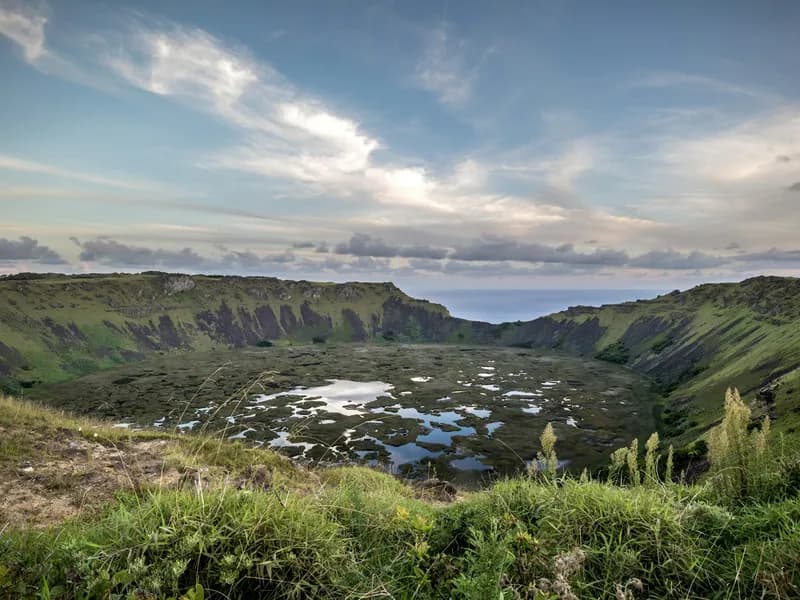
Orongo & Rano Kau Crater
A ceremonial village of stone houses perched on the rim of a vast, lake-filled volcanic crater, center of the Birdman (Tangata Manu) cult. Part of the park ticket; allow 1-2 hours. Petroglyphs and dramatic clifftop views over the sea.
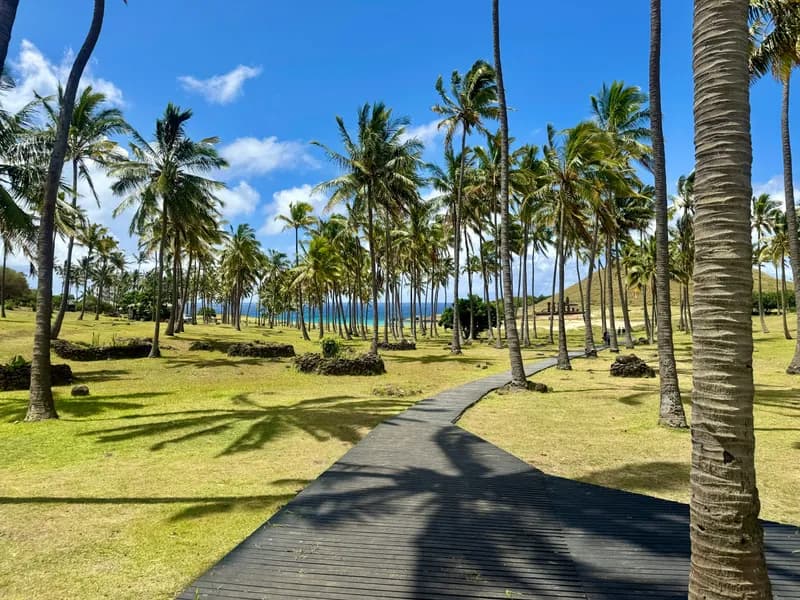
Anakena Beach
The island's only true white-sand beach, backed by coconut palms and the moai of Ahu Nau Nau. Free to swim; the ahu is inside the park. About 20 km north of town — combine with a swim and a picnic, allowing a half day.
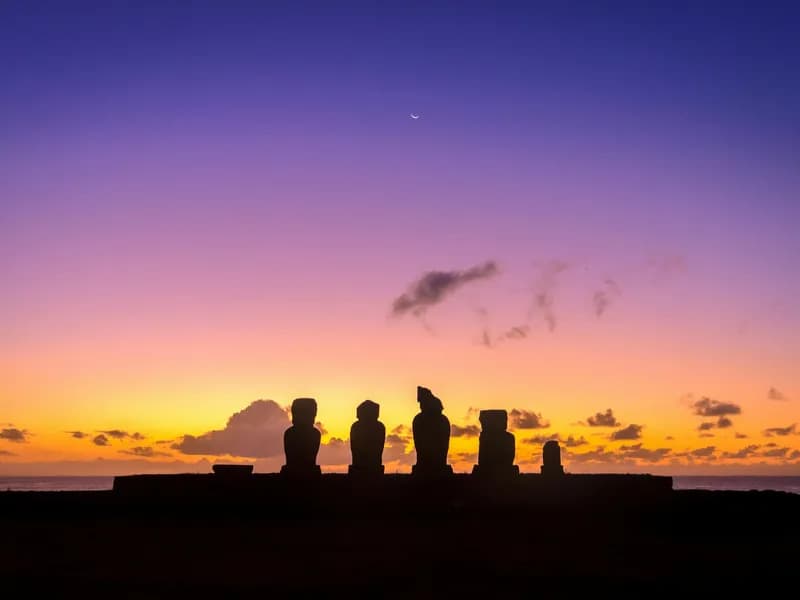
Ahu Tahai (Sunset Moai)
A trio of restored ceremonial platforms just outside Hanga Roa, including a rare moai with restored coral-and-obsidian eyes. Free and walkable from town; the best-loved sunset spot on the island. Allow an hour around dusk.

Ahu Akivi
A rare inland platform of seven moai that famously face the ocean, aligned with the equinox sunset. Covered by the park ticket; a quick roadside stop of 30-45 minutes. Said to represent the island's seven original explorers.
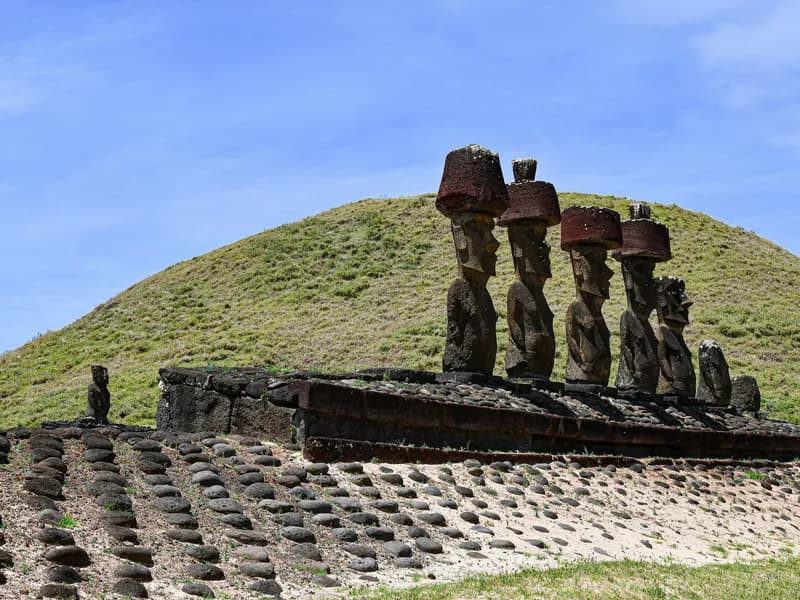
Puna Pau Quarry
The red scoria quarry where the moai's distinctive 'pukao' topknots were carved, with several finished cylinders scattered nearby. Part of the park ticket; a short 30-minute visit with a panoramic hilltop view over Hanga Roa.
Planned Itinerary
7-Day Easter Island Itinerary
Arrival in Rapa Nui & Sunset at Ahu Tahai
Land at Mataveri International (IPC) after the ~5.5-hour LATAM flight from Santiago. The runway sits right inside Hanga Roa, so hotel transfers are barely 5 minutes. Buy your park ticket, settle in, and ease into island time with a first sunset.
Buy the Rapa Nui National Park ticket at the airport CONAF desk(20 minutes)
Around USD 80 (~76,000 CLP), cash or card; valid 10 days. Guard it — you show it at nearly every site, and Rano Raraku and Orongo can each be entered only once.
Transfer & check-in in Hanga Roa(30 minutes)
Stay near Tahai for sunset walks — Altiplanico Rapa Nui or Nayara Hangaroa sit on the ocean edge; town-center guesthouses on Atamu Tekena are cheaper.
Orientation stroll along Atamu Tekena & Caleta Hanga Roa(1.5 hours)
Walk the main street, then the little fishing harbor with the solitary Ahu Tautira moai and turtles in the shallows.
Sunset at Ahu Tahai(1.5 hours)
Free and a 10-minute walk from town. Ahu Ko Te Riku here is the island's only moai with restored coral-and-obsidian eyes — it glows at dusk.
Dinner at Te Moana(1.5 hours)
Oceanfront on Atamu Tekena; grilled local tuna or ceviche around CLP 15,000.
Rano Kau Crater, Orongo & the Birdman Cult
Devote the day to the southwest corner and the towering Rano Kau volcano. Because Orongo can be entered only once on your ticket, do it properly today with time to linger on the crater rim.
Ascend to the Rano Kau crater rim(1 hour)
Drive the 7 km road or hike up from town; the reward is a mile-wide caldera cradling a reed-covered lake.
Explore Orongo ceremonial village(1.5 hours)
Restored stone houses and Birdman (Tangata Manu) petroglyphs perched on the cliff above the Motu Nui islet. One-time entry — take it slow.
Ana Kai Tangata sea cave(45 minutes)
On the south coast near the airport; red-and-white birdman paintings survive on the cave ceiling above the surf.
Lunch at La Kaleta(1 hour)
Harborside at Caleta Hanga Roa; ceviche and tuna poke around CLP 12,000 with the best water view in town.
Museo Antropológico Sebastián Englert(1 hour)
Near Tahai; the female moai, a real rongorongo replica, and the only original moai eye ever found. Entry ~CLP 1,000.
Tongariki Sunrise, Rano Raraku Quarry & the South Coast
The island's signature day. A pre-dawn drive east (~20 min) delivers sunrise behind the fifteen moai of Tongariki, then the moai 'nursery' at Rano Raraku (one-time entry), looping home along the south coast.
Sunrise at Ahu Tongariki(1.5 hours)
The grandest platform — 15 restored moai silhouetted against the dawn. Arrive by 6:30am in summer; bring a fleece, it's cold before the sun.
Rano Raraku quarry loop trail(1.5 hours)
The volcanic quarry where nearly every moai was carved; hundreds stand half-buried on the slope. One-time entry, so walk the full marked loop.
Ahu Akahanga & Ahu Vaihu(45 minutes)
Toppled moai left face-down exactly where they fell — a stark contrast to the restored sites.
Vinapu(30 minutes)
The precisely fitted stone wall behind the ahu looks uncannily Inca — a favorite puzzle for archaeologists.
Dinner at Haka Honu(1.5 hours)
Oceanfront near Tahai; fish of the day or a burger around CLP 14,000, catch the sunset from the terrace.
Free Morning & Anakena Beach
Your rest half-day. Sleep in, drift through town, then drive ~20 km north to Anakena, the island's only true white-sand beach and the legendary landing place of the first king, Hotu Matu'a.
Slow morning in Hanga Roa(2 hours)
Coffee and famously good gelato at Mikafe by the harbor, then browse the Feria Artesanal craft market.
Swim at Anakena Beach(2 hours)
Drive ~30 min north; turquoise water backed by coconut palms. Free to swim — pack a picnic and sunscreen.
Ahu Nau Nau(45 minutes)
The exquisitely preserved moai behind the beach, several with topknots and carved back detailing, protected by the sand for centuries.
Te Pito Kura on the return(30 minutes)
The round magnetic 'navel of the world' stone and Paro, the largest moai ever raised (now fallen, ~10 m).
Dinner at Kaloa(1.5 hours)
Grill house in town; well-priced meats and fish, mains around CLP 13,000.
Ahu Akivi, Puna Pau Topknots & Lava Caves
Explore the green inland heart of the island, west of center, linking two more highlight platforms with a pair of lava-tube caves.
Ahu Akivi(45 minutes)
A rare inland ahu of seven moai that face the ocean, aligned to the equinox sunset; said to be the island's seven original explorers.
Puna Pau red scoria quarry(45 minutes)
Where the reddish pukao topknots were carved; finished cylinders lie scattered, and the hilltop gives a panorama over Hanga Roa.
Ana Te Pahu (Banana Cave)(45 minutes)
A collapsed lava tube with taro and banana still growing in the sunlit sinkhole — bring a torch to go deeper.
Ana Kakenga (Two Windows Cave)(1 hour)
Crawl through a low lava tube that opens onto twin windows in the sea cliff. Torch and careful footing essential.
Dinner at Tataku Vave(1.5 hours)
Seafood at Hanga Piko harbor on the southern edge of town; superb fresh fish, mains around CLP 18,000.
Diving the Crystalline Pacific & a Curanto Feast
A day on and in the water — Rapa Nui has some of the clearest water on Earth — capped by a traditional umu earth-oven dinner and dance.
Two-tank dive with Mike Rapu or Orca Diving Center(4 hours)
Based at Caleta Hanga Roa; 40-60 m visibility over coral pinnacles and a submerged moai replica set for divers. Around CLP 60,000.
Snorkel at Poko Poko (Pea) beach(1.5 hours)
The sheltered town swimming spot if you'd rather stay on the surface; gear rents for a few thousand pesos nearby.
Afternoon rest(2 hours)
Spa time or a hammock — you've earned it before the evening feast.
Te Ra'ai cultural evening(3 hours)
Umu pae (hot-stone earth-oven) dinner and a Rapa Nui music-and-dance show just outside town, ~CLP 60,000 pp; book a day ahead.
Last Morning & Departure
A gentle final morning for photos and souvenirs before the LATAM flight back to Santiago. The airport is a 5-minute drive, so no rush.
Farewell walk at Ahu Tahai & Caleta Hanga Roa(1 hour)
One last look at the sunset moai and the harbor in the calm morning light.
Last souvenirs at the Feria Artesanal(1 hour)
Hand-carved moai, obsidian and shell jewelry, rongorongo tablets — haggle gently, and carry cash.
Tuna empanadas at Ariki o Te Pana (Tia Berta)(30 minutes)
The island's famous huge empanadas de atún near the football field, about CLP 5,000 each.
Checkout & transfer to Mataveri Airport (IPC)(45 minutes)
5-minute drive; LATAM to Santiago takes ~5.5 hours. Reconfirm your seat the day before.
14-Day Easter Island Itinerary
Arrival in Rapa Nui & Sunset at Ahu Tahai
Land at Mataveri International (IPC) after the ~5.5-hour LATAM flight from Santiago. The runway sits inside Hanga Roa, so transfers are barely 5 minutes. Buy your park ticket, settle in, and welcome the island with a first sunset.
Buy the Rapa Nui National Park ticket at the airport CONAF desk(20 minutes)
Around USD 80 (~76,000 CLP), cash or card; valid 10 days. Rano Raraku and Orongo can each be entered only once, so plan those visits deliberately.
Transfer & check-in in Hanga Roa(30 minutes)
The island's only town. Ocean-edge stays near Tahai (Altiplanico, Nayara Hangaroa) suit sunset lovers; Atamu Tekena guesthouses are more budget-friendly.
Orientation stroll along Atamu Tekena & Caleta Hanga Roa(1.5 hours)
The main street and the fishing harbor with the lone Ahu Tautira moai and green sea turtles below the pier.
Sunset at Ahu Tahai(1.5 hours)
Free, 10 minutes on foot from town; Ahu Ko Te Riku is the only moai with restored coral-and-obsidian eyes.
Dinner at Te Moana(1.5 hours)
Oceanfront on Atamu Tekena; grilled tuna around CLP 15,000.
Rano Kau Crater, Orongo & the Birdman Cult
Spend the day in the southwest on the Rano Kau volcano. Orongo is a one-time-entry site, so give it the full morning while you're fresh.
Ascend to the Rano Kau crater rim(1 hour)
A mile-wide caldera holding a reed-covered lake; drive the 7 km road or hike up from Hanga Roa.
Explore Orongo ceremonial village(1.5 hours)
Stone houses and Birdman petroglyphs on the cliff edge above Motu Nui. One-time entry — linger and read the panels.
Ana Kai Tangata sea cave(45 minutes)
Birdman paintings on the cave ceiling above the crashing south-coast surf, near the airport.
Lunch at La Kaleta(1 hour)
Harborside ceviche and poke around CLP 12,000 at Caleta Hanga Roa.
Museo Antropológico Sebastián Englert(1 hour)
The female moai, rongorongo script, and the only surviving original coral moai eye. Entry ~CLP 1,000.
Tongariki Sunrise, Rano Raraku Quarry & the South Coast
The island's signature day. Pre-dawn drive east (~20 min) for sunrise at Tongariki, the moai nursery at Rano Raraku (one-time entry), then the south-coast ruins on the way home.
Sunrise at Ahu Tongariki(1.5 hours)
15 restored moai against the dawn — the island's grandest platform. Arrive by 6:30am in summer and bundle up.
Rano Raraku quarry loop trail(1.5 hours)
Hundreds of half-buried moai on the volcano where they were all carved. One-time entry, so walk the full loop.
Ahu Akahanga & Ahu Vaihu(45 minutes)
Toppled moai left as they fell — a haunting reminder of the island's upheavals.
Vinapu(30 minutes)
The precision-fitted 'Inca-like' stone wall behind the ahu, near the airport.
Dinner at Haka Honu(1.5 hours)
Oceanfront near Tahai; fish or burger around CLP 14,000 with a terrace sunset.
Free Morning & Anakena Beach
A rest half-day. Lazy morning in town, then drive ~20 km north to Anakena, the island's only white-sand beach and the mythical landing of King Hotu Matu'a.
Slow morning in Hanga Roa(2 hours)
Coffee and gelato at Mikafe, browse the Feria Artesanal — no schedule today.
Swim at Anakena Beach(2 hours)
Turquoise water and coconut palms; free to swim. Bring a picnic — there are only a couple of food kiosks.
Ahu Nau Nau(45 minutes)
Beautifully preserved moai with topknots and carved backs, protected for centuries under the sand.
Te Pito Kura on the return(30 minutes)
The round magnetic 'navel of the world' stone and fallen Paro, the largest moai ever raised.
Dinner at Kaloa(1.5 hours)
In-town grill; meats and fish around CLP 13,000.
Ahu Akivi, Puna Pau Topknots & Ana Te Pahu Cave
The green inland heart of the island, west of center, linking two more highlight platforms with a lava-tube cave garden.
Ahu Akivi(45 minutes)
Seven inland moai that face the ocean, aligned to the equinox — the island's original explorers.
Puna Pau red scoria quarry(45 minutes)
Where the red pukao topknots were carved; hilltop panorama over Hanga Roa.
Ana Te Pahu (Banana Cave)(1 hour)
A collapsed lava tube with taro and banana in the sinkhole; a torch lets you follow the tunnel deeper.
Lunch in Hanga Roa & rest(1.5 hours)
Tuna empanadas at Tia Berta, then an easy afternoon.
Dinner at Tataku Vave(1.5 hours)
Fresh seafood at Hanga Piko harbor; mains around CLP 18,000.
Diving the Crystalline Pacific
Rapa Nui has some of the clearest water on Earth. Spend the day underwater or snorkeling, with a relaxed afternoon to recover.
Two-tank dive with Mike Rapu or Orca Diving Center(4 hours)
From Caleta Hanga Roa; 40-60 m visibility, coral pinnacles and a submerged moai replica, ~CLP 60,000.
Snorkel at Poko Poko (Pea) beach(1.5 hours)
The sheltered town swimming cove if you're not diving; easy gear rental nearby.
Afternoon rest & Mikafe(2 hours)
Recover with an ice cream over the harbor — no diving-day exertion after.
Dinner at Neptune's Table or Kotaro sushi(1.5 hours)
Fresh tuna prepared two very different ways; mains from CLP 14,000.
Summit of Maunga Terevaka
Climb the island's highest volcano (507 m), the only spot with a full 360° horizon and every coast in view. The trailhead is near Ahu Akivi / Vaitea; go by foot or on horseback.
Horseback trek or hike to the Terevaka summit(5 hours)
Ride with Pikera Uri or Cabalgatas Pantu (~CLP 45,000) or hike ~2 hours each way from the Akivi side.
360° summit panorama(30 minutes)
Ocean on every side and the whole island below — the best overview you'll get of Rapa Nui.
Picnic on the grassy slopes(45 minutes)
No facilities up top, so carry water and a packed lunch from town.
Sunset drinks at Haka Honu(1.5 hours)
Ease the saddle-sore legs with a cocktail on the oceanfront terrace.
West Coast Walk: Ahu Tepeu & Ana Kakenga Sea Cave
Follow the wild, less-visited west coast north from Tahai past ruined platforms and boat-shaped house foundations to a dramatic sea cave. A half-day walk with big surf and few people.
Coastal path from Tahai to Ahu Tepeu(2 hours)
Passes Ahu Akapu's lone moai and hare paenga (boat-house) foundations; one of the longest ahu on the island.
Ana Kakenga (Two Windows Cave)(1 hour)
Squeeze through the low lava tube to twin cliff windows over the pounding surf. Bring a torch and mind your footing.
Picnic on the clifftop(45 minutes)
Wind-blown and wave-battered; watch for the spray blowholes below.
Dinner at Te Moai Sunset(1.5 hours)
Casual grill on the north edge of town with sunset moai views, mains around CLP 13,000.
Slow Day in Hanga Roa
A well-earned rest day with no driving — the town rewards slow wandering, and half the fun of Rapa Nui is its unhurried pace.
Late breakfast at Mikafe(1 hour)
Espresso and pastries over Caleta Hanga Roa, watching the fishing boats.
Feria Artesanal Municipal craft market(1.5 hours)
On Tu'u Maheke St; carved moai, obsidian and shell jewelry, and rongorongo tablets straight from local artisans.
Swim at Poko Poko (Pea) beach(2 hours)
The town's sheltered swimming spot with a poolside restobar for a lazy afternoon.
Second sunset at Ahu Tahai(1 hour)
It never gets old, and the light is different every evening.
Dinner at Te Moana(1.5 hours)
Return for the ceviche or the catch of the day, around CLP 15,000.
Poike Peninsula Hike
The island's oldest volcano forms the remote eastern headland. A guided half-day hike over grassland cliffs — access is culturally sensitive, so go with a local guide.
Guided hike across the Poike headland(5 hours)
To Maunga Pua Katiki and past the Ana o Keke 'cave of the virgins' cliff (viewed from outside). Guide ~CLP 40,000.
The Poike ditch & isolated moai(45 minutes)
Site of the island's legendary conflict; a handful of weathered moai stand far from the crowds.
Picnic on the headland(45 minutes)
Sweeping ocean views with almost no one else around — carry everything in and out.
Casual dinner in town(1.5 hours)
Tuna empanadas at Tia Berta or a burger at Haka Honu after the long walk.
Papa Vaka Petroglyphs, Ovahe & Anakena Swim
A relaxed north-coast day pairing ancient rock art with two beaches — return to Anakena because one visit is never enough.
Papa Vaka petroglyphs(45 minutes)
Giant carvings of tuna, sharks and outrigger canoes on flat lava slabs — the island's largest petroglyph field.
Ovahe cove(1.5 hours)
A tucked-away pink-tinged beach near Anakena, quieter than its famous neighbor; watch the tide and falling rocks.
Return swim & picnic at Anakena(2 hours)
Palm shade, white sand and warm water; the food kiosks sell ceviche and empanadas if you skipped a picnic.
Ahu Nau Nau in golden light(30 minutes)
Late-afternoon sun warms the topknots — better photos than the midday glare.
Dinner at Kaloa(1.5 hours)
Back in town; hearty grill plates around CLP 13,000.
Rapa Nui Cooking & Traditional Dance
A hands-on cultural day: learn to build an umu earth oven with a local family, then a high-energy traditional dance show in the evening.
Umu (curanto) cooking experience(3 hours)
Layer chicken, fish, sweet potato and banana leaves over hot volcanic stones with a local host; ~CLP 55,000 including the feast.
Taste po'e(30 minutes)
The sweet baked banana-and-pumpkin pudding cooked in the same earth oven — the island's signature dessert.
Afternoon rest(2 hours)
Digest and nap before the show; the umu leaves you happily full.
Kari Kari (or Vai Te Mihi) dance show(1.5 hours)
Body-painted dancers, drumming and Polynesian chant; tickets ~CLP 25,000, book ahead in high season.
Motu Nui Boat Trip & Farewell Sunset
Head out to sea toward the Birdman islets off Orongo, then close the trip with a final Tahai sunset and a memorable dinner.
Boat trip to Motu Nui & Motu Iti(3 hours)
The islets the Birdman competitors once swam to; snorkel or dive the exceptionally clear water, ~CLP 60,000.
Lunch at Tataku Vave(1.5 hours)
The day's catch at Hanga Piko harbor — grilled kana kana or tuna, mains around CLP 18,000.
Final sunset at Ahu Tahai(1.5 hours)
The classic farewell; arrive early to claim a good grassy spot.
Farewell dinner at Te Moana(1.5 hours)
Toast the trip with pisco sour and the freshest tuna in town.
Departure Day
A gentle final morning for souvenirs and one last coffee before the LATAM flight to Santiago. The airport is a 5-minute drive.
Morning walk at Caleta Hanga Roa(1 hour)
A last look at the harbor moai and the turtles, coffee at Mikafe.
Last souvenirs at the Feria Artesanal(1 hour)
Hand-carved moai and obsidian pieces; carry cash, cards aren't universal.
Checkout & transfer to Mataveri Airport (IPC)(45 minutes)
5-minute drive; reconfirm your LATAM seat, and expect a flower lei send-off at the little airport.
LATAM flight to Santiago(5.5 hours)
Grab a window seat for a last aerial view of the triangular island as it slips away.
21-Day Easter Island Itinerary
Arrival in Rapa Nui & First Sunset at Tahai
Land at Mataveri International (IPC) after the ~5.5-hour LATAM flight from Santiago. The runway sits inside Hanga Roa, so transfers are barely 5 minutes. With three weeks ahead there's no rush — settle in and greet the island at sunset.
Buy the Rapa Nui National Park ticket at the airport CONAF desk(20 minutes)
Around USD 80 (~76,000 CLP), valid 10 days. Rano Raraku and Orongo are one-time entries; front-load the park sites into your first ten days and keep the receipt.
Transfer & check-in in Hanga Roa(30 minutes)
For a long stay consider a cabaña with a kitchen — self-catering from the market tames the island's high food prices.
Orientation stroll along Atamu Tekena & Caleta Hanga Roa(1.5 hours)
Learn the two main streets, the harbor with Ahu Tautira, and where the ATMs are (they sometimes run dry — draw cash early).
Sunset at Ahu Tahai(1.5 hours)
Free, a 10-minute walk from town; Ahu Ko Te Riku's restored coral eyes catch the last light.
Dinner at Te Moana(1.5 hours)
Oceanfront on Atamu Tekena; grilled tuna around CLP 15,000.
Rano Kau Crater, Orongo & the Birdman Village
Begin the park sightseeing in the southwest on the Rano Kau volcano. Orongo is a one-time entry, so give it an unhurried morning while you're fresh.
Ascend to the Rano Kau crater rim(1 hour)
A mile-wide caldera with a reed-lake below; hike up from town or drive the 7 km road.
Explore Orongo ceremonial village(1.5 hours)
Stone houses and Birdman petroglyphs on the cliff above Motu Nui; one-time entry, so read every panel.
Ana Kai Tangata sea cave(45 minutes)
Birdman ceiling paintings above the south-coast surf near the airport.
Lunch at La Kaleta(1 hour)
Harborside ceviche around CLP 12,000.
Museo Antropológico Sebastián Englert(1 hour)
The female moai, rongorongo, and the only original coral moai eye; entry ~CLP 1,000.
Tongariki Sunrise, Rano Raraku & the South Coast
The signature day. Pre-dawn drive east (~20 min) for sunrise at Tongariki, the moai nursery at Rano Raraku (one-time entry), then the south-coast ruins on the loop home.
Sunrise at Ahu Tongariki(1.5 hours)
15 moai silhouetted against the dawn; arrive by 6:30am in summer and dress warm.
Rano Raraku quarry loop trail(1.5 hours)
Hundreds of half-buried moai on the carving volcano; one-time entry, so walk the whole loop.
Ahu Akahanga & Ahu Vaihu(45 minutes)
Toppled moai left where they fell along the south coast.
Vinapu(30 minutes)
The 'Inca-like' precision stone wall near the airport.
Dinner at Haka Honu(1.5 hours)
Oceanfront terrace near Tahai; fish or burger around CLP 14,000.
Slow Day: Museum, Market & the Harbor
Your first rest day — no driving. Digest the big early sites and settle into island rhythm around Hanga Roa.
Late breakfast at Mikafe(1 hour)
Espresso and gelato over Caleta Hanga Roa.
Feria Artesanal Municipal craft market(1.5 hours)
Tu'u Maheke St; watch carvers at work and pick up obsidian jewelry and moai carvings.
Swim at Poko Poko (Pea) beach(2 hours)
The sheltered town cove with a poolside restobar.
Sunset at Ahu Tahai(1 hour)
A second, unhurried look at the sunset moai.
Dinner at Kotaro sushi(1.5 hours)
Surprisingly good tuna sushi in town, mains from CLP 14,000.
North Coast: Anakena, Ovahe, Te Pito Kura & Papa Vaka
A full north-coast circuit combining rock art, two beaches and the mythical royal landing site — drive ~20 km north and work your way along the shore.
Papa Vaka petroglyphs(45 minutes)
Giant carvings of tuna, sharks and canoes on lava slabs — the island's largest petroglyph field.
Te Pito Kura(30 minutes)
The round magnetic 'navel of the world' stone and fallen Paro, the largest moai ever raised.
Anakena Beach & Ahu Nau Nau(2.5 hours)
Swim off the island's only white-sand beach; the moai behind it are the best preserved, protected under sand for centuries.
Ovahe cove(1 hour)
The quiet pink-tinged beach next door; mind the tide and loose cliff rocks.
Dinner at Kaloa(1.5 hours)
Grill plates around CLP 13,000 back in town.
Inland Heart: Ahu Akivi, Puna Pau & Ana Te Pahu
The green west-central interior, linking two highlight platforms with a lava-tube cave garden. Short drives, gentle pace.
Ahu Akivi(45 minutes)
Seven inland moai facing the ocean, aligned to the equinox — the seven original explorers.
Puna Pau red scoria quarry(45 minutes)
Source of the red pukao topknots; panoramic hilltop over Hanga Roa.
Ana Te Pahu (Banana Cave)(1 hour)
A collapsed lava tube with taro and banana in the sinkhole; take a torch to explore the tunnel.
Lunch of tuna empanadas at Tia Berta(45 minutes)
The island's famous huge empanadas de atún, ~CLP 5,000 each.
Dinner at Tataku Vave(1.5 hours)
Fresh seafood at Hanga Piko harbor; mains around CLP 18,000.
West Coast Walk: Ahu Tepeu & Ana Kakenga Sea Cave
Follow the wild west coast north from Tahai past ruined platforms and boat-house foundations to a dramatic twin-windowed sea cave. Few people, big surf.
Coastal path from Tahai to Ahu Tepeu(2 hours)
Passes Ahu Akapu's lone moai and hare paenga foundations; one of the longest ahu on the island.
Ana Kakenga (Two Windows Cave)(1 hour)
Crawl through the lava tube to twin cliff windows over the surf; torch and careful footing needed.
Clifftop picnic(45 minutes)
Watch for blowhole spray on the rocks below.
Dinner at Te Moai Sunset(1.5 hours)
Casual grill with sunset moai views on the north edge of town, mains around CLP 13,000.
Diving the Clear Pacific
Rapa Nui has some of the clearest water on Earth. Spend the day underwater; if you're new to diving, this is the place to try it.
Two-tank dive with Mike Rapu or Orca Diving Center(4 hours)
From Caleta Hanga Roa; 40-60 m visibility over coral pinnacles and a submerged moai replica, ~CLP 60,000.
Discover Scuba option for beginners(3 hours)
No certification needed for a guided intro dive; ~CLP 55,000, and the calm clear water is ideal for first-timers.
Afternoon rest & Mikafe(2 hours)
Take it easy after diving; ice cream over the harbor.
Dinner at Neptune's Table(1.5 hours)
Fresh fish in town, mains from CLP 14,000.
Summit of Maunga Terevaka
Climb the island's highest volcano (507 m) for the only full 360° horizon and every coast in view. Trailhead near Ahu Akivi / Vaitea; go on foot or on horseback.
Horseback trek or hike to the Terevaka summit(5 hours)
Ride with Pikera Uri or Cabalgatas Pantu (~CLP 45,000) or hike ~2 hours each way.
360° summit panorama(30 minutes)
Ocean on every side and the whole triangular island below.
Picnic on the slopes(45 minutes)
No facilities up top — carry water and lunch from town.
Sunset drinks at Haka Honu(1.5 hours)
Rest tired legs with a cocktail on the oceanfront terrace.
Rest Day: Spa & Poko Poko Beach
A true do-nothing day at the midpoint of the trip. Slow travel means letting some days stay empty — Rapa Nui is best savored, not sprinted.
Long breakfast & harbor watching(1.5 hours)
Coffee at Mikafe while the fishing boats come and go.
Swim & sunbathe at Poko Poko (Pea) beach(2.5 hours)
The sheltered town swimming spot; float, read, repeat.
Spa or massage at the hotel(1.5 hours)
Several stays (Nayara Hangaroa, Hare Noi) offer treatments; walk-in rates for non-guests too.
Easy dinner at Te Moana(1.5 hours)
Return for the ceviche, around CLP 15,000.
Poike Peninsula Hike
Use the last of your 10-day park window on the remote eastern headland — the island's oldest volcano. A guided half-day hike over sensitive grassland cliffs.
Guided hike across the Poike headland(5 hours)
To Maunga Pua Katiki, past the Ana o Keke 'cave of the virgins' cliff (viewed from outside). Guide ~CLP 40,000.
The Poike ditch & isolated moai(45 minutes)
Site of the island's legendary clash; weathered moai stand far from any crowds.
Headland picnic(45 minutes)
Vast ocean views and near-total solitude — pack everything in and out.
Casual dinner in town(1.5 hours)
Empanadas at Tia Berta or a burger at Haka Honu after the long walk.
Umu Earth-Oven Cooking & Rapa Nui Language
A hands-on cultural day now that the sightseeing marathon is behind you — learn to cook the traditional way and pick up the island's Polynesian tongue.
Umu (curanto) cooking experience(3 hours)
Layer chicken, fish and sweet potato over hot volcanic stones with a local host; ~CLP 55,000 with the feast.
Rapa Nui language mini-lesson(1 hour)
Learn greetings and place-name meanings ('iorana' hello, 'maururu' thank you) with your host — it transforms how you read the sites.
Taste po'e(30 minutes)
The sweet banana-and-pumpkin pudding baked in the same earth oven.
Sunset at Ahu Tahai(1 hour)
A relaxed evening after the feast.
Photography Walk & Golden-Hour Tahai
A slow creative day built around light rather than mileage. No driving — just the town, the coast and a camera.
Morning photo walk around Hanga Roa & Caleta(2 hours)
Fishing boats, the harbor moai, murals and the cemetery's white crosses in soft early light.
Café break & editing at Mikafe(1 hour)
Cull the morning's shots over coffee and gelato.
Rest afternoon(2 hours)
Hammock, book, or a nap — this is a deliberately empty block.
Golden-hour shoot at Ahu Tahai(1.5 hours)
The best-loved sunset moai; arrive an hour before dusk to work the changing light.
Dinner at La Kaleta(1.5 hours)
Harborside poke and ceviche around CLP 12,000.
Carving Workshop, Craft Market & Kari Kari Dance
Go deeper into living Rapa Nui culture — try your hand at wood or stone carving, then a high-energy traditional dance show.
Moai carving workshop(2.5 hours)
A local artisan teaches you to carve a small moai or fish hook from wood or scoria; ~CLP 40,000 and you keep the piece.
Return to the Feria Artesanal(1 hour)
Now that you understand the craft, pick pieces with a better eye; carry cash.
Afternoon rest(1.5 hours)
Recharge before the evening show.
Kari Kari (or Vai Te Mihi) dance show(1.5 hours)
Body-painted dancers, drumming and chant; ~CLP 25,000, book ahead.
Motu Nui Boat Trip & a Second Dive
Back out to sea toward the Birdman islets off Orongo — a highlight worth doing once the winds are right, so this day is weather-flexible.
Boat trip to Motu Nui & Motu Iti(3 hours)
The islets the Birdman competitors swam to; snorkel or dive the crystal water, ~CLP 60,000.
Second dive at a new site(2 hours)
Having warmed up on day 8, explore a deeper wall or cave dive with your operator, ~CLP 45,000 for a single tank.
Lunch at Tataku Vave(1.5 hours)
The day's catch at Hanga Piko harbor, mains around CLP 18,000.
Sunset at Ahu Tahai(1 hour)
Wind down after a full water day.
Slow Beach Day at Anakena
Return to the island's only white-sand beach for a proper do-nothing day — the beach itself is free to enjoy, no park sites required.
Drive north to Anakena(30 minutes)
~20 km on the paved north road; go early to claim palm shade.
Swim, snorkel & sunbathe(3 hours)
Warm, calm turquoise water — the best swimming on the island.
Beach lunch at the kiosks(1 hour)
Ceviche, empanadas and cold drinks from the Anakena food stalls, around CLP 8,000.
Sunset dinner at Haka Honu(1.5 hours)
Back in town for the oceanfront terrace.
Rest Day in Hanga Roa
Another unhurried town day. With three weeks you can afford to let the island set the pace — wander, eat well, do nothing in particular.
Breakfast & a slow morning(2 hours)
Pastries at Mikafe, then browse the shops along Atamu Tekena.
Visit the Hanga Roa church (Iglesia de Santa Cruz)(45 minutes)
A striking blend of Catholic and Rapa Nui carving; Sunday mass includes hymns sung in Rapa Nui.
Poko Poko swim or hotel spa(2 hours)
Whichever you're in the mood for — pure downtime.
Dinner at Kotaro or Te Moana(1.5 hours)
Fresh tuna prepared your way, mains from CLP 14,000.
Fishing with the Caleta & a Sunset Feast
Join local fishermen for a morning on the water, then eat your catch — a genuine slice of island life beyond the moai.
Morning fishing trip from Caleta Hanga Roa(3 hours)
Arrange with a local boat the day before; troll for tuna and kana kana, ~CLP 50,000 for a small group.
Cook the catch(1.5 hours)
Many operators or your cabaña host will grill the day's fish, or take it to Tataku Vave to prepare.
Afternoon rest(2 hours)
Sea legs need a nap.
Sunset at Ahu Tahai(1.5 hours)
One of your last, and by now a familiar ritual.
Sunrise Photography & Favorite Corners
Revisit the free, no-ticket-needed places you've come to love, chasing the best light of the trip. A gentle, flexible day.
Dawn shoot at the Caleta & Ahu Akapu(2 hours)
Early light on the harbor and the lone coastal moai north of Tahai — both free to visit anytime.
Breakfast at Mikafe(1 hour)
Warm up over coffee and review the morning's frames.
Optional park re-entry(2 hours)
If you want one more Tongariki or Anakena visit, a fresh park ticket (~USD 80) can be bought at the CONAF office — otherwise stick to the free coast.
Farewell drinks at Haka Honu(1.5 hours)
Toast three weeks on the world's most remote island.
Farewell Day & Te Ra'ai Cultural Feast
A relaxed final full day for packing, last souvenirs and a proper send-off dinner with music and dance.
Last souvenir shopping(1.5 hours)
Final rounds of the Feria Artesanal for carvings and obsidian; carry cash, and pack fragile pieces well.
Leisurely lunch & packing(2 hours)
An easy afternoon — nothing on the schedule but the flight tomorrow.
Sunset at Ahu Tahai(1 hour)
Your farewell to the sunset moai.
Te Ra'ai cultural feast & show(3 hours)
Umu pae earth-oven dinner and a Rapa Nui dance-and-music performance just outside town, ~CLP 60,000 pp; the perfect finale.
Departure Day
A gentle final morning before the LATAM flight to Santiago. The airport is a 5-minute drive, so there's time for one last coffee.
Morning walk at Caleta Hanga Roa(1 hour)
A last look at the harbor and the turtles, coffee at Mikafe.
Any final souvenirs & empanada stop(45 minutes)
One more tuna empanada at Tia Berta for the road, ~CLP 5,000.
Checkout & transfer to Mataveri Airport (IPC)(45 minutes)
5-minute drive; reconfirm your LATAM seat and expect a flower-lei send-off.
LATAM flight to Santiago(5.5 hours)
Take a window seat for a last aerial glimpse of Rapa Nui adrift in the Pacific.
Travel Tips
Local Customs
Buy the National Park Ticket on Arrival
Almost every major site is inside Rapa Nui National Park, which charges foreigners around USD 80 (payable in cash or card at the airport or CONAF office). It's valid for 10 days, but note that Rano Raraku and Orongo can each be entered only once — plan your route accordingly.
Never Touch or Climb the Moai
The statues and their platforms (ahu) are sacred and legally protected; walking on an ahu or touching a moai can bring heavy fines and deeply offends the Rapa Nui people. Stay behind the marked stone borders and hire a local guide to understand the sites' significance.
Visa & Entry
You May Need a Tourist Entry Form
Easter Island is Chilean territory, so nationals who enter mainland Chile visa-free do the same here. Since 2018 visitors must complete a PDI entry form declaring a stay of up to 30 days and show a return ticket and proof of lodging — fill it in before boarding in Santiago.
transport
Flights Are Limited — Rent a Vehicle to Explore
Only LATAM flies here, mostly from Santiago (about 5.5 hours), so book months ahead and confirm the return leg. On the island there's no public transport; renting a 4x4, ATV, or bike is the way to reach distant ahu. Note that rental insurance often isn't offered, so drive cautiously.
Budget
Everything Is Expensive — Bring Cash
Because nearly all goods are shipped or flown in, food and fuel cost far more than the mainland. Some smaller vendors are cash-only and ATMs occasionally run dry, so carry Chilean pesos. Self-catering from the Hanga Roa market helps stretch a budget.
Ready to explore Easter Island?
Get AI-powered recommendations for your trip
Plan a Trip to Easter IslandRelated Articles
Travel GuidesEaster Island Q&A: Everything You Need to Plan a Trip to Rapa Nui
Flights, tickets, guides, timing, budget and the practical stuff nobody warns you about until you're standing at the CONAF desk. FairTravels' Easter Island desk answers the questions travelers ask most.
Travel GuidesThe Archaeology of Rapa Nui: A History Lover's Guide to Easter Island's Moai
Nearly 900 statues, a quarry frozen mid-carve, a birdman cult on a cliff, and a script nobody can fully read. If you love archaeology, Easter Island is close to a pilgrimage. Here is how to read it.
StoriesDawn at Ahu Tongariki: The Slow Wonder of Rapa Nui
Fifteen giants against the Pacific dawn, a road that circles a triangle of volcanoes, and the most remote inhabited island on Earth. Here is what Easter Island does to a traveler who slows down.