
Jerusalem

Photo: Yuval Zukerman / Unsplash
Key Facts
Best Time to Visit
Spring (March-May) and autumn (September-November) bring mild, pleasant weather. Summers are hot and dry; winters cool with occasional rain and rare snow. Expect crowds and closures around Jewish, Christian, and Muslim high holy days
Language
Hebrew and Arabic (both official); English widely spoken in tourism
Currency
Israeli New Shekel (ILS)
Time Zone
Israel Standard Time (IST, UTC+2; UTC+3 in summer DST)
Airport
Ben Gurion International (TLV) near Tel Aviv, ~45-60 minutes away by train, bus, or shared sherut taxi
Population
City proper ~980,000, the largest city in the region
Climate
Mediterranean mountain climate; hot dry summers, cool wet winters, sitting at ~750m elevation in the Judean Hills
Safety Rating
Exercise Increased Caution — tourist areas are generally calm but the wider region sees periodic unrest; always check your government's current travel advisory before and during your trip
Sabbath (Shabbat)
Most Jewish-run businesses and public transport shut down from Friday sunset to Saturday nightfall; plan food and transit around it
Top Highlights

The Western Wall (Kotel)
Judaism's holiest accessible prayer site — a surviving retaining wall of the Second Temple's Mount, where visitors of all faiths come to pray and tuck written prayers into its ancient stones. Open 24/7, free entry. Dress modestly; the plaza is divided into men's and women's sections, and men must cover their heads (paper kippot are provided). No photography on Shabbat. The atmosphere on Friday evening as Shabbat begins is deeply moving.

Church of the Holy Sepulchre
Christianity's most sacred church, traditionally built over both the site of Jesus's crucifixion (Golgotha) and his tomb. Shared, at times uneasily, by six denominations, it's a labyrinth of chapels, incense, and pilgrims. Free entry; open early morning to evening (hours vary). Expect long queues at the Edicule (the tomb). Dress modestly — covered shoulders and knees. Arrive at opening or late in the day to avoid the largest tour crowds.

Temple Mount & Dome of the Rock
The gold-capped Dome of the Rock and Al-Aqsa Mosque crown one of Islam's holiest sites, sacred also to Jews and Christians as the Temple Mount / Haram al-Sharif. Non-Muslim visitors may enter the compound (not the buildings) only during restricted morning hours via the Mughrabi Bridge by the Western Wall, subject to security and frequent closures. Entry is free but strictly controlled; dress very modestly and bring no religious texts of other faiths. Check that day's access before queuing.

The Old City & Its Four Quarters
A walled square kilometer divided into the Jewish, Muslim, Christian, and Armenian Quarters — a maze of covered souks, hidden rooftops, and layered history you could wander for days. Enter free through gates like the Jaffa or Damascus Gate. Walk the Ramparts (small fee) atop the 16th-century Ottoman walls for a rooftop perspective. Get lost deliberately, but keep a map — the alleys twist and the quarters blur into one another.
Via Dolorosa & Mount of Olives
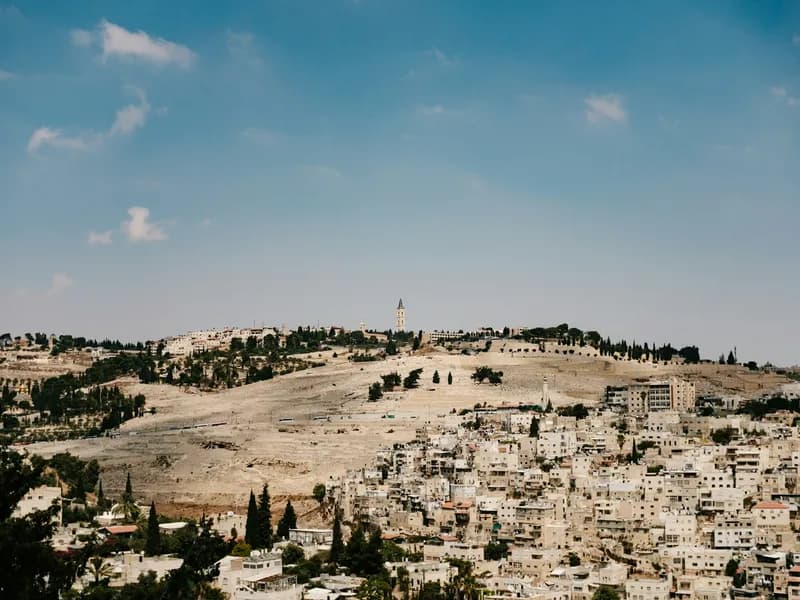
Trace the Via Dolorosa, the traditional route of Jesus's final walk marked by 14 Stations of the Cross through the Muslim and Christian Quarters (free; Franciscan-led processions run Friday afternoons). For the definitive panorama, head to the Mount of Olives, where a sweeping viewpoint overlooks the Old City and the golden Dome — best in morning light. Below lie the Garden of Gethsemane and the vast ancient Jewish cemetery.

Yad Vashem
Israel's profound World Holocaust Remembrance Center on Mount Herzl — a moving, world-class museum, memorial, and archive. The Hall of Names and the Children's Memorial are especially powerful. Free entry; allow at least 3 hours and note children under 10 aren't admitted to the main museum. Reached by light rail. An essential, sobering counterpoint to the ancient sites, best visited with time and emotional space to reflect.

Mahane Yehuda Market (The Shuk)
Jerusalem's bustling food market — a sensory feast of spices, halva, fresh produce, bakeries, and hummus joints by day that transforms into a lively bar-and-restaurant scene by night. Free to wander; come hungry. Thursday and Friday mornings are frantic as locals shop for Shabbat, when it then closes for the Sabbath. A brilliant, modern, secular contrast to the Old City and the best place to eat your way through the city.
Planned Itinerary
7-Day Jerusalem Itinerary
Arrival at Ben Gurion & Old City Gates
Land at Ben Gurion (TLV), transfer up into the Judean Hills, check in near the Old City, and get a gentle first orientation through Jaffa Gate before the jet lag hits. Keep your paper entry slip safe — you'll need it at the hotel.
Transfer from Ben Gurion to Jerusalem(35-60 minutes)
Fastest is the train to Yitzhak Navon station (~25-35 min, ~18 ILS) but it does NOT run on Shabbat. Otherwise a Nesher shared sherut taxi runs 24/7 door-to-door for ~70 ILS. Load a Rav-Kav card at the station for city travel.
Hotel check-in near Jaffa Gate / Mamilla(45 minutes)
Base yourself around Jaffa Gate, the Jewish Quarter, or the Mamilla area for walkable Old City access. Show your entry slip at reception.
Orientation walk through Jaffa Gate(1.5 hours)
Enter the Old City at Jaffa Gate, pass the Tower of David citadel, and wander the Armenian and Christian Quarter lanes just to get your bearings. Note where the gates are before dark.
Rooftop sunset drink at the Austrian Hospice(1 hour)
Climb to the Austrian Hospice rooftop terrace at the corner of the Via Dolorosa for the classic Old City skyline view and an apple strudel with coffee (~35 ILS). Quiet, calm, and a perfect first-evening spot.
Dinner in the Christian Quarter(1 hour)
Casual first-night dinner near New Gate; expect ~60-90 ILS for a mid-range meal. Turn in early for tomorrow's dawn start.
Old City Holy Sites — Dawn Start
Hit the Old City's three great faiths before the tour buses arrive. Early morning is everything here — beat both the crowds and the midday heat, and respect strict dress codes throughout.
Western Wall (Kotel) at dawn(45 minutes)
Arrive by 7am while it's quiet. Free, open 24/7. Men cover heads (paper kippot provided); modest dress for all. Tuck a written prayer into the ancient stones. No photography on Shabbat.
Temple Mount & Dome of the Rock(1.5 hours)
Non-Muslims enter the compound (not the buildings) ONLY during restricted morning hours via the Mughrabi Bridge by the Western Wall — typically ~7:30-11am, subject to security and frequent closures. Free but strictly controlled; dress very modestly, bring no other faiths' religious texts. Confirm that day's access before queuing.
Hummus lunch at Abu Shukri(1 hour)
Legendary hummus at Abu Shukri in the Muslim Quarter (on Al-Wad Street near the Via Dolorosa). A plate of hummus with pita and pickles runs ~30-45 ILS. Come hungry; cash helps.
Church of the Holy Sepulchre(1.5 hours)
Christianity's holiest church, over Golgotha and the tomb of Christ. Free; arrive after lunch as tour groups thin. Expect queues at the Edicule. Covered shoulders and knees required. A labyrinth of chapels, incense, and six denominations.
Ramparts Walk & evening rest(1 hour)
Climb the 16th-century Ottoman walls (small fee ~20 ILS) for a rooftop perspective over the quarters, then rest your feet — day two is long.
Mount of Olives, Gethsemane & Via Dolorosa
Cross the Kidron Valley for the definitive Old City panorama in morning light, descend past sacred gardens, then trace Christ's final walk back into the walls. A downhill, walkable day best done clockwise.
Mount of Olives viewpoint(1 hour)
Taxi or bus up first (~40 ILS by cab) for the sweeping panorama over the Old City and the golden Dome — best in morning light. Below spreads the vast ancient Jewish cemetery.
Garden of Gethsemane & Church of All Nations(1 hour)
Walk downhill to the Garden of Gethsemane with its ancient olive trees and the Church of All Nations. Free entry; modest dress. Quiet and moving in the early hours.
Via Dolorosa — 14 Stations of the Cross(1.5 hours)
Re-enter via the Lions' Gate and trace the traditional route of Jesus's final walk through the Muslim and Christian Quarters, ending at the Holy Sepulchre. Free; the Franciscan-led procession runs Friday afternoons.
Lunch at Lina in the Christian Quarter(1 hour)
Lina restaurant serves excellent hummus and ful just off the Via Dolorosa near the Holy Sepulchre; ~35-50 ILS. A local institution.
Free afternoon in the souks(2 hours)
Deliberately get lost in the covered Muslim Quarter souk — spices, sweets, ceramics. Haggle gently. Buy Armenian ceramics or halva. Keep a map; the alleys twist.
City of David & Western Wall Tunnels
Go underground and back in time — the layered archaeology beneath the Old City. Book the tunnel tour in advance; slots sell out. A cooler, subterranean day.
City of David archaeological park(2.5 hours)
Just south of the Dung Gate, this is Jerusalem's original core. Walk Hezekiah's Tunnel (wading through knee-deep spring water — bring sandals and a torch) or the dry Canaanite tunnel. Entry ~35 ILS; guided options more. Book ahead.
Western Wall Tunnels tour(1.25 hours)
A guided tour along the hidden northern extent of the Western Wall, deep beneath the Muslim Quarter — the Herodian stones are staggering. ~40 ILS; MUST be pre-booked online, timed entry. Modest dress.
Lunch at the Cardo / Jewish Quarter(1 hour)
Eat in the restored Jewish Quarter near the Roman Cardo; falafel or a dairy cafe, ~40-70 ILS. See the Broad Wall and Byzantine ruins on the way.
Davidson Center & Southern Wall excavations(1.5 hours)
The Jerusalem Archaeological Park (Davidson Center) reveals the monumental Herodian street and the original Temple steps pilgrims once climbed. ~30 ILS. A fitting close to an archaeology day.
Dead Sea, Masada & Ein Gedi Day Trip
A long but unmissable desert day dropping to the lowest point on Earth. Book a guided day tour or hire a driver — it's a ~1.5 hour descent through the Judean Desert. Start very early to climb Masada before the heat.
Sunrise drive to Masada(1.5 hours each way)
Guided day tours from Jerusalem run ~350-450 ILS including transport and guide. Leave ~6am to beat the desert heat on the fortress.
Masada fortress & cable car(2.5 hours)
Herod's clifftop desert fortress and the site of the Zealots' last stand. Cable car up (~72 ILS return) or the Snake Path on foot at dawn. UNESCO site; astonishing Dead Sea views.
Ein Gedi Nature Reserve(1.5 hours)
Hike the David Waterfall trail through a desert oasis — ibex and hyrax roam freely. Entry ~29 ILS. Refreshing spring pools.
Float in the Dead Sea(1.5 hours)
Float effortlessly in the mineral-rich water at a public beach (Ein Bokek or Kalia). Coat yourself in the black mud. No shaving beforehand and don't get it in your eyes. Beach entry ~50 ILS; rinse showers on site.
West Jerusalem — Yad Vashem, Israel Museum & the Shuk
Cross to modern, secular West Jerusalem via the light rail. A profound morning of remembrance, an afternoon of treasures, and a lively market evening. This is Jerusalem's other half.
Yad Vashem, World Holocaust Remembrance Center(3 hours)
On Mount Herzl, reached by the Jaffa St light rail (~6 ILS, Rav-Kav). Free entry; a moving, world-class museum — the Hall of Names and Children's Memorial especially. Allow 3+ hours; children under 10 not admitted to the main museum. Bring emotional space to reflect.
Israel Museum & Shrine of the Book(2.5 hours)
Home of the Dead Sea Scrolls in the white-domed Shrine of the Book, plus the vast Second Temple Model of ancient Jerusalem. Entry ~55 ILS. World-class archaeology and art wings.
Late lunch in the German Colony(1 hour)
Leafy Emek Refaim street in the German Colony has excellent cafes and restaurants; ~70-110 ILS. A relaxed, upscale contrast.
Evening at Mahane Yehuda Market(2.5 hours)
By night the Shuk transforms into a buzzing bar-and-restaurant scene. Dinner at Machneyuda (book ahead, ~250 ILS pp — a Jerusalem institution) or graze the stalls. Try knafeh, fresh juice, and shakshuka. The best eating in the city.
Bethlehem Morning & Departure
A short cross-boundary morning to Bethlehem, then final packing and the transfer back to Ben Gurion. Time your departure around Shabbat — the airport train doesn't run Friday sunset to Saturday night.
Half-day trip to Bethlehem(3.5 hours)
Bethlehem is in the West Bank (~10 km south). Take a guided tour (~200 ILS) or an Arab bus from Damascus Gate. Visit the Church of the Nativity over the traditional birthplace of Jesus (free) and see sections of the separation wall. Bring your passport for the checkpoint.
Last hummus or knafeh stop(45 minutes)
One final Old City hummus (Abu Shukri) or a knafeh in the Muslim Quarter before you leave; ~30-45 ILS.
Hotel checkout & pack(45 minutes)
Collect your entry slip and any last souvenirs. Confirm your transfer timing against Shabbat closures.
Transfer to Ben Gurion Airport(35-60 minutes)
Train from Yitzhak Navon (~25-35 min, not on Shabbat) or a Nesher sherut (24/7, ~70 ILS). Arrive 3 hours early — Israeli airport security is thorough.
14-Day Jerusalem Itinerary
Arrival at Ben Gurion & Old City Gates
Land at Ben Gurion (TLV), transfer up into the Judean Hills, check in near the Old City, and get a gentle first orientation through Jaffa Gate. Keep your paper entry slip safe for hotels.
Transfer from Ben Gurion to Jerusalem(35-60 minutes)
Train to Yitzhak Navon station (~25-35 min, ~18 ILS) — not on Shabbat — or a Nesher shared sherut 24/7 door-to-door for ~70 ILS. Load a Rav-Kav card for city travel.
Hotel check-in near Jaffa Gate / Mamilla(45 minutes)
Base near Jaffa Gate or the Jewish Quarter for walkable Old City access. Present your entry slip at reception.
Orientation walk through Jaffa Gate(1.5 hours)
Enter at Jaffa Gate, pass the Tower of David citadel, and wander the Armenian Quarter lanes to get your bearings before dark.
Sunset drink at the Austrian Hospice rooftop(1 hour)
Climb to the Austrian Hospice rooftop on the Via Dolorosa for the classic Old City skyline, coffee and apple strudel (~35 ILS).
Dinner in the Christian Quarter(1 hour)
Casual first-night dinner near New Gate; ~60-90 ILS. Rest for tomorrow's dawn start.
Old City Holy Sites — Dawn Start
Hit the Old City's three great faiths before the tour buses arrive. Early morning beats crowds and heat; respect strict dress codes throughout.
Western Wall (Kotel) at dawn(45 minutes)
Arrive by 7am while quiet. Free, 24/7. Men cover heads (kippot provided); modest dress. Tuck a prayer into the stones. No photography on Shabbat.
Temple Mount & Dome of the Rock(1.5 hours)
Non-Muslims enter the compound (not buildings) only during restricted morning hours via the Mughrabi Bridge — typically ~7:30-11am, subject to security and closures. Free but controlled; dress very modestly, no other faiths' texts. Confirm access first.
Hummus lunch at Abu Shukri(1 hour)
Legendary hummus on Al-Wad Street in the Muslim Quarter, ~30-45 ILS. Cash helps.
Church of the Holy Sepulchre(1.5 hours)
Christianity's holiest church over Golgotha and Christ's tomb. Free; go after lunch as groups thin. Queues at the Edicule. Covered shoulders and knees.
Ramparts Walk(1 hour)
Walk the Ottoman walls (~20 ILS) for a rooftop view over the quarters, then rest.
Mount of Olives, Gethsemane & Via Dolorosa
Cross the Kidron Valley for the definitive panorama in morning light, descend past sacred gardens, then trace Christ's final walk back inside the walls. A downhill, walkable day.
Mount of Olives viewpoint(1 hour)
Taxi up first (~40 ILS) for the sweeping panorama over the Old City and golden Dome in morning light, above the ancient Jewish cemetery.
Garden of Gethsemane & Church of All Nations(1 hour)
Walk down to the garden's ancient olive trees and the Church of All Nations. Free; modest dress. Quiet in early hours.
Via Dolorosa — 14 Stations(1.5 hours)
Re-enter via Lions' Gate and trace the route through the Muslim and Christian Quarters to the Holy Sepulchre. Free; Franciscan procession Fridays.
Lunch at Lina(1 hour)
Excellent hummus and ful near the Holy Sepulchre; ~35-50 ILS. A local institution.
Free afternoon in the souks(2 hours)
Get lost in the covered Muslim Quarter souk — spices, halva, Armenian ceramics. Haggle gently; keep a map.
City of David & Western Wall Tunnels
Go underground into the layered archaeology beneath the Old City. Pre-book the tunnel tour — slots sell out. A cooler, subterranean day.
City of David archaeological park(2.5 hours)
South of Dung Gate, Jerusalem's original core. Wade Hezekiah's Tunnel (bring sandals and a torch) or the dry route. Entry ~35 ILS. Book ahead.
Western Wall Tunnels tour(1.25 hours)
Guided tour of the hidden Western Wall beneath the Muslim Quarter — colossal Herodian stones. ~40 ILS; MUST pre-book, timed entry. Modest dress.
Lunch in the Jewish Quarter / Cardo(1 hour)
Falafel or a dairy cafe near the Roman Cardo; ~40-70 ILS. See the Broad Wall on the way.
Davidson Center & Southern Wall(1.5 hours)
The Herodian street and the original Temple steps pilgrims climbed. ~30 ILS.
West Jerusalem — Yad Vashem & Israel Museum
Cross to modern West Jerusalem by light rail. A profound morning of remembrance and an afternoon of treasures. Take the Jaffa St line from the Old City.
Yad Vashem, Holocaust Remembrance Center(3 hours)
On Mount Herzl via the light rail (~6 ILS). Free; the Hall of Names and Children's Memorial are especially moving. Under-10s not admitted to the main museum. Allow 3+ hours.
Mount Herzl(45 minutes)
Israel's national military cemetery and memorial, a short walk from Yad Vashem. Free; a quiet, reflective stop.
Israel Museum & Shrine of the Book(2.5 hours)
The Dead Sea Scrolls in the white-domed Shrine of the Book, plus the vast Second Temple Model. Entry ~55 ILS. World-class wings.
Evening at Mahane Yehuda Market(2.5 hours)
The Shuk by night — a buzzing bar scene. Dinner at Machneyuda (book ahead, ~250 ILS pp) or graze the stalls for knafeh, shakshuka, fresh juice.
Dead Sea, Masada & Ein Gedi
A long desert day to the lowest point on Earth. Guided day tour or private driver; ~1.5 hour descent through the Judean Desert. Start very early to climb Masada before the heat.
Sunrise drive to Masada(1.5 hours each way)
Guided day tours ~350-450 ILS including transport and guide. Leave ~6am to beat the heat.
Masada fortress & cable car(2.5 hours)
Herod's clifftop fortress and site of the Zealots' last stand. Cable car ~72 ILS return or the Snake Path at dawn. UNESCO site with astonishing views.
Ein Gedi Nature Reserve(1.5 hours)
Hike the David Waterfall trail through a desert oasis; ibex roam freely. Entry ~29 ILS.
Float in the Dead Sea(1.5 hours)
Float in the mineral water and coat yourself in mud at Ein Bokek or Kalia. No shaving beforehand; keep it out of your eyes. Beach ~50 ILS.
Shabbat Rest & Bethlehem
A slower Shabbat day. With the light rail, buses, and airport train shut from Friday sunset, stay local — Arab-run Old City sites and Bethlehem keep running. A built-in rest.
Experience Shabbat at the Western Wall(1.5 hours)
Friday evening as Shabbat begins, the plaza fills with song and dancing — deeply moving. No photography. If your day is Saturday, enjoy a quiet morning instead.
Half-day trip to Bethlehem(3.5 hours)
In the West Bank (~10 km south), unaffected by Shabbat. Guided tour (~200 ILS) or Arab bus from Damascus Gate. Church of the Nativity over the traditional birthplace of Jesus (free); see the separation wall. Bring your passport.
Relaxed lunch in the Old City(1 hour)
Arab-run Muslim/Christian Quarter eateries stay open on Shabbat. Hummus or maqluba, ~40-60 ILS.
Free evening(2 hours)
Rest, wander the quiet lanes, or read on a rooftop. A deliberate breather before heading north.
Transfer to Tel Aviv & Jaffa
Swap ancient stone for beachfront Bauhaus. Take the fast train down to Tel Aviv (~35 min), drop bags, and dive into the old port of Jaffa. A total change of pace.
Train to Tel Aviv(35 minutes)
From Yitzhak Navon to Tel Aviv HaHagana / Savidor Center (~28 ILS). Check in near the beach or Neve Tzedek.
Old Jaffa & the flea market(2.5 hours)
Wander Old Jaffa's stone alleys, the port, and the Shuk HaPishpeshim (flea market) with its cafes and antique stalls. Free to roam.
Lunch of hummus at Abu Hassan (Ali Karavan)(1 hour)
Jaffa's most famous hummus, in Ajami; ~30-40 ILS. Go early — they sell out and close by mid-afternoon.
Sunset on the Tel Aviv promenade(1.5 hours)
Walk the Tayelet promenade from Jaffa toward the beach for Mediterranean sunset. Dinner in the buzzing Florentin or Carmel Market area, ~80-130 ILS.
Tel Aviv — Bauhaus, Beaches & Markets
A full day of Israel's modern, secular capital of cool. Bauhaus architecture, markets, and beach time — the anti-Jerusalem. Everything runs; it barely stops for Shabbat here.
White City Bauhaus walk(2 hours)
Tel Aviv holds the world's largest concentration of Bauhaus buildings (UNESCO). Walk Rothschild Boulevard and Dizengoff; the Bauhaus Center offers maps and tours (~65 ILS).
Carmel Market (Shuk HaCarmel) lunch(1.5 hours)
Graze the bustling market — sabich, borekas, fresh juice; ~40-70 ILS. Neighboring Nachalat Binyamin has a craft fair Tue/Fri.
Beach afternoon(2 hours)
Relax on Gordon or Frishman beach — matkot paddleball, warm Mediterranean water, and sun loungers (~20 ILS).
Dinner in Neve Tzedek or Florentin(1.5 hours)
Neve Tzedek's charming lanes or gritty-cool Florentin for dinner and nightlife; ~90-150 ILS.
Caesarea & North to the Galilee
Travel north along the coast, stopping at Roman Caesarea, then continue inland to the Sea of Galilee. A driving/tour day linking coast to lake — a rental car pays off here.
Caesarea National Park(2 hours)
Herod's grand Roman port city on the sea — theatre, hippodrome, and aqueduct on the beach. Entry ~39 ILS. En route north from Tel Aviv.
Drive to the Sea of Galilee(1.5 hours)
Continue inland toward Tiberias and the lake, the heart of Jesus's Galilean ministry. Check into a lakeside guesthouse.
Lunch of St. Peter's fish(1 hour)
Grilled St. Peter's fish (tilapia) at a Tiberias lakeside restaurant; ~90-120 ILS.
Sunset by the lake(1 hour)
Walk the Tiberias promenade or a quiet shore at dusk. The Galilee is calm and green — a world away from the desert.
Sea of Galilee & Nazareth
The Christian heartland of the Galilee — the sites of Jesus's ministry ring the lake, and Nazareth sits in the hills above. A gentle, spiritual day around the water.
Capernaum & Mount of Beatitudes(2 hours)
Capernaum, Jesus's ministry base with a synagogue and St. Peter's house (~10 ILS), and the Mount of Beatitudes church overlooking the lake (free). Serene.
Tabgha & the Jordan River(1.5 hours)
Tabgha's Church of the Multiplication (free), and optionally the Yardenit baptism site on the Jordan River.
Drive to Nazareth(45 minutes)
Up into the hills to Nazareth, Jesus's hometown and Israel's largest Arab city.
Basilica of the Annunciation & old market(1.5 hours)
The vast modern Basilica of the Annunciation (free) over the traditional home of Mary, then the Arab old market. Dinner of Galilean-Arab cuisine, ~70-100 ILS.
Golan Heights or Free Day
Either explore the dramatic volcanic Golan Heights or take a well-earned slower day by the lake. A flexible buffer to recharge before returning south.
Golan Heights drive(3 hours)
Drive up to the Golan — Mount Bental's old bunkers and Syria views, waterfalls at Banias/Hermon Stream, and a Golan winery tasting (~50 ILS).
Golan winery lunch(1.5 hours)
The Golan's basalt soil produces excellent wine; lunch with a tasting at a boutique winery, ~120-160 ILS.
Kayak or swim in the Jordan(2 hours)
Seasonal Jordan River kayaking (~120 ILS) or a lake swim — a fun, active alternative for warmer months.
Relaxed lakeside evening(1.5 hours)
Quiet dinner by the Sea of Galilee. Rest up; tomorrow you head back south.
Return to Jerusalem — Loose Ends & the Shuk
Travel back to Jerusalem and use the day for whatever you missed — a second Old City wander, a museum, or serious market eating. Pack tonight to leave the morning free.
Drive/train back to Jerusalem(2.5 hours)
Return south. Drop the car or arrive by train; re-check into a Jerusalem hotel.
Tower of David Museum(1.5 hours)
The recently renovated citadel museum tells Jerusalem's whole history superbly; ~57 ILS. Great ramparts and views.
Old City souvenir shopping(1.5 hours)
Final haggling for Armenian ceramics, olive-wood carvings, and halva in the souks.
Farewell dinner at Machneyuda / the Shuk(2 hours)
One last blowout at Mahane Yehuda — Machneyuda (book ahead, ~250 ILS pp) or the buzzing bars. The best food in the city.
Departure from Ben Gurion
A final morning, then the transfer back to the airport. Mind Shabbat timing — the train doesn't run Friday sunset to Saturday night — and allow plenty of time for security.
Slow morning & last hummus(1.5 hours)
One final Abu Shukri hummus or a Muslim Quarter knafeh (~30-45 ILS), and a quiet last walk to the Western Wall to say goodbye.
Hotel checkout & pack(45 minutes)
Collect your entry slip and last souvenirs. Confirm transfer timing against Shabbat closures.
Transfer to Ben Gurion Airport(35-60 minutes)
Train from Yitzhak Navon (~25-35 min, not on Shabbat) or Nesher sherut (24/7, ~70 ILS).
Airport security & departure(3 hours)
Arrive 3 hours early — Israeli airport security is thorough and questioning is normal. Have your entry slip and travel details ready.
21-Day Jerusalem Itinerary
Arrival at Ben Gurion & Old City Gates
Land at Ben Gurion (TLV), transfer up into the Judean Hills, check in near the Old City, and get a gentle orientation through Jaffa Gate. Keep your paper entry slip safe for hotels.
Transfer from Ben Gurion to Jerusalem(35-60 minutes)
Train to Yitzhak Navon (~25-35 min, ~18 ILS) — not on Shabbat — or a Nesher sherut 24/7 door-to-door for ~70 ILS. Load a Rav-Kav card.
Hotel check-in near Jaffa Gate(45 minutes)
Base near Jaffa Gate or the Jewish Quarter for walkable Old City access. Show your entry slip.
Orientation walk through Jaffa Gate(1.5 hours)
Enter at Jaffa Gate, pass the Tower of David, and wander the Armenian Quarter lanes to get your bearings.
Sunset at the Austrian Hospice rooftop(1 hour)
Classic Old City skyline from the Austrian Hospice terrace on the Via Dolorosa; strudel and coffee ~35 ILS.
Dinner in the Christian Quarter(1 hour)
Casual first-night dinner near New Gate; ~60-90 ILS.
Old City Holy Sites — Dawn Start
Hit the Old City's three great faiths before the tour buses arrive. Early morning beats crowds and heat; respect strict dress codes.
Western Wall (Kotel) at dawn(45 minutes)
By 7am while quiet. Free, 24/7. Men cover heads (kippot provided); modest dress. No photography on Shabbat.
Temple Mount & Dome of the Rock(1.5 hours)
Non-Muslims enter the compound (not buildings) only in restricted morning hours via the Mughrabi Bridge (~7:30-11am), subject to security. Free but controlled; very modest dress, no other faiths' texts. Confirm access first.
Hummus lunch at Abu Shukri(1 hour)
Legendary hummus on Al-Wad Street, Muslim Quarter; ~30-45 ILS. Cash helps.
Church of the Holy Sepulchre(1.5 hours)
Christianity's holiest church over Golgotha and Christ's tomb. Free; go after lunch. Queues at the Edicule. Covered shoulders and knees.
Ramparts Walk(1 hour)
Walk the Ottoman walls (~20 ILS) for a rooftop view over the quarters.
Mount of Olives, Gethsemane & Via Dolorosa
Cross the Kidron Valley for the definitive panorama in morning light, descend past sacred gardens, then trace Christ's final walk back inside the walls.
Mount of Olives viewpoint(1 hour)
Taxi up first (~40 ILS) for the sweeping panorama over the Old City and golden Dome, above the ancient Jewish cemetery.
Garden of Gethsemane & Church of All Nations(1 hour)
Ancient olive trees and the Church of All Nations. Free; modest dress.
Via Dolorosa — 14 Stations(1.5 hours)
Re-enter via Lions' Gate and trace the route to the Holy Sepulchre. Free; Franciscan procession Fridays.
Lunch at Lina(1 hour)
Excellent hummus and ful near the Holy Sepulchre; ~35-50 ILS.
Free afternoon in the souks(2 hours)
Get lost in the covered Muslim Quarter souk — spices, halva, ceramics. Haggle gently; keep a map.
City of David & Western Wall Tunnels
Go underground into the layered archaeology beneath the Old City. Pre-book the tunnel tour. A cooler, subterranean day.
City of David archaeological park(2.5 hours)
South of Dung Gate, Jerusalem's original core. Wade Hezekiah's Tunnel (sandals and torch) or the dry route. Entry ~35 ILS. Book ahead.
Western Wall Tunnels tour(1.25 hours)
Guided tour of the hidden Western Wall beneath the Muslim Quarter — colossal Herodian stones. ~40 ILS; MUST pre-book, timed entry.
Lunch in the Jewish Quarter / Cardo(1 hour)
Falafel or a dairy cafe near the Roman Cardo; ~40-70 ILS. See the Broad Wall.
Davidson Center & Southern Wall(1.5 hours)
The Herodian street and the original Temple steps; ~30 ILS.
West Jerusalem — Yad Vashem & Israel Museum
Cross to modern West Jerusalem by light rail for a profound morning of remembrance and an afternoon of treasures.
Yad Vashem, Holocaust Remembrance Center(3 hours)
On Mount Herzl via the Jaffa St light rail (~6 ILS). Free; the Hall of Names and Children's Memorial are especially moving. Under-10s not admitted to the main museum. Allow 3+ hours.
Mount Herzl(45 minutes)
National military cemetery and memorial, a short walk from Yad Vashem. Free; reflective.
Israel Museum & Shrine of the Book(2.5 hours)
The Dead Sea Scrolls in the Shrine of the Book, plus the vast Second Temple Model. Entry ~55 ILS.
Evening at Mahane Yehuda Market(2.5 hours)
The Shuk by night — a buzzing bar scene. Machneyuda (book ahead, ~250 ILS pp) or graze the stalls.
Shabbat Rest & Bethlehem
A slower Shabbat day. With the light rail, buses, and airport train shut from Friday sunset, stay local — Arab-run sites and Bethlehem keep running. A built-in rest.
Shabbat at the Western Wall(1.5 hours)
Friday evening as Shabbat begins, the plaza fills with song and dancing — deeply moving. No photography.
Half-day trip to Bethlehem(3.5 hours)
West Bank (~10 km south), unaffected by Shabbat. Tour (~200 ILS) or Arab bus from Damascus Gate. Church of the Nativity (free); see the separation wall. Bring your passport.
Relaxed Old City lunch(1 hour)
Arab-run eateries stay open on Shabbat. Maqluba or hummus, ~40-60 ILS.
Free evening(2 hours)
Rest, wander quiet lanes, or read on a rooftop before heading to the desert.
Dead Sea, Masada & Ein Gedi
A long desert day to the lowest point on Earth. Guided tour or private driver; ~1.5 hour descent through the Judean Desert. Start very early to climb Masada before the heat.
Sunrise drive to Masada(1.5 hours each way)
Guided tours ~350-450 ILS with transport and guide. Leave ~6am.
Masada fortress & cable car(2.5 hours)
Herod's clifftop fortress and the Zealots' last stand. Cable car ~72 ILS return or Snake Path at dawn. UNESCO site.
Ein Gedi Nature Reserve(1.5 hours)
Hike the David Waterfall trail through a desert oasis; ibex roam. Entry ~29 ILS.
Float in the Dead Sea(1.5 hours)
Float in the mineral water and coat in mud at Ein Bokek or Kalia. No shaving beforehand; keep it out of your eyes. Beach ~50 ILS.
Desert Drive to Mitzpe Ramon (Negev)
Head deep into the Negev desert to the rim of the Ramon Crater — Israel's Grand Canyon. A dramatic drive south into stark, silent landscapes.
Drive south into the Negev(2.5 hours)
From the Dead Sea/Jerusalem down through the desert to Mitzpe Ramon. A rental car or organized desert tour works best out here.
Ramon Crater (Makhtesh Ramon) viewpoint(1.5 hours)
Stand at the visitor center on the rim of the world's largest erosion crater — 40 km long. Entry ~28 ILS. Look for Nubian ibex wandering the town's edge.
Desert lunch in Mitzpe Ramon(1 hour)
The Spice Quarter industrial zone has surprisingly good cafes and a chocolate/brewery scene; ~60-90 ILS.
Stargazing on the crater rim(1.5 hours)
Mitzpe Ramon has some of Israel's darkest skies — a nighttime desert stargazing tour (~120 ILS) or just lie back on the rim.
Negev Hike & Drive to Eilat
A desert hike in the crater, then continue to the Red Sea resort of Eilat at Israel's southern tip. Big-sky driving through the Arava.
Ramon Crater hike or jeep tour(2.5 hours)
Hike to the Carpentry (Hamakhtesh) prismatic rock formations or take a jeep tour into the crater floor (~180 ILS). Bring lots of water.
Drive to Eilat via the Arava(1.5 hours)
Continue south to Eilat on the Red Sea, bordering Egypt and Jordan. Check into a resort.
Red Sea afternoon swim(1.5 hours)
Relax on the beach; the Red Sea is warm and calm. Coral Beach south of town is best for snorkeling.
Dinner on the Eilat promenade(1.5 hours)
Seafood and resort dining along the marina; ~90-140 ILS.
Eilat — Red Sea Diving & Rest Day
A relaxed resort day of coral reefs and warm water — a genuine break in the itinerary. Snorkel or dive the reefs, or simply do nothing by the sea.
Snorkel or dive at Coral Beach Reserve(3 hours)
One of the northernmost tropical reefs in the world, right off the shore. Reserve entry ~35 ILS; guided intro dive ~250-350 ILS.
Lunch by the marina(1 hour)
Casual lunch at the Eilat marina; ~60-90 ILS.
Underwater Observatory Marine Park(2 hours)
See the reef without getting wet, plus sharks and turtles; ~119 ILS. Great for a hot afternoon.
Free evening — rest day(2 hours)
Do nothing. Pool, beach, or an early night before the long haul north tomorrow.
North to Tel Aviv & Jaffa
Travel the length of the country back to the coast. Fly Eilat to Tel Aviv (~1 hr) or drive, then settle into Tel Aviv and explore old Jaffa. A big transit day.
Eilat to Tel Aviv(1-4 hours)
A short domestic flight from Ramon Airport (~from 250 ILS) beats the ~4.5 hr drive. Check in near the Tel Aviv beach or Neve Tzedek.
Old Jaffa & flea market(2 hours)
Wander Jaffa's stone alleys, the port, and the Shuk HaPishpeshim flea market. Free to roam.
Hummus at Abu Hassan (Ali Karavan)(1 hour)
Jaffa's most famous hummus, in Ajami; ~30-40 ILS. Go early — they sell out.
Sunset on the Tel Aviv promenade(1.5 hours)
Walk the Tayelet from Jaffa toward the beach for sunset; dinner in Florentin or by Carmel Market, ~80-130 ILS.
Tel Aviv — Bauhaus, Beaches & Markets
A full day of Israel's modern capital of cool. Bauhaus architecture, markets, and beach — the anti-Jerusalem.
White City Bauhaus walk(2 hours)
The world's largest concentration of Bauhaus buildings (UNESCO). Rothschild Boulevard and Dizengoff; Bauhaus Center maps/tours ~65 ILS.
Carmel Market lunch(1.5 hours)
Graze the market — sabich, borekas, juice; ~40-70 ILS. Nachalat Binyamin craft fair Tue/Fri.
Beach afternoon(2 hours)
Relax on Gordon or Frishman beach — matkot, warm water, loungers (~20 ILS).
Dinner in Neve Tzedek(1.5 hours)
Charming lanes and fine dining in Neve Tzedek; ~90-150 ILS.
Tel Aviv Free Day & Nightlife
A flexible rest day in Tel Aviv — museums, more beach, or a day trip, then experience the city's famous night scene. Nothing here stops for Shabbat.
ANU Museum of the Jewish People or Tel Aviv Museum of Art(2.5 hours)
ANU (~52 ILS) tells the global Jewish story; the Tel Aviv Museum of Art (~50 ILS) is world-class modern architecture and collection.
Lunch and cafes on Dizengoff(1 hour)
Sit at a Dizengoff or Rothschild cafe and watch the city; ~50-80 ILS.
Free beach or pool time(2 hours)
Another slow afternoon by the Mediterranean — a genuine breather.
Tel Aviv nightlife(2.5 hours)
Dinner and bars in Florentin or Rothschild; the city stays up late. ~100-160 ILS.
Caesarea, Haifa & the Bahá'í Gardens
Head north up the coast to Roman Caesarea, then to Haifa for the spectacular terraced Bahá'í Gardens cascading down Mount Carmel. A coast-and-hillside day.
Caesarea National Park(2 hours)
Herod's Roman port — theatre, hippodrome, and seaside aqueduct. Entry ~39 ILS.
Bahá'í Gardens, Haifa(1.5 hours)
The dazzling 19-terrace gardens down Mount Carmel around the golden-domed Shrine of the Báb — a UNESCO site. Free; the upper viewpoint is stunning. Guided garden tours are free but timed; modest dress.
Lunch in the German Colony, Haifa(1 hour)
Ben Gurion Avenue below the gardens has cafes with the Shrine framed above; ~70-100 ILS.
Check in / evening in Haifa or Akko(1.5 hours)
Base in Haifa or push on to Akko. Wander Haifa's mixed Arab-Jewish neighborhoods at dusk.
Akko (Acre) — Crusader City
Explore Akko, a walled Crusader and Ottoman port city and UNESCO site — underground halls, a bustling souk, and fresh seafood. One of Israel's most atmospheric old towns.
Akko Crusader Halls & tunnels(2 hours)
The subterranean Hospitaller fortress and the Templars' Tunnel beneath the city. Combined ticket ~49 ILS. Remarkable medieval engineering.
Old Akko souk & harbour(1.5 hours)
Wander the covered market and the working fishing harbour within the sea walls. Free to roam.
Seafood lunch at Uri Buri(1.5 hours)
Uri Buri is one of Israel's most celebrated seafood restaurants, in a historic Akko house; ~150-220 ILS. Book ahead — worth it.
Drive to the Sea of Galilee(1.5 hours)
Head inland to Tiberias and the lake, checking into a lakeside guesthouse for the Galilee leg.
Sea of Galilee & Nazareth
The Christian heartland — the sites of Jesus's ministry ring the lake, and Nazareth sits in the hills above. A gentle, spiritual day around the water.
Capernaum & Mount of Beatitudes(2 hours)
Capernaum, Jesus's ministry base (~10 ILS), and the Mount of Beatitudes church over the lake (free). Serene.
Tabgha & the Jordan River(1.5 hours)
Tabgha's Church of the Multiplication (free) and optionally the Yardenit baptism site.
St. Peter's fish lunch(1 hour)
Grilled tilapia at a Tiberias lakeside restaurant; ~90-120 ILS.
Nazareth & Basilica of the Annunciation(2 hours)
Up to Nazareth for the vast Basilica of the Annunciation (free) and the Arab old market. Dinner of Galilean-Arab cuisine, ~70-100 ILS.
Golan Heights & Wineries
Explore the dramatic volcanic Golan Heights — old bunkers, waterfalls, and some of Israel's best wine. Big views toward Syria and Lebanon.
Mount Bental & the Golan lookout(1.5 hours)
Old army bunkers and trenches with sweeping views into Syria; free. Stark and evocative.
Banias / Hermon Stream waterfalls(1.5 hours)
A lush nature reserve with an ancient temple to Pan and Israel's largest waterfall; entry ~29 ILS.
Golan winery tour & lunch(2 hours)
The Golan's basalt soil yields excellent wine; a boutique winery tour and lunch, ~120-160 ILS.
Return to the lake, relaxed evening(1.5 hours)
Quiet dinner by the Sea of Galilee. A slower end to the northern leg.
Galilee Free Day
A well-earned rest day in the green Galilee — a lake cruise, a hot spring, a Druze village lunch, or simply lakeside idleness. Recharge before returning to Jerusalem.
Boat cruise on the Sea of Galilee(1.5 hours)
A wooden boat ride across the calm lake from Tiberias (~60 ILS) — the same waters of the Gospels.
Druze village lunch on Mount Carmel or the Golan(1.5 hours)
Hearty Druze pita, labneh, and stuffed vegetables in a village like Daliyat al-Karmel or Majdal Shams; ~60-90 ILS.
Hamat Gader hot springs (optional)(2 hours)
Thermal-mineral pools in a valley near the Yarmouk; ~99 ILS. Relaxing for tired legs.
Lazy lakeside evening(1.5 hours)
Do nothing by the water. A deliberate rest before the drive south.
Return to Jerusalem — Loose Ends
Travel back to Jerusalem and use the day for whatever you missed on the first pass — a museum, a quieter Old City wander, or serious market eating.
Drive/train back to Jerusalem(2.5 hours)
Return south, drop the car, and re-check into a Jerusalem hotel.
Tower of David Museum(1.5 hours)
The renovated citadel museum tells Jerusalem's whole history superbly; ~57 ILS. Great ramparts and views.
Mea Shearim & Nachlaot wander(1.5 hours)
Walk the ultra-Orthodox Mea Shearim (dress very conservatively; no photos of people) and the artsy Nachlaot lanes. A window into another world.
Dinner at Machneyuda / the Shuk(2 hours)
Return to Mahane Yehuda for the city's best food — Machneyuda (book ahead, ~250 ILS pp) or the bars.
Jerusalem Deep Cuts & Farewell
A final full day for the details — a lesser-seen museum, a rooftop, and a last slow lap of the Old City before you leave. Pack tonight to keep the morning free.
Church of the Holy Sepulchre revisit at dawn(1 hour)
Return at opening (~5am on some days) when it's near-empty and you can enter the Edicule without a queue. Utterly different from the crowded daytime.
Rooftop promenade of the Old City(1.5 hours)
Walk the little-known rooftops where the Christian, Muslim, and Jewish Quarters meet — access near the Cardo/Habad Street. A quiet, panoramic secret. Free.
Farewell hummus at Abu Shukri(1 hour)
One last plate of the city's best hummus in the Muslim Quarter; ~30-45 ILS.
Final souvenir shopping & pack(2 hours)
Last haggling for Armenian ceramics, olive wood, and halva, then pack. Confirm your transfer against Shabbat timing.
Departure from Ben Gurion
A final morning, then the transfer back to the airport. Mind Shabbat timing — the train doesn't run Friday sunset to Saturday night — and allow plenty of time for security.
Slow morning & goodbye at the Western Wall(1.5 hours)
A quiet last walk to the Kotel and a final Muslim Quarter knafeh (~25-40 ILS).
Hotel checkout & pack(45 minutes)
Collect your entry slip and last souvenirs. Confirm transfer timing against Shabbat.
Transfer to Ben Gurion Airport(35-60 minutes)
Train from Yitzhak Navon (~25-35 min, not on Shabbat) or Nesher sherut (24/7, ~70 ILS).
Airport security & departure(3 hours)
Arrive 3 hours early — Israeli airport security is thorough and questioning is normal. Have your entry slip and details ready.
Travel Tips
Safety
Check Current Travel Advisories Before and During Your Trip
Jerusalem's main tourist areas are usually calm, but the broader region experiences periodic unrest and the situation can change quickly. Read your own government's up-to-date travel advisory before booking and again before you go, register with your embassy if recommended, keep travel insurance that fits the risk level, and avoid demonstrations. Follow local news and any instructions from security personnel, especially around holy sites and holidays.
Local Customs
Dress Modestly and Respect Each Faith's Rules
This is a deeply religious city. Cover shoulders and knees at all holy sites; men cover their heads at the Western Wall (free kippot provided), and women may need a scarf at some sites. Never photograph people praying without asking, avoid photography at the Western Wall on Shabbat, and dress especially conservatively in ultra-Orthodox neighborhoods like Mea Shearim, where immodest dress and phones on Shabbat cause genuine offense.
Everything Stops for Shabbat — Plan Ahead
From Friday sunset to Saturday nightfall, most Jewish-run shops, restaurants, and public transport (buses, the light rail, and trains to the airport) shut down completely. Stock up on food and cash beforehand, and note that some hotels use a 'Shabbat elevator' that stops on every floor. Arab-run businesses in the Old City and East Jerusalem, plus sherut shared taxis, keep running — so you won't starve, but planning saves frustration.
transport
Train or Sherut from Ben Gurion, Light Rail in the City
From Ben Gurion Airport the fast train reaches Jerusalem's Yitzhak Navon station in ~25-35 minutes (but doesn't run on Shabbat), while shared sherut taxis run door-to-door 24/7 for a fixed fare. Within Jerusalem, the modern light rail and buses cover most sights cheaply — buy a rechargeable Rav-Kav card. The Old City is walkable and largely pedestrian; wear sturdy shoes for the worn, uneven stone lanes.
Visa & Entry
Visa-Free for Many, and Keep Your Entry Slip
Citizens of the US, UK, EU, Canada, Australia and many others enter Israel visa-free for up to 90 days. Israel no longer stamps passports — you receive a paper (or digital) entry slip; keep it safe, as you'll need it for hotels and car rental. Note that an Israeli entry record can complicate later travel to a few countries, so ask border staff not to stamp if that concerns you. Some nationalities must pre-register online, so check current rules.
Budget
Israel Is Pricey — Eat at the Shuk and Use a Rav-Kav
Jerusalem is expensive by regional standards: mid-range meals easily run 60-120 ILS and hotels are costly, especially around holidays. Save by eating falafel, hummus, and market food at Mahane Yehuda, staying in the Old City hostels or guesthouses, and loading a Rav-Kav transit card instead of taking taxis. Many top sites (Western Wall, Holy Sepulchre, Yad Vashem, Old City wandering) are free — the history costs nothing.
Related Articles
StoriesFour Thousand Years, One Gate: Walking Into the Old City of Jerusalem
Step through the Damascus Gate and four thousand years press in at once — incense and spice, prayer and footfall, the golden dome catching the first light. This is a scene-by-scene walk through the walled heart of Jerusalem.
Travel GuidesThe Complete Jerusalem Travel Guide for 2026
Everything you need to plan Jerusalem: the best time to go, getting in from Ben Gurion, where to stay in the Old City's four quarters, what to see, what to eat, budgets in shekels, safety, and the Hebrew and Arabic phrases that open doors.
StoriesWhat Locals Know About Jerusalem That No Guidebook Tells You
Ask anyone who lives inside the Old City walls and they'll tell you the same thing: Jerusalem rewards the early riser and punishes the crowd-follower. Here's the distilled local wisdom on Shabbat, the shuk, and where the good hummus really is.