
Lyon

Key Facts
Best Time to Visit
May to June and September to October; 8 December for the Fête des Lumières
Language
French (English widely spoken in the centre)
Currency
Euro (EUR)
Time Zone
CET (UTC+1), CEST (UTC+2) in summer
Airport
Lyon-Saint Exupéry (LYS), 25 km east — Rhônexpress tram to Part-Dieu in 30 min (~€16)
Population
520,000 (city proper), 2.3 million (metro area) — France's third-largest city
Climate
Semi-continental — warm summers (25-30°C), cold winters (0-8°C)
Safety Rating
Generally Safe (Level 1)
UNESCO Status
500 hectares covering Vieux Lyon, Fourvière, Presqu'île and Croix-Rousse, inscribed 1998
Top Highlights

Basilique Notre-Dame de Fourvière
The white basilica on the hill, free to enter, open daily ~7AM-7PM. Take the funicular from Vieux Lyon on a single metro ticket (~€2) rather than the steep 20-min climb. Allow 1h with the terrace, which reaches Mont Blanc on a clear day. Locals call the hill 'the hill that prays' — Croix-Rousse opposite is 'the hill that works'.
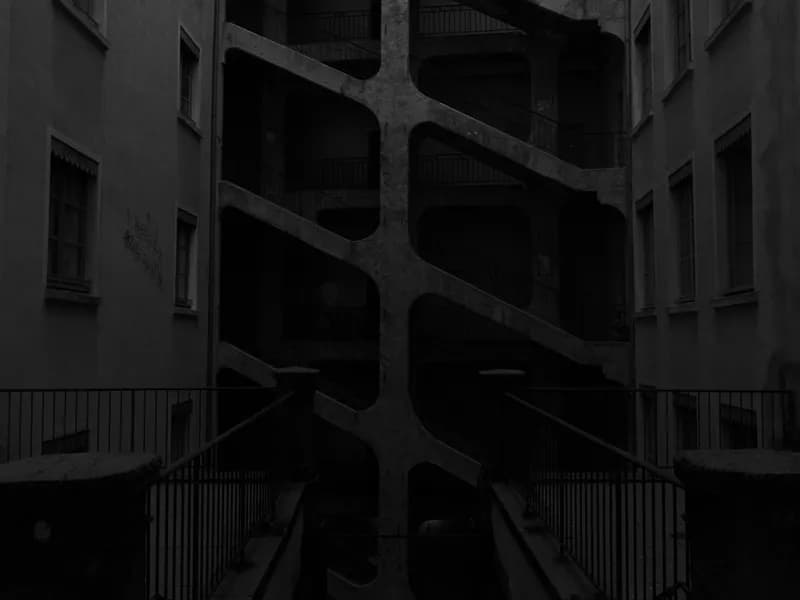
Vieux Lyon & the Traboules
The largest Renaissance quarter in Europe after Venice, threaded with traboules — covered passageways cutting straight through buildings and courtyards, built so silk could cross town dry. Around 40 are open to the public and free; look for the small plaque beside the door. Cour des Voraces in Croix-Rousse is the spectacular one.
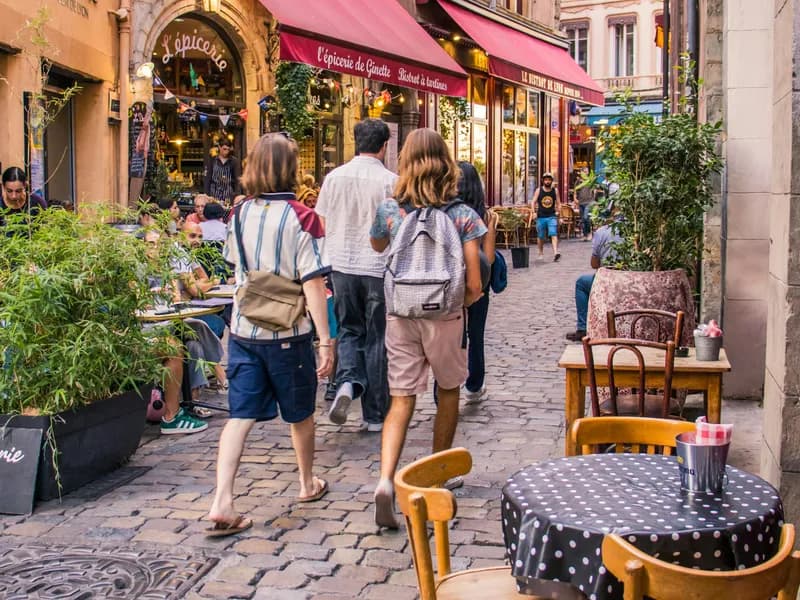
Les Bouchons Lyonnais
The city's defining institution: small taverns serving quenelle de brochet, andouillette, salade lyonnaise and praline tart. Only ~20 hold the certified 'Les Bouchons Lyonnais' label — look for the Gnafron puppet sticker in the window. Set menus run €25-35. Most close Sunday and Monday.

Musée des Confluences
A deconstructivist crystal of steel and glass at the exact tip of the peninsula where the Rhône meets the Saône. Entry ~€12 for permanent plus temporary shows, closed Mondays. Allow 2-3h. Take tram T1 to the terminus — the building alone justifies the trip.
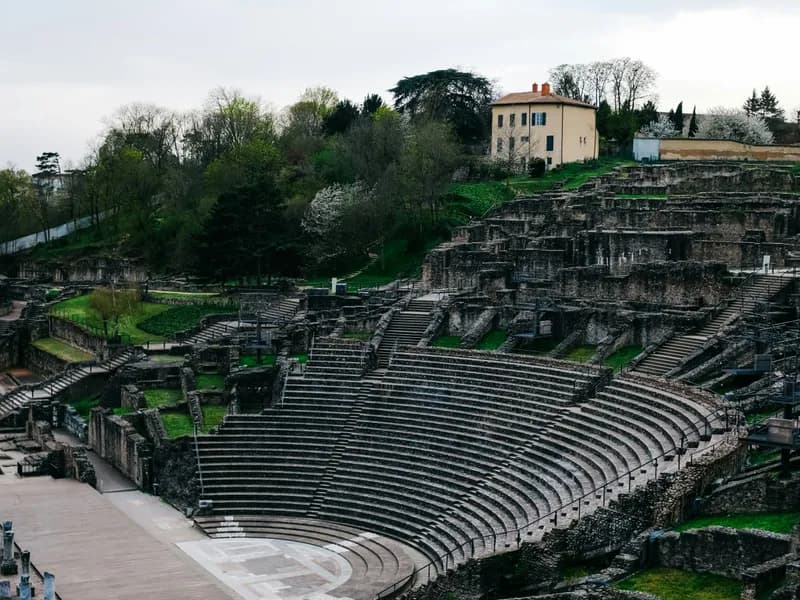
Théâtres Romains de Fourvière
A Roman theatre from 15 BC seating 10,000, carved into the hillside and still in use — the Nuits de Fourvière festival stages concerts here every June and July. Free entry to the site, daily 7AM-7PM. Allow 1h. Lugdunum, the Roman city, was capital of all Gaul.
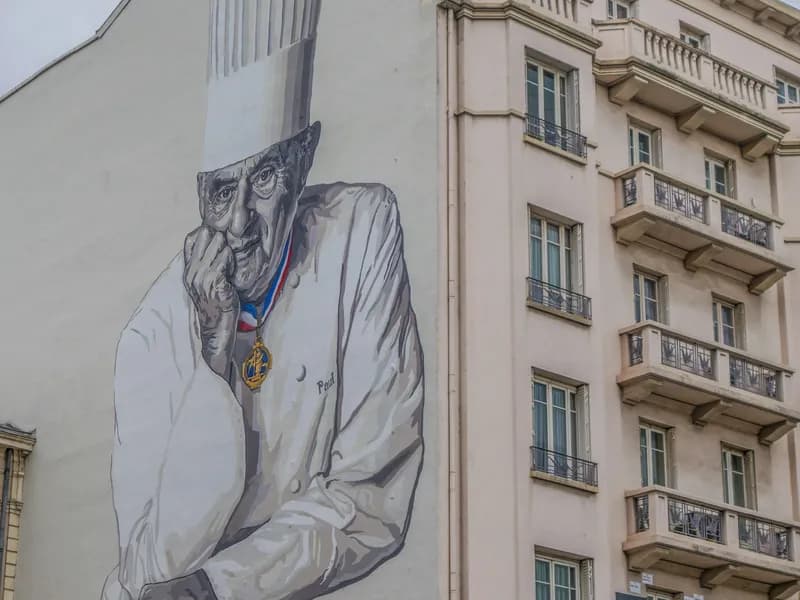
Halles de Lyon Paul Bocuse
The indoor market named for the chef who defined modern French cooking, with ~48 vendors. Tue-Sat 7AM-10:30PM, Sun 7AM-1PM, closed Mondays. Free. Allow 1-2h. Do it properly: Saint-Marcellin cheese from Mère Richard and a dozen oysters with a glass of white, standing at the counter.
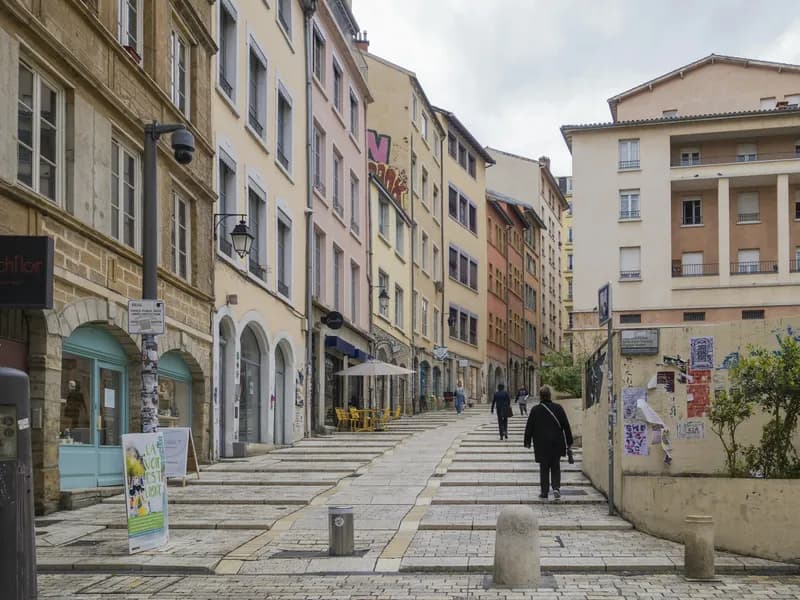
Mur des Canuts
The largest trompe-l'œil fresco in Europe — 1,200 m² of painted Croix-Rousse street that looks entirely real from across the road. Free, outdoors, always visible. Allow 20 min. It has been repainted three times since 1987 so the painted residents visibly age. Pair it with the Fresque des Lyonnais on the Saône quays.
Planned Itinerary
7-Day Lyon Itinerary
Arrival & First Steps on the Presqu'île
Land at Lyon-Saint Exupéry and take the Rhônexpress tram to Part-Dieu (30 min, ~€16 one way — steep for the distance, but it is the only direct link). Check into the Presqu'île around Cordeliers or Bellecour, the flat spine of the city between the two rivers, then walk off the flight before an early bouchon dinner.
Rhônexpress tram from LYS to Part-Dieu(30 minutes)
Buy on the platform machine, ~€16 one way, trams every 15 min from 5AM to midnight. From Part-Dieu take metro B one stop to Saxe-Gambetta then D to Bellecour, or a 10-min taxi (~€15). Keep your bag close at Part-Dieu — the station surrounds are the one part of central Lyon worth watching.
Check in around Cordeliers or Bellecour(45 minutes)
The Presqu'île puts you a 10-min walk from Vieux Lyon, the foot of Croix-Rousse and the Rhône quays. Hôtel des Célestins and Hôtel Silky are honest mid-range; Cour des Loges in Vieux Lyon if you are splurging.
Place Bellecour and the Presqu'île spine(1 hour)
Europe's largest pedestrian square, all raked red gravel and nowhere to sit — the Lyonnais treat it as a crossroads, not a destination. Find the small Saint-Exupéry statue on the east side (he was born five minutes away at 8 rue Alphonse Fochier), then walk north up rue de la République.
Aperitif at Le Comptoir de la Bourse(1 hour)
33 rue de la Bourse. Proper cocktails at €12-14 in a room that takes it seriously without being precious. Ask for a communard if you want the local move: kir made with Beaujolais instead of white.
Dinner at Le Garet(2 hours)
7 rue du Garet, a certified bouchon with the Gnafron sticker in the window — book a day or two ahead, it seats about 40 and closes weekends. Menu around €30. Start with the saladiers, then quenelle de brochet sauce Nantua. Wine arrives in a pot lyonnais, the 46cl bottle with the ridiculous thick base.
Fourvière — the Hill That Prays
Up the hill early, before the heat and the coach groups. The funicular from Vieux Lyon is part of the TCL network, so a standard ~€2 ticket covers it — locals call it la ficelle, the string. Basilica, Roman theatres and the Lugdunum museum all sit within ten minutes of each other, then you walk back down into the old town.
Funicular F2 from Vieux Lyon to Fourvière(5 minutes)
Metro D to Vieux Lyon, then the funicular from the same station hall. ~€2 on a normal TCL ticket, no separate fare — do not let anyone sell you a special one. Two lines run: F2 up to Fourvière for the basilica, F1 to Saint-Just for the far end of the hill.
Basilique Notre-Dame de Fourvière(1 hour)
Free, daily around 7AM-7PM. Go into the crypt below first — austere and empty while everyone crowds the gold-drenched upper church. From the esplanade the whole city lays out beneath you, and on a clear winter morning Mont Blanc sits on the horizon 200 km east. The rooftop tour (~€10, seasonal) is worth it if the sky is sharp.
Théâtres Romains de Fourvière(1 hour)
Free, daily 7AM-7PM, five minutes downhill from the basilica. The big theatre dates to 15 BC and seated 10,000 when Lugdunum was capital of all Gaul; the odeon beside it is smaller and better preserved. Sit high on the tiers — the acoustics still work. In June and July the Nuits de Fourvière festival stages concerts on this exact stone.
Lugdunum Musée et Théâtres Romains(1.5 hours)
17 rue Cléberg, ~€7, closed Mondays. Bernard Zehrfuss buried it in the hillside so it barely exists from outside — you spiral down a concrete ramp past the Claudian Tablet, the bronze record of the speech Emperor Claudius gave in AD 48 arguing that Gauls should sit in the Roman Senate.
Jardin des Curiosités and the walk down(1 hour)
Take F1 one stop to Saint-Just for this small free terrace at Place de l'Abbé Larue — a dozen chairs facing the best free view in Lyon and almost nobody in them. Then walk down Montée du Chemin Neuf into Vieux Lyon, about 15 min of cobbles and switchbacks. Wear real shoes.
Dinner at Daniel et Denise Saint-Jean(2 hours)
36 rue Tramassac, at the bottom of the hill. Joseph Viola is a Meilleur Ouvrier de France and world champion of pâté en croûte — order it, it arrives as a wedge of pastry with a foie gras and sweetbread core. €35-45 à la carte. Book ahead.
Vieux Lyon, the Traboules and Guignol
The largest Renaissance quarter in Europe after Venice, and the whole point is what you cannot see from the street. Traboules cut straight through buildings and courtyards — around 40 are open to the public, free, marked by a small bronze plaque beside the door. Push the door; it opens. Keep your voice down, because people live here.
Cathédrale Saint-Jean and the astronomical clock(45 minutes)
Free, open from 8:15AM. The 14th-century astronomical clock in the north transept still runs its automaton show — a rooster crows, angels move — at 12PM, 2PM, 3PM and 4PM. Look at the west front too: Protestants smashed the statues in 1562 and the empty niches were never refilled.
The Long Traboule, 54 rue Saint-Jean to 27 rue du Bœuf(30 minutes)
The famous one: four courtyards and four buildings threaded end to end, emerging a whole street away. Open roughly 8AM-7PM. Silk was carried through these dry; the Resistance used them to lose the Gestapo. Look up in the second courtyard for the spiral stair towers.
Tour Rose and rue du Bœuf(30 minutes)
16 rue du Bœuf — a pink Renaissance stair tower in a courtyard you can simply walk into, free. The street takes its name from the stone ox carved on the corner at number 36. This is the quieter of the two main old-town streets; rue Saint-Jean absorbs the crowds.
Lunch at Les Adrets(1.5 hours)
30 rue du Bœuf. The weekday lunch formule runs €20-24 for three courses and is one of the honest deals in a quarter full of traps. Rule of thumb here: a laminated menu in six languages, a host waving you in, or anything advertising pizza means walk on.
Musée Gadagne(2 hours)
1 place du Petit Collège, ~€8, closed Monday and Tuesday. Two museums in one Renaissance mansion — Lyon's history downstairs, the marionette museum upstairs — but the real prize is the hanging garden on the roof, four floors up, with a café and almost nobody in it.
Guignol at the Théâtre Le Guignol de Lyon(1 hour)
2 rue Louis Carrand. Guignol was invented here in 1808 by a silk worker turned tooth-puller, and he is still a Lyonnais rather than a children's character — the Compagnie des Zonzons plays satire for adults on some evenings, €12-16. Book online.
Nightcap at La Cave des Voyageurs(1 hour)
7 place Saint-Paul, at the quiet north end of the quarter. A cellar wine bar with Beaujolais crus by the glass from €4 and a cheese plate that leans hard on Saint-Marcellin.
Croix-Rousse — the Hill That Works
The silk-weavers' hill and Lyon's most self-contained neighbourhood: the plateau still calls itself 'the village'. Take metro C from Hôtel de Ville — it is a rack railway, the only one on the French metro network, and it climbs hard. Go on a market morning.
Marché de la Croix-Rousse(1.5 hours)
Along Boulevard de la Croix-Rousse, Tuesday to Sunday roughly 6AM-1PM. A real neighbourhood market, not a tourist one — Bresse chickens with the blue leg tag, cardoons in winter, and stallholders who will absolutely tell you that you have chosen the wrong melon.
Maison des Canuts(1 hour)
10-12 rue d'Ivry, ~€9 for the guided visit with a live demonstration on a Jacquard loom, usually 11AM and 3:30PM, Tue-Sat. A canut could weave about 20 cm a day at 24,000 threads. Understanding that number is the point of the whole hill.
Mur des Canuts(20 minutes)
36 boulevard des Canuts, metro C to Hénon. 1,200 m² of trompe-l'œil, the largest in Europe, and from across the road you will genuinely try to walk into it. Repainted three times since 1987, so the painted residents have visibly aged and the children have grown up. Free, always there.
Praline tart at Sébastien Bouillet(20 minutes)
15 place de la Croix-Rousse. The pink praline tart is the Lyonnais dessert and Bouillet makes the version worth the sugar coma — a slice about €5. The chocolate shop next door is where you buy gifts you will not actually give away.
Cour des Voraces(30 minutes)
9 place Colbert, or in from 14bis montée Saint-Sébastien. A six-storey open stair cascade in a courtyard, built around 1840, and the most spectacular traboule in the city — the canuts fortified it during the 1848 revolt. Free, still residential, so keep it quiet.
Walk down the Montée de la Grande Côte(45 minutes)
The old spine of the hill, pedestrian the whole way from the plateau down to Terreaux. Detour into Passage Thiaffait, now the Village des Créateurs — around 20 independent designers with actual studios — and rue Burdeau below it is the best browsing street in Lyon.
Dinner at Café des Fédérations(2 hours)
8-10 rue du Major Martin, at the foot of the slopes. Certified bouchon: sausages hanging over the bar, red-checked cloths, and no decisions to make — the ~€30 menu just arrives, saladiers first, and you eat what Lyon eats. Book.
Rest Day: Tête d'Or, the Brotteaux and Les Halles
A deliberate day off from hills and cobbles. Sleep in, then spend it flat on the Rive Gauche — the park, the 6th arrondissement, and Les Halles Paul Bocuse in the late afternoon when the vendors are winding down but the counters are still serving.
Late breakfast at Slake Coffee House(1 hour)
3 rue Chavanne. Lyon's coffee scene is thin but Slake is the real thing — proper filter about €4 and a flat white that would pass in Melbourne. Mokxa on the same street is the other one worth the walk.
Parc de la Tête d'Or(2.5 hours)
Free, open 6:30AM-10:30PM in summer. 117 hectares with a lake you can row on (~€10 for 30 min) and a free zoo, but the greenhouses from the 1860s are the actual reason to come — Victorian iron and glass full of palms. The roseraie peaks in June with 30,000 plants.
Wander the Brotteaux(1 hour)
The 6th arrondissement: Haussmann-scale buildings, no tourists, and the old Brotteaux station on place Jules Ferry, an 1859 beauty that is now a brasserie. This is where Lyon's money lives and it is an excellent place to do nothing.
Bernachon(30 minutes)
42 cours Franklin Roosevelt, closed Mondays. One of a handful of chocolatiers on earth that roasts its own beans from scratch. Buy a small box of palets d'or, about €10. The tea room next door does the Président cake that Paul Bocuse commissioned.
Halles de Lyon Paul Bocuse(1.5 hours)
102 cours Lafayette, a 10-min walk south. Tue-Sat 7AM-10:30PM, Sun to 1PM, closed Monday, free to enter. Do it standing: a dozen oysters and a glass of Mâcon at the counter, then Saint-Marcellin from Mère Richard — she is the reason Bocuse himself shopped here — and rosette and a sabodet from Maison Sibilia for the road.
Dinner at Brasserie L'Est(2 hours)
14 place Jules Ferry, inside the old Brotteaux station. One of Bocuse's four compass-point brasseries; a model train runs on a track above the diners, which sounds naff and is somehow perfect. Mains €20-26. Easier to book than a bouchon, and open Sundays, which most bouchons are not.
Beaux-Arts, Terreaux and the Confluence
A north-to-south run down the peninsula: the great museum at Terreaux in the morning, then tram T1 to the tip where the Rhône swallows the Saône and the architecture goes deliberately strange. End with the best meal of the trip.
Musée des Beaux-Arts(2.5 hours)
20 place des Terreaux, ~€8, closed Tuesdays, 10AM-6PM. A 17th-century abbey holding the second-best collection in France after the Louvre — Perugino, Veronese, a serious Egyptian wing and a Soulages room. Start at the top and work down. The cloister garden is free to sit in even without a ticket.
Place des Terreaux and the Bartholdi fountain(30 minutes)
The lead fountain of four horses charging into the sea is by Bartholdi, the Statue of Liberty man — Bordeaux commissioned it, could not pay, and Lyon bought it. The 69 small fountains set into the paving are Buren's. The Hôtel de Ville behind is 1670s.
Lunch at Culina Hortus(1.5 hours)
38 rue de l'Arbre Sec. A serious vegetable restaurant in the world capital of pork, which is a joke the chef is fully in on — lunch menu around €29 and one of the best kitchens in the 1st. Book. If you want the opposite, Le Musée at 2 rue des Forces is a certified bouchon two minutes away.
Tram T1 to the Musée des Confluences(20 minutes)
Metro A from Hôtel de Ville to Perrache (5 min), then T1 south along quai Rambaud to the Musée des Confluences stop. A normal ~€2 ticket covers both. You watch the old docks turn into the new quarter through the window.
Musée des Confluences(2.5 hours)
86 quai Perrache, ~€12 including temporary shows, closed Mondays. Coop Himmelb(l)au's deconstructivist crystal sits on the exact point where the two rivers meet, and the building alone justifies the trip. Inside it refuses to be a natural history museum — a mammoth beside a Ferrari beside Tuareg jewellery, arranged by question rather than category.
Quai Rambaud, La Sucrière and the Cube Orange(1.5 hours)
Walk back north along the dock. La Sucrière at number 49 is a 1930s sugar warehouse that now hosts the Biennale; the Cube Orange at number 96 is Jakob+MacFarlane's building with a hole punched through it. Le Sucre, the rooftop on La Sucrière, runs drinks and DJs from spring to autumn — €5-10 entry, the view is the point.
Dinner at La Mère Brazier(2.5 hours)
12 rue Royale. Eugénie Brazier's original room, where she became the first woman to hold three Michelin stars in 1933 and where Bocuse trained; Mathieu Viannay runs it now at two stars. Menus from ~€95 at lunch, €145+ at dinner. Order the volaille de Bresse demi-deuil, truffle slid under the skin — that is her dish and this is her house. Book weeks ahead.
Saint-Antoine Market and Departure
Save the riverside market for the last morning — it is the best food shopping in the city and most of it travels. Then a slow lap of the quays, checkout, and the Rhônexpress back to LYS.
Marché Saint-Antoine(1.5 hours)
Quai Saint-Antoine, Tuesday to Sunday roughly 6AM-1PM, closed Monday. Two hundred metres of stalls along the Saône with Fourvière across the water. Come hungry — someone will be selling saucisson brioché that you should eat standing up. For cheese to fly home, ask for 'sous vide, pour l'avion' and they will do it without comment.
Fresque des Lyonnais(20 minutes)
49 quai Saint-Vincent, a 10-min walk north along the water. Thirty famous Lyonnais painted six storeys up a blank gable wall — Bocuse in his whites at ground level, the Lumière brothers, Saint-Exupéry leaning out of a window with the Little Prince. Free, and the counterpart to the Mur des Canuts.
Last shopping at Voisin(30 minutes)
Branches across the Presqu'île including 28 rue de la République. Buy coussins de Lyon — green marzipan cushions with a curaçao ganache, about €12 a box — which are the correct gift and survive a flight far better than the Saint-Marcellin does.
Checkout and Rhônexpress to LYS(1.5 hours)
Metro to Part-Dieu, then the Rhônexpress from the tram platform on the east flank of the station — allow 10 min to find it, the signage is poor. 30 min to the airport, ~€16, departures every 15 min. Be at LYS two hours out: since the EU Entry/Exit System went live, non-EU passports get a face scan and fingerprints and the queue is slower than the old stamp.
14-Day Lyon Itinerary
Arrival & First Steps on the Presqu'île
Land at Lyon-Saint Exupéry and take the Rhônexpress tram to Part-Dieu (30 min, ~€16 one way — steep for the distance, but it is the only direct link). Check into the Presqu'île around Cordeliers or Bellecour, the flat spine between the two rivers, then walk off the flight before an early bouchon dinner.
Rhônexpress tram from LYS to Part-Dieu(30 minutes)
Buy on the platform machine, ~€16 one way, every 15 min from 5AM to midnight. From Part-Dieu take metro B one stop to Saxe-Gambetta then D to Bellecour, or a 10-min taxi (~€15). Keep your bag close at Part-Dieu — the station surrounds are the one part of central Lyon worth watching.
Check in around Cordeliers or Bellecour(45 minutes)
For two weeks, take an apartment rather than a hotel — you will want a fridge for the Halles haul. The Presqu'île puts you a 10-min walk from Vieux Lyon, the foot of Croix-Rousse and the Rhône quays.
Place Bellecour and the Presqu'île spine(1 hour)
Europe's largest pedestrian square, all raked red gravel and nowhere to sit — the Lyonnais treat it as a crossroads, not a destination. Find the small Saint-Exupéry statue on the east side (he was born five minutes away at 8 rue Alphonse Fochier), then walk north up rue de la République.
Aperitif at Le Comptoir de la Bourse(1 hour)
33 rue de la Bourse. Proper cocktails at €12-14 in a room that takes it seriously without being precious. Ask for a communard: kir made with Beaujolais instead of white, which is the local move and costs about €6.
Dinner at Chez Hugon(2 hours)
12 rue Pizay. A certified bouchon, family-run since 1969, maybe ten tables, and Madame will tell you what you are eating rather than ask. ~€30 for the menu. The tablier de sapeur — breaded, fried tripe — is the dish to be brave about on night one. Book.
Fourvière — the Hill That Prays
Up the hill early, before the heat and the coach groups. The funicular from Vieux Lyon is part of the TCL network, so a standard ~€2 ticket covers it — locals call it la ficelle, the string. Basilica, Roman theatres and the Lugdunum museum sit within ten minutes of each other, then you walk back down.
Funicular F2 from Vieux Lyon to Fourvière(5 minutes)
Metro D to Vieux Lyon, then the funicular from the same station hall. ~€2 on a normal TCL ticket, no separate fare. Two lines run: F2 to Fourvière for the basilica, F1 to Saint-Just for the far end of the hill.
Basilique Notre-Dame de Fourvière(1 hour)
Free, daily around 7AM-7PM. Go into the crypt first — austere and empty while everyone crowds the gold-drenched upper church. From the esplanade the city lays out below and on a clear winter morning Mont Blanc sits on the horizon 200 km east. The rooftop tour (~€10, seasonal) is worth it if the sky is sharp.
Théâtres Romains de Fourvière(1 hour)
Free, daily 7AM-7PM, five minutes downhill from the basilica. The big theatre dates to 15 BC and seated 10,000 when Lugdunum was capital of all Gaul; the odeon beside it is smaller and better preserved. Sit high on the tiers — the acoustics still work. In June and July the Nuits de Fourvière festival stages concerts on this stone.
Lugdunum Musée et Théâtres Romains(1.5 hours)
17 rue Cléberg, ~€7, closed Mondays. Bernard Zehrfuss buried it in the hillside so it barely exists from outside — you spiral down a concrete ramp past the Claudian Tablet, the bronze record of the speech Claudius gave in AD 48 arguing that Gauls should sit in the Roman Senate.
Jardin des Curiosités and the walk down(1 hour)
Take F1 one stop to Saint-Just for this small free terrace at Place de l'Abbé Larue — a dozen chairs facing the best free view in Lyon and almost nobody in them. Then walk down Montée du Chemin Neuf into Vieux Lyon, 15 min of cobbles and switchbacks.
Dinner at Daniel et Denise Saint-Jean(2 hours)
36 rue Tramassac. Joseph Viola is a Meilleur Ouvrier de France and world champion of pâté en croûte — order it, it arrives as a wedge of pastry with a foie gras and sweetbread core. €35-45 à la carte. Book ahead.
Vieux Lyon, the Traboules and Guignol
The largest Renaissance quarter in Europe after Venice, and the whole point is what you cannot see from the street. Traboules cut straight through buildings and courtyards — around 40 are open to the public, free, marked by a small bronze plaque beside the door. Push the door; it opens. Keep your voice down, because people live here.
Cathédrale Saint-Jean and the astronomical clock(45 minutes)
Free, open from 8:15AM. The 14th-century astronomical clock in the north transept still runs its automaton show — a rooster crows, angels move — at 12PM, 2PM, 3PM and 4PM. Look at the west front: Protestants smashed the statues in 1562 and the empty niches were never refilled.
The Long Traboule, 54 rue Saint-Jean to 27 rue du Bœuf(30 minutes)
The famous one: four courtyards and four buildings threaded end to end, emerging a whole street away. Open roughly 8AM-7PM. Silk was carried through these dry; the Resistance used them to lose the Gestapo. Look up in the second courtyard for the spiral stair towers.
Tour Rose and rue du Bœuf(30 minutes)
16 rue du Bœuf — a pink Renaissance stair tower in a courtyard you can simply walk into, free. The street takes its name from the stone ox carved on the corner at number 36. This is the quieter of the two main old-town streets; rue Saint-Jean absorbs the crowds.
Lunch at Les Adrets(1.5 hours)
30 rue du Bœuf. The weekday lunch formule runs €20-24 for three courses and is one of the honest deals in a quarter full of traps. Rule of thumb here: a laminated menu in six languages, a host waving you in, or anything advertising pizza means walk on.
Musée Gadagne(2 hours)
1 place du Petit Collège, ~€8, closed Monday and Tuesday. Two museums in one Renaissance mansion — Lyon's history downstairs, the marionette museum upstairs — but the real prize is the hanging garden on the roof, four floors up, with a café and almost nobody in it.
Guignol at the Théâtre Le Guignol de Lyon(1 hour)
2 rue Louis Carrand. Guignol was invented here in 1808 by a silk worker turned tooth-puller, and he is still a Lyonnais rather than a children's character — the Compagnie des Zonzons plays satire for adults on some evenings, €12-16. Book online.
Nightcap at La Cave des Voyageurs(1 hour)
7 place Saint-Paul, at the quiet north end of the quarter. A cellar wine bar with Beaujolais crus by the glass from €4 and a cheese plate that leans hard on Saint-Marcellin.
Croix-Rousse — the Hill That Works
The silk-weavers' hill and Lyon's most self-contained neighbourhood: the plateau still calls itself 'the village'. Take metro C from Hôtel de Ville — a rack railway, the only one on the French metro network, and it climbs hard. Go on a market morning.
Marché de la Croix-Rousse(1.5 hours)
Along Boulevard de la Croix-Rousse, Tuesday to Sunday roughly 6AM-1PM. A real neighbourhood market, not a tourist one — Bresse chickens with the blue leg tag, cardoons in winter, and stallholders who will absolutely tell you that you have chosen the wrong melon.
Maison des Canuts(1 hour)
10-12 rue d'Ivry, ~€9 for the guided visit with a live demonstration on a Jacquard loom, usually 11AM and 3:30PM, Tue-Sat. A canut could weave about 20 cm a day at 24,000 threads. Understanding that number is the point of the whole hill.
Mur des Canuts(20 minutes)
36 boulevard des Canuts, metro C to Hénon. 1,200 m² of trompe-l'œil, the largest in Europe, and from across the road you will genuinely try to walk into it. Repainted three times since 1987, so the painted residents have visibly aged and the children have grown up. Free, always there.
Praline tart at Sébastien Bouillet(20 minutes)
15 place de la Croix-Rousse. The pink praline tart is the Lyonnais dessert and Bouillet makes the version worth the sugar coma — a slice about €5.
Jardin Rosa Mir(30 minutes)
87 Grande rue de la Croix-Rousse, through an unmarked gate, free. A mason named Jules Senis spent 30 years covering a hidden terraced garden in seashells and stones after a cancer recovery he credited to the Virgin. Tiny opening hours — Saturday afternoons and some weekdays, April to October only — and one of the strangest things in France.
Cour des Voraces(30 minutes)
9 place Colbert, or in from 14bis montée Saint-Sébastien. A six-storey open stair cascade in a courtyard, built around 1840, and the most spectacular traboule in the city — the canuts fortified it during the 1848 revolt. Free, still residential, so keep it quiet.
Down the Grande Côte and dinner at Café des Fédérations(3 hours)
Walk down the Montée de la Grande Côte, the pedestrian spine from the plateau to Terreaux, detouring into Passage Thiaffait and the Village des Créateurs. Dinner at 8-10 rue du Major Martin: certified bouchon, sausages over the bar, and the ~€30 menu just arrives. Book.
Les Halles, Beaux-Arts and Terreaux
The Presqu'île's museum day, bookended by food. Start at the covered market on the Rive Gauche while the vendors are fresh, cross back over the Rhône for the Musée des Beaux-Arts, and finish with an opera or a bouchon at Terreaux.
Halles de Lyon Paul Bocuse(1.5 hours)
102 cours Lafayette, metro B to Part-Dieu then a 10-min walk. Tue-Sat 7AM-10:30PM, Sun to 1PM, closed Monday, free. Do it properly and standing: a dozen oysters and a glass of Mâcon at the counter, Saint-Marcellin from Mère Richard — she is the reason Bocuse himself shopped here — and rosette from Maison Sibilia. Giraudet does the quenelles.
Musée des Beaux-Arts(2.5 hours)
20 place des Terreaux, ~€8, closed Tuesdays, 10AM-6PM. A 17th-century abbey holding the second-best collection in France after the Louvre — Perugino, Veronese, a serious Egyptian wing and a Soulages room. Start at the top and work down. The cloister garden is free to sit in even without a ticket.
Place des Terreaux and the Bartholdi fountain(30 minutes)
The lead fountain of four horses charging into the sea is by Bartholdi, the Statue of Liberty man — Bordeaux commissioned it, could not pay, and Lyon bought it. The 69 small fountains in the paving are Buren's. The Hôtel de Ville behind is 1670s.
Opéra de Lyon(1 hour)
1 place de la Comédie. Jean Nouvel kept the 1831 neoclassical shell and dropped a black glass barrel vault on top of it, which locals hated for about a decade and now love. Tickets from ~€15 in the gods; even without one, the dancers rehearse in the glass-walled studio at the top and you can watch from the street after dark.
Dinner at Le Musée(2 hours)
2 rue des Forces. A certified bouchon in a former stable, one small room, blackboard menu, ~€25-30. The Sunday-Monday closure that catches everyone out applies here too — if it is shut, La Meunière at 11 rue Neuve is five minutes away and does the saladiers lyonnais as eight bowls you serve yourself from.
Rest Day: Parc de la Tête d'Or and the Brotteaux
A deliberate day off. No hills, no cobbles, no museums with a timed entry. Spend it flat on the Rive Gauche in the 6th arrondissement, where Lyon stops performing for visitors and just gets on with a Saturday.
Late breakfast at Slake Coffee House(1 hour)
3 rue Chavanne. Lyon's coffee scene is thin but Slake is the real thing — proper filter about €4. Mokxa on the same street is the other one worth the walk.
Parc de la Tête d'Or(3 hours)
Free, 6:30AM-10:30PM in summer. 117 hectares with a lake you can row on (~€10 for 30 min) and a free zoo, but the greenhouses from the 1860s are the actual reason to come — Victorian iron and glass full of palms. The roseraie peaks in June with 30,000 plants. Rent a Vélo'v (€1.80 day pass, first 30 min of each trip free) and do a lap.
Wander the Brotteaux(1.5 hours)
Haussmann-scale buildings, no tourists, and the old Brotteaux station on place Jules Ferry, an 1859 beauty now converted to a brasserie. This is where Lyon's money lives and it is an excellent place to do nothing.
Bernachon(30 minutes)
42 cours Franklin Roosevelt, closed Mondays. One of a handful of chocolatiers on earth that roasts its own beans from scratch. A small box of palets d'or is about €10. The tea room next door does the Président cake Paul Bocuse commissioned.
Dinner at Brasserie L'Est(2 hours)
14 place Jules Ferry, inside the old station. One of Bocuse's four compass-point brasseries; a model train runs on a track above the diners, which sounds naff and is somehow perfect. Mains €20-26, easier to book than a bouchon, and open Sundays when most bouchons are dark.
The Confluence
South to the tip of the peninsula, where the Rhône swallows the Saône and Lyon decided to build something that looks nothing like the rest of it. Tram T1 from Perrache down quai Rambaud, an old dockland turned into an architecture showroom.
Tram T1 to the Musée des Confluences(20 minutes)
Metro A to Perrache, then T1 south along quai Rambaud to the Musée des Confluences stop. A normal ~€2 ticket covers both legs. You watch the docks turn into the new quarter through the window.
Musée des Confluences(3 hours)
86 quai Perrache, ~€12 including temporary shows, closed Mondays. Coop Himmelb(l)au's deconstructivist crystal sits on the exact point where the two rivers meet, and the building alone justifies the trip. Inside it refuses to be a natural history museum — a mammoth beside a Ferrari beside Tuareg jewellery, arranged by question rather than category. Take the outside ramp for the confluence view.
Lunch on the quai Rambaud docks(1.5 hours)
The Confluence's food is newer and lighter than the bouchon world — the pontoon terraces along the old dock do plates for €15-20 with water on three sides. Le Sucre's ground-floor room and the Docks bars all serve; nothing here is a bouchon and nothing is pretending to be.
La Sucrière and the Cube Orange(1.5 hours)
Walk north up the dock. La Sucrière at 49 quai Rambaud is a 1930s sugar warehouse that now hosts the Lyon Biennale (art in odd years, dance in even); the Cube Orange at number 96 is Jakob+MacFarlane's building with a hole punched through it. Le Monolithe and the green cube are on the same 800 m stretch.
Sunset drink at Le Sucre(2 hours)
Rooftop of La Sucrière, spring to autumn, €5-10 entry. Concrete, deckchairs, a DJ, and the sun going down behind Fourvière with the whole peninsula in front of you. It turns into a serious electronic club after midnight — the same crew runs Nuits Sonores every May.
Beaujolais — Golden Stone and the Crus
Hire a car for the day (from ~€45 at Part-Dieu; the villages are unreachable otherwise) and drive 45 min north-west into the pierres dorées country, where every wall is built of ochre limestone that glows at the end of the day. Nine of the ten Beaujolais crus sit in a 20 km strip further north. This is not the wine you think it is.
Oingt(1.5 hours)
45 min from Lyon on the D485 then D96. Classed among the Plus Beaux Villages de France and built entirely of golden stone; park below and walk up through the Porte de Nizy. Climb the tower of the old keep (~€2, honesty box) for the whole Azergues valley. The Chapelle Saint-Mathieu at the top is usually empty.
Lunch in Vaux-en-Beaujolais(1.5 hours)
Vaux is the real Clochemerle from Gabriel Chevallier's 1934 novel and leans into it shamelessly — there is a museum in the village hall about a fictional urinal scandal. The Auberge de Clochemerle does a serious tasting menu (book ahead), or the village cafés will feed you andouillette and a pot of Beaujolais-Villages for €18.
Tasting at Château Thivin, Côte de Brouilly(1.5 hours)
Odenas, on the flank of Mont Brouilly. The oldest estate on the hill, run by the Geoffray family since 1877, and the wines are the argument against everyone who dismisses gamay — mineral, structured, ageing a decade. Tastings by appointment, bottles €15-30. Villié-Morgon is 15 min north if you want the natural-wine pilgrimage to Marcel Lapierre's cellar.
Mont Brouilly summit(45 minutes)
Drive up to the chapel at 484 m — Notre-Dame-aux-Raisins, built in 1857 to beg the Virgin to stop the mildew. Vines fall away in every direction and on a clear evening you get the Alps to the east. Free, five minutes' walk from the car park.
Fleurie, Chiroubles and the drive home(1.5 hours)
Loop through Fleurie and Chiroubles on the D68, the route des crus — 20 km of ridge road with a cru sign every couple of kilometres. Back in Lyon in 1h10 on the A6. If you happen to be here on the third Thursday of November, the whole region is drunk by dawn.
Cooking Class and the Silk Workshops
A deliberately slow day that earns the food you have been eating. Market in the morning, hands in the kitchen, then an afternoon in the silk trades that paid for all of it. No trains, no hills, nothing timed after 6PM.
Market and cooking class at Plum Lyon Teaching Kitchen(5 hours)
Croix-Rousse. Lucy Vanel runs small English-language classes — about six people — that start at the Croix-Rousse market choosing what is actually good that morning, then cook it in her kitchen and eat it with wine. Around €165-185 per person. Book weeks ahead; this is the best food thing you can do in Lyon that isn't eating.
Atelier de Soierie(1 hour)
33 rue Romarin, at the foot of the slopes, Mon-Sat. Free demonstrations of hand silk-screen printing and gold-leaf lamé, done by the people who restore fabric for Versailles. They print scarves while you watch and sell them from €35. No pressure, no coach parties.
Soierie Saint-Georges(45 minutes)
11 rue Mourguet, Vieux Lyon. Ludovic de la Calle weaves on 19th-century Jacquard looms to order — the last workshop in Lyon doing it commercially. Demonstrations most afternoons, free, and the clacking is deafening in the best way. Ask what he is currently making; it is usually for a château.
Aperitif on the Berges du Rhône(2 hours)
The péniches moored along quai Victor Augagneur — La Marquise and Le Sirius are the institutions. Beer €5, a DJ from about 8PM, and half of Lyon under 35 sitting on the bank watching the river go by. Sitting on the grass with your own bottle is free and entirely the local move.
Pérouges — a Medieval Village 40 Minutes Out
A walled hill village that time forgot so thoroughly it now doubles as a film set — The Three Musketeers has been shot here twice. Take the TER from Part-Dieu to Meximieux-Pérouges (35-40 min, ~€9), then a 20-min uphill walk. You are back in Lyon by mid-afternoon with the evening free.
TER to Meximieux-Pérouges(40 minutes)
From Part-Dieu, roughly hourly, ~€9 each way. Buy at the yellow machines or on SNCF Connect. The station sits at the bottom of the hill; the village is a 2 km walk up through fields, or a €10 taxi from the station car park.
The walled village and rue des Rondes(2 hours)
Enter by the Porte d'En-Haut, past the église-forteresse whose north wall doubles as the rampart. Everything inside is cobbles laid in the 13th century — ankle-turning and unimproved, which is the whole charm. The circuit of rue des Rondes takes 30 min; the lime tree on Place du Tilleul was planted in 1792 as a liberty tree.
Galette de Pérouges at the Hostellerie(1 hour)
Place du Tilleul. The galette is why people come: a thin sugar-crusted brioche baked to order and served hot with crème, about €12 and enough for two. The Hostellerie invented it in 1912, and the terrace on the square is where you eat it.
Musée du Vieux Pérouges(45 minutes)
Also on Place du Tilleul, ~€5. Two rooms of hemp-weaving tools and village oddments in a 13th-century house — small, and worth it for the building rather than the collection. Skip it if the weather is good and you would rather sit on the ramparts.
Evening back in Lyon: dinner at La Meunière(2 hours)
11 rue Neuve, a five-minute walk off rue Mercière — which looks like the place to eat and is largely a trap. La Meunière is certified, ~€30, and famous for the saladiers lyonnais: eight bowls of lentils, tripe, herring and pig's trotter arrive and you help yourself until you stop.
Vienne — Roman Gaul, 30 Minutes South
Lyon gets the fame but Vienne has the better-preserved Roman town: a complete temple standing in the middle of a shopping street, a theatre bigger than Fourvière's, and a museum across the river built directly on the excavated town. TER from Part-Dieu, 30 min, ~€8.
Temple d'Auguste et de Livie(30 minutes)
Place du Palais, free, and the shock is how casual it is — a complete 1st-century BC temple with its columns intact, sitting in a square with cafés around it. It survived by being turned into a church, then a courthouse, then a museum. Nobody is looking at it but you.
Théâtre antique de Vienne(1 hour)
7 rue du Cirque, ~€4, closed Mondays out of season. 13,000 seats cut into Mont Pipet, bigger than Fourvière's, and buried under 17 metres of earth until 1908. Climb to the top row. Jazz à Vienne fills it every night from late June to mid-July — Miles Davis, Ella Fitzgerald and Chet Baker all played this stone.
Lunch at L'Estancot, or La Pyramide if you are committing(1.5 hours)
L'Estancot at 4 rue de la Table Ronde does criques — grated potato galettes, the Ardèche speciality — for about €15. Or do it properly: La Pyramide at 14 boulevard Fernand Point is Fernand Point's old house, the restaurant that trained Bocuse, Troisgros and Chapel, now two stars under Patrick Henriroux. Lunch from ~€75. Book.
Musée gallo-romain de Saint-Romain-en-Gal(2 hours)
Across the Rhône on the right bank, 15 min on foot over the bridge, ~€6, closed Mondays. Built over 7 hectares of excavated Roman town — you walk on glass above actual streets, houses and workshops. The mosaic collection is the best outside Arles.
Cathédrale Saint-Maurice and the Pyramide(45 minutes)
The cathedral took 400 years and shows it — Romanesque at the bottom, flamboyant Gothic at the top, with the same 1562 iconoclast damage as Lyon's. Then walk 10 min south to the Pyramide, a 20 m obelisk that stood on the spine of the Roman circus. Trains back to Lyon run until about 10PM.
Free Morning, then the Birth of Cinema
A genuine rest day with one obligation in the afternoon. Monplaisir, out in the 8th on metro D, is where the Lumière brothers filmed workers leaving their factory in 1895 — the first film ever shot. Then the trip's second Michelin dinner.
Free morning(3 hours)
Do nothing, on purpose. If you insist: the Sunday Marché de la Création on quai Romain Rolland (artists selling their own work, 6AM-1PM), a Vélo'v run along the Berges du Rhône (€1.80 day pass, first 30 min free), or an hour in the Musée des Beaux-Arts cloister with a book — no ticket needed for the garden.
Institut Lumière(2 hours)
25 rue du Premier Film, metro D to Monplaisir-Lumière, ~€8, closed Mondays. The Lumière family villa, and 50 metres away the hangar wall that appears in the first film in history. Thierry Frémaux, who runs Cannes, runs this too — the programming in the cinema downstairs is exceptional and tickets are about €7.
Centre d'Histoire de la Résistance et de la Déportation(1.5 hours)
14 avenue Berthelot, ~€8, closed Monday and Tuesday, a 10-min metro ride back toward the centre. Housed in the building the Gestapo used as its Lyon headquarters, where Klaus Barbie tortured people in the cellars. Lyon was the capital of the Resistance and this museum does not flinch. Go while you still have energy for it.
Dinner at Takao Takano(2.5 hours)
33 rue Malesherbes, 6th. Two stars, and the most quietly precise cooking in Lyon — Japanese technique on Rhône-Alpes produce, in a dining room with almost nothing on the walls. Menus from ~€80 at lunch, €150+ at dinner. Book a month out. If it is full, Les Apothicaires at 23 rue de Sèze is the other one to try.
Côte-Rôtie, Condrieu and Tain-l'Hermitage
The northern Rhône starts 30 km south of Lyon and the vineyards are almost vertical — terraces on 60-degree granite that must be worked by hand. Rent a car (~€45) and drive the N86/D386 down the right bank. This is syrah and viognier at their global best, and the day ends in a chocolate factory. Pick a driver before you leave.
Ampuis and the Côte-Rôtie terraces(1.5 hours)
40 min from Lyon. The 'roasted slope' is a 3 km wall of terraces above the village, split into Côte Blonde and Côte Brune — the story goes that a lord left one to each daughter. E. Guigal at Château d'Ampuis takes visitors by appointment; Domaine Jamet and Stéphane Ogier are the ones sommeliers whisper about. Tastings €15-30, often refunded against a purchase.
Condrieu(1 hour)
10 min south. Two hundred hectares total, all viognier, and the wine nearly went extinct in the 1960s — down to 8 hectares before Georges Vernay rebuilt it. Vernay's cellar on rue Nationale tastes by appointment; a bottle starts around €40 and is worth it once in your life. Château-Grillet, a single-estate appellation of 3.5 hectares, is next door and sells to almost nobody.
Lunch at Le Beau Rivage, or on the bank(1.5 hours)
2 rue du Beau Rivage, Condrieu — a Michelin-listed riverside room with a terrace over the Rhône, lunch from about €45. Or do it cheap: rosette and a baguette from the village and eat on the bank watching the barges push up from Marseille.
Tain-l'Hermitage and the hill(1.5 hours)
50 min further south. The hill of Hermitage is 136 hectares of granite above the town and the walk up to the chapel takes 30 min through the vines — signposted from Place du Taurobole, free, and the view runs to the Vercors. M. Chapoutier and Paul Jaboulet Aîné both have shops on the main street with cheap by-the-glass flights.
Valrhona Cité du Chocolat(1.5 hours)
12 avenue du Président Roosevelt, Tain-l'Hermitage, ~€12. Valrhona has made chocolate here since 1922 and this is their visitor factory — genuinely good, tasting at nearly every station, and the shop sells the professional bars pastry chefs actually use. Then it is an hour back to Lyon on the A7.
Last Market and Departure
One more lap of the Saône, the shopping you have been putting off, then the Rhônexpress. Give yourself the whole morning — Lyon does mornings better than it does evenings.
Marché Saint-Antoine(1.5 hours)
Quai Saint-Antoine, Tuesday to Sunday roughly 6AM-1PM, closed Monday. The best food shopping in the city, strung 200 m along the Saône with Fourvière across the water. For cheese to fly home, ask for 'sous vide, pour l'avion' and they will do it without comment.
Fresque des Lyonnais(20 minutes)
49 quai Saint-Vincent, 10 min north along the water. Thirty Lyonnais painted six storeys up a blank gable — Bocuse in his whites at ground level, the Lumière brothers, Saint-Exupéry leaning from a window with the Little Prince. Free, and the counterpart to the Mur des Canuts you saw on day 4.
Last shopping: Voisin and Bahadourian(1 hour)
Voisin at 28 rue de la République for coussins de Lyon — green marzipan cushions with curaçao ganache, about €12 a box. Then Bahadourian at 20 rue Villeroy, an Armenian spice house running since 1929, floor to ceiling, and the thing to bring home that nobody else will have thought of.
Checkout and Rhônexpress to LYS(1.5 hours)
Metro to Part-Dieu, then the Rhônexpress platform on the east flank of the station — signage is bad, allow 10 min. 30 min to the airport, ~€16, every 15 min. Be at LYS two hours out: since the EU Entry/Exit System went live, non-EU passports get a face scan and fingerprints and the queue is slower than the old stamp.
21-Day Lyon Itinerary
Arrival & First Steps on the Presqu'île
Land at Lyon-Saint Exupéry and take the Rhônexpress tram to Part-Dieu (30 min, ~€16 one way — steep for the distance, but it is the only direct link). Check into the Presqu'île around Cordeliers or Bellecour, the flat spine between the two rivers. Three weeks is long enough to live here rather than visit, so start slowly.
Rhônexpress tram from LYS to Part-Dieu(30 minutes)
Buy on the platform machine, ~€16 one way, every 15 min from 5AM to midnight. From Part-Dieu take metro B one stop to Saxe-Gambetta then D to Bellecour, or a 10-min taxi (~€15). Keep your bag close at Part-Dieu — the station surrounds are the one part of central Lyon worth watching.
Check into an apartment on the Presqu'île(45 minutes)
For three weeks take a flat, not a hotel — you will want a fridge for the Halles haul and a washing machine before the Alps. Around Cordeliers or Ainay you are a 10-min walk from Vieux Lyon, the foot of Croix-Rousse and both rivers. Reckon €90-140 a night.
Place Bellecour and the Presqu'île spine(1 hour)
Europe's largest pedestrian square, all raked red gravel and nowhere to sit — the Lyonnais treat it as a crossroads, not a destination. Find the small Saint-Exupéry statue on the east side (he was born five minutes away at 8 rue Alphonse Fochier), then walk north up rue de la République.
Aperitif at Le Comptoir de la Bourse(1 hour)
33 rue de la Bourse. Proper cocktails at €12-14 in a room that takes it seriously without being precious. Ask for a communard: kir made with Beaujolais instead of white, about €6, and the correct way to start three weeks here.
Dinner at Chez Hugon(2 hours)
12 rue Pizay. A certified bouchon, family-run since 1969, maybe ten tables, and Madame will tell you what you are eating rather than ask. ~€30 for the menu. The tablier de sapeur — breaded, fried tripe — is the dish to be brave about on night one. Book.
Fourvière — the Hill That Prays
Up the hill early, before the heat and the coach groups. The funicular from Vieux Lyon is part of the TCL network, so a standard ~€2 ticket covers it — locals call it la ficelle, the string. Basilica, Roman theatres and the Lugdunum museum sit within ten minutes of each other, then you walk back down.
Funicular F2 from Vieux Lyon to Fourvière(5 minutes)
Metro D to Vieux Lyon, then the funicular from the same station hall. ~€2 on a normal TCL ticket, no separate fare. Two lines run: F2 to Fourvière for the basilica, F1 to Saint-Just for the far end of the hill. For a three-week stay, buy a TCL monthly or a rechargeable card on day one.
Basilique Notre-Dame de Fourvière(1 hour)
Free, daily around 7AM-7PM. Go into the crypt first — austere and empty while everyone crowds the gold-drenched upper church. From the esplanade the city lays out below and on a clear winter morning Mont Blanc sits on the horizon 200 km east, which is a useful preview of week three. The rooftop tour (~€10, seasonal) is worth it if the sky is sharp.
Théâtres Romains de Fourvière(1 hour)
Free, daily 7AM-7PM, five minutes downhill. The big theatre dates to 15 BC and seated 10,000 when Lugdunum was capital of all Gaul; the odeon beside it is smaller and better preserved. Sit high on the tiers — the acoustics still work. In June and July the Nuits de Fourvière festival stages concerts on this exact stone; if your dates land there, book tickets before you fly.
Lugdunum Musée et Théâtres Romains(1.5 hours)
17 rue Cléberg, ~€7, closed Mondays. Bernard Zehrfuss buried it in the hillside so it barely exists from outside — you spiral down a concrete ramp past the Claudian Tablet, the bronze record of the speech Claudius gave in AD 48 arguing Gauls should sit in the Roman Senate. It sets up Vienne later in the trip.
Jardin des Curiosités and the walk down(1 hour)
Take F1 one stop to Saint-Just for this small free terrace at Place de l'Abbé Larue — a dozen chairs facing the best free view in Lyon and almost nobody in them. Then walk down Montée du Chemin Neuf into Vieux Lyon, 15 min of cobbles and switchbacks.
Dinner at Daniel et Denise Saint-Jean(2 hours)
36 rue Tramassac. Joseph Viola is a Meilleur Ouvrier de France and world champion of pâté en croûte — order it, it arrives as a wedge of pastry with a foie gras and sweetbread core. €35-45 à la carte. Book ahead.
Vieux Lyon, the Traboules and Guignol
The largest Renaissance quarter in Europe after Venice, and the whole point is what you cannot see from the street. Traboules cut straight through buildings and courtyards — around 40 are open to the public, free, marked by a small bronze plaque beside the door. Push the door; it opens. Keep your voice down, because people live here.
Cathédrale Saint-Jean and the astronomical clock(45 minutes)
Free, open from 8:15AM. The 14th-century astronomical clock in the north transept still runs its automaton show — a rooster crows, angels move — at 12PM, 2PM, 3PM and 4PM. Look at the west front: Protestants smashed the statues in 1562 and the empty niches were never refilled.
The Long Traboule, 54 rue Saint-Jean to 27 rue du Bœuf(30 minutes)
The famous one: four courtyards and four buildings threaded end to end, emerging a whole street away. Open roughly 8AM-7PM. Silk was carried through these dry; the Resistance used them to lose the Gestapo. Look up in the second courtyard for the spiral stair towers.
Tour Rose and rue du Bœuf(30 minutes)
16 rue du Bœuf — a pink Renaissance stair tower in a courtyard you can simply walk into, free. The street takes its name from the stone ox carved on the corner at number 36. This is the quieter of the two main old-town streets; rue Saint-Jean absorbs the crowds.
Lunch at Les Adrets(1.5 hours)
30 rue du Bœuf. The weekday lunch formule runs €20-24 for three courses and is one of the honest deals in a quarter full of traps. Rule of thumb here: a laminated menu in six languages, a host waving you in, or anything advertising pizza means walk on.
Musée Gadagne(2 hours)
1 place du Petit Collège, ~€8, closed Monday and Tuesday. Two museums in one Renaissance mansion — Lyon's history downstairs, the marionette museum upstairs — but the real prize is the hanging garden on the roof, four floors up, with a café and almost nobody in it.
Guignol at the Théâtre Le Guignol de Lyon(1 hour)
2 rue Louis Carrand. Guignol was invented here in 1808 by a silk worker turned tooth-puller, and he is still a Lyonnais rather than a children's character — the Compagnie des Zonzons plays satire for adults on some evenings, €12-16. Book online.
Nightcap at La Cave des Voyageurs(1 hour)
7 place Saint-Paul, at the quiet north end of the quarter. A cellar wine bar with Beaujolais crus by the glass from €4 and a cheese plate that leans hard on Saint-Marcellin. Useful reconnaissance for the Beaujolais day on day 9.
Croix-Rousse — the Hill That Works
The silk-weavers' hill and Lyon's most self-contained neighbourhood: the plateau still calls itself 'the village'. Take metro C from Hôtel de Ville — a rack railway, the only one on the French metro network, and it climbs hard. Go on a market morning and give the whole day to it.
Marché de la Croix-Rousse(1.5 hours)
Along Boulevard de la Croix-Rousse, Tuesday to Sunday roughly 6AM-1PM. A real neighbourhood market — Bresse chickens with the blue leg tag, cardoons in winter, and stallholders who will absolutely tell you that you have chosen the wrong melon. Come back on day 8 with a chef.
Maison des Canuts(1 hour)
10-12 rue d'Ivry, ~€9 for the guided visit with a live demonstration on a Jacquard loom, usually 11AM and 3:30PM, Tue-Sat. A canut could weave about 20 cm a day at 24,000 threads. Understanding that number is the point of the whole hill.
Mur des Canuts(20 minutes)
36 boulevard des Canuts, metro C to Hénon. 1,200 m² of trompe-l'œil, the largest in Europe, and from across the road you will genuinely try to walk into it. Repainted three times since 1987, so the painted residents have visibly aged and the children have grown up. Free, always there.
Praline tart at Sébastien Bouillet(20 minutes)
15 place de la Croix-Rousse. The pink praline tart is the Lyonnais dessert and Bouillet makes the version worth the sugar coma — a slice about €5. The chocolate shop next door is where you buy gifts you will not actually give away.
Jardin Rosa Mir(30 minutes)
87 Grande rue de la Croix-Rousse, through an unmarked gate, free. A mason named Jules Senis spent 30 years covering a hidden terraced garden in seashells and stones after a cancer recovery he credited to the Virgin. Tiny opening hours — Saturday afternoons and a few weekdays, April to October only — and one of the strangest things in France.
Cour des Voraces(30 minutes)
9 place Colbert, or in from 14bis montée Saint-Sébastien. A six-storey open stair cascade in a courtyard, built around 1840, and the most spectacular traboule in the city — the canuts fortified it during the 1848 revolt. Free, still residential, so keep it quiet.
Amphithéâtre des Trois Gaules and the Grande Côte(1 hour)
Free, on rue Burdeau. The Romans built it in AD 19 as the federal assembly point for all sixty Gaulish tribes, and Christians were martyred here in AD 177 — there is a post in the arena marking it. Then walk down the pedestrian Montée de la Grande Côte, detouring into Passage Thiaffait and the Village des Créateurs, about 20 independent designers with real studios.
Dinner at Café des Fédérations(2 hours)
8-10 rue du Major Martin. Certified bouchon: sausages over the bar, red-checked cloths, and no decisions to make — the ~€30 menu just arrives, saladiers first, and you eat what Lyon eats. Book.
Les Halles, Beaux-Arts and the Opéra
The Presqu'île's museum day, bookended by food. Start at the covered market on the Rive Gauche while the vendors are fresh, cross back over the Rhône for the Musée des Beaux-Arts, and end under Jean Nouvel's black barrel vault.
Halles de Lyon Paul Bocuse(2 hours)
102 cours Lafayette, metro B to Part-Dieu then a 10-min walk. Tue-Sat 7AM-10:30PM, Sun to 1PM, closed Monday, free. Do it standing: a dozen oysters and a glass of Mâcon at the counter, Saint-Marcellin from Mère Richard — she is the reason Bocuse himself shopped here — rosette and a sabodet from Maison Sibilia, quenelles from Giraudet. Forty-eight vendors; take an hour just to walk it first.
Musée des Beaux-Arts(3 hours)
20 place des Terreaux, ~€8, closed Tuesdays, 10AM-6PM. A 17th-century abbey holding the second-best collection in France after the Louvre — Perugino, Veronese, a serious Egyptian wing and a Soulages room. Three weeks means you can afford to do it properly: start at the top, work down, and sit in the cloister garden afterwards, which is free even without a ticket.
Place des Terreaux and the Bartholdi fountain(30 minutes)
The lead fountain of four horses charging into the sea is by Bartholdi, the Statue of Liberty man — Bordeaux commissioned it, could not pay, and Lyon bought it. The 69 small fountains in the paving are Buren's. The Hôtel de Ville behind is 1670s.
Opéra de Lyon(3 hours)
1 place de la Comédie. Jean Nouvel kept the 1831 neoclassical shell and dropped a black glass barrel vault on top, which locals hated for a decade and now love. Tickets from ~€15 in the gods — worth booking something, anything, from the season. Even without a ticket, the dancers rehearse in the glass-walled studio at the top and you can watch from the street after dark.
Late dinner at Le Musée(2 hours)
2 rue des Forces. A certified bouchon in a former stable, one small room, blackboard menu, €25-30, two minutes from the opera. Closed Sunday and Monday like most of them — if it is shut, La Meunière at 11 rue Neuve does the saladiers lyonnais as eight bowls you serve yourself from.
Rest Day: Parc de la Tête d'Or and the Brotteaux
The first deliberate day off. No hills, no cobbles, nothing with a timed entry. Spend it flat on the Rive Gauche in the 6th arrondissement, where Lyon stops performing for visitors and just gets on with its Saturday.
Late breakfast at Slake Coffee House(1 hour)
3 rue Chavanne. Lyon's coffee scene is thin but Slake is the real thing — proper filter about €4 and a flat white that would pass in Melbourne. Mokxa on the same street is the other one worth the walk.
Parc de la Tête d'Or(3.5 hours)
Free, 6:30AM-10:30PM in summer. 117 hectares with a lake you can row on (~€10 for 30 min) and a free zoo, but the greenhouses from the 1860s are the actual reason to come — Victorian iron and glass full of palms. The roseraie peaks in June with 30,000 plants. Rent a Vélo'v (€1.80 day pass, first 30 min of every trip free) and do a slow lap.
Wander the Brotteaux(1.5 hours)
Haussmann-scale buildings, no tourists, and the old Brotteaux station on place Jules Ferry, an 1859 beauty now converted to a brasserie. This is where Lyon's money lives and it is an excellent place to do absolutely nothing.
Bernachon(30 minutes)
42 cours Franklin Roosevelt, closed Mondays. One of a handful of chocolatiers on earth that roasts its own beans from scratch. A small box of palets d'or is about €10. The tea room next door does the Président cake Paul Bocuse commissioned for a Légion d'honneur lunch in 1975.
Dinner at Brasserie L'Est(2 hours)
14 place Jules Ferry, inside the old station. One of Bocuse's four compass-point brasseries; a model train runs on a track above the diners, which sounds naff and is somehow perfect. Mains €20-26, easier to book than a bouchon, and open Sundays when most bouchons are dark.
The Confluence
South to the tip of the peninsula, where the Rhône swallows the Saône and Lyon decided to build something that looks nothing like the rest of it. Tram T1 from Perrache down quai Rambaud, an old dockland turned architecture showroom. Nothing here is older than you are, which after a week of Renaissance stone is the point.
Tram T1 to the Musée des Confluences(20 minutes)
Metro A to Perrache, then T1 south along quai Rambaud to the Musée des Confluences stop. A normal ~€2 ticket covers both legs. You watch the docks turn into the new quarter through the window.
Musée des Confluences(3 hours)
86 quai Perrache, ~€12 including temporary shows, closed Mondays, open Thursdays until 10PM. Coop Himmelb(l)au's deconstructivist crystal sits on the exact point where the two rivers meet, and the building alone justifies the trip. Inside it refuses to be a natural history museum — a mammoth beside a Ferrari beside Tuareg jewellery, arranged by question rather than category. Take the outside ramp for the confluence view.
Lunch on the quai Rambaud docks(1.5 hours)
The Confluence's food is newer and lighter than the bouchon world — the pontoon terraces along the old dock do plates for €15-20 with water on three sides. Nothing here is a bouchon and nothing is pretending to be, which by day seven is a relief.
La Sucrière, the Cube Orange and the docks walk(1.5 hours)
Walk north up the dock. La Sucrière at 49 quai Rambaud is a 1930s sugar warehouse that hosts the Lyon Biennale (art in odd years, dance in even); the Cube Orange at number 96 is Jakob+MacFarlane's building with a hole punched through it. Le Monolithe and the green cube are on the same 800 m stretch — it is the densest run of contemporary architecture in France outside Paris.
Sunset drink at Le Sucre(2 hours)
Rooftop of La Sucrière, spring to autumn, €5-10 entry. Concrete, deckchairs, a DJ, and the sun going down behind Fourvière with the whole peninsula in front of you. It turns into a serious electronic club after midnight — the same crew runs Nuits Sonores every May.
Cooking Class and the Silk Workshops
A slow day that earns the food you have been eating. Market in the morning, hands in the kitchen until mid-afternoon, then the silk trades that paid for all of it. No trains, no hills, nothing timed after 6PM.
Market and cooking class at Plum Lyon Teaching Kitchen(5 hours)
Croix-Rousse. Lucy Vanel runs small English-language classes — about six people — that start at the Croix-Rousse market choosing what is actually good that morning, then cook it in her kitchen and eat it with wine. Around €165-185 per person. Book weeks ahead; this is the best food thing you can do in Lyon that isn't eating.
Atelier de Soierie(1 hour)
33 rue Romarin, at the foot of the slopes, Mon-Sat. Free demonstrations of hand silk-screen printing and gold-leaf lamé, done by the people who restore fabric for Versailles. They print scarves while you watch and sell them from €35. No pressure, no coach parties.
Soierie Saint-Georges(45 minutes)
11 rue Mourguet, Vieux Lyon. Ludovic de la Calle weaves on 19th-century Jacquard looms to order — the last workshop in Lyon doing it commercially. Demonstrations most afternoons, free, and the clacking is deafening in the best way. Ask what he is currently making; it is usually for a château.
Aperitif on the Berges du Rhône(2 hours)
The péniches moored along quai Victor Augagneur — La Marquise and Le Sirius are the institutions. Beer €5, a DJ from about 8PM, and half of Lyon under 35 sitting on the bank watching the river go by. Sitting on the grass with your own bottle is free and entirely the local move.
Beaujolais — Golden Stone and the Crus
Hire a car (from ~€45 at Part-Dieu; the villages are unreachable otherwise) and drive 45 min north-west into the pierres dorées country, where every wall is ochre limestone that glows at the end of the day. Nine of the ten Beaujolais crus sit in a 20 km strip further north. This is not the wine you think it is.
Oingt(1.5 hours)
45 min from Lyon on the D485 then D96. Classed among the Plus Beaux Villages de France and built entirely of golden stone; park below and walk up through the Porte de Nizy. Climb the tower of the old keep (~€2, honesty box) for the whole Azergues valley. The Chapelle Saint-Mathieu at the top is usually empty. Ternand and Bagnols are 15 min away and just as good with a tenth of the visitors.
Lunch in Vaux-en-Beaujolais(1.5 hours)
Vaux is the real Clochemerle from Gabriel Chevallier's 1934 novel and leans into it shamelessly — there is a museum in the village about a fictional urinal scandal. The Auberge de Clochemerle does a serious tasting menu (book), or the village cafés will feed you andouillette and a pot of Beaujolais-Villages for €18.
Tasting at Château Thivin, Côte de Brouilly(1.5 hours)
Odenas, on the flank of Mont Brouilly. The oldest estate on the hill, run by the Geoffray family since 1877, and the wines are the argument against everyone who dismisses gamay — mineral, structured, ageing a decade. Tastings by appointment, bottles €15-30. Villié-Morgon is 15 min north if you want the natural-wine pilgrimage to Marcel Lapierre's cellar.
Mont Brouilly summit(45 minutes)
Drive up to the chapel at 484 m — Notre-Dame-aux-Raisins, built in 1857 to beg the Virgin to stop the mildew. Vines fall away in every direction and on a clear evening you get the Alps to the east. Free, five minutes from the car park.
Fleurie, Chiroubles and the drive home(1.5 hours)
Loop through Fleurie and Chiroubles on the D68, the route des crus — 20 km of ridge road with a cru sign every couple of kilometres. Back in Lyon in 1h10 on the A6. If your dates land on the third Thursday of November, the whole region is drunk by dawn.
Free Day: the Birth of Cinema and the Resistance
A rest day with two optional stops out east on metro D, both in the 8th and 7th and neither more than 20 min from the centre. Monplaisir is where the Lumière brothers filmed workers leaving their factory in 1895 — the first film ever shot. Do one, or neither, and end with a two-star dinner.
Free morning(3 hours)
Do nothing, on purpose — you have the Alps coming. If you insist: the Sunday Marché de la Création on quai Romain Rolland (artists selling their own work, 6AM-1PM), a Vélo'v run along the Berges du Rhône, or an hour in the Musée des Beaux-Arts cloister with a book, which needs no ticket.
Institut Lumière(2 hours)
25 rue du Premier Film, metro D to Monplaisir-Lumière, ~€8, closed Mondays. The Lumière family villa, and 50 metres away the hangar wall that appears in the first film in history. Thierry Frémaux, who runs Cannes, runs this too — the programming in the cinema downstairs is exceptional and tickets are about €7. Check what is showing before you go; catching a print here is the better version of the visit.
Centre d'Histoire de la Résistance et de la Déportation(1.5 hours)
14 avenue Berthelot, ~€8, closed Monday and Tuesday, 10 min back toward the centre on metro D. Housed in the building the Gestapo used as its Lyon headquarters, where Klaus Barbie tortured people in the cellars. Lyon was the capital of the Resistance and this museum does not flinch. Not a light stop — go while you have energy for it, or leave it.
Dinner at Takao Takano(2.5 hours)
33 rue Malesherbes, 6th. Two stars, and the most quietly precise cooking in Lyon — Japanese technique on Rhône-Alpes produce in a dining room with almost nothing on the walls. Menus from ~€80 at lunch, €150+ at dinner. Book a month out. If it is full, Les Apothicaires at 23 rue de Sèze or Prairial at 11 rue Chavanne are the ones to try.
Pérouges and the Bresse Country
East by train into the Ain: a walled medieval village in the morning, then the flatlands that produce the only chicken in the world with its own AOC. Part-Dieu to Meximieux-Pérouges is 35-40 min (~€9), then Meximieux to Bourg-en-Bresse another 25 min. A car makes the same loop easier if you would rather drive.
Pérouges: the walled village(2 hours)
TER to Meximieux-Pérouges, then 2 km uphill on foot or a €10 taxi. Enter by the Porte d'En-Haut, past the église-forteresse whose north wall doubles as the rampart. Everything inside is 13th-century cobbles, ankle-turning and unimproved, which is the charm. The Three Musketeers has been filmed here twice. The lime tree on Place du Tilleul was planted in 1792 as a liberty tree.
Galette de Pérouges at the Hostellerie(1 hour)
Place du Tilleul. The galette is why people come: a thin sugar-crusted brioche baked to order and served hot with crème, about €12 and enough for two. The Hostellerie invented it in 1912, and the terrace on the square is where you eat it.
Monastère Royal de Brou, Bourg-en-Bresse(1.5 hours)
25 min on from Meximieux by train, ~€9. Marguerite of Austria built it between 1506 and 1532 as a tomb for a husband she was married to for three years, and the result is the most extravagant flamboyant Gothic in France — a polychrome tiled roof, choir stalls carved by one workshop in two years, and three tombs of alabaster lace. ~€9.50, closed some Mondays.
Poulet de Bresse at L'Auberge Bressane(2 hours)
166 boulevard de Brou, facing the monastery. Bresse chicken has been AOC since 1957 — blue feet, white feathers, red comb, the colours of the flag, and each bird carries a numbered leg ring. Order it à la crème with morels, around €35. If you are willing to detour 30 min west, Georges Blanc at Vonnas has held three stars since 1981 and is the definitive version.
Train back to Lyon(1 hour)
Bourg-en-Bresse to Part-Dieu direct, about an hour, ~€14, roughly hourly until late evening. Pack tonight: you leave for the Alps in the morning and you will want a smaller bag.
To Annecy — the Lake and the Vieille Ville
Leave Lyon for four nights in the Alps. TER from Part-Dieu to Annecy is about 2h and €25-30; book on SNCF Connect a few days out. Annecy is a canal town wedged between a mountain wall and the cleanest lake in Europe, and the water is genuinely turquoise, which nobody believes until they see it. Two nights.
Train from Lyon Part-Dieu to Annecy(2 hours)
Direct TERs run several times a day, ~€25-30, or you change at Aix-les-Bains. Sit on the right leaving Lyon for the Bugey vineyards. Leave the bulk of your luggage in the Lyon flat if you kept it — you only need four days of clothes and a rain shell.
Check in and walk the Vieille Ville(2 hours)
Stay in or just off the old town — it is 10 min from the station on foot. Rue Sainte-Claire under its arcades and the canals of the Thiou are the postcard; the Palais de l'Isle, the 12th-century prison shaped like a ship's prow in mid-canal, is the single most photographed building in Haute-Savoie (~€5.50 to go in, and honestly the outside is the point).
Pont des Amours and the Jardins de l'Europe(45 minutes)
The bridge between the Canal du Vassé and the lake, and the local story is that couples who kiss on it stay together. Ignore that and walk into the Jardins de l'Europe for the first proper look at the water — the lake is fed by an underground spring and is regularly measured as the purest in Europe.
Swim at the Plage d'Albigny(1.5 hours)
20 min walk around the eastern shore, free, and where locals actually swim rather than the crowded municipal beach. Water hits 22-24°C in July and August and is bracing but survivable in June. Grass, trees, mountains on three sides.
Dinner at Le Freti(2 hours)
12 rue Sainte-Claire, up a staircase above a cheese shop. Fondue savoyarde and raclette done by people who have been doing it since the 1970s, about €22-26 a head. It is heavy, it is unreconstructed, and after a lake swim it is exactly right. If you want the other extreme, Le Clos des Sens in Annecy-le-Vieux holds three stars and does an all-lake-and-vegetable menu — book two months out.
Annecy — the Lake Day
A slow day on the water, which is the entire reason to be here. The Voie Verte cycle path runs 33 km down the western shore on an old railbed — flat, car-free and one of the best rides in France. Rent a bike and take all day over it.
Rent a bike and ride the Voie Verte to Duingt(3 hours)
Rentals near the Jardins de l'Europe from ~€15 for a half day, €25 for an e-bike. The path leaves from the lakefront and runs flat along the western shore — Sévrier at 5 km, Duingt at 12 km with its château on a spit of land. Ride out, swim, ride back. There are jetties the whole way and nobody minds you using them.
Lunch in Talloires or at a lakeside buvette(1.5 hours)
Talloires is on the eastern shore, so either boat across (Compagnie des Bateaux, ~€16 return) or eat on the western side. The buvettes along the Voie Verte do a plate of charcuterie and a demi for €12-15 with your feet in the water, which beats any restaurant in the town centre.
Col de la Forclaz(2 hours)
A 30-min drive or taxi up above the eastern shore to 1,150 m. This is one of the great paragliding launch sites in Europe — tandem flights €100-120, booked same day if the weather holds, and you land on the lakeshore 20 min later. If you would rather keep your feet down, the terrace at the top does a beer with the whole lake laid out below for €5.
Marché d'Annecy or an evening in the arcades(1.5 hours)
The market fills the Vieille Ville on Tuesday, Friday and Sunday mornings — reblochon, tomme de Savoie, and diots (Savoyard sausages) if you are self-catering. Otherwise just drink in the arcades on rue Sainte-Claire and watch the Thiou go under the houses.
To Chamonix and the Aiguille du Midi
Annecy to Chamonix is about 2h by car or bus (the train needs a change at Saint-Gervais and takes longer). You are heading into the Mont Blanc massif, and the mountain is 4,806 m — the highest in Western Europe and the reason mountaineering exists as a sport. Two nights. Check the weather the night before and be flexible about which day you go up.
Annecy to Chamonix(2 hours)
FlixBus and BlaBlaCar Bus both run it for €10-20, or drive via the A40. The valley opens up after Sallanches and Mont Blanc appears on the right — it is genuinely startling the first time, a white wall filling the windscreen.
Téléphérique de l'Aiguille du Midi(3.5 hours)
~€75 return, from Chamonix centre. Two stages take you from 1,035 m to 3,842 m in 20 minutes, which is a brutal altitude gain — move slowly at the top, some people faint. The summit terrace puts Mont Blanc close enough to argue with, and the Step into the Void glass box hangs you over a 1,000 m drop. Book the first cabins online: the mountain clouds over by early afternoon most days.
Lunch at Le Cap Horn or on the terrace(1.5 hours)
74 rue des Moulins, Chamonix — Savoyard-Japanese, which sounds like a mistake and is not, mains €20-30. If you would rather stay high, the Aiguille du Midi has a café at 3,842 m where a coffee costs €4.50 and comes with the best view money can buy.
Chamonix town and the Maison de la Montagne(1.5 hours)
190 place de l'Église. Chamonix is a serious alpinism town wearing a tourist coat — the Compagnie des Guides here was founded in 1821 and is the oldest in the world. The office boards list the day's conditions, and the cemetery on the way out of town is where the climbers who did not come back are buried. It reframes the cable car.
Dinner and an early night(2 hours)
Le Rond de Carotte on rue Whymper does a proper €35 menu with mountain produce, or La Calèche on rue Docteur Paccard is the tourist-facing but genuinely good fondue option. You are at 1,035 m and it will affect your sleep; the beer will affect it more.
Chamonix — Mer de Glace and Lac Blanc
The glacier and the balcony. Montenvers is a rack railway from 1908 that runs to a viewpoint above the Mer de Glace, France's largest glacier; Lac Blanc is the hike everyone photographs, with the whole massif reflected in it. Pick one for the morning and one for the afternoon, or do the train and take the rest of the day slowly.
Montenvers railway to the Mer de Glace(3 hours)
~€38 return from Chamonix station, 20 min up to 1,913 m. The glacier is 7 km long and shrinking fast — the descent to the ice cave now takes 580 steps and a gondola where it used to take 3 metres, and the markers on the rock face show the ice level by year. It is the most legible piece of climate evidence in Europe and it is upsetting to read.
La Flégère and the Lac Blanc hike(4 hours)
Cable car from Les Praz (~€22 return) to 1,877 m, then about 2h up to Lac Blanc at 2,352 m — a steady, non-technical climb with chains on two short sections. The payoff is Mont Blanc, the Drus and the Aiguille Verte reflected in the water. Snow can linger into early July; check at the Maison de la Montagne. If you would rather not, the Grand Balcon Sud from La Flégère to Planpraz is flat and just as good.
Recover in Chamonix(2 hours)
QC Terme Chamonix Mont-Blanc, the spa on the edge of town, runs about €55 for a half day of outdoor pools facing the massif. It is the correct end to two weeks of walking and the correct start to the last week of eating.
Dinner at Le Bistrot(2 hours)
151 avenue de l'Aiguille du Midi. A Michelin-starred kitchen in a ski town, which is rarer than it sounds — menus from ~€60. Book. Otherwise Chamonix's après scene runs on the Chambre Neuf and the MBC brewery, both of which are loud, cheap and full of seasonaires.
Back to Lyon — a Travel Day, Nothing More
Chamonix to Lyon is about 3h by car or 4h by bus and train via Saint-Gervais and Bellegarde. Do not schedule anything. You have been moving for four days, you have a wine leg and an Ardèche leg ahead, and the point of three weeks is being able to waste one.
Chamonix to Lyon(3.5 hours)
The bus is €20-30 and direct-ish; the train needs a change at Saint-Gervais-les-Bains and sometimes Bellegarde, ~€40. Driving the A40 is 3h and the Alps recede in the mirror for the first hour of it. Aim to be back on the Presqu'île by mid-afternoon.
Laundry, unpack, do nothing(2 hours)
This is a real activity and it is why you took a flat. There is a lavomatique on almost every Presqu'île street; €5 a wash. Then sit on the Berges du Rhône with a bottle from the Beaujolais day and watch the rowers go past.
Easy dinner at Le Bouchon des Filles(2 hours)
20 rue Sergent Blandan, on the slopes below Croix-Rousse. Run by women in explicit homage to the mères lyonnaises, and the cooking is lighter than the certified bouchons — same repertoire, half the lard. Around €30 for the menu. Not officially certified and better for it. Book.
Vienne — Roman Gaul, 30 Minutes South
An easy day trip on the train while your legs recover. Lyon gets the fame but Vienne has the better-preserved Roman town: a complete temple standing in a shopping street, a theatre bigger than Fourvière's, and a museum across the river built directly on the excavated town. TER from Part-Dieu, 30 min, ~€8.
Temple d'Auguste et de Livie(30 minutes)
Place du Palais, free, and the shock is how casual it is — a complete 1st-century BC temple with its columns intact, sitting in a square with cafés around it. It survived by being turned into a church, then a courthouse, then a museum. Nobody is looking at it but you.
Théâtre antique de Vienne(1 hour)
7 rue du Cirque, ~€4, closed Mondays out of season. 13,000 seats cut into Mont Pipet, bigger than the one at Fourvière, and buried under 17 metres of earth until 1908. Climb to the top row. Jazz à Vienne fills it every night from late June to mid-July — Miles Davis, Ella Fitzgerald and Chet Baker all played this stone.
Lunch at La Pyramide(2.5 hours)
14 boulevard Fernand Point. This is Fernand Point's old house — the restaurant that trained Bocuse, Troisgros, Chapel and effectively invented modern French cooking — now two stars under Patrick Henriroux. Lunch menu from ~€75, which for the lineage is a bargain. Book. If it is closed, L'Estancot at 4 rue de la Table Ronde does criques, the Ardèche potato galette, for €15.
Musée gallo-romain de Saint-Romain-en-Gal(2 hours)
Across the Rhône on the right bank, 15 min on foot over the bridge, ~€6, closed Mondays. Built over 7 hectares of excavated Roman town — you walk on glass above actual streets, houses and workshops. The mosaic collection is the best outside Arles.
Cathédrale Saint-Maurice and the Pyramide(45 minutes)
The cathedral took 400 years and shows it — Romanesque at the bottom, flamboyant Gothic at the top, with the same 1562 iconoclast damage as Lyon's. Then walk 10 min south to the Pyramide, a 20 m obelisk from the spine of the Roman circus. Trains back to Lyon run until about 10PM. Pick up a hire car in Lyon this evening for tomorrow.
South to the Northern Rhône — Côte-Rôtie and Condrieu
Drive out of Lyon for a two-night loop down the river. The northern Rhône starts 30 km south of the city and the vineyards are almost vertical — terraces on 60-degree granite that have to be worked by hand. Take the N86/D386 down the right bank rather than the motorway. Overnight in Tain-l'Hermitage; agree on a driver before the first cellar.
Ampuis and the Côte-Rôtie terraces(2 hours)
40 min from Lyon. The 'roasted slope' is a 3 km wall of terraces above the village, split into Côte Blonde and Côte Brune — the story goes that a lord left one to each daughter. E. Guigal at Château d'Ampuis takes visitors by appointment; Domaine Jamet and Stéphane Ogier are the ones sommeliers whisper about. Tastings €15-30, usually refunded against a purchase. Walk a terrace and you will never complain about the price again.
Condrieu and Château-Grillet(1.5 hours)
10 min south. Two hundred hectares total, all viognier, and the wine nearly went extinct in the 1960s — down to 8 hectares before Georges Vernay rebuilt it. Vernay's cellar on rue Nationale tastes by appointment; a bottle starts around €40 and is worth it once in your life. Château-Grillet, a single-estate appellation of 3.5 hectares, is next door and sells to almost nobody.
Lunch at Le Beau Rivage, Condrieu(1.5 hours)
2 rue du Beau Rivage. A riverside dining room with a terrace over the Rhône, lunch from about €45. Or do it cheap: rosette and a baguette from the village, eaten on the bank watching the barges push up from Marseille. Both are correct.
Saint-Joseph at Mauves and Tournon(1.5 hours)
Keep going south on the N86 through the Saint-Joseph appellation — 50 km of granite slope, the best of it around Mauves and Tournon-sur-Rhône. Tournon has a 16th-century château above the river (~€6) and the Passerelle Marc Seguin, the world's first modern suspension footbridge from 1825, which walks you straight over into Tain.
Check in and dinner at Tain-l'Hermitage(2.5 hours)
Small town, easy hotels from ~€90. Le Mangevins on rue Docteur Paul Durand is the bistro everyone in the wine trade eats at — no menu, blackboard only, around €35, and the wine list is criminally underpriced because the growers drink there. Book, it has about eight tables.
Hermitage, Valrhona, then West into the Ardèche
Morning on the most famous hill in the northern Rhône and in a chocolate factory, then turn west and drive 1h45 into the Ardèche — limestone gorges, a river with a natural arch across it, and the oldest painted cave in the world. Overnight in Vallon-Pont-d'Arc.
Walk up the hill of Hermitage(1.5 hours)
136 hectares of granite above the town, signposted from Place du Taurobole, free, about 30 min up through the vines to the chapel. The view runs to the Vercors and, on a good day, Mont Blanc. Les Bessards, Le Méal and Les Greffieux are the named parcels you have been reading on labels — you are standing on them.
M. Chapoutier or Paul Jaboulet Aîné(1 hour)
Both have shops on the main street of Tain with by-the-glass flights from €10-20 — the cheapest way to taste Hermitage without buying a €200 bottle. Chapoutier prints its labels in braille, which started when a blind musician friend asked to read one. Cave de Tain, the co-op, is the value option and better than co-op wine has any right to be.
Valrhona Cité du Chocolat(1.5 hours)
12 avenue du Président Roosevelt, Tain-l'Hermitage, ~€12. Valrhona has made chocolate here since 1922 and this is their visitor factory — genuinely good, tasting at nearly every station, and the shop sells the professional bars that pastry chefs actually use. Buy the Guanaja 70% and pretend it is for someone else.
Drive to Vallon-Pont-d'Arc(2 hours)
1h45 west and south through the Ardèche hills — the landscape changes completely, from Rhône terraces to garrigue, holm oak and limestone. It is Provence before Provence. Rooms in Vallon from ~€80; the town is small, touristy in August and dead in April.
Pont d'Arc at dusk(1 hour)
A 60 m natural limestone arch spanning the river, 5 km from Vallon, free and always there. Get there in the last hour of light when the day-trippers and the canoes have gone and swim under it. This is the entrance to the gorges and the reason people were living here 36,000 years ago.
Grotte Chauvet, the Gorges, and Back to Lyon
The oldest known figurative art on earth, then the scenic road along the gorge rim, then the drive north to Lyon (about 2h30 on the A7) for the last dinner. Book Chauvet 2 online before you go — slots sell out, especially in summer.
Grotte Chauvet 2 - Ardèche(2 hours)
4 km from Vallon-Pont-d'Arc, ~€17, timed entry, book ahead. The original cave has been sealed since its 1994 discovery and will never open — this is a full-scale facsimile, and the accuracy is such that it stops feeling like a replica within about ninety seconds. Lions, rhinos and horses drawn 36,000 years ago by people using the rock's own contours for muscle. It is UNESCO-listed and it is the single most affecting thing in this itinerary.
Route des Gorges de l'Ardèche(1.5 hours)
The D290 runs 30 km along the rim from Vallon to Saint-Martin with a dozen signed belvederes — Serre de Tourre, the Gournier and the Grand Belvédère are the ones to stop at. Free. Below you the river runs 300 m down through the limestone and there will be canoes on it like grains of rice.
Lunch in Balazuc or Vogüé(1.5 hours)
Both are Plus Beaux Villages, both are 30 min back toward the A7, and both are stacked up a cliff over the river. Balazuc is the better one — a single street of stone houses, a Romanesque church, and a café on the terrace where lunch is €18 and nobody is in a hurry.
Drive back to Lyon(2.5 hours)
North on the A7 via Montélimar and Valence, about 2h30. Drop the hire car at Part-Dieu or Perrache; check the fuel policy, French rentals are strict about it. You will be back on the Presqu'île by late afternoon with time to change.
Final dinner at L'Auberge du Pont de Collonges(3 hours)
40 quai de la Plage, Collonges-au-Mont-d'Or, 20 min north of the centre by taxi (~€30). Paul Bocuse's house, two stars now rather than three but still the temple — the soupe aux truffes VGE, made for Giscard d'Estaing in 1975, and the loup en croûte. Menus €175-280. Book weeks out. If you would rather stay in town and end where Lyon's cooking actually began, La Mère Brazier at 12 rue Royale is Eugénie Brazier's original room, where she took three stars in 1933 and where Bocuse trained — menus from ~€145.
Last Market and Departure
One more lap of the Saône, the shopping you have been putting off for three weeks, then the Rhônexpress. Give yourself the whole morning — Lyon does mornings better than it does evenings, and this is the last one.
Marché Saint-Antoine(1.5 hours)
Quai Saint-Antoine, Tuesday to Sunday roughly 6AM-1PM, closed Monday. Two hundred metres of stalls along the Saône with Fourvière across the water — the best food shopping in the city and, after three weeks, the stalls you have been going back to. For cheese to fly home, ask for 'sous vide, pour l'avion' and they will do it without comment.
Fresque des Lyonnais(20 minutes)
49 quai Saint-Vincent, 10 min north along the water. Thirty famous Lyonnais painted six storeys up a blank gable — Bocuse in his whites at ground level, the Lumière brothers, Saint-Exupéry leaning from a window with the Little Prince. Free. By now you have been to nearly all of their places, which is the correct way to look at it.
Last shopping: Voisin, Bahadourian and the Halles(1.5 hours)
Voisin at 28 rue de la République for coussins de Lyon, green marzipan cushions with curaçao ganache, ~€12 a box. Bahadourian at 20 rue Villeroy, an Armenian spice house running since 1929. And if it is not a Monday, one last pass through Les Halles at 102 cours Lafayette for vacuum-packed Saint-Marcellin from Mère Richard and a rosette from Sibilia.
Checkout and Rhônexpress to LYS(1.5 hours)
Metro to Part-Dieu, then the Rhônexpress platform on the east flank of the station — signage is bad, allow 10 min. 30 min to the airport, ~€16, every 15 min. Be at LYS two hours out: since the EU Entry/Exit System went live, non-EU passports get a face scan and fingerprints and the queue is slower than the old stamp.
Travel Tips
Visa & Entry
Schengen Entry: EES Now, ETIAS Later
France is in the Schengen area — US, UK, Canadian and Australian passport holders get 90 days visa-free in any 180. The EU Entry/Exit System (EES) has been fully operational at all Schengen external borders since 10 April 2026: expect a facial scan and fingerprints on first entry instead of a passport stamp. ETIAS is NOT yet required — it launches in Q4 2026 and only becomes mandatory around April 2027, at EUR 20 (free under 18 and over 70). The official portal is not open yet, so any site selling you an ETIAS today is a scam.
transport
Getting In: Rhônexpress or TGV
The Rhônexpress tram is the only direct link from LYS airport to Part-Dieu — 30 min, ~€16 one way, which is steep for the distance but there is no cheap alternative. From Paris, the TGV takes 2h to Part-Dieu and often costs less than flying once you count the transfer.
The Funicular Is Just a Metro Ticket
Lyon's two funiculars up Fourvière are part of the TCL network, so a standard ~€2 ticket covers them — no separate fare. A single ticket also covers the metro, trams and buses for 1h. Locals call the funicular 'la ficelle', the string.
Local Customs
How to Spot a Fake Bouchon
Vieux Lyon is full of tourist traps calling themselves bouchons. The real ones carry the certified 'Les Bouchons Lyonnais' label with the Gnafron mascot — there are only about 20. Warning signs: a laminated menu in six languages, a host waving you in, and anything advertising pizza. Book ahead; real bouchons are small and full.
Budget
Lyon City Card
The Lyon City Card (from ~€29/24h) bundles all public transport, ~20 museums, the funiculars and a guided walk or river cruise. Worth it if you are museum-hopping; skip it if your plan is mostly Vieux Lyon, the traboules and eating, all of which are free or cheap anyway.
Safety
Fête des Lumières and Night Areas
Lyon is a comfortable city, though Part-Dieu station surrounds and parts of La Guillotière feel edgier late at night, and pickpockets work metro lines B and D. If you come for the Fête des Lumières (four nights around 8 December), expect ~2 million visitors, book months ahead, and accept that the crowd moves as one — it is the most beautiful and the most congested Lyon ever gets.
Related Articles
StoriesDusk on the Hill That Prays: A Walk Through Lyon
An evening and a morning through Lyon — the traboules of Vieux Lyon, the white basilica on Fourvière at dusk, the Rhône and the Saône, a bouchon table waiting at eight, and the December city that turns entirely to light.
TipsLyon Travel Tips: 18 Things to Know Before You Go
Practical, no-nonsense Lyon tips: the Rhônexpress from the airport, how to spot a real bouchon, why the funicular is just a metro ticket, which metro lines pickpockets work, the Fête des Lumières, 2026 border rules, and what to pack.
Travel GuidesHow to Eat Your Way Through Lyon: Bouchons, Quenelles, and the Best Food Market in France
France's gastronomic capital, decoded: how to spot a real certified bouchon, where to eat the perfect quenelle, standing lunch at Les Halles de Lyon-Paul Bocuse, pink praline tarts, and a two-day eating plan with prices.