
Siena

Key Facts
Best Time to Visit
April to June and September to October; the Palio runs 2 July and 16 August
Language
Italian (English spoken in tourist areas)
Currency
Euro (EUR)
Time Zone
CET (UTC+1), CEST (UTC+2) in summer
Airport
Florence Peretola (FLR), 75 km north; Pisa (PSA), 130 km northwest — Siena has no airport
Population
53,000 (city proper), 265,000 (province)
Climate
Mediterranean — hot dry summers (30-33°C), cool damp winters (3-10°C)
Safety Rating
Very Safe (Level 1)
UNESCO Status
Historic centre inscribed since 1995
Top Highlights
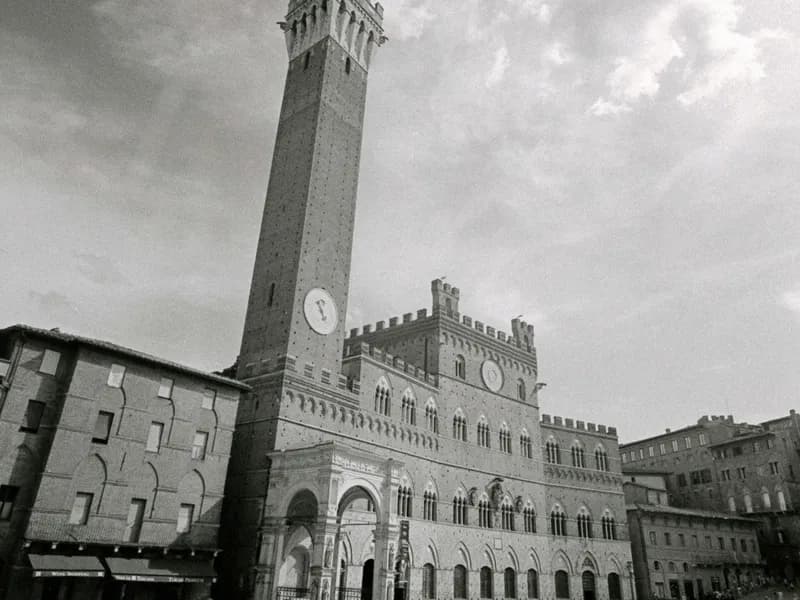
Piazza del Campo
The shell-shaped brick square sloping down to the Palazzo Pubblico, paved in nine segments for the medieval Council of Nine who governed here. Free and open always. Allow 30 min just to sit on the warm brick with everyone else — that is the intended use. Twice a year it becomes a racetrack.

Duomo di Siena
A zebra-striped marble cathedral of almost aggressive ambition. Entry via the OPA SI Pass (~€15-21), covering the Duomo, Piccolomini Library, Baptistery, Crypt and Museo dell'Opera. Allow 2-3h for the complex. The 56-panel inlaid marble floor is only fully uncovered for a few weeks — roughly late June to July and mid-August to mid-October.

Torre del Mangia
87m and 400 steps with no lift, capped at ~50 people inside at once. Entry ~€10 — book a time slot online or arrive at opening, because the queue is capped and closes early. Allow 45 min. Built to exactly match the Duomo's height so that church and state stood level.

Palazzo Pubblico & Museo Civico
Holds Ambrogio Lorenzetti's 'Allegory of Good and Bad Government' (1338) — the most important secular fresco cycle of the Middle Ages, painted to remind the councillors next door what they were for. Entry ~€10. Allow 1h. Still partly Siena's working town hall.
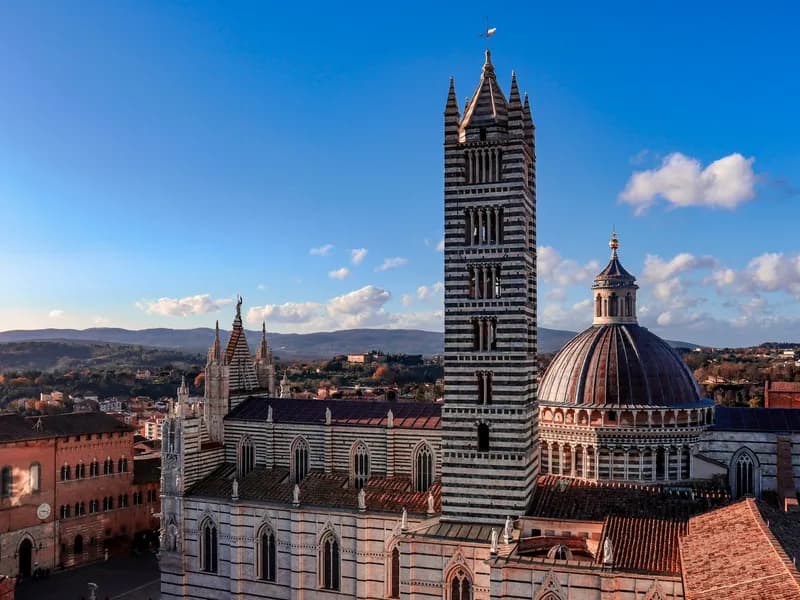
Museo dell'Opera & the Facciatone
Climb the wall of the 'new cathedral' Siena began in 1339 and abandoned when the Black Death killed half the city — the nave was never built, so you stand on the top of an unfinished facade. Included in the OPA SI Pass. Narrow spiral stairs, timed entry. The best view in Siena, and a monument to overreach.
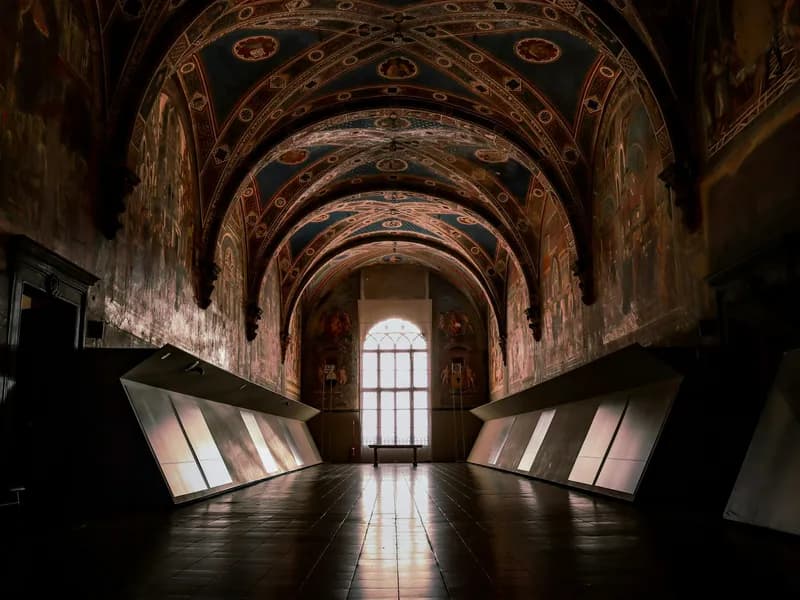
Santa Maria della Scala
A pilgrim hospital that ran for a thousand years, now a museum stacked four levels into the hillside opposite the Duomo. Entry ~€9. Allow 1.5h. The Pellegrinaio ward is frescoed with scenes of the hospital at work — medieval medicine, painted by the people doing it. Far emptier than anything across the square.

Basilica di San Domenico
Free entry, allow 30 min. The preserved head of St. Catherine of Siena — patron saint of Italy and co-patron of Europe — is displayed in the chapel; the rest of her is in Rome. The terrace outside gives the classic view of the Duomo floating above the rooftops at sunset.
Planned Itinerary
7-Day Siena Itinerary
Arrival from Florence & First Evening on the Campo
Land at Florence Peretola (FLR), 75 km north — Siena has no airport. Tram T2 to Firenze Santa Maria Novella, then the Autolinee Toscane Rapida coach from the Autostazione next door, which drops you at Piazza Gramsci inside the walls, five minutes from the Campo. Resist the urge to rent a car today: the historic centre is a camera-monitored ZTL and a single wrong turn is an €80-100 fine that reaches you months later via your rental company.
Tram T2 from FLR to Firenze Santa Maria Novella(22 minutes)
€1.70 from the machine on the platform, validate on board. Runs every 5 min. The Autostazione is a 4-minute walk from the tram stop, on Via Santa Caterina da Siena.
Rapida coach 131R, Florence to Siena(75 minutes)
~€9, buy on the at-bus app or at the Autostazione window. Take the Rapida, not the Ordinaria — the ordinary service stops in every Chianti village and takes 2 hours. Sit on the left for the vineyards.
Check in — Terzo di Città(45 minutes)
Palazzo Ravizza (Pian dei Mantellini 34) is a family-run palazzo with a garden that drops straight into open countryside — rare inside the walls. Wheel your bag along Via di Città's flagstones, not the brick side lanes; the brick will destroy your wheels.
Walk down Banchi di Sopra to Piazza del Campo(30 minutes)
Time this for after 7PM. The day-trippers leave at 6 and the square exhales. Nine brick segments fan down to the Palazzo Pubblico, one for each member of the medieval Council of Nine. Sit on the warm brick — that is the intended use.
Aperitivo at Bar Il Palio(1 hour)
Piazza del Campo 47. You are paying €9 for a spritz and €4 for the view of the Torre del Mangia going gold. Worth it once; after tonight you drink at Enoteca I Terzi.
Dinner at Trattoria Papei(1.5 hours)
Piazza del Mercato 6, directly behind the Palazzo Pubblico. Order pici all'aglione (€10) — fat hand-rolled spaghetti in a garlic-tomato sauce that has been on Sienese tables for 500 years. No reservation before 8PM and you will wait; go at 7:30.
The Duomo Complex & Santa Maria della Scala
Everything today happens within 100 metres of Piazza del Duomo — the cathedral on one side, the thousand-year-old pilgrim hospital directly opposite. Buy the OPA SI Pass first thing at the Duomo ticket office; individually these sites run €8-15 each, so the pass pays for itself at the second door.
Buy the OPA SI Pass(15 minutes)
Duomo ticket office, Piazza Duomo 8, opens 09:30. €15-21 depending on season and whether the inlaid marble floor is uncovered. Covers Duomo, Piccolomini Library, Baptistery, Crypt, Museo dell'Opera and the Facciatone climb.
Duomo di Siena and the Piccolomini Library(1.5 hours)
Opens 10:30 (Sundays 13:30). Be at the door at 10:25. Nicola Pisano's 1268 pulpit is the reason to look up; the 56-panel inlaid marble floor is the reason to look down — fully uncovered only roughly late June to July and mid-August to mid-October. The Piccolomini Library off the left aisle is a colour bomb: Pinturicchio frescoed it 1502-08 and the pigment has barely faded.
Baptistery and the Crypt(45 minutes)
Down the steps behind the apse on Piazza San Giovanni — most people never find them. The baptismal font carries panels by Ghiberti, Donatello and Jacopo della Quercia in one basin. The Crypt was only rediscovered in 1999 under a century of rubble; its 13th-century frescoes never saw sunlight, so the blues are still blue.
Lunch at Pizzicheria de Miccoli(30 minutes)
Via di Città 93-95. A wild boar hangs over the counter and the ceiling is entirely salami. Ask for a panino with finocchiona and pecorino di Pienza, ~€6. Eat it standing on the street like everyone else.
Museo dell'Opera and the Facciatone climb(1.5 hours)
Duccio's Maestà (1311) is here — it was carried into the Duomo in procession with the whole city following, and it is still the best thing in Siena. Then take the narrow spiral stairs to the Facciatone: you are standing on the top of a cathedral facade that has no cathedral behind it. Siena began the 'new Duomo' in 1339 and the Black Death killed half the city before the nave went up. Best view in town, and a monument to overreach.
Santa Maria della Scala(1.5 hours)
€9, straight across the square, open to 19:00 in summer. A pilgrim hospital that ran for a thousand years, now stacked four levels down into the hillside. The Pellegrinaio ward is frescoed with the hospital actually working — medieval medicine painted by the people doing it. It is half-empty while the Duomo is heaving 40 metres away.
Dinner at Osteria da Divo(2 hours)
Via Franciosa 25. The back dining rooms are carved Etruscan tomb chambers — actual ones. Book a day ahead and ask for a table in the cellar rooms, not the front. Mains €18-24.
Torre del Mangia, the Lorenzetti Frescoes & Sunset at San Domenico
The Campo's civic core in one day. Get to the tower at opening — only ~50 people are allowed inside at once, so the queue is capped and the ticket desk simply closes when the day's slots are gone, often by early afternoon in summer.
Torre del Mangia(45 minutes)
€10, opens 10:00. Book a time slot online the night before or be in the courtyard by 09:45. 87 metres, 400 steps, no lift, and the last flight is a near-vertical ladder in a stone shaft — genuinely not for the claustrophobic. Built to exactly match the Duomo's height so that church and state stood level.
Palazzo Pubblico & Museo Civico(1.5 hours)
€10, same courtyard. Ambrogio Lorenzetti's 'Allegory of Good and Bad Government' (1338) wraps the Sala dei Nove — the councillors sat in this room with a painted reminder of what happens if they got it wrong. The Bad Government wall is deliberately damaged and half-ruined; the Good Government wall shows Siena's own streets. Next door, Simone Martini's Maestà. The building is still partly the working town hall.
Fonte Gaia(15 minutes)
The fountain at the top of the Campo. What you are looking at is a 19th-century copy — Jacopo della Quercia's weathered 1419 originals are inside Santa Maria della Scala, which you saw yesterday. Water still arrives here through the bottini, 25 km of hand-dug medieval tunnels under the city.
Lunch at Consorzio Agrario di Siena(1 hour)
Via Pianigiani 5, just off Banchi di Sopra. A working farmers' co-op food hall since 1901 with a pizza-al-taglio and pasta counter at the back. Locals outnumber visitors four to one. Full plate and a glass of Chianti Colli Senesi for under €12.
Pinacoteca Nazionale(1.5 hours)
Via San Pietro 29, €8, and you may have entire rooms to yourself. This is the Sienese school laid out chronologically — Duccio, Simone Martini, the Lorenzetti brothers, and Sassetta's small strange panels. Go upstairs first and work down; the top floor is the good one and everyone runs out of stamina before reaching it.
Sunset from the Basilica di San Domenico terrace(45 minutes)
Free entry, 15 min walk northwest. Inside, the preserved head of St Catherine of Siena is displayed in her chapel — patron saint of Italy, and the rest of her is in Rome. Then step onto the terrace outside for the postcard: the Duomo's striped mass floating above the rooftops, best 30 minutes before sunset.
Dinner at La Taverna di San Giuseppe(2 hours)
Via Giovanni Duprè 132, five minutes uphill from the Campo. Book at least three days ahead. The dining room is a 12th-century Etruscan cellar and the Cinta Senese pork is the best version of Siena's native pig you will eat. €45-55 a head with wine.
Day Trip: San Gimignano's Towers
The medieval Manhattan, 40 km northwest. Fourteen towers survive of an original seventy-odd, built by rival families in a straight competition to out-build each other. Take the bus — it is direct-ish, cheap, and spares you the ZTL. Go early: San Gimignano between 11AM and 4PM is a coach park with a town attached.
Bus 130 from Piazza Gramsci to Poggibonsi, change for San Gimignano(75 minutes total)
~€6.50 each way. The 08:10 departure gets you inside the walls before the Florence coaches. Buy both legs on the at-bus app; the Poggibonsi change is across the same bus station forecourt, roughly 10 minutes.
Collegiata di Santa Maria Assunta(1 hour)
€5, open from 10:00. From the outside it is a plain brick barn; inside, every wall is frescoed — Bartolo di Fredi's Old Testament on the left, Lippo Memmi's New Testament on the right, Taddeo di Bartolo's gleefully horrible Last Judgement over the door. Ghirlandaio's Santa Fina chapel is the quiet masterpiece most people walk past.
Torre Grossa(45 minutes)
€9 including the Palazzo Comunale and Pinacoteca. 54 metres and the only tower in town you are allowed to climb — from the top you see the other thirteen at eye level, which is the whole point. On the way, the Sala di Dante has Lippo Memmi's Maestà; Dante himself spoke in this room in 1300.
Vernaccia tasting at the Rocca di Montestaffoli(1 hour)
The ruined fortress at the top of town, free to enter, with the Museo del Vino inside. Vernaccia di San Gimignano was Italy's very first DOC in 1966 — a mineral, almondy white that has nothing to do with the sweet stuff its name suggests. Tasting flights around €10-15. The wall walk here is the best free view in Tuscany.
Gelato at Gelateria Dondoli(20 minutes)
Piazza della Cisterna 4. Sergio Dondoli has won the gelato world championship more than once and there is always a line — join it. Get the Crema di Santa Fina (saffron and pine nuts) or the Vernaccia sorbet. €3.50.
Sant'Agostino and the walk back(45 minutes)
Free, at the far quiet end of town. Benozzo Gozzoli's Life of St Augustine cycle runs behind the altar and there is usually nobody in here. Walk the back lanes toward Porta San Matteo on the way out — the crowd never leaves the two main streets.
Return bus and late dinner in Siena(2.5 hours)
Last useful connection back is around 18:30-19:00 — check the at-bus app in the morning, because Sunday service thins out badly. Eat at Il Grattacielo (Via dei Pontani 8), a two-table hole in the wall where €12 gets you a board of cured meats, pecorino and a jug of red.
Slow Day: Contrada Siena, Fontebranda & the Fortezza
No tickets, no queues, no opening times to chase. Today is about the seventeen contrade — the rival neighbourhoods that actually run this city — and the parts of Siena the day-trippers never reach. Sleep in. Start at 10.
Coffee and ricciarelli at Nannini(30 minutes)
Banchi di Sopra 24, Siena's caffè since 1872 (yes, the singer Gianna is family). Stand at the bar — €1.30 for an espresso seated is €4. Take a ricciarello, the soft almond biscuit, and a slice of panforte to see what 700-year-old crusader rations became.
Casa di Santa Caterina and Fontebranda(1.5 hours)
Costa di Sant'Antonio, free. Catherine's family home, converted into a stack of oratories — her father was a dyer and the house sits above the Fontebranda spring that fed the trade. Walk down the steep lane to the fountain itself: a 12th-century brick arcade still full of water, in the heart of Contrada dell'Oca (the Goose), the most decorated contrada in Palio history.
Contrada museum visit(1 hour)
Each contrada keeps its own museum of banners, costumes and every Palio it has ever won — and they open by appointment only, free, staffed by volunteers. Email the Oca or the Torre (Via Salicotto) a week ahead via their contrada website. This is the single best thing you can do in Siena and almost no visitor does it: someone's grandfather will walk you through 400 years of grudges.
Spot the contrada boundaries(30 minutes)
Walk any lane and watch the wall plaques and street lamps change: a snail, a wave, a tortoise, a caterpillar. Each contrada has its own modern baptismal fountain where babies are formally made members. You will start seeing the city as seventeen villages that happen to share a wall.
Lunch at Orto de' Pecci(1.5 hours)
Via Porta Giustizia 39. Five minutes below the Campo there is an actual farm in a green valley inside the medieval walls — an urban co-op that employs people in recovery, with donkeys, a vineyard and a restaurant using its own produce. €15-20 for lunch under the trees, with the Torre del Mangia over your shoulder. Almost no tourist finds it.
Fortezza Medicea walls at sunset(1 hour)
Free, always open. Cosimo I built it in 1561 to sit on the Sienese after Florence crushed the republic, and they hated it so much they now use it for jogging and jazz. Walk the ramparts anticlockwise for the whole city in profile. In July it hosts Siena Jazz; in the evenings it is teenagers and dog walkers.
Dinner at Grotta di Santa Caterina da Bagoga(2 hours)
Via della Galluzza 26. The chef, Pierino Fagnani, rode in the Palio seventeen times under the nickname Bagoga and won it twice; the walls are his. Order the pici alle briciole and let him talk to you about horses. €35-45.
Monteriggioni & the Chianti Classico Road
Head north on the SR222 — the Chiantigiana — through the vineyards between Siena and Florence, with a walled hill fort as the first stop. Hire a car with a driver for the day (€250-320 through your hotel, split between two couples it is fine) or rent from the office on Via Vittorio Veneto near the Fortezza and park outside the walls on return. If you drive, one person tastes and one does not; the Carabinieri run checkpoints on the Chiantigiana on weekends.
Monteriggioni walls(1 hour)
20 minutes north, €4 for the walls and museum, opens 09:30. Fourteen towers on a perfect ring wall, built by Siena in 1214 as a forward fort against Florence. Dante saw it and put it in Inferno XXXI — the giants ringing the pit of hell stand 'as Montereggion crowns itself with towers.' The wall walk takes 15 minutes; the village inside is two streets and a well. Be gone by 11 when the coaches land.
Castellina in Chianti and the Via delle Volte(1 hour)
25 minutes east through vineyards. Duck into the Via delle Volte — a covered medieval walkway tunnelled inside the ramparts, with windows punched through to the valley on one side. It is dark, cool and completely free, and it was a defensive corridor before it was a curiosity.
Lunch at Antica Macelleria Cecchini, Panzano(2 hours)
Via XX Luglio 11. Dario Cecchini is an eighth-generation butcher who recites Dante over the meat counter and hands out free glasses of wine and lard on toast to whoever is standing there. Three ways to eat: MacDario upstairs (a €15-20 burger, walk-in), Solociccia (€35, communal tables, no steak), or the Officina della Bistecca (€60ish, the full bistecca alla fiorentina). Book Officina and Solociccia weeks ahead; MacDario you can chance.
Tasting at Castello di Ama, Lecchi in Chianti(1.5 hours)
Book ahead, ~€30-40. A working Chianti Classico estate that commissions serious contemporary art and buries it in the cellars and courtyards — Kapoor, Kounellis, Daniel Buren. You walk from a Louise Bourgeois installation into a barrel room. Their L'Apparita Merlot is one of Italy's great wines and their base Chianti Classico is €25 at the gate.
Greve in Chianti, Piazza Matteotti(45 minutes)
The arcaded triangular square — irregular because each family built their own arch. Antica Macelleria Falorni has been curing meat on this square since 1729; buy vacuum-packed finocchiona and cinghiale salame to take home (it is legal into the UK/EU, not into the US).
Return to Siena(45 minutes)
Down the SR222 with the light going sideways across the vineyards. Park at Il Fagiolone (Via Vittorio Emanuele II, free) or Parcheggio Stadio and walk in through Porta Camollia, which carries the inscription 'Cor magis tibi Sena pandit' — Siena opens its heart to you wider still.
Late dinner at Enoteca I Terzi(1.5 hours)
Via dei Termini 7. Kitchen runs late by Siena standards, the wine list is the deepest in the walls, and they will happily pour you three Chianti Classicos side by side to show you what the day was actually about. €40 a head.
Last Morning & Departure
The coach back to Florence takes 75 minutes and the tram to FLR another 22, so work backwards from your flight and add an hour of slack — the Rapida runs roughly hourly but thins on Sundays. Leave the bags at the hotel and take one last lap.
Final espresso on the Campo(30 minutes)
Not at the terrace tables. Go to Caffè Fiorella, Via di Città 13 — a bar barely two metres wide where they roast their own beans, €1.20 standing, and then carry it round the corner and sit on the brick for ten minutes.
Shopping on Via di Città and Banchi di Sopra(1.5 hours)
Antica Drogheria Manganelli (Via di Città 71-73) for panforte and cantucci in tins that survive a suitcase. Pizzicheria de Miccoli for vacuum-packed pecorino. Skip the contrada flags in the tourist shops — if you want one, the contrada museums sell the real ones and the money stays in the neighbourhood.
Hotel checkout and walk to Piazza Gramsci(30 minutes)
Checkout is usually 11:00. All roads inside the walls converge on the ridge streets; Gramsci is a 5-10 minute walk from anywhere in the centre, and the bus station is the underground level below the piazza — go down the ramp, do not stand at street level looking confused.
Rapida coach to Firenze Autostazione(75 minutes)
~€9 on the at-bus app. Buy the ticket before boarding; the driver's card reader is unreliable and buying on board carries a surcharge.
Tram T2 to Florence Peretola (FLR)(22 minutes)
€1.70. The stop is a 4-minute walk from the Autostazione, back past Santa Maria Novella. If you are flying from Pisa (PSA) instead, take the train from Firenze SMN to Pisa Centrale (~1h) and the Pisa Mover shuttle (5 min, €5) — budget 2.5 hours from Siena, not 2.
14-Day Siena Itinerary
Arrival from Florence & First Evening on the Campo
Land at Florence Peretola (FLR), 75 km north — Siena has no airport of its own. Tram T2 to Firenze Santa Maria Novella, then the Autolinee Toscane Rapida coach from the Autostazione next door, which drops you at Piazza Gramsci inside the walls. You will pick up a car on day 9, not today: the historic centre is a camera-monitored ZTL and one wrong turn is an €80-100 fine that arrives via your rental company months after you are home.
Tram T2 from FLR to Firenze Santa Maria Novella(22 minutes)
€1.70 from the platform machine, validate on board, every 5 minutes. The Autostazione is a 4-minute walk on Via Santa Caterina da Siena.
Rapida coach 131R, Florence to Siena(75 minutes)
~€9 on the at-bus app. Take the Rapida, never the Ordinaria — the ordinary service calls at every Chianti village and takes two hours. Sit on the left.
Check in — Terzo di Città(45 minutes)
Palazzo Ravizza (Pian dei Mantellini 34) has a walled garden that falls away into open countryside, which is a strange and lovely thing to have inside a medieval city. Book a garden-side room. For fourteen nights, ask for the weekly rate — they have one, they just do not advertise it.
First walk down Banchi di Sopra to Piazza del Campo(30 minutes)
After 7PM, once the day-trippers have gone. Nine brick segments fan down to the Palazzo Pubblico — one for each member of the medieval Council of Nine who governed from the building at the bottom. Sit down on the brick. Everyone does; that is what it is for.
Aperitivo at Bar Il Palio(1 hour)
Piazza del Campo 47. €9 for a spritz and the Torre del Mangia turning gold. Do it once tonight, then never pay Campo prices again.
Dinner at Trattoria Papei(1.5 hours)
Piazza del Mercato 6, right behind the Palazzo Pubblico. Pici all'aglione, €10 — fat hand-rolled spaghetti in garlic and tomato, the most Sienese thing on any menu. Arrive at 7:30 or queue.
The Duomo Complex, Top to Bottom
A zebra-striped marble cathedral of almost aggressive ambition, plus everything the OPA SI Pass bundles with it. Buy the pass at the ticket office first — the individual sites are €8-15 each, so it wins from your second door. Today is a full day inside 100 metres of Piazza del Duomo, and you will still not be bored.
Buy the OPA SI Pass(15 minutes)
Duomo ticket office, Piazza Duomo 8, opens 09:30. €15-21 depending on season and whether the marble floor is uncovered. Covers Duomo, Piccolomini Library, Baptistery, Crypt, Museo dell'Opera and the Facciatone.
Duomo di Siena and the Piccolomini Library(2 hours)
Opens 10:30 (Sundays 13:30); be at the door at 10:25. Nicola Pisano carved the pulpit in 1268 and it is still the best thing at eye level. The 56-panel inlaid marble floor is only fully uncovered roughly late June to July and mid-August to mid-October — the rest of the year most of it sleeps under hardboard. Pinturicchio's Piccolomini Library (1502-08) off the left aisle still has its original pigment and it hits like a slap.
Baptistery and the Crypt(45 minutes)
Down the steps behind the apse onto Piazza San Giovanni — hardly anyone with a pass bothers. The font carries panels by Ghiberti, Donatello and Jacopo della Quercia in a single basin. The Crypt was found by accident in 1999 under centuries of fill; its 13th-century frescoes were sealed from light, so the blues are still genuinely blue.
Lunch at Pizzicheria de Miccoli(30 minutes)
Via di Città 93-95. A whole wild boar hangs over the counter and the ceiling is salami. Panino with finocchiona and pecorino di Pienza, ~€6, eaten standing in the street.
Museo dell'Opera and Duccio's Maestà(1 hour)
Duccio finished the Maestà in 1311 and the entire city walked it into the cathedral in procession with the shops shut. It is here, at eye level, and it is the single greatest object in Siena.
The Facciatone climb(45 minutes)
Narrow spiral stairs, timed entry, included in the pass. You climb the wall of the 'new cathedral' Siena started in 1339 and abandoned when the Black Death killed half the city — the nave was never built, so you emerge on top of an unfinished facade with sky where the roof should be. Best view in Siena and a permanent monument to overreach.
Dinner at Osteria da Divo(2 hours)
Via Franciosa 25, two minutes from the Duomo. The back rooms are carved Etruscan tomb chambers. Book a day ahead and specifically ask for the cellar, not the front room. Mains €18-24.
Torre del Mangia, Lorenzetti & a Free Afternoon
The civic half of the city — the tower and the frescoed room that told Siena's rulers what they were for. Get to the tower at opening: only ~50 people are permitted inside at once, so the queue is capped and the desk simply closes when the slots are gone, often by early afternoon in summer. Then stop, deliberately. Fourteen days is long enough to waste an afternoon well.
Torre del Mangia(45 minutes)
€10, opens 10:00 — book a slot online the night before or be in the Palazzo Pubblico courtyard by 09:45. 87 metres, 400 steps, no lift, and the final flight is effectively a ladder in a stone chimney. It was built to match the Duomo's height exactly, so that church and state stood level.
Palazzo Pubblico & Museo Civico(1.5 hours)
€10. Ambrogio Lorenzetti's 'Allegory of Good and Bad Government' (1338) wraps the Sala dei Nove — the most important secular fresco cycle of the Middle Ages, painted so the nine councillors meeting in this room could not forget the job. Good Government shows recognisable Sienese streets; Bad Government is half-destroyed, which is almost too neat. Simone Martini's Maestà is next door. The building is still partly the working town hall.
Fonte Gaia and the bottini(20 minutes)
The fountain at the head of the Campo is a 19th-century copy — Jacopo della Quercia's eroded 1419 originals sit inside Santa Maria della Scala. Water still reaches it through the bottini, 25 km of hand-dug medieval aqueduct tunnels under the city. The comune runs occasional guided descents into them; ask the tourist office on the Campo, they sell out instantly and are extraordinary.
Lunch at Consorzio Agrario di Siena(1 hour)
Via Pianigiani 5. A working farmers' co-op since 1901 with a pizza-al-taglio and pasta counter in the back. Locals outnumber visitors four to one. Full plate plus a glass of Chianti Colli Senesi under €12.
Free afternoon — get lost on purpose(3 hours)
Siena is three ridges and you cannot truly get lost: every downhill lane eventually spits you onto the Campo. Walk the Terzo di Camollia north of Banchi di Sopra, where the city becomes residential — laundry, scooters, kids, no menus in four languages. Nap. You have twelve days left.
Dinner at Osteria Il Carroccio(1.5 hours)
Via Casato di Sotto 32, a lane off the Campo most people walk past. Tiny, Slow Food-listed, run by two women. Ask for the ribollita even in summer — the bread-and-bean soup that Tuscany built on poverty. €30-35.
Santa Maria della Scala, the Pinacoteca & Sunset at San Domenico
The quiet half of Siena's museums — a thousand-year-old pilgrim hospital and the deepest collection of Sienese painting anywhere, both of which sit half-empty while the Duomo heaves 40 metres away. Everything today is in the Terzo di Città, walking distance, no rush.
Santa Maria della Scala(2 hours)
€9, opposite the Duomo, open to 19:00 in summer. A pilgrim hospital that ran for a thousand years, now stacked four levels down into the hillside. The Pellegrinaio ward is frescoed with the hospital at work — medieval medicine painted by the men practising it, including a scene of a surgeon that is more honest than anything in an art gallery. Jacopo della Quercia's original Fonte Gaia panels are down here too.
The Oratorio di Santa Caterina della Notte(20 minutes)
Buried in the lowest level of Santa Maria della Scala, included in your ticket, and consistently missed. A dark confraternity chapel where Catherine of Siena prayed at night. Almost nobody comes down this far — most visitors run out of legs two floors above.
Lunch at Pasticceria Bini(45 minutes)
Via dei Fusari 9, a 200-metre walk. A neighbourhood pasticceria, not a restaurant — savoury schiacciata, a couple of tables, coffee at €1.20. This is what Sienese people eat on a Tuesday.
Pinacoteca Nazionale(1.5 hours)
Via San Pietro 29, €8, and you may have whole rooms to yourself. The Sienese school in order: Duccio, Simone Martini, both Lorenzettis, and Sassetta's small strange panels. Take the lift to the top floor and work down — the best rooms are up there and everyone else has burned out before they reach them.
Sunset from the Basilica di San Domenico terrace(45 minutes)
Free, 15 minutes northwest. Inside, the preserved head of St Catherine of Siena sits in its chapel — patron saint of Italy and co-patron of Europe; the rest of her is in Rome, which she would have found funny. Outside, the terrace gives the classic shot of the Duomo floating over the roofline. Be there 30 minutes before sundown.
Dinner at Il Pomodorino(1.5 hours)
Via Camporegio 13, just below San Domenico. Neapolitan pizza on a terrace pointed straight at the Duomo. €10-14 a pizza, a fraction of what the same view costs on the Campo. Book the terrace, not the room.
Slow Day: Contrada Siena, Fontebranda & the Fortezza
No tickets, no queues, no opening hours. Today is the seventeen contrade — the rival neighbourhoods that genuinely run this city — plus the corners day-trippers never see. Sleep in; start at 10.
Coffee and ricciarelli at Nannini(30 minutes)
Banchi di Sopra 24, in business since 1872 (yes, the singer Gianna is family). Stand at the bar: €1.30 standing versus €4 seated is not a scam, it is the law. Take a ricciarello and a wedge of panforte — 700-year-old crusader rations that turned into Christmas.
Casa di Santa Caterina and Fontebranda(1.5 hours)
Costa di Sant'Antonio, free. Catherine's family house, turned into a stack of oratories. Her father was a dyer, which is why the house hangs above the Fontebranda spring that powered the trade — walk down the steep lane to the fountain, a 12th-century brick arcade still brimming, in the heart of Contrada dell'Oca, the winningest contrada in Palio history.
Contrada museum visit (book a week ahead)(1 hour)
Every contrada keeps a museum of banners, costumes and every Palio it has won — appointment only, free, staffed by volunteers. Email the Oca or the Torre (Via Salicotto) through their contrada website a week in advance. This is the best hour available in Siena and almost no visitor takes it: someone's grandfather will walk you through four centuries of grudges and show you the silk of the palio his father rode for.
Read the walls(30 minutes)
Walk any lane watching the plaques and lamp brackets change: goose, wave, tortoise, caterpillar, snail. Each contrada has a modern baptismal fountain where infants are formally enrolled. Once you see the boundaries you cannot unsee them — Siena becomes seventeen villages sharing one wall.
Lunch at Orto de' Pecci(1.5 hours)
Via Porta Giustizia 39. Five minutes below the Campo there is a working farm in a green valley inside the medieval walls — a social co-op employing people in recovery, with donkeys, a vineyard and a kitchen using its own produce. €15-20 under the trees with the Torre del Mangia over your shoulder. Practically no tourist finds this.
Fortezza Medicea walls at sunset(1 hour)
Free, always open. Cosimo I built it in 1561 to keep the conquered Sienese down, and they now use it for jogging and jazz, which is its own kind of victory. Walk the ramparts anticlockwise for the whole city in silhouette.
Dinner at Grotta di Santa Caterina da Bagoga(2 hours)
Via della Galluzza 26. The chef, Pierino Fagnani, rode seventeen Palios as 'Bagoga' and won two; the walls are his career. Order pici alle briciole and ask him about horses. €35-45.
Day Trip: San Gimignano's Towers
The medieval Manhattan, 40 km northwest — fourteen surviving towers of an original seventy-odd, raised by rival families in a pure competition to out-build each other. Take the bus and skip the ZTL entirely. Go early; between 11AM and 4PM San Gimignano is a coach park with a town attached.
Bus 130 from Piazza Gramsci to Poggibonsi, change for San Gimignano(75 minutes total)
~€6.50 each way. The 08:10 puts you inside the walls before the Florence coaches. Buy both legs on the at-bus app; the Poggibonsi change is across the same forecourt, about 10 minutes.
Collegiata di Santa Maria Assunta(1 hour)
€5, opens 10:00. A plain brick barn outside; inside, every surface frescoed — Bartolo di Fredi's Old Testament left, Lippo Memmi's New Testament right, Taddeo di Bartolo's gleefully appalling Last Judgement over the door. Ghirlandaio's Santa Fina chapel is the quiet masterpiece nobody stops at.
Torre Grossa(45 minutes)
€9 with the Palazzo Comunale and Pinacoteca. 54 metres and the only climbable tower in town — from the top the other thirteen are at eye level, which is the entire point. On the way up, the Sala di Dante holds Lippo Memmi's Maestà; Dante addressed this room in person in 1300.
Vernaccia at the Rocca di Montestaffoli(1 hour)
The ruined fortress at the top, free, with the Museo del Vino inside. Vernaccia di San Gimignano was Italy's first-ever DOC in 1966 — mineral, almondy, dry, nothing like the sweet wine its name implies. Flights €10-15. The wall walk here is the best free view in Tuscany, and it is thirty steps from a square where people are queuing to pay for a worse one.
Gelato at Gelateria Dondoli(20 minutes)
Piazza della Cisterna 4. Sergio Dondoli is a repeat gelato world champion; the line is real, join it. Crema di Santa Fina (saffron and pine nuts) or the Vernaccia sorbet, €3.50.
Sant'Agostino(45 minutes)
Free, at the far quiet end. Benozzo Gozzoli's Life of St Augustine runs behind the altar and you will likely be alone with it. Walk back via Porta San Matteo and the residential lanes — the crowd never leaves the two main streets, so the town is 70% empty at all times.
Return bus and late dinner in Siena(2.5 hours)
Last useful connection is around 18:30-19:00; check at-bus in the morning because Sunday service is thin. Eat at Il Grattacielo (Via dei Pontani 8) — two tables, no menu, €12 for a board of salumi, pecorino and a jug of red.
Monteriggioni & the Chianti Classico Road
North on the SR222, the Chiantigiana, through the vineyards between Siena and Florence, opening at a walled hill fort. Hire a car with a driver today (€250-320 via your hotel) — you will have your own car from day 9, and today involves tasting. If you do drive yourself, one person tastes and one does not; the Carabinieri run weekend checkpoints on the Chiantigiana and the limit is 0.5.
Monteriggioni walls(1 hour)
20 minutes north, €4 for walls and museum, opens 09:30. Fourteen towers on a perfect ring, built by Siena in 1214 as a forward fort against Florence. Dante saw it and dropped it into Inferno XXXI — the giants ringing hell's pit stand 'as Montereggion crowns itself with towers.' The wall walk is 15 minutes; the village inside is two streets and a well. Leave by 11.
Castellina in Chianti and the Via delle Volte(1 hour)
25 minutes east. The Via delle Volte is a covered medieval walkway tunnelled inside the ramparts, windows punched through to the valley on one side — dark, cool, free, and a defensive corridor long before it was a photo.
Lunch at Antica Macelleria Cecchini, Panzano(2 hours)
Via XX Luglio 11. Dario Cecchini is an eighth-generation butcher who recites Dante over the counter and pushes free wine and lard-on-toast at anyone standing near it. Three options: MacDario upstairs (€15-20 burger, walk-in), Solociccia (€35, communal tables, no steak), or Officina della Bistecca (~€60, the full bistecca alla fiorentina). Book the latter two weeks ahead.
Tasting at Castello di Ama, Lecchi in Chianti(1.5 hours)
Book ahead, ~€30-40. A serious Chianti Classico estate that commissions contemporary art and installs it in the cellars — Kapoor, Kounellis, Daniel Buren. You walk out of a Louise Bourgeois piece into a barrel room. Their L'Apparita is one of Italy's great wines; the base Chianti Classico is €25 at the gate.
Radda in Chianti(45 minutes)
The old capital of the medieval Lega del Chianti, and the quietest of the three big Chianti towns. Casa Chianti Classico, in the former convent of Santa Maria al Prato, has an enoteca where you can taste across a dozen producers side by side for around €15 — the single most efficient way to learn what Sangiovese does across the appellation.
Return to Siena via Greve(1 hour)
Ten minutes in Greve's arcaded triangular Piazza Matteotti — irregular because every family built their own arch. Antica Macelleria Falorni has cured meat on this square since 1729; vacuum-packed finocchiona travels fine into the UK and EU, not into the US. Then back down the SR222 with the light going sideways across the vines.
Hands in the Flour: Market Morning & a Cooking Class
A deliberately unstructured day inside the walls, built around learning to make the food you have been eating for a week. If your day 8 lands on a Wednesday, do not move it — the La Lizza market is the one Sienese institution that is emphatically not for you, and that is exactly why you should go.
La Lizza market (Wednesdays, 07:30-13:30)(1.5 hours)
The open ground below the Fortezza fills with 700-odd stalls every Wednesday — the whole province comes in for it. Groceries and cheese at the Fortezza end, clothes and household junk toward Viale Cesare Maccari. Buy pecorino, a bag of borlotti and whatever the old women are queueing for. If it is not a Wednesday, go to the Mercato nel Campo stall row or the Consorzio Agrario instead.
Cooking class — pici, pasta and Tuscan basics(4 hours)
Book a small in-town class (Fabio's Cooking Class and Podere Le Vigne both run 6-8 person sessions, €80-110 including lunch and wine). Insist on one that includes pici: it is rolled by hand with no egg and no machine, the dough is flour and water and nothing else, and getting the thickness even is much harder than it looks. You will also do a ragù di cinghiale and probably a panna cotta.
Eat what you made(1.5 hours)
Every decent class ends with you sitting down to your own lunch and a bottle of Chianti Colli Senesi. Take notes on the aglione — the giant sweet garlic in pici all'aglione is a specific Val di Chiana cultivar and normal garlic will not reproduce the dish. Buy some at the market first if you want to try at home.
Siesta(2 hours)
You have eaten and drunk a full day's calories by 2PM. Siena shuts from roughly 13:30 to 16:00 anyway — the shops genuinely close. Do what the city does.
Aperitivo at Enoteca I Terzi(1.5 hours)
Via dei Termini 7. The deepest wine list inside the walls, and they will pour you three Chianti Classicos or three Brunellos side by side and explain the difference before you drive south tomorrow. A flight plus a plate of crostini, €25.
Evening concert at the Accademia Musicale Chigiana (summer)(2 hours)
Via di Città 89. From July into August the Chigiana International Festival puts world-class musicians in a private palazzo's frescoed hall, and students give free recitals almost nightly. Tickets €15-40, often available same-day. Check the board outside the door — the programme is genuinely serious and almost no visitor knows it exists.
Car Day: The Crete Senesi & Monte Oliveto Maggiore
Pick up the car and drive southeast into the Crete Senesi — grey clay badlands with almost no trees, the anti-Chianti. This is the Tuscany that photographs like a charcoal drawing: bare rolling clay, lone cypresses, and the occasional abbey. Roads are narrow, unfenced and beautiful; the whole loop is about 90 km.
Collect the rental car(45 minutes)
Hertz and Avis both sit on Via Vittorio Veneto near the Fortezza, outside the ZTL — walk out to them, do not bring a car in. Take the smallest car you will tolerate; Val d'Orcia lanes are 1.5 cars wide. Photograph every existing scratch before you leave the lot, and confirm the plate is NOT registered for the ZTL — you want it staying outside the walls.
Drive the SP438 to Asciano via Leonina(1 hour)
The Lauretana road out of Siena. Stop at the pull-in below Leonina for the classic Crete view, and again at Site Transitoire — Jean-Paul Philippe's stone land-art frame planted in a field near Leonina, free, usually deserted, aligned so the sun sets through it at the solstice. Nearby, Podere Baccoleno's cypress spiral is the most photographed farm track in Tuscany; it is a private drive, shoot it from the road.
Abbazia di Monte Oliveto Maggiore(2 hours)
Free (donation), open 09:15-12:00 and 15:15-17:00 — the midday closure is real, plan around it. The Great Cloister carries 36 frescoes of the life of St Benedict: Luca Signorelli did nine, then Sodoma did the rest and painted himself into them with his pet badgers. Do not skip the church — Fra Giovanni da Verona's inlaid wood choir stalls are a masterpiece of illusion in walnut. The monks still run a pharmacy selling their own liqueurs and balms.
Lunch in Asciano(1.5 hours)
La Mencia (Corso Matteotti 85) or the osteria on the corso — €14-18 for pici and a secondo, no English menu, no tourists. Asciano is a real working Crete town of 7,000 people that has never once tried to charm anybody.
Museo Palazzo Corboli, Asciano(45 minutes)
€5 and you will be the only person in it. A small civic museum with genuinely good Sienese Gothic panels and an Etruscan section, in a frescoed 13th-century palazzo. Twenty minutes from the tourist stream and it may as well be another century.
Return via Buonconvento(1 hour)
A flat walled village on the Via Francigena with the Museo della Mezzadria — the sharecropping museum. Mezzadria ran Tuscan farming until the 1960s and every landscape you have admired this week was shaped by it; this small museum is the reason all those farmhouses exist where they do. Then park at Il Fagiolone (Via Vittorio Emanuele II, free) and walk in through Porta Camollia.
Montalcino, Brunello & the Abbey of Sant'Antimo
42 km south, an hour on the SR2 and up. Montalcino is a small fortified town that happens to sit on one of the three or four most valuable wine appellations on earth. Book your tasting before you leave Siena — the good estates do not take walk-ins, and the ones that do are not the good estates.
Drive Siena to Montalcino(1 hour)
SR2 Cassia south through Buonconvento, then the climb. Park outside Porta Burelli; the town is small and the centre is restricted. Leave by 09:00.
Fortezza di Montalcino(1 hour)
€4 for the ramparts, opens 09:00. Built 1361, and it is the last stand of the Sienese Republic — when Florence took Siena in 1555, 600 families fled here and kept the republic alive until 1559. The enoteca inside the fortress walls pours Brunello by the glass from €8. The wall walk gives you the whole Orcia valley and Monte Amiata behind it.
Brunello tasting at a working estate(2 hours)
Book ahead: Poggio Antico (~€30-40, cellar tour plus four wines, superb views) or Fattoria dei Barbi (~€25, and its own osteria for lunch). Brunello is 100% Sangiovese Grosso and legally cannot be sold until five years after harvest, six for the Riserva — the reason it costs what it does is that the money sits in a barrel for half a decade. Taste the Rosso di Montalcino too; it is the same fruit, released early, and at €18 it is what the growers actually drink.
Lunch at Osticcio or the estate osteria(1.5 hours)
If you are not eating at Barbi, Osticcio (Via Matteotti 23) has a terrace hanging over the Val d'Orcia and a wine list of 800 labels. €30-40. Book the terrace or there is no point.
Abbazia di Sant'Antimo, Castelnuovo dell'Abate(1.5 hours)
10 km south, free. A pale Romanesque abbey standing alone in an olive field — travertine and onyx, with alabaster windows that turn the interior honey-coloured in late afternoon. Charlemagne supposedly founded it in 781. The canons still sing the hours in Gregorian chant; times are posted at the door and vespers is the one to catch. Sit at the back and say nothing.
Return to Siena(1 hour)
Take the back road via Sant'Angelo in Colle rather than retracing the Cassia — it is 15 minutes longer through the vineyards on the southern slope, and at 6PM in summer the light on it is the reason people move here.
Val d'Orcia: Pienza, San Quirico & a Thermal Soak at Bagno Vignoni
The easy day. Pienza is a pope's fifteenth-century vanity project — he demolished his home village and had it rebuilt as an 'ideal city' — and Bagno Vignoni's main square is a swimming pool. Between them lies the piece of countryside that is on the cover of every book about Tuscany. Drive slowly, stop often, and end in hot water.
Drive to Pienza via the SP146(1 hour 15 minutes)
The last stretch from San Quirico to Pienza is the road — the Cappella della Madonna di Vitaleta sits alone in a field with its cypress avenue on your right, and the wheat-field hills here are where Gladiator's Elysium was shot. There are two proper lay-bys; use them, do not stop on the road, the locals will not thank you.
Pienza(2.5 hours)
Pius II bulldozed his birthplace Corsignano in 1459 and had Bernardo Rossellino rebuild it as a Renaissance ideal city in four years; he died three years later. Piazza Pio II is the whole thesis in one square. Palazzo Piccolomini (€7) for the hanging garden and the loggia view over the Orcia. Then walk the perimeter lane — the street names are Via dell'Amore, Via del Bacio, Via della Fortuna, which is the least subtle thing in Tuscany and completely charming.
Pecorino di Pienza tasting and lunch(1.5 hours)
Marusco e Maria on Corso il Rossellino will let you taste fresco, semi-stagionato, stagionato and the ones aged in walnut leaves or ash side by side. Buy the one aged in ash. Lunch at La Bandita Townhouse (€35-45) or a €7 pecorino-and-pear panino from any of the corso shops eaten on the wall.
San Quirico d'Orcia and the Horti Leonini(1 hour)
10 minutes back west. The Horti Leonini is a 1580 Renaissance garden — free, gated, box hedges in geometry with a holm oak wood behind, and usually completely empty. Then the Collegiata's three carved portals; the middle one has lions and caryatids and is 800 years old and nobody is looking at it.
Bagno Vignoni(2 hours)
The village's main square is a 49x29 metre Roman thermal pool, steaming, walled, with a loggia at one end — you cannot swim in it and Lorenzo de' Medici and Catherine of Siena both did. For an actual soak, buy a day pass at Hotel Posta Marcucci's Val di Sole pool (~€25-30, 52°C water at source) and float looking at Rocca d'Orcia on its crag. The free Parco dei Mulini below the village has the old mill channels and a warm stream where locals sit for nothing.
Dinner and drive home(2 hours)
Eat before you drive: La Bottega di Cacio (Bagno Vignoni) does simple, good, €25-30. Then 75 minutes back up the Cassia in the dark — the road is unlit and has deer and boar on it after dusk, so take it at 60, not 90.
Montepulciano, Vino Nobile & the White Whale of Bagni San Filippo
The last Val d'Orcia town, and the steepest — Montepulciano is a single ridge street that climbs 200 metres from the gate to Piazza Grande, and the return leg takes in a hot spring that has built its own limestone waterfall in the woods.
Drive to Montepulciano(1 hour 15 minutes)
Park at Parcheggio San Donato or Fortezza and take the free orange bus up, unless you want the climb on the outbound rather than the return — you do not.
Cantina De' Ricci(1 hour)
Via Ricci 9-11, free to walk in, tasting €10-15. A Gothic cellar carved eight levels down through Etruscan tufa into a cathedral-sized brick vault — the descent alone is worth the trip, and it is the most theatrical wine cellar in Tuscany. Vino Nobile di Montepulciano is Sangiovese (here called Prugnolo Gentile), was the first Italian wine ever awarded DOCG in 1980, and is the value play against Brunello at half the price.
Piazza Grande and the Palazzo Comunale tower(1 hour)
The square at the top: an unfinished raw-brick Duomo facade, Michelozzo's town hall that is a deliberate copy of Florence's Palazzo Vecchio, and a well with Medici lions on it. Climb the tower (€5) for Lake Trasimeno on a clear day. Twilight fans: New Moon's 'Volterra' scenes were filmed on this square, not in Volterra, and the tourist office is quietly weary of the question.
Lunch at Osteria Acquacheta(1.5 hours)
Via del Teatro 22. Two sittings, book ahead or turn up at noon exactly. They do one thing: bistecca, cut in front of you on the block, sold by weight (~€4.50/100g, minimum about 800g for two), served on a wooden board, red only, rare only, and they will not argue about it. €30 a head.
Tempio di San Biagio(45 minutes)
Below the walls, free, a 10-minute walk down the cypress avenue from Porta al Prato. Antonio da Sangallo the Elder built it 1518-1545 in honey travertine on a Greek cross, standing alone in a field with nothing around it — the purest High Renaissance building in Tuscany and half the visitors above never come down for it. Late afternoon light turns it gold.
Bagni San Filippo, Fosso Bianco(1.5 hours)
40 minutes southwest on the flank of Monte Amiata. Park in the village, walk 10 minutes down the marked path into the wood and you reach the Balena Bianca — a white calcium formation the size of a house, built up over centuries by hot water, with warm pools beneath it. Free. Bring a towel and flip-flops, and do not put the car keys down anywhere. Go at 5PM when the day crowd has left.
Drive back to Siena(1 hour 30 minutes)
The long way home; leave the springs by 19:00. Eat something modest when you land — Il Grattacielo (Via dei Pontani 8) is open late and costs €12.
Volterra: Alabaster, Etruscans & the Balze
West to a completely different city — Etruscan before Rome, walled in the 4th century BC, still carving the same translucent stone out of the same hills. Volterra is windswept, grey, unsentimental and 75 km from Siena; it is the antidote to a week of honey-coloured hill towns. Drop the car back in Siena tonight.
Drive Siena to Volterra(1 hour 30 minutes)
Via Colle di Val d'Elsa and the SR68. If you want to break the drive, Colle di Val d'Elsa's upper town makes 95% of Italy's crystal — the Museo del Cristallo (€3) is small and genuinely interesting. Park at Volterra's Parcheggio Docciola or Vallebuona, outside the walls.
Porta all'Arco(20 minutes)
The Etruscan gate, 4th century BC, with three eroded stone heads set into the arch — nobody knows who they are. In June 1944 the retreating Germans ordered it blown; the townspeople prised up the street's paving stones overnight and filled the archway solid so it could not be mined. The stones are still in the road. Free, and most people drive past it.
Alab'Arte alabaster workshop(1 hour)
Via Orti Sant'Agostino 28. Giorgio Finazzo and Roberto Chiti carve in a working studio you can walk straight into — no ticket, no show. Alabaster comes out of these hills, is soft enough to shape by hand and glows when lit from behind, and Volterra has worked it since the Etruscans. They also run half-day hands-on sessions (~€60-80, book ahead) where you actually cut and polish a piece. The white dust on everything is the real thing, not atmosphere.
Museo Etrusco Guarnacci(1.5 hours)
Via Don Minzoni 15, ~€8. One of Europe's oldest public museums (1761) and it is wall-to-wall funerary urns — over 600 of them, each with the deceased reclining on the lid. The reason to come is the Ombra della Sera: a bronze votive figure stretched to an impossible thinness, made around the 3rd century BC, which looks so much like a Giacometti that it is unsettling. D'Annunzio named it 'the shadow of the evening'.
Lunch and the Roman Theatre(2 hours)
Eat at Ristorante Enoteca Del Duca (Via di Castello 2, €35-45) or grab a schiacciata on Via Matteotti. Then walk to Via Lungo le Mura del Mandorlo and look down: the entire 1st-century BC Roman theatre lies below you, complete, and you can see all of it for free from the wall — which is why the paid entrance below is one of Italy's great optional tickets.
Le Balze at sunset(45 minutes)
2 km northwest, free. Vast crumbling clay cliffs that have been eating Volterra for two thousand years — an Etruscan necropolis, a Roman road and a Benedictine abbey have all gone over the edge, and the abbey ruin standing at the lip is going next. It is the most quietly alarming view in Tuscany. Best in low sun.
Drive back and return the car(2 hours)
Leave Le Balze by 18:00. The Hertz/Avis offices on Via Vittorio Veneto shut around 19:00 — call ahead if you will be late and ask about the key-drop box. Then walk in through the Fortezza and eat at Osteria Il Carroccio (Via Casato di Sotto 32) having handed back the keys.
Last Morning & Departure
The coach to Florence takes 75 minutes and the tram to FLR another 22 — work back from your flight and add an hour of slack, because the Rapida runs roughly hourly and thins on Sundays. Leave the bags at the hotel and take one last lap of a city you now know by feel.
Final espresso at Caffè Fiorella(30 minutes)
Via di Città 13. A bar two metres wide that roasts its own beans, €1.20 standing. Carry it round the corner and sit on the Campo brick for ten minutes with no camera out.
Shopping on Via di Città and Banchi di Sopra(1.5 hours)
Antica Drogheria Manganelli (Via di Città 71-73) for panforte and cantucci in tins that survive a suitcase. Pizzicheria de Miccoli for vacuum-packed pecorino. Skip the mass-produced contrada flags — if you want one, the contrada museum you visited on day 5 sells the real thing and the money stays in the neighbourhood.
Checkout and walk to Piazza Gramsci(30 minutes)
Checkout is usually 11:00; they will hold bags after. Gramsci is 5-10 minutes from anywhere in the centre and the bus station is the underground level below the square — take the ramp down, do not stand at street level.
Rapida coach to Firenze Autostazione(75 minutes)
~€9, buy on the at-bus app before boarding. Onboard purchase carries a surcharge and the driver's reader is unreliable.
Tram T2 to Florence Peretola (FLR)(22 minutes)
€1.70, a 4-minute walk from the Autostazione past Santa Maria Novella. Flying from Pisa (PSA) instead: train Firenze SMN to Pisa Centrale (~1h) then the Pisa Mover (5 min, €5) — budget 2.5 hours from Siena, not 2.
21-Day Siena Itinerary
Arrival from Florence & First Evening on the Campo
Land at Florence Peretola (FLR), 75 km north — Siena has no airport. Tram T2 to Firenze Santa Maria Novella, then the Autolinee Toscane Rapida coach from the Autostazione next door to Piazza Gramsci, inside the walls. No car for the first nine days: the centre is a camera-monitored ZTL and a single wrong turn is an €80-100 fine billed through your rental company months later. Three weeks here means you can afford to arrive badly and do nothing today.
Tram T2 from FLR to Firenze Santa Maria Novella(22 minutes)
€1.70 from the platform machine, validate on board, runs every 5 minutes. The Autostazione is 4 minutes on foot down Via Santa Caterina da Siena.
Rapida coach 131R, Florence to Siena(75 minutes)
~€9 on the at-bus app. Take the Rapida, never the Ordinaria, which calls at every Chianti village and takes two hours. Sit on the left.
Check in — Terzo di Città(45 minutes)
Palazzo Ravizza (Pian dei Mantellini 34) has a garden that drops into open countryside inside the medieval walls. Important for this trip: book nights 1-10 and 16-21 and cancel the middle — you will be in the Val d'Orcia and Cortona for days 11-15, and paying for five empty nights is a rookie tax. They will store a bag for free while you are gone.
Walk down Banchi di Sopra to Piazza del Campo(30 minutes)
After 7PM, once the day-trippers have cleared. Nine brick segments fan down to the Palazzo Pubblico — one per member of the medieval Council of Nine. Sit on the brick. That is the intended use and you will do it a dozen more times before this trip ends.
Aperitivo at Bar Il Palio(1 hour)
Piazza del Campo 47. €9 for a spritz and the Torre del Mangia going gold. The single acceptable time to pay Campo prices is your first night.
Dinner at Trattoria Papei(1.5 hours)
Piazza del Mercato 6, behind the Palazzo Pubblico. Pici all'aglione, €10 — fat hand-rolled spaghetti in garlic and tomato. Arrive at 7:30 or queue.
The Duomo Complex, Top to Bottom
A zebra-striped marble cathedral of almost aggressive ambition and everything the OPA SI Pass bundles with it. Buy the pass first: individual sites are €8-15 each, so it wins at your second door. Everything today happens within 100 metres of Piazza del Duomo.
Buy the OPA SI Pass(15 minutes)
Duomo ticket office, Piazza Duomo 8, opens 09:30. €15-21 depending on season and whether the marble floor is uncovered. Covers Duomo, Piccolomini Library, Baptistery, Crypt, Museo dell'Opera and the Facciatone. Keep it — it runs three days, so you can split the complex if you want.
Duomo di Siena and the Piccolomini Library(2 hours)
Opens 10:30 (Sundays 13:30); be at the door at 10:25. Nicola Pisano's 1268 pulpit is the reason to look up; the 56-panel inlaid marble floor is the reason to look down — fully uncovered only roughly late June to July and mid-August to mid-October, otherwise mostly boarded. Pinturicchio frescoed the Piccolomini Library 1502-08 and the pigment has barely moved in five centuries.
Baptistery and the Crypt(45 minutes)
Down the steps behind the apse onto Piazza San Giovanni; most pass-holders never find them. The font carries Ghiberti, Donatello and Jacopo della Quercia panels in one basin. The Crypt was rediscovered by accident in 1999 under centuries of fill — its 13th-century frescoes never saw daylight, so the blues are still blue.
Lunch at Pizzicheria de Miccoli(30 minutes)
Via di Città 93-95. A wild boar hangs over the counter, the ceiling is salami. Panino with finocchiona and pecorino di Pienza, ~€6, eaten standing in the street.
Museo dell'Opera and Duccio's Maestà(1 hour)
Duccio finished it in 1311 and the whole city carried it into the cathedral in procession with the shops shut and the bells going. It is here at eye level and it is the greatest object in Siena.
The Facciatone climb(45 minutes)
Narrow spiral stairs, timed entry, in the pass. You climb the wall of the 'new cathedral' Siena began in 1339 and abandoned when the Black Death took half the city — the nave was never built, so you surface on top of an unfinished facade with sky behind it. Best view in Siena and a permanent monument to overreach.
Dinner at Osteria da Divo(2 hours)
Via Franciosa 25. The back dining rooms are carved Etruscan tomb chambers — actual ones. Book a day ahead and ask for the cellar, not the front. Mains €18-24.
Torre del Mangia & the Lorenzetti Frescoes
The civic core: the tower, and the room where Siena's rulers were painted a warning. Be at the tower for opening — only ~50 people are allowed inside at once, so the queue is capped and the desk closes when the day's slots go, often by early afternoon in summer. Afternoon is deliberately loose.
Torre del Mangia(45 minutes)
€10, opens 10:00. Book a slot online the night before or be in the Palazzo Pubblico courtyard by 09:45. 87 metres, 400 steps, no lift, and the last flight is a ladder in a stone chimney — genuinely bad for claustrophobes. Built to exactly match the Duomo's height so church and state stood level. The bell-ringer it is named for was a layabout: Mangiaguadagni, 'eat-the-profits'.
Palazzo Pubblico & Museo Civico(1.5 hours)
€10, same courtyard. Ambrogio Lorenzetti's 'Allegory of Good and Bad Government' (1338) wraps the Sala dei Nove — the most important secular fresco cycle of the Middle Ages, painted so the nine councillors meeting in the room could not forget the job. Good Government shows Siena's own streets, dancing and harvest; Bad Government is half-ruined, which is almost too neat to bear. Simone Martini's Maestà is next door. Still partly the working town hall.
Fonte Gaia and the bottini(20 minutes)
The fountain at the head of the Campo is a 19th-century copy; Jacopo della Quercia's eroded 1419 originals are inside Santa Maria della Scala. Water still arrives through the bottini — 25 km of hand-dug medieval tunnels under the city. The comune runs occasional guided descents; ask at the tourist office on the Campo the day you arrive, because they sell out immediately and are extraordinary.
Lunch at Consorzio Agrario di Siena(1 hour)
Via Pianigiani 5. A working farmers' co-op since 1901 with a pizza-al-taglio and pasta counter at the back. Locals outnumber visitors four to one; full plate plus a glass of Chianti Colli Senesi under €12.
Free afternoon in the Terzo di Camollia(3 hours)
North of Banchi di Sopra the city goes residential — laundry lines, scooters, kids playing football against a 700-year-old wall, and no menu in four languages. Walk out to Porta Camollia and read the inscription over the arch: 'Cor magis tibi Sena pandit' — Siena opens its heart to you wider still. Then go back and nap. You have eighteen days.
Dinner at Osteria Il Carroccio(1.5 hours)
Via Casato di Sotto 32, a lane off the Campo nobody turns down. Tiny, Slow Food-listed, two women running it. Order the ribollita even in July — the bread-and-bean soup Tuscany built out of being poor. €30-35.
Santa Maria della Scala, the Pinacoteca & Sunset at San Domenico
The quiet half of Siena — a thousand-year-old pilgrim hospital and the deepest collection of Sienese painting on earth, both half-empty while the Duomo heaves 40 metres away. All of it inside the Terzo di Città, walking distance, no clock.
Santa Maria della Scala(2 hours)
€9, directly opposite the Duomo, open to 19:00 in summer. A pilgrim hospital that ran for a thousand years, now stacked four levels into the hillside. The Pellegrinaio ward is frescoed with the hospital actually working — medieval medicine painted by the men doing it, including a surgeon scene more honest than anything in an art gallery. Della Quercia's original Fonte Gaia panels are down here.
Oratorio di Santa Caterina della Notte(20 minutes)
The lowest level of Santa Maria della Scala, included, and consistently missed. A dark confraternity chapel where Catherine prayed at night. Nobody gets down this far — most visitors' legs give out two floors up.
Lunch at Pasticceria Bini(45 minutes)
Via dei Fusari 9, 200 metres. A neighbourhood pasticceria, not a restaurant — savoury schiacciata, two tables, coffee €1.20. This is what Sienese people actually eat on a Tuesday.
Pinacoteca Nazionale(1.5 hours)
Via San Pietro 29, €8, and you may have entire rooms to yourself. The Sienese school in order: Duccio, Simone Martini, both Lorenzettis, Sassetta's small strange panels. Lift to the top floor and work down — the best rooms are up there and everyone burns out before reaching them.
Sunset from the Basilica di San Domenico terrace(45 minutes)
Free, 15 minutes northwest. Inside, the preserved head of St Catherine of Siena sits in her chapel — patron saint of Italy and co-patron of Europe; the rest of her is in Rome, which she would probably have found funny. Outside, the terrace gives the Duomo floating over the rooftops. Be there 30 minutes before sundown.
Dinner at Il Pomodorino(1.5 hours)
Via Camporegio 13, just below San Domenico. Neapolitan pizza on a terrace aimed straight at the Duomo, €10-14. A fraction of what the same view costs on the Campo. Book the terrace or do not bother.
Slow Day: Contrada Siena, Fontebranda & the Fortezza
No tickets, no queues, no opening hours. Today is the seventeen contrade — the rival neighbourhoods that actually run this city — and the parts of Siena that nobody on a day trip will ever reach. Sleep in. Start at 10.
Coffee and ricciarelli at Nannini(30 minutes)
Banchi di Sopra 24, since 1872 (yes, the singer Gianna is family). Stand at the bar — €1.30 standing versus €4 seated is not a scam, it is the law. Take a ricciarello and a wedge of panforte: 700-year-old crusader rations that turned into Christmas.
Casa di Santa Caterina and Fontebranda(1.5 hours)
Costa di Sant'Antonio, free. Catherine's family home, converted into a stack of oratories. Her father was a dyer, which is exactly why the house hangs over the Fontebranda spring that powered the trade — walk down the steep lane to the fountain itself, a 12th-century brick arcade still brimming, in the heart of Contrada dell'Oca, the winningest contrada in Palio history.
Contrada museum visit (book a week ahead)(1 hour)
Every contrada keeps a museum of banners, costumes and every Palio it has ever won — appointment only, free, staffed by volunteers. Email the Oca or the Torre (Via Salicotto) via their contrada website a week out. This is the best hour available in Siena and almost no visitor takes it: someone's grandfather walks you through 400 years of grudges and shows you the silk his father rode for.
Read the walls(30 minutes)
Walk any lane watching the plaques and lamp brackets change: goose, wave, tortoise, caterpillar, snail. Each contrada has a modern baptismal fountain where babies are formally enrolled — you are born into this, you do not choose it, and you cannot leave. Once you see the boundaries the city becomes seventeen villages sharing a wall.
Lunch at Orto de' Pecci(1.5 hours)
Via Porta Giustizia 39. Five minutes below the Campo there is a working farm in a green valley inside the medieval walls — a social co-op employing people in recovery, with donkeys, a vineyard and a kitchen using its own produce. €15-20 under the trees with the Torre del Mangia over your shoulder. Practically no tourist finds it.
Fortezza Medicea walls at sunset(1 hour)
Free, always open. Cosimo I built it in 1561 to sit on the conquered Sienese; they now use it for jogging and jazz, which is its own revenge. Ramparts anticlockwise for the whole city in silhouette. Siena Jazz plays here in July.
Dinner at Grotta di Santa Caterina da Bagoga(2 hours)
Via della Galluzza 26. Chef Pierino Fagnani rode seventeen Palios as 'Bagoga' and won two; the walls are his career. Pici alle briciole, and ask him about horses. €35-45.
Day Trip: San Gimignano's Towers
The medieval Manhattan, 40 km northwest — fourteen surviving towers of an original seventy-odd, raised by rival families in a straight competition to out-build each other. Bus, not car. Go early: between 11AM and 4PM San Gimignano is a coach park with a town attached.
Bus 130 from Piazza Gramsci to Poggibonsi, change for San Gimignano(75 minutes total)
~€6.50 each way. The 08:10 puts you inside the walls before the Florence coaches land. Both legs on the at-bus app; the Poggibonsi change is across the same forecourt, about 10 minutes.
Collegiata di Santa Maria Assunta(1 hour)
€5, opens 10:00. A plain brick barn outside; inside, every surface frescoed — Bartolo di Fredi's Old Testament left, Lippo Memmi's New Testament right, Taddeo di Bartolo's gleefully appalling Last Judgement over the door. Ghirlandaio's Santa Fina chapel is the quiet masterpiece nobody stops for.
Torre Grossa(45 minutes)
€9 with the Palazzo Comunale and Pinacoteca. 54 metres and the only climbable tower in town — the other thirteen sit at eye level from the top, which is the whole point of the exercise. On the way, the Sala di Dante holds Lippo Memmi's Maestà; Dante addressed this room in person in 1300.
Vernaccia at the Rocca di Montestaffoli(1 hour)
The ruined fortress at the top, free, Museo del Vino inside. Vernaccia di San Gimignano was Italy's first-ever DOC in 1966 — mineral, almondy, bone dry, nothing like the sweet wine the name suggests. Flights €10-15. Best free view in Tuscany, thirty steps from a square where people are queuing to pay for a worse one.
Gelato at Gelateria Dondoli(20 minutes)
Piazza della Cisterna 4. Sergio Dondoli is a repeat gelato world champion; the queue is honest, join it. Crema di Santa Fina (saffron and pine nuts) or the Vernaccia sorbet, €3.50.
Sant'Agostino(45 minutes)
Free, at the far quiet end. Benozzo Gozzoli's Life of St Augustine runs behind the altar and you will probably be alone with it. Walk back through the lanes toward Porta San Matteo — the crowd never leaves the two main streets, so 70% of the town is empty at all times.
Return bus and late dinner in Siena(2.5 hours)
Last useful connection around 18:30-19:00; check at-bus in the morning, Sunday service is thin. Eat at Il Grattacielo (Via dei Pontani 8) — two tables, no menu, €12 for salumi, pecorino and a jug of red.
Free Morning, the Duomo Roof & Siena's Forgotten Churches
A short day by design. One niche ticket that almost no visitor books, two churches that would be headline sights in any other city, and an afternoon with nothing in it. Do not set an alarm.
Porta del Cielo — the Duomo roof and attic tour(1.5 hours)
~€20, separate from the OPA SI Pass, small timed groups, must be booked online days ahead. A guide takes you up into the cathedral's roof void and out onto the walkways above the nave, so you look down into the church from the vaulting and out over the city from between the marble stripes. Almost no one does this. It is the best ticket in Siena and it is not on the standard pass, which is precisely why it stays quiet.
Chiesa di Santa Maria dei Servi(45 minutes)
Free, a 15-minute walk southeast into the Terzo di San Martino, and it is almost always empty. Coppo di Marcovaldo's Madonna del Bordone (1261) is inside — he painted it as a prisoner of war after Siena beat Florence at Montaperti, essentially as a ransom. The grass terrace outside gives the best full-city panorama there is: Duomo, Torre and the whole ridge in one frame, with nobody in it.
Lunch at La Vecchia Latteria or a panino on the terrace(45 minutes)
La Vecchia Latteria (Via San Pietro 10) makes gelato with real milk and no colouring — the pistachio is grey-green, which is how you know. €3. Otherwise take a panino up to the Servi terrace and eat it looking at the view you paid €20 to see from the other side this morning.
Oratorio di San Bernardino(45 minutes)
Piazza San Francesco, ~€5 (often on a combined diocesan ticket), seasonal hours — check before walking over. The upper oratory is frescoed by Sodoma and Beccafumi, two of the great Sienese Mannerists, in a single small perfect room. Next door, the vast brick barn of San Francesco is free and worth ten minutes for the scale alone.
Nothing(4 hours)
This is a scheduled activity. Buy a bottle of Chianti Colli Senesi from any alimentari for €8, take a book to the Campo, and stay until the brick loses its heat. Fourteen more days of Tuscany are coming; the people who burn out do it in week one.
Dinner at Ristorante Enzo(2 hours)
Via Camollia 49, up in the residential north where you will be the only foreigners. Old-school, white tablecloths, a proper wine list, and the best fish in a city 90 km from the sea. €45-55.
Hands in the Flour: Market Morning & a Cooking Class
Learn to make what you have been eating for a week. If day 8 lands on a Wednesday, do not shift it — the La Lizza market is the one Sienese institution that is emphatically not for you, which is exactly the reason to go.
La Lizza market (Wednesdays, 07:30-13:30)(1.5 hours)
The ground below the Fortezza fills with roughly 700 stalls every Wednesday and the entire province comes in for it. Food and cheese at the Fortezza end, clothes and household junk toward Viale Cesare Maccari. Buy pecorino, borlotti and whatever the old women are queuing for. Not a Wednesday? Use the Consorzio Agrario instead.
Cooking class — pici and Tuscan basics(4 hours)
Book a small class (Fabio's Cooking Class and Podere Le Vigne both run 6-8 person sessions, €80-110 with lunch and wine). Insist on one that teaches pici: flour and water, no egg, no machine, rolled by hand, and getting an even thickness is far harder than it looks. You will also do a ragù di cinghiale and probably a panna cotta.
Eat what you made(1.5 hours)
Every decent class ends with your own lunch and a bottle of Chianti Colli Senesi. Take notes on the aglione — the giant sweet garlic in pici all'aglione is a specific Val di Chiana cultivar and ordinary garlic will not reproduce the dish at home. Buy a head at the market first.
Siesta(2 hours)
You have eaten a day's calories by 2PM. Siena closes from roughly 13:30 to 16:00 regardless — the shops genuinely shut. Do what the city does.
Aperitivo at Enoteca I Terzi(1.5 hours)
Via dei Termini 7. The deepest list inside the walls. Ask them to pour Chianti Classico, Vino Nobile and Brunello side by side — all Sangiovese, three different places — before you go and drink each in its home town over the next fortnight. A flight and crostini, €25.
Chigiana concert (summer evenings)(2 hours)
Accademia Musicale Chigiana, Via di Città 89. From July into August the Chigiana International Festival puts serious musicians into a private palazzo's frescoed hall and its students give free recitals most nights. €15-40, often same-day. The programme board is by the door and almost no visitor knows it is there.
Day Trip: Volterra's Alabaster & Etruscans
West to a completely different city — Etruscan before Rome existed, walled in the 4th century BC, still carving the same translucent stone out of the same hills. Volterra is windswept, grey and unsentimental: the antidote to a week of honey-coloured hill towns. Doable by bus today; you get your car tomorrow.
Bus 130 to Colle di Val d'Elsa, change to the 770 for Volterra(2 hours each way)
~€8 each way, roughly four usable connections a day — check at-bus the night before and write down the return time, because missing it means a €90 taxi. The slowness is the price of not driving; if it annoys you, this is the one day worth shifting to your car week.
Porta all'Arco(20 minutes)
The Etruscan gate, 4th century BC, with three eroded stone heads set in the arch — nobody knows who they are. In June 1944 the retreating Germans ordered it destroyed; the townspeople prised up the street's paving overnight and packed the archway solid so it could not be mined. The stones are still in the road under your feet. Free, and everyone walks past it.
Alab'Arte alabaster workshop(1 hour)
Via Orti Sant'Agostino 28. Giorgio Finazzo and Roberto Chiti carve in a working studio you walk straight into — no ticket, no performance. Alabaster comes out of these hills, is soft enough to shape by hand and glows when backlit; Volterra has worked it since the Etruscans and the trade nearly died in the 1970s. They run hands-on half-days (~€60-80, book ahead) where you actually cut and polish a piece. The white dust on everything is real.
Museo Etrusco Guarnacci(1.5 hours)
Via Don Minzoni 15, ~€8. One of Europe's oldest public museums (1761), and it is 600-plus funerary urns with the dead reclining on every lid. You come for the Ombra della Sera: a votive bronze stretched to impossible thinness around the 3rd century BC that looks so exactly like a Giacometti it is genuinely disorienting. D'Annunzio gave it the name — 'the shadow of the evening'.
Lunch and the Roman Theatre(2 hours)
Enoteca Del Duca (Via di Castello 2, €35-45) or a schiacciata off Via Matteotti. Then walk to Via Lungo le Mura del Mandorlo and look over: the complete 1st-century BC Roman theatre lies below you and you see all of it for free from the wall — which makes the paid entrance one of Italy's great optional tickets.
Le Balze(45 minutes)
2 km northwest, free — a 25-minute walk or a €10 taxi. Vast crumbling clay cliffs that have been eating Volterra for two thousand years: an Etruscan necropolis, a Roman road and a Benedictine abbey have all gone over the edge, and the abbey ruin standing at the lip is next. The most quietly alarming view in Tuscany.
Return to Siena(2 hours)
Do not miss the 770 back to Colle. Eat late and simply at Il Grattacielo (Via dei Pontani 8), €12, open when everywhere else has given up.
Car Day: Monteriggioni & the Chianti Classico Road
Collect the car and go north on the SR222, the Chiantigiana, through the vineyards between Siena and Florence. Rule for the day: one person tastes, one does not. The Carabinieri run weekend checkpoints on the Chiantigiana and the limit is 0.5. Sleep in Siena tonight; tomorrow you leave for five nights.
Collect the rental car(45 minutes)
Hertz and Avis are on Via Vittorio Veneto near the Fortezza, outside the ZTL — walk out to them. Take the smallest car you can stand; Val d'Orcia lanes are 1.5 cars wide. Photograph every existing scratch, and confirm the plate is NOT ZTL-registered — you want it living outside the walls at Il Fagiolone (Via Vittorio Emanuele II, free) all week.
Monteriggioni walls(1 hour)
20 minutes north, €4 for walls and museum, opens 09:30. Fourteen towers on a perfect ring, built by Siena in 1214 as a forward fort against Florence. Dante saw it and put it in Inferno XXXI — the giants ringing the pit of hell stand 'as Montereggion crowns itself with towers.' The wall walk is 15 minutes; the village inside is two streets and a well. Be gone by 11 when the coaches land.
Castellina in Chianti and the Via delle Volte(1 hour)
25 minutes east. The Via delle Volte is a covered medieval walkway tunnelled inside the ramparts with windows punched through to the valley — dark, cool, free, and a defensive corridor centuries before it was a photograph.
Lunch at Antica Macelleria Cecchini, Panzano(2 hours)
Via XX Luglio 11. Dario Cecchini is an eighth-generation butcher who recites Dante over the meat and hands free wine and lard-on-toast to whoever is standing there. Three ways in: MacDario upstairs (€15-20 burger, walk-in), Solociccia (€35, communal tables, no steak), Officina della Bistecca (~€60, the full bistecca alla fiorentina). Book the last two weeks ahead.
Tasting at Castello di Ama, Lecchi in Chianti(1.5 hours)
Book ahead, ~€30-40. A serious Chianti Classico estate that commissions contemporary art and buries it in the cellars and courtyards — Kapoor, Kounellis, Daniel Buren. You walk out of a Louise Bourgeois piece into a barrel room. L'Apparita is one of Italy's great wines; the base Chianti Classico is €25 at the gate.
Radda in Chianti(45 minutes)
The old capital of the medieval Lega del Chianti and the quietest of the three big towns. Casa Chianti Classico, in the former convent of Santa Maria al Prato, runs an enoteca where you taste a dozen producers side by side for about €15 — the most efficient hour available for learning what Sangiovese does across the appellation.
Return to Siena via Greve(1 hour)
Ten minutes in Greve's arcaded triangular Piazza Matteotti — irregular because every family built its own arch. Antica Macelleria Falorni has cured meat on this square since 1729. Then the SR222 south with the light going sideways across the vines.
The Crete Senesi, Monte Oliveto Maggiore & South to Montalcino
Check out of Siena (leave a bag) and drive southeast into the Crete Senesi — grey clay badlands with almost no trees, the anti-Chianti, photographing like a charcoal drawing. End the day 42 km further south in Montalcino, your base for three nights. This is the trip's centre of gravity: you stop commuting and start living somewhere.
Check out and load the car(30 minutes)
Your Siena hotel will hold a bag free for five days — take only what you need for Val d'Orcia and Cortona. Pull the car up outside Porta San Marco or Porta Tufi rather than dragging cases to Il Fagiolone.
Drive the SP438 Lauretana to Asciano(1 hour)
Stop at the pull-in below Leonina for the classic Crete view, then at Site Transitoire — Jean-Paul Philippe's stone land-art frame standing in a field near Leonina, free, usually deserted, aligned so the sun sets through it at the solstice. Podere Baccoleno's cypress spiral is nearby and is the most photographed farm track in Tuscany; it is a private drive, shoot it from the road.
Abbazia di Monte Oliveto Maggiore(2 hours)
Free (donation), open 09:15-12:00 and 15:15-17:00 — the midday closure is real. The Great Cloister carries 36 frescoes of the life of St Benedict: Luca Signorelli painted nine, then Sodoma did the rest and put himself in them alongside his pet badgers. Do not skip the church — Fra Giovanni da Verona's inlaid wood choir stalls are an illusionist masterpiece in walnut. The monks still run a pharmacy selling their own liqueurs.
Lunch in Asciano(1.5 hours)
La Mencia (Corso Matteotti 85) or the osteria on the corso — €14-18 for pici and a secondo, no English menu, no tourists. Asciano is a working town of 7,000 that has never tried to charm anyone.
Buonconvento and the Museo della Mezzadria(1 hour)
A flat walled village on the Via Francigena with the sharecropping museum. Mezzadria ran Tuscan farming until the 1960s and shaped every landscape you have admired for ten days; this small museum explains why the farmhouses stand exactly where they stand. €5, and you will be alone in it.
Check in at Montalcino(1 hour)
30 minutes further south and up. Stay inside the walls if you want to walk to dinner (Hotel Vecchia Oliviera, Porta Cerbaia) or on an estate below town if you want silence and a pool. Park outside Porta Burelli; the centre is restricted. Three nights here, no packing, no commute.
First dinner at Osticcio(2 hours)
Via Matteotti 23. A terrace hanging over the Val d'Orcia and a list of 800 labels. Book the terrace or there is no point. €30-40, and ask the sommelier to start you on a Rosso di Montalcino rather than the Brunello — you have three days for that.
Brunello Day & Gregorian Chant at Sant'Antimo
You are living on top of one of the three or four most valuable wine appellations on earth. Book both tastings before you arrive in Italy — the good estates do not take walk-ins, and the ones that do are not the good estates. No driving beyond 15 km all day.
Fortezza di Montalcino(1 hour)
€4 for the ramparts, opens 09:00, five minutes from your bed. Built 1361, and this is where the Sienese Republic actually died — when Florence took Siena in 1555, 600 families fled here and kept the republic alive until 1559. The enoteca inside pours Brunello by the glass from €8, which at 09:30 is a decision you get to make for yourself.
Morning tasting at Poggio Antico(2 hours)
Book ahead, ~€30-40 for a cellar tour and four wines. Brunello is 100% Sangiovese Grosso and legally cannot be sold until five years after harvest, six for Riserva — the price is the cost of money sleeping in a barrel for half a decade. Their terrace looks back at the town on its hill.
Lunch at Fattoria dei Barbi(2 hours)
The estate osteria, ~€30, and they cure their own salumi and age their own pecorino in the cellars beneath you. Ask for the tasting with the food rather than before it — Brunello is built for animal fat and is faintly hostile without it. Their Rosso di Montalcino at €18 is the same fruit released early and it is what the growers themselves drink midweek.
Afternoon off in Montalcino(2 hours)
Sleep it off. The town is four streets and 5,000 people and by day two the barman knows your order, which is the entire argument for basing here rather than day-tripping from Siena.
Abbazia di Sant'Antimo at vespers(1.5 hours)
10 km south at Castelnuovo dell'Abate, free. A pale Romanesque abbey standing alone in an olive field — travertine and onyx, with alabaster windows that turn the whole interior honey-coloured in late afternoon. Charlemagne supposedly founded it in 781. The canons still sing the hours in Gregorian chant; times are posted at the door, vespers is the one. Sit at the back and say nothing at all.
Sunset drive via Sant'Angelo in Colle(1 hour)
The back road along the southern slope rather than the main road home — 15 minutes longer through the vineyards, and at 7PM in summer the light on it is why people sell their houses and move here. Dinner at Il Leccio in Sant'Angelo (€30) if you are hungry, or a plate of cheese on your terrace if you are not.
Pienza, San Quirico & a Thermal Soak at Bagno Vignoni
The easy day, and the postcard. Pienza is a pope's fifteenth-century vanity project — he demolished his home village and had it rebuilt as an 'ideal city' — and Bagno Vignoni's main square is a swimming pool. Between them is the countryside that is on the cover of every book about Tuscany. Drive slowly, stop often, finish in hot water.
Drive Montalcino to Pienza via the SP146(45 minutes)
The stretch from San Quirico to Pienza is the road: the Cappella della Madonna di Vitaleta stands alone in a field with its cypress avenue, and the wheat hills here are where Gladiator's Elysium was shot. Two proper lay-bys exist; use them. Do not stop on the carriageway — the locals drive this at speed and are not amused.
Pienza(2.5 hours)
Pius II bulldozed his birthplace, Corsignano, in 1459 and had Bernardo Rossellino rebuild it as a Renaissance ideal city in four years. He died three years after it was finished. Piazza Pio II is the entire thesis in one square. Palazzo Piccolomini (€7) for the hanging garden and the loggia over the Orcia. Then the perimeter lane: Via dell'Amore, Via del Bacio, Via della Fortuna — the least subtle street naming in Italy and completely disarming.
Pecorino di Pienza tasting(1 hour)
Marusco e Maria on Corso il Rossellino will line up fresco, semi-stagionato, stagionato, and the wheels aged in walnut leaves or under ash. Taste them in that order and buy the ash. €15-25 for a wheel that will survive the flight home in a vacuum bag.
Lunch in Pienza(1.5 hours)
La Bandita Townhouse (€35-45) for a proper sit-down, or a €7 pecorino-and-pear panino from any corso shop eaten sitting on the south wall with the whole Val d'Orcia in front of you. The wall is better.
San Quirico d'Orcia and the Horti Leonini(1 hour)
10 minutes west. The Horti Leonini is a 1580 Renaissance garden — free, gated, box hedges in strict geometry with a holm oak wood behind, and usually completely empty. Then the Collegiata's three carved portals; the central one has lions and caryatids, is 800 years old, and nobody is looking at it.
Bagno Vignoni(2.5 hours)
The village's main square is a 49x29 metre Roman thermal pool — steaming, walled, with a loggia at one end. You cannot swim in it; Lorenzo de' Medici and Catherine of Siena both did. For an actual soak, buy a day pass at Hotel Posta Marcucci's Val di Sole pool (~€25-30, water 52°C at source) and float looking up at Rocca d'Orcia on its crag. The free Parco dei Mulini below the village has the medieval mill channels and a warm stream where locals sit for nothing at all.
Dinner and the short drive home(2 hours)
La Bottega di Cacio in Bagno Vignoni, simple and good, €25-30. Then 30 minutes back to Montalcino — the road is unlit and has boar and deer on it after dark, so take it at 60, not 90.
Montepulciano, the White Whale & East to Cortona
Check out of Montalcino and work east across the province, ending in Cortona for two nights. Montepulciano is a single ridge street climbing 200 metres from the gate to Piazza Grande, and there is a hot spring in a wood on the way that has built its own limestone waterfall.
Check out and drive to Montepulciano(1 hour)
Park at Parcheggio San Donato or Fortezza and take the free orange shuttle bus up. Do the climb on the way down, not the way up — the street is genuinely steep and you have a full day ahead.
Cantina De' Ricci(1 hour)
Via Ricci 9-11, free to walk in, tasting €10-15. A Gothic cellar carved eight levels down through Etruscan tufa into a brick vault the size of a cathedral — the descent alone justifies the town, and it is the most theatrical wine cellar in Tuscany. Vino Nobile di Montepulciano is Sangiovese (here called Prugnolo Gentile), was the first Italian wine ever awarded DOCG in 1980, and is the value play against Brunello at half the money.
Piazza Grande and the Palazzo Comunale tower(1 hour)
An unfinished raw-brick Duomo facade, Michelozzo's town hall built as a deliberate copy of Florence's Palazzo Vecchio, and a well with Medici lions. Climb the tower (€5) for Lake Trasimeno on a clear day. Twilight fans: New Moon's 'Volterra' was filmed on this square, not in Volterra, and the tourist office is quietly tired of the question.
Lunch at Osteria Acquacheta(1.5 hours)
Via del Teatro 22. Two sittings; book ahead or be at the door at noon. They do one thing: bistecca, cut in front of you on the block, sold by weight (~€4.50/100g, about 800g minimum for two), on a board, red only, rare only, and they will not negotiate. €30 a head.
Tempio di San Biagio(45 minutes)
Below the walls, free, a 10-minute walk down the cypress avenue from Porta al Prato. Antonio da Sangallo the Elder built it 1518-1545 in honey travertine on a Greek cross, standing alone in a field with nothing around it — the purest High Renaissance building in Tuscany, and half the people in the town above never walk down to it.
Bagni San Filippo, Fosso Bianco(1.5 hours)
A 40-minute detour southwest onto the flank of Monte Amiata. Park in the village, walk 10 minutes down the marked path into the wood, and there is the Balena Bianca — a white calcium formation the size of a house, built by hot water over centuries, with warm pools under it. Free. Towel, flip-flops, and do not put the car keys down. Best at 5PM once the day crowd goes.
Drive to Cortona and check in(1 hour 15 minutes)
East across the Val di Chiana, and you cross into Arezzo province and a different Tuscany — flatter, richer, Etruscan. Stay inside the walls (Dolce Maria on Via Ghini, or the Hotel San Michele on Via Guelfa) and park at Parcheggio Santo Spirito. Two nights.
Slow Day in Cortona
A whole day in a town of 2,000 people inside the walls, on a hill 600 metres above the Val di Chiana, that has been continuously inhabited since the Etruscans. No driving. Frances Mayes bought a house here in 1990 and wrote Under the Tuscan Sun about it, which is either why you came or something you will politely ignore.
Coffee on the steps of the Palazzo Comunale(45 minutes)
Piazza della Repubblica. The wide stone staircase is the town's living room and everyone in Cortona sits on it at some point every day. €1.20 at the bar, then sit and let the town assemble itself around you.
MAEC — Museo dell'Accademia Etrusca(1.5 hours)
Piazza Signorelli, ~€10. Cortona was one of the twelve cities of the Etruscan league and this museum holds the proof — above all the lampadario, a 5th-century BC bronze chandelier weighing 58 kg, ringed with sirens and river gods, dredged out of a ditch in 1840. There is nothing else like it anywhere. The museum has been collecting since 1727.
Museo Diocesano and Fra Angelico's Annunciation(45 minutes)
Piazza del Duomo, ~€5. One small room justifies the ticket: Fra Angelico's Annunciation (c. 1434), painted while he was living here, with the gold still burning and Gabriel's wings striped like a bird you might actually see. Signorelli — a Cortona native — is on the surrounding walls. You will likely have it to yourself.
Lunch at Trattoria Dardano(1.5 hours)
Via Dardano 24. A family kitchen doing roast meats on a wood grill — rabbit, guinea fowl, pigeon — for €10-14 a plate, with house wine in a jug. It is the cheapest good meal you will eat in three weeks and it has not changed its menu in decades.
Walk up to Santa Margherita and the Fortezza del Girifalco(2 hours)
A steep 25-minute climb through the top of town. Margherita of Cortona was a 13th-century runaway and unmarried mother who became the town's saint; her incorrupt body is in a glass case above the altar and the church is free. Keep climbing to the Medici fortress (~€5) for the whole Val di Chiana and Lake Trasimeno laid out below. Do it at 5PM.
Aperitivo and dinner in the walls(2.5 hours)
Sit in Piazza della Repubblica with a spritz as the swifts go over, then eat at Osteria del Teatro (Via Maffei 2, €35-45). Cortona empties completely after dark once the day visitors drive down the hill — the town is yours, which is exactly what two nights buys you and one never does.
Arezzo, Piero della Francesca & Back to Siena
North to Arezzo — a wealthy, unglamorous, genuinely un-touristed city of 100,000 that happens to hold one of the greatest fresco cycles in the world. Book the Piero before you leave home; entry is timed, capped and sells out. Then west to Siena for the final stretch.
Check out and drive to Arezzo(45 minutes)
35 minutes north on the E45/A1. Park at Pietri or Mecenate below the old town and take the escalators up — Arezzo has a ZTL too, and it is enforced with exactly as much enthusiasm as Siena's.
Legend of the True Cross, Basilica di San Francesco(1 hour)
Cappella Bacci, ~€12, timed 30-minute slots for 25 people, book weeks ahead at the official site. Piero della Francesca painted it 1452-66 and it is the reason art historians talk about him the way they do — silent, geometric, weightless figures in a story that runs from Adam's death to the cross. Thirty minutes is exactly enough time and not a minute more than you will want.
Piazza Grande and Santa Maria della Pieve(1 hour)
A square sloping like the Campo's cousin, with Vasari's loggia along the top and the Pieve's stacked Romanesque apse — 'the hundred holes' — closing one side. Roberto Benigni filmed Life Is Beautiful here. On the first weekend of every month the Fiera Antiquaria fills it with the biggest antiques market in Italy, and in June and September the Giostra del Saracino puts jousters in it.
Lunch at Antica Osteria l'Agania(1.5 hours)
Via Mazzini 10. Aretine home cooking with no concessions: grifi e polenta (veal cheek), plus the offal dishes most kitchens have quietly dropped. €25-30 and the room is entirely locals, because Arezzo gets a fraction of the visitors it deserves.
Duomo and Cimabue's crucifix at San Domenico(1 hour)
The Duomo has another Piero — a small, severe Mary Magdalene fresco beside the sacristy door, free, and hardly anyone notices it. Then walk ten minutes to San Domenico for Cimabue's crucifix (c. 1265), also free, hanging alone in a plain church, painted right at the moment Italian art stopped being Byzantine.
Drive back to Siena and check in(1 hour 30 minutes)
West on the SS73 through the Chianti hills rather than the motorway — slower, prettier, and it lands you at Porta Ovile. Park at Il Fagiolone (free) and collect the bag your hotel has been holding for five days. Ask for a different room than the first stay; they will usually oblige and you will see another side of the building.
Welcome-back dinner at Enoteca I Terzi(2 hours)
Via dei Termini 7. You have now drunk Chianti Classico, Vino Nobile and Brunello in their home towns. Go back and taste the same flight you had on day 8 and see how differently it reads. €40.
Rest Day: Nothing Scheduled
Sixteen days in, five to go, and this is the day you do not spend. The car sits at Il Fagiolone. No ticket, no drive, no reservation before 8PM. Siena rewards the second and third look far more than the first, and by now you can navigate the ridges without the map.
The Campo, again, with nothing to do(2 hours)
Coffee at Caffè Fiorella (Via di Città 13, €1.20 standing, they roast their own), carried to the brick. Watch which lanes the Sienese use and which ones only visitors use — after two weeks you can tell, and it is the clearest sign you have stopped being a day-tripper.
Orto Botanico dell'Università di Siena(1 hour)
Via Pier Andrea Mattioli 4, ~€3, a five-minute walk from the Duomo and unknown to essentially every visitor. A university botanic garden terraced down the Valle di Sant'Agostino, 300 years old, with greenhouses and a Tuscan medicinal-plant collection that ties directly back to what you saw painted at Santa Maria della Scala. Benches, shade, nobody.
Long lunch at Orto de' Pecci(2.5 hours)
Via Porta Giustizia 39. Go back — the farm in the valley inside the walls is the best place in Siena to lose three hours. €15-20, order slowly, sit under the trees, and let them bring what came in from the garden this morning.
The Terzo di San Martino, aimlessly(2 hours)
The least visited of the three ridges. Wander Via Salicotto and Via dei Servi past the Torre and Nicchio contrada headquarters, out toward Porta Romana — a huge double gate at the bottom of the city that almost nobody walks to, where the Palio's silk banner is traditionally received when it arrives from Rome.
Dinner at Osteria Le Logge(2.5 hours)
Via del Porrione 33, off the Campo. The best restaurant inside the walls, in an old pharmacy with the original wooden cabinets still holding the wine. Gianni Brunelli's kitchen; the pici and the pigeon are the things. €60-75 a head. Book a week out and take the corner table by the window.
San Galgano's Roofless Abbey & Massa Marittima
Southwest into the empty quarter of the province — the direction nobody goes. A Gothic abbey with no roof, a sword in a stone that is real, and a small mining town with a fresco so peculiar it was censored for a century. About 200 km round trip, the last long drive of the trip.
Abbazia di San Galgano(1.5 hours)
35 km southwest, ~€5, opens 09:00. A vast French Gothic Cistercian abbey built in the 1220s, abandoned after the Black Death, stripped of its roof, and now standing open to the sky in a green field with grass growing down the nave. Tarkovsky shot Nostalghia's final scene here. Come at opening: with nobody in it, the acoustics of a roofless cathedral do something to you.
Eremo di Montesiepi and the sword in the stone(45 minutes)
Free, a 10-minute walk up the hill above the abbey. A circular Romanesque chapel with a banded brick dome, built over the spot where Galgano Guidotti — a violent local nobleman turned hermit — drove his sword into a rock in 1180 to renounce war. The sword is still in the rock, under glass. Metal dating puts it in the 12th century. The Arthurian legend was written down a decade later, and the direction of borrowing is an open argument.
Drive to Massa Marittima(45 minutes)
Southwest through the Colline Metallifere — the metal-bearing hills the Etruscans mined for copper and silver 2,500 years ago and the reason any of these towns exist. Park below the old town.
Piazza Garibaldi and the Duomo di San Cerbone(1 hour)
One of the finest squares in Italy and virtually nobody has heard of it. Everything in it is deliberately asymmetric — the cathedral sits at an angle on its own stepped plinth, facing nothing square-on, so the whole space reads as a stage set. Free to enter; the 13th-century carved font is cut from a single block of travertine.
Fonte dell'Abbondanza and the Tree of Fertility(30 minutes)
Via Ximenes, free. A public fountain from the 1260s with a fresco above it — the Albero della Fecondità, a tree with 25 phalluses hanging from its branches and women beneath it fighting over them. It is medieval political propaganda about Guelph and Ghibelline fertility, it is the only image of its kind in Europe, it was plastered over and forgotten, and it was only rediscovered in 1999-2000. The town is charmingly matter-of-fact about it.
Lunch at Osteria da Tronca(1.5 hours)
Vicolo Porte 5. A stone cellar doing the Maremma's food, which is poorer and older than Siena's — acquacotta, the 'cooked water' soup of bread, onion and an egg that shepherds lived on. €25-30.
Torre del Candeliere and the drive back(2 hours)
€5 for the tower and the Arco Senese — the flying arch that connected the Sienese fortress to the town wall after Siena took Massa in 1335. Then 90 minutes back northeast to Siena. Drop the car at Hertz/Avis on Via Vittorio Veneto by 19:00 — call ahead if you will be late and ask about the key box. You are done driving.
Day Trip: Florence, on Your Own Terms
90 minutes each way by coach, and the point of doing Florence at the end of a Tuscan trip rather than the start is that you have earned the right to ignore most of it. No Uffizi, no Accademia, no three-hour queues. Three things, chosen because Siena has spent two weeks teaching you how to read them.
Rapida coach 131R to Firenze Autostazione(75-90 minutes)
~€9 from Piazza Gramsci, buy on the at-bus app. The 08:00 gets you into Florence before 09:30. The bus station is beside Santa Maria Novella, so you walk straight out into the centre — the train would have dumped you at Empoli for a change and taken longer.
Museo di San Marco(1.5 hours)
Piazza San Marco 3, ~€8, opens 08:15, and it is the great empty museum of Florence. Fra Angelico frescoed a small painting into each of 43 monks' cells — one image, for one man, to look at alone for a lifetime. You walk the dormitory corridor opening doors. The Annunciation at the top of the stairs will stop you mid-step. Savonarola's cell is at the end.
Cappella Brancacci, Santa Maria del Carmine(1 hour)
Piazza del Carmine, ~€10, timed entry, book ahead. Masaccio painted this in the 1420s and invented what came next — his Expulsion from Eden is two people howling, with real weight and real shadow, sixty years before anything you have seen in Siena caught up. Standing here after two weeks of Sienese Gothic is the whole history of Italian art in one afternoon.
Lunch at Trattoria Sostanza(1.5 hours)
Via del Porcellana 25. Since 1869, communal marble tables, no printed menu worth the name. Order the petto di pollo al burro — chicken breast in a butter sauce, which sounds like nothing and is the reason people book from other continents. €35-45, cash strongly preferred, book ahead.
Bargello(1.5 hours)
Via del Proconsolo 4, ~€10, and a fraction of the Uffizi's crowd for arguably better objects. Donatello's bronze David — the first freestanding nude since antiquity — plus Ghiberti's and Brunelleschi's competition panels for the Baptistery doors, mounted side by side so you can judge the 1401 contest yourself. Having just spent a fortnight in Siena, you will.
Coach back to Siena(90 minutes)
Head back around 18:00. Twenty minutes out of Florence the coach climbs into the Chianti and the difference between the two cities stops being an argument and becomes a landscape. Eat late and cheap at Il Grattacielo (Via dei Pontani 8), €12.
Last Full Day: Siena, Slowly
Twenty days in, and the last day belongs entirely to the city. Nothing is booked except dinner. This is when you go back to the two or three things you actually liked rather than the ones you were supposed to see, and it is the best day of the trip almost every time.
Go back to one room(2 hours)
The Sala dei Nove in the Museo Civico (€10) is the usual answer — Lorenzetti's Good and Bad Government reads completely differently now that you have driven the roads it paints, seen the same contado, and understood who was scared of whom. Or Duccio's Maestà. Or the Pellegrinaio. Pick one, buy the ticket again, and sit with it for an hour like a normal person.
Buy the food you will miss(1.5 hours)
Antica Drogheria Manganelli (Via di Città 71-73) for panforte and cantucci in tins that survive a suitcase. Pizzicheria de Miccoli for vacuum-packed pecorino and finocchiona — legal into the UK and EU, not into the US, and the customs beagles at Boston are extremely good at their job. A bottle of Brunello from the enoteca costs less here than duty free.
Lunch at Trattoria Papei(1.5 hours)
Piazza del Mercato 6. Close the loop — it is where you ate on night one. Order the pici all'aglione again and see whether you can now taste the aglione as its own thing rather than as garlic. You can.
A last lap of the walls(2 hours)
Walk the perimeter from Porta Camollia in the north round to Porta Romana in the south — about 4 km, mostly downhill, and you pass through half the contrade in an afternoon. The walls are 7 km in total and this is the good half. Nobody does this walk and it is the only way to understand the shape of the three ridges you have been climbing for three weeks.
Sunset from the Facciatone or San Domenico(45 minutes)
Your OPA SI Pass has long expired, so unless you rebuy it, take the free option: the San Domenico terrace, with the Duomo floating over the roofline exactly as it did on day 4, except now you know what is inside it. Thirty minutes before sundown.
Farewell dinner at La Taverna di San Giuseppe(2.5 hours)
Via Giovanni Duprè 132. A 12th-century Etruscan cellar, the best Cinta Senese pork in the city, and a wine list deep in the Brunellos and Vino Nobiles you have now stood in the vineyards of. Book a week ahead. €50-60 a head. Order the thing you cannot get at home.
Departure
The coach to Florence is 75 minutes and the tram to FLR another 22 — work backwards from your flight and add an hour of slack, because the Rapida runs roughly hourly and thins badly on Sundays. Leave the bags at the hotel and take one last unhurried lap of a city you now know by feel rather than by map.
Final espresso at Nannini(30 minutes)
Banchi di Sopra 24, standing at the bar, €1.30, with a ricciarello. Three weeks ago you would have sat down and paid €4 for it. This is progress.
Ten minutes on the brick(20 minutes)
Walk down to the Campo one last time and sit on the slope for as long as your flight allows. Twice a year this is a racetrack and 40,000 people are packed onto the stones you are lying on; the rest of the year it is the best public space in Europe and it is free.
Checkout and walk to Piazza Gramsci(30 minutes)
Checkout is usually 11:00 and they will hold bags after. Gramsci is 5-10 minutes from anywhere in the centre; the bus station is the underground level below the square — take the ramp down.
Rapida coach to Firenze Autostazione(75 minutes)
~€9 on the at-bus app, bought before boarding. Onboard purchase carries a surcharge and the driver's card reader is a coin flip.
Tram T2 to Florence Peretola (FLR)(22 minutes)
€1.70, a 4-minute walk from the Autostazione past Santa Maria Novella. Flying from Pisa (PSA) instead: train Firenze SMN to Pisa Centrale (~1h) then the Pisa Mover (5 min, €5) — budget 2.5 hours from Siena, not 2. If your flight is before 10AM, sleep at the airport hotel the night before rather than gambling on the first coach.
Travel Tips
Visa & Entry
Schengen Entry: EES Now, ETIAS Later
Italy is in the Schengen area — US, UK, Canadian and Australian passport holders get 90 days visa-free in any 180. The EU Entry/Exit System (EES) has been fully operational at all Schengen external borders since 10 April 2026: expect a facial scan and fingerprints on first entry instead of a passport stamp. ETIAS is NOT yet required — it launches in Q4 2026 and only becomes mandatory around April 2027, at EUR 20 (free under 18 and over 70). The official portal is not open yet, so any site selling you an ETIAS today is a scam.
transport
Take the Bus From Florence, Not the Train
Siena's rail link requires a change at Empoli and drops you below the hill. The Autolinee Toscane Rapida coach from Florence's Autostazione takes ~75 min for ~€9 and stops at Piazza Gramsci, inside the walls and five minutes from the Campo. This is the rare case where the bus simply wins.
The ZTL Will Fine You Months Later
The historic centre is a ZTL (limited traffic zone) monitored by camera. Driving in without a permit triggers an automatic fine of €80-100+ per pass, typically arriving via your rental company months after you fly home. Park at Il Campo, Santa Caterina or Stadio and ride the escalators up. Your hotel can register your plate if you must drive in — ask first, not after.
Budget
The OPA SI Pass Maths
The OPA SI Pass (~€15-21 depending on season and whether the marble floor is uncovered) bundles the Duomo, Piccolomini Library, Baptistery, Crypt, Museo dell'Opera and the Facciatone climb. Individually these run €8-15 each, so the pass wins from the second site. Buy it at the Duomo ticket office.
Local Customs
The Palio Is Not a Show For You
Two 90-second bareback races (2 July, 16 August) between ten of the 17 contrade, run on packed earth over the Campo's bricks. This is a live neighbourhood rivalry with medieval roots, not a re-enactment. The centre of the Campo is free, but you must be inside by ~4PM for a ~7PM race, with no re-entry, no shade and no toilets. Balcony seats run €250-500+ and sell out a year ahead.
Stay the Night
Almost everyone arrives from Florence at 10AM and is gone by 6PM. Siena after the day-trippers is a different city: the Campo goes quiet, the contrada fountains and flags start making sense, and the restaurants stop performing. One night changes the whole visit.
Related Articles
Travel Guides12 Things to Do in Siena That Actually Earn Your Time
Siena's easy to do badly - roll in, snap the Campo, leave by six. Don't. From the Facciatone climb your Duomo pass already covers to the farm hidden inside the walls, here are 12 things in Siena worth your hours, plus the three rules that fix everything.
SeasonalPalio Season in Siena: Why Summer 2026 Belongs to the Contrade
Two afternoons a year - 2 July and 16 August - Siena's Piazza del Campo becomes a bareback racetrack and the whole city loses its mind on purpose. Here's how to build a Tuscan summer around the Palio, from the weather to the packing list to race-day crowds.
StoriesThe Square That Tilts: An Evening in Siena's Piazza del Campo
When the last coach to Florence pulls out, Siena stops performing and starts breathing. Follow the golden-hour walk down to the shell-shaped Campo, up to the striped Duomo, and into the pici and panforte of a city built for staying the night.