
Toledo

Photo: Alexandre Brondino / Unsplash
Key Facts
Best Time to Visit
March to May and September to October — summer routinely tops 35°C on the shadeless hilltop
Language
Spanish (Castilian); English spoken in tourist areas
Currency
Euro (EUR)
Time Zone
CET (UTC+1), CEST (UTC+2) in summer
Airport
Madrid-Barajas Adolfo Suárez (MAD), 75 km north — Toledo has no airport of its own
Population
85,000 (city proper), 210,000 (province)
Climate
Continental Mediterranean — hot dry summers (33-38°C), cool winters (2-12°C)
Safety Rating
Very Safe (Level 1)
UNESCO Status
The entire historic city has been a World Heritage Site since 1986
Top Highlights

Toledo Cathedral (Catedral Primada)
One of Europe's great Gothic cathedrals, built over the city's main mosque from 1226. Entry ~€12-15 including audioguide; Mon-Sat 10AM-6:30PM, Sun 2-6:30PM. Allow 1.5-2h. The sacristy is effectively a art gallery — El Greco's 'El Espolio' hangs above the altar, with Goya, Titian and Caravaggio nearby.

Alcázar de Toledo & Army Museum
The square fortress crowning the highest point of the city, rebuilt after near-destruction in the 1936 siege and now the Museo del Ejército. Entry ~€5, free on Sundays, closed Mondays. Allow 2h. The excavated Roman and Visigothic foundations in the basement are included.
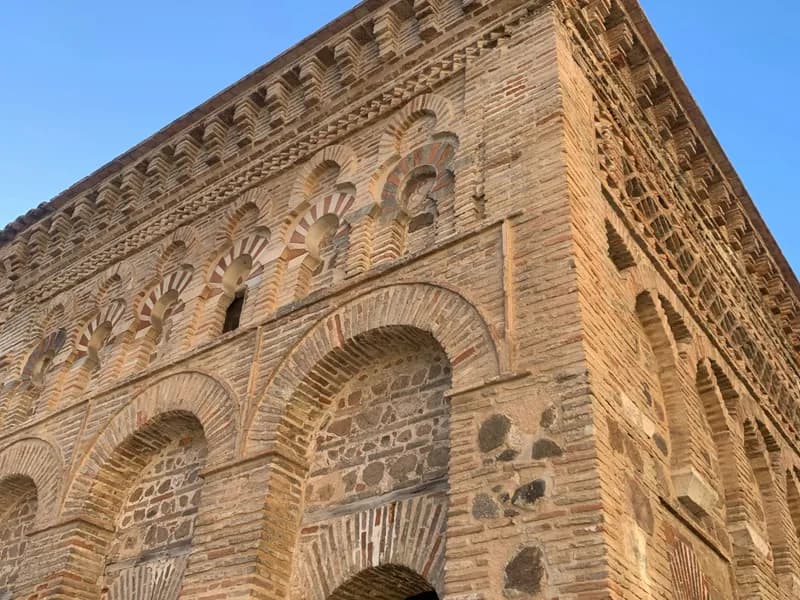
Iglesia de Santo Tomé
Holds a single painting: El Greco's 'The Burial of the Count of Orgaz' (1586), still hanging in the exact spot it was painted for, above the tomb it depicts. Entry ~€4, allow 20 min — there is one room and nothing else. Go early; tour groups fill it by 11AM.
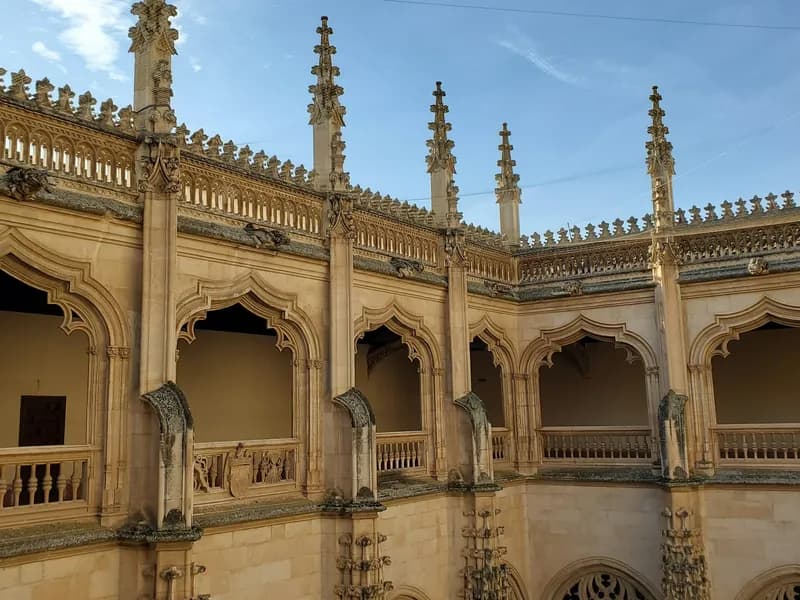
Monasterio de San Juan de los Reyes
Isabelline Gothic cloister built by Ferdinand and Isabella as their intended burial place. Entry ~€4, allow 45 min. The chains hanging on the exterior wall belonged to Christian prisoners freed at the fall of Granada in 1492 — they have hung there ever since.
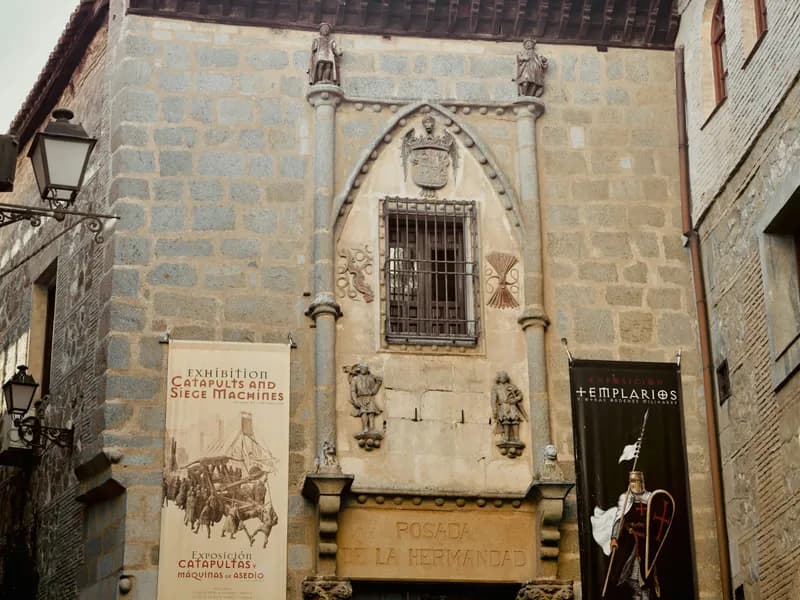
Sinagoga del Tránsito & Sephardic Museum
A 14th-century synagogue with Mudéjar plasterwork — Hebrew and Arabic inscriptions on the same wall. Entry €3, free Saturdays from 2PM and all day Sunday. Allow 1h. The attached museum covers Sephardic life up to the 1492 expulsion.
Santa María la Blanca
Built around 1180 as a synagogue, by Muslim architects, under Christian rule — the three-cultures story in one building. Later a church. Entry ~€4, allow 30 min. Thirty-two horseshoe arches and white octagonal pillars, closer to a mosque than to anything else in Spain.
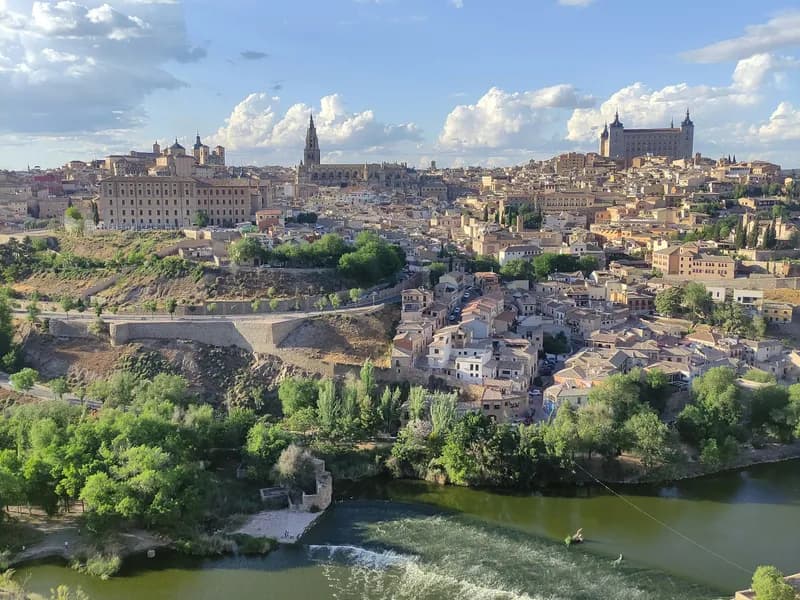
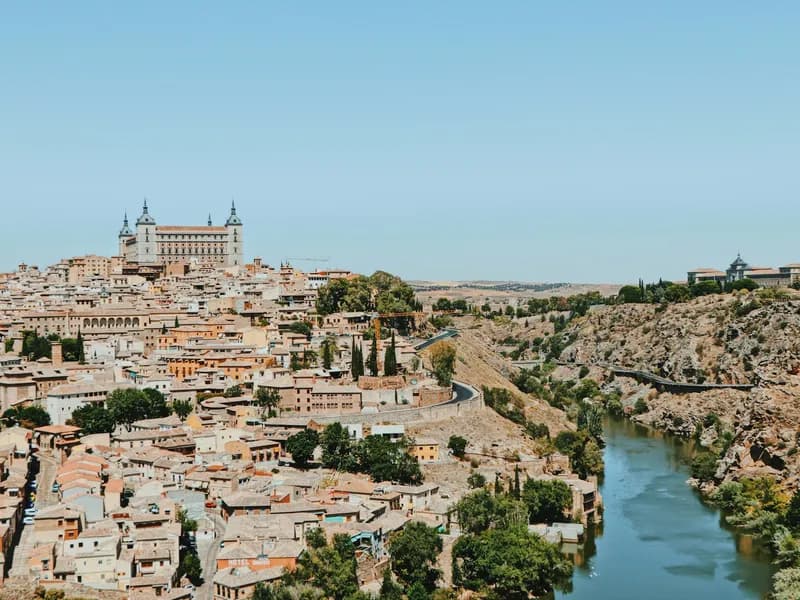
Mirador del Valle
The postcard view of the whole walled city across the Tagus gorge. Free, always open. It is 3 km from the old town — take bus #71 from Plaza de Zocodover or a taxi (~€10). Come 30 min before sunset, when the stone turns amber and the buses have gone.
Planned Itinerary
7-Day Toledo Itinerary
Arrival from Madrid & First Night Inside the Walls
Land at Madrid-Barajas (MAD) — Toledo has no airport of its own and sits 75 km south. The cheapest fast route is Cercanías C-1 from Terminal 4 to Atocha, then the AVANT high-speed train to Toledo in 33 minutes. Check in inside the walls, not at a chain hotel down by the river: the entire argument for Toledo is being here after 6PM, when the coach parties have gone and the lit cathedral belongs to the 85,000 people who live here.
Cercanías C-1 from Barajas T4 to Madrid Atocha(25 minutes)
Follow the purple 'Cercanías' signs in T4's basement, not the Metro signs — €2.60, and it drops you inside Atocha's main Renfe hall a two-minute walk from the AVANT gates. If you land at T1/T2/T3 you'll need the free inter-terminal shuttle to T4 first (15 min).
AVANT train Atocha → Toledo(33 minutes)
From €14 each way. Book on renfe.com a few days out — there are only about ten departures a day and they genuinely sell out, especially the 09:20 and 17:20. Sit on the right-hand side; the walled city rises out of the plain in the last two minutes before the station.
Bus #61 or #62 from Toledo station to Plaza de Zocodover(10 minutes)
€1.50, pay the driver. Toledo's 1919 neo-Mudéjar station is a beautiful building and a punishing 20-minute uphill walk from the old town with luggage — take the bus. Buses wait directly outside the station door and leave when the train empties.
Check in inside the Casco Histórico(1 hour)
Stay within the walls. Hospedería Casa de Cisneros (Cardenal Cisneros 12) is built directly onto Roman and Moorish masonry, 40m behind the cathedral apse, from about €90. Hotel Santa Isabel (Santa Isabel 24) is a converted 15th-century palace at around €65 with a roof terrace. Warn your driver or taxi: many lanes are too narrow for cars, so expect to walk the last 100m.
Dinner at Bar Ludeña, Plaza de la Magdalena 13(1.5 hours)
The tavern that invented carcamusas — pork and veal stewed with tomato, peas and white wine, about €6.50 a ración with bread to mop it. It's small, loud, tiled and full of locals; there's a dining room through the back if the bar is three deep. Wash it down with a caña for €1.80.
Night walk: floodlit cathedral and Calle del Comercio(1 hour)
Free, and the reason you stayed the night. Walk Calle del Comercio down from Zocodover, cut left at Calle Hombre de Palo, and come out under the cathedral's west front at Plaza del Ayuntamiento. Around 10:30PM in summer it's floodlit, empty and silent. Loop back via Calle de la Trinidad.
Toledo Cathedral, the Jesuit Rooftops & Sunset at the Mirador
Your one unmissable day. The Catedral Primada opens at 10AM and the first coaches reach it around 10:45 — be at the ticket office on Calle Cardenal Cisneros at 09:50. Afternoon stays in the same 400 metres of the upper town, and the day ends 3 km away across the gorge at the Mirador del Valle for the view the whole city is famous for.
Toledo Cathedral (Catedral Primada)(2 hours)
€12.50 with audioguide, Mon-Sat 10AM-6:30PM, Sun 2-6:30PM. Buy at the office on Calle Cardenal Cisneros, not at the main west door. Do the sacristy first while it's empty — El Greco's 'El Espolio' hangs over its altar, with Goya's Arrested Christ, Titian and a Caravaggio in the same room. Then the Transparente: a baroque hole punched through the Gothic vault so light falls on the tabernacle, best around 11AM.
Iglesia de los Jesuitas (San Ildefonso) rooftop towers(45 minutes)
€4, or free with the Pulsera Turística — buy the bracelet here (€12 for seven monuments, no expiry) and it pays for itself by your third stop tomorrow. Climb the twin bell towers: this is the best panorama from inside the walls, with the cathedral spire and the Alcázar in one frame. Five minutes uphill from the cathedral via Plaza Padre Juan de Mariana.
Lunch at Colección Catedral, Nuncio Viejo 1(1 hour)
Chef Adolfo Muñoz's tapas bar, 90 seconds from the cathedral. Order the venison tartare and the tomato salad with Toledo olive oil, around €25 a head — the same kitchen brain as his €90 restaurant around the corner at a fraction of it. Vermouth on tap for €2.50.
Museo de Santa Cruz, Miguel de Cervantes 3(1 hour)
Free entry, just off Zocodover. A 16th-century hospital with a Plateresque doorway carved like sugar-work and a coffered ceiling over the cross-shaped ward. It holds several El Grecos including his Assumption, plus the Tapestry of the Zodiac. Nobody queues here and that is the point — it's your quiet hour of the day.
Sunset at the Mirador del Valle(2 hours)
Free, always open. Bus #71 from Plaza de Zocodover, or a taxi for about €10 — it's 3 km around the Carretera de Circunvalación and not a walk you want in heat. Arrive 30 minutes before sunset: the stone turns amber, the last coaches leave, and you get the postcard of the whole walled city in its bend of the Tagus. Check the return bus time before you settle in, or book the taxi back.
Dinner at Alfileritos 24(1.5 hours)
Calle Alfileritos 24, in a 14th-century house with exposed brick vaults. Modern Castilian — the slow-cooked lamb shoulder and the ajoblanco are both excellent, around €35-40 a head with wine. Book a day ahead; the ground-floor tavern takes walk-ins if you can't get the dining room.
The Jewish Quarter & El Greco
The whole day fits in the western wedge of the old town — Judería, Santo Tomé and San Juan de los Reyes are within 500 metres of each other, so there's no zigzagging. Start at Santo Tomé the moment it opens: it is one small room with one painting and the tour groups fill it by 11AM. Note that the two state museums (Tránsito and Museo del Greco) close on Mondays — if today is Monday, swap with Day 4.
Iglesia de Santo Tomé — 'The Burial of the Count of Orgaz'(25 minutes)
€4 or free on the Pulsera. Opens 10AM — be at the door at 09:55. One room, one El Greco from 1586, still hanging exactly where he painted it for, directly above the tomb it depicts. Stand at the back for the first two minutes: the horizontal split between the earthly funeral and the heaven above only reads from distance. The boy at bottom-left pointing out is El Greco's son.
Museo del Greco, Paseo del Tránsito(1 hour)
€3, free Saturdays from 2PM and all day Sunday; closed Mondays. It isn't actually his house — it's a reconstruction by a Spanish marquis in 1911 — but the collection is real, including the 'View and Plan of Toledo' and the full Apostolado series. The Mudéjar cellar underneath is original 14th-century.
Sinagoga del Tránsito & Museo Sefardí(1 hour)
€3, free Saturday from 2PM and all Sunday; closed Mondays. Look up at the wall above the ark: Hebrew and Arabic inscriptions cut into the same Mudéjar plasterwork, financed by a Jewish treasurer to a Christian king. The attached museum runs to the 1492 expulsion decree — the tombstones in the garden are the quiet part.
Lunch at Restaurante Locum, Calle Locum 6(1.5 hours)
A 17th-century house near Santo Tomé with a glass-roofed patio. Around €40 a head; the partridge escabeche and the cod with pisto manchego are the ones to order. Book — it's ten tables and the Michelin listing means Spaniards fill it at 2:30PM sharp.
Santa María la Blanca(30 minutes)
€4 or free on the Pulsera. Built around 1180 as a synagogue by Muslim architects under a Christian king — the three-cultures story compressed into one room. Thirty-two horseshoe arches on whitewashed octagonal pillars; it looks more like Córdoba's mosque than anything else in Spain. Go on a bright afternoon: the pine-cone capitals only show when raking light hits them.
Monasterio de San Juan de los Reyes(45 minutes)
€4 or free on the Pulsera. Ferdinand and Isabella built this Isabelline Gothic cloister as their own burial place, then took Granada and were buried there instead. The chains bolted to the outside wall belonged to Christian prisoners freed at Granada in 1492 and have hung there since. The upper cloister gallery is usually empty at 6PM.
Drinks at La Abadía, Plaza de San Nicolás 3(1.5 hours)
Vaulted 16th-century cellars turned beer hall. Order a caña (€2) and they bring a free tapa unasked — order three and you've had dinner. The bombas and the migas are worth paying for. Loud, young, and the only place in the old town with real noise after 11PM.
Free Morning by the Tagus & the Alcázar
Your rest day — nothing before 11AM. Toledo is built on a 100m rock and by day three your calves know it. Spend the morning at river level on the Senda Ecológica where it's ten degrees cooler, then take the afternoon inside the Alcázar. Note the Alcázar is closed Mondays and free on Sundays.
Slow morning and the Senda Ecológica riverside path(2 hours)
Free. Drop down through Puerta del Cambrón to the north bank and walk the marked path upstream toward the Puente de Alcántara — roughly 3 km of flat gravel under the cliffs, with the whole city hanging above you. Go before 11AM in summer; there's no shade after that. You'll pass the Baño de la Cava tower and almost no other tourists.
Puente de San Martín and the Fly Toledo zipline(45 minutes)
The bridge is free and 14th-century; the zipline strung beside it is €10 and takes you 180m across the Tagus gorge in about 30 seconds. Weekends year-round, daily in summer, no booking needed — just turn up at the tower on the west bank. It is silly and it is the best €10 in the city.
Lunch at El Trébol, Calle Santa Fe 1(1 hour)
A five-table bar behind Zocodover that exists for one thing: the bomba, a fist of potato and spiced meat, breaded and fried, about €2.20 each. Two plus a beer is lunch for under €10. Standing room only at 2PM — go at 1:30.
Alcázar de Toledo & Museo del Ejército(2 hours)
€5, free Sundays, closed Mondays. The square fortress on the city's highest point, blown apart in the 1936 siege and rebuilt. Skip the upper floors of regimental uniforms if you're short on patience and go straight to the basement: the excavated Roman street and Visigothic foundations are included in the ticket and are the oldest thing you'll stand on in Toledo. The north-facing windows give a free rooftop view.
Evening at Círculo de Arte Toledo, Plaza de San Vicente 2(2 hours)
A deconsecrated medieval church turned café and concert hall — you drink a gin-tonic (€8) under a Mudéjar apse. Check the board outside for the night's gig; there's usually jazz or Spanish singer-songwriter stuff two or three nights a week for €10-15. Kitchen does decent sharing plates until 11PM.
Windmills of La Mancha — Orgaz, Consuegra & Tembleque
The one day you leave the walls. Rent a car for 24 hours (Europcar or Avis on Avenida de Madrid near the train station, from about €45 — book ahead, the Toledo branches are tiny). This is a 2h15 driving loop south into La Mancha and back, with a windmill ridge, a castle and two of the best plaza mayores in central Spain. Leave by 8:30AM in summer: Consuegra's ridge is entirely shadeless and 38°C by 2PM.
Drive Toledo → Orgaz on the CM-42(30 minutes)
Yes, that Orgaz — the count whose burial you saw at Santo Tomé held this town. Park free on the edge of the Plaza Mayor. There's a 14th-century castle you can walk around, a Churrigueresque church, and a bakery on the square selling bizcocho for €2. Twenty minutes is enough; it's a coffee stop, not a destination.
Consuegra — Cerro Calderico windmills and the Castillo de la Muela(2.5 hours)
Twelve whitewashed windmills strung along a bare ridge above the plain, with a 12th-century castle at the end of the line. Combined castle-and-mill ticket around €6; the mill called 'Bolero' houses the tourist office and 'Sancho' still has its working millstones and gets fired up on demand. Drive to the ridge-top car park rather than walking up from town. If you're here the last weekend of October, the Fiesta de la Rosa del Azafrán has women hand-plucking saffron threads on the square.
Lunch in Consuegra(1 hour)
Come down off the ridge to the Plaza de España and find a menú del día for €12-14 — three courses, bread and wine included, served 2-3:30PM only. Order the migas or the pisto manchego and ask for the local saffron in whatever they'll put it in. This is farm-town Spain, not tourist Spain; almost no English.
Tembleque — Plaza Mayor(45 minutes)
Twenty-five minutes north-east, just off the A-4, and almost nobody stops. A 17th-century square ringed on two levels by wooden galleries, still used as a bullring at fiesta time — the beams are notched where the barriers slot in. Free, always open, and you will likely have it to yourself.
Drive back to Toledo via the A-4 and CM-42(50 minutes)
Return the car before the office shuts (usually 7PM) or park at the Safont car park under the walls — €12 for 24 hours — and take the Remonte Peatonal de Recaredo, the free outdoor escalators, straight up into the old town. Locals use them; almost no tourists find them.
Dinner at Kumera, Calle Alfonso X el Sabio 2(1.5 hours)
The value pick of the old town — modern Manchegan cooking, around €25-30 a head. The oxtail brioche and the cod with romesco are the standards. Small room, books out by Friday; call in the morning.
Roman & Moorish Toledo, Swords and Marzipan
The layers under the medieval city, then the two crafts that still keep Toledo employed. Everything today is in the northern half of the old town and just outside the Puerta de Bisagra, so it's a compact walking day with an easy escalator ride when you need it. End with your best dinner of the trip.
Mezquita del Cristo de la Luz(40 minutes)
€3 or free on the Pulsera; opens 10AM. Built in 999 AD and the oldest standing building in the city — a nine-bay mosque no bigger than a garage, with nine different vault designs so the architect could show off. The Roman road paving is exposed under glass at the entrance. Go first thing; the room takes about eight people before it feels full.
Cuevas de Hércules and the Termas Romanas(45 minutes)
Both free. The Cuevas (Plaza de Valdecaleros end of Calle San Ginés) are a Roman cistern under a medieval church under a modern street — three eras stacked vertically, opened by volunteers on limited hours, usually 10AM-2PM. Then the Roman baths at Plaza Amador de los Ríos, visible through a glass floor in the middle of a normal square.
Fábrica de Espadas Mariano Zamorano, Calle Ciudad 19(45 minutes)
Free to walk into. Toledo armed Europe for 2,000 years and this family forge, going since 1870, is one of the last places still hammering blades by hand rather than importing them from Albacete. Ask and they'll usually let you watch the tempering. A real hand-forged blade starts around €200; the €15 letter openers on Calle Comercio come from a factory.
Damascene workshop on Paseo de Recaredo(45 minutes)
The city's other craft: 24-carat gold wire hammered into blackened steel, one thread at a time, then fired and burnished. The workshops down at Recaredo let you watch the inlay work at the bench, which is the only way to understand why a real damascene pendant costs €60 and the identical-looking souvenir costs €8. Take the free Recaredo escalators back up afterwards.
Marzipan from the Convento de San Clemente(30 minutes)
Toledo's mazapán has been made by convent nuns since the Middle Ages. At San Clemente you ring a bell, speak into a wooden turntable, put your euros on it, and it revolves back with a box of marzipan — the cloistered nuns are never seen. About €12 a box, roughly 10AM-1PM and 4-6PM. Confitería Santo Tomé at Calle Santo Tomé 5 (since 1856) is the polished alternative if the torno is shut.
Farewell dinner at Restaurante Adolfo, Calle Hombre de Palo 7(2.5 hours)
The city's serious restaurant, tucked behind the cathedral. Tasting menu around €90, à la carte around €70 — game, saffron and Toledo olive oil taken as seriously as anywhere in Castile. Ask to see the cellar before you leave: there's a 14th-century painted Jewish ceiling down there, uncovered during building works. Book two weeks ahead.
Departure — Last Marzipan and the Train North
Toledo's train to Madrid takes 33 minutes and Atocha to Barajas is another 25, so allow 3.5 hours from the old town to the MAD check-in desk and you'll be comfortable. Use the morning for the things you kept saying you'd get to.
Last walk: Puerta del Sol and Puerta de Bisagra(1 hour)
Free. Walk downhill from Zocodover through the Mudéjar Puerta del Sol — the double-arched 14th-century gate everyone photographs from the wrong side — and continue to the Puerta de Bisagra with Charles V's double-headed eagle carved the size of a car. Downhill the whole way, which matters with a suitcase.
Final shopping on Calle del Comercio(45 minutes)
Marzipan travels well and lasts months; damascene is light and flat and survives a suitcase. Buy the mazapán from Santo Tomé (Calle Santo Tomé 5) or Zocodover branch rather than the airport, and expect around €12-18 a box. Skip the mass-produced sword racks.
Checkout and bus #61/62 to Toledo station(30 minutes)
€1.50 from Plaza de Zocodover. Give yourself 15 minutes at the station just to look at it — the 1919 neo-Mudéjar ticket hall with its horseshoe arches and stained glass is a genuine building, not a pastiche, and everyone rushes past it.
AVANT Toledo → Madrid Atocha, then Cercanías C-1 to Barajas T4(1.5 hours)
33 minutes on the AVANT (from €14, pre-booked), then the C-1 from Atocha's basement to T4 in 25 minutes for €2.60. If you're flying from T1/T2/T3, add the free inter-terminal shuttle. A door-to-door private transfer from the old town to MAD runs about €130 and takes an hour if you'd rather not move luggage twice.
14-Day Toledo Itinerary
Arrival from Madrid & First Night Inside the Walls
Land at Madrid-Barajas (MAD) — Toledo has no airport and sits 75 km south. Cercanías C-1 from Terminal 4 to Atocha, then the AVANT high-speed train to Toledo in 33 minutes. Base yourself inside the walls for the full fortnight: with a two-week stay you can afford an apartment in the Casco Histórico, and the whole argument for Toledo is being here after the coaches leave at 6PM.
Cercanías C-1 from Barajas T4 to Madrid Atocha(25 minutes)
€2.60. Follow the purple 'Cercanías' signs in T4's basement, not the Metro signs — it delivers you inside Atocha's Renfe hall two minutes from the AVANT gates. From T1/T2/T3 take the free inter-terminal shuttle to T4 first (15 min).
AVANT train Atocha → Toledo(33 minutes)
From €14 each way, booked on renfe.com a few days ahead — only around ten departures a day and they sell out. Right-hand side going south: the walled city rises out of the plain in the final two minutes.
Bus #61 or #62 to Plaza de Zocodover(10 minutes)
€1.50 to the driver, waiting outside the station door. The alternative is a 20-minute uphill walk with luggage, which you will regret.
Settle into an apartment in the Casco Histórico(1.5 hours)
For 14 nights, take a flat rather than a hotel — the Judería and the streets around Santo Tomé have restored 16th-century houses from about €70 a night, and a kitchen matters once you find the Mercado de San Agustín. Warn the owner of your arrival hour: most lanes are too narrow for cars and you'll walk the last 100m.
Dinner at Bar Ludeña, Plaza de la Magdalena 13(1.5 hours)
The tavern that invented carcamusas — pork and veal stewed with tomato, peas and white wine, €6.50 a ración. Tiled, loud, and full of Toledanos rather than tour groups. Caña €1.80. There's a dining room behind if the bar is three deep.
Night walk under the floodlit cathedral(1 hour)
Free. Down Calle del Comercio from Zocodover, left at Calle Hombre de Palo, out under the west front at Plaza del Ayuntamiento around 10:30PM. Lit, empty, silent. This single walk is why the guidebooks tell you not to day-trip Toledo.
Toledo Cathedral & the Jesuit Rooftops
The Catedral Primada opens at 10AM and the first coach groups reach it about 10:45 — be at the ticket office on Calle Cardenal Cisneros at 09:50 and you'll have the sacristy to yourself. The rest of the day stays within 400 metres, on the high ground around the cathedral and Zocodover.
Toledo Cathedral (Catedral Primada)(2 hours)
€12.50 with audioguide, Mon-Sat 10AM-6:30PM, Sun 2-6:30PM. Ticket office is on Calle Cardenal Cisneros, not the west door. Sacristy first: El Greco's 'El Espolio' over its altar, Goya's Arrested Christ, Titian and a Caravaggio in the same room. Then the Transparente — a baroque hole cut through the Gothic vault to drop light on the tabernacle, best around 11AM.
Iglesia de los Jesuitas (San Ildefonso) towers(45 minutes)
€4, or free with the Pulsera Turística — buy the €12 bracelet here. It covers seven monuments including San Juan de los Reyes, Santo Tomé, Santa María la Blanca and the Mezquita del Cristo de la Luz, has no expiry, and pays for itself at the third site. The twin towers give the best view from inside the walls.
Lunch at Colección Catedral, Nuncio Viejo 1(1 hour)
Adolfo Muñoz's tapas bar 90 seconds from the cathedral. Venison tartare, tomato salad with Toledo oil, vermouth on tap at €2.50 — about €25 a head for the same kitchen brain as his €90 restaurant round the corner.
Museo de Santa Cruz, Miguel de Cervantes 3(1 hour)
Free. A 16th-century hospital with a Plateresque doorway carved like sugar-work and a coffered ceiling over the cross-shaped ward. Several El Grecos including his Assumption, plus the Tapestry of the Zodiac. Nobody queues; that's the appeal.
Evening on Plaza de Zocodover(2 hours)
The city's living room, and once its Moorish livestock market ('suq al-dawabb'). Take an outside table, order a beer for €2.50, and watch the shift change around 8PM as the last day-trippers vanish downhill and Toledo's own families arrive for the paseo. Dinner is late here — nothing before 9PM.
The Jewish Quarter — Tránsito, Santa María la Blanca & San Juan de los Reyes
A compact day in the western wedge of the old town; everything is within 500 metres. Note that the Sinagoga del Tránsito is a state museum and closes on Mondays — if today is a Monday, swap this with Day 5.
Sinagoga del Tránsito & Museo Sefardí(1 hour)
€3, free Saturdays from 2PM and all day Sunday; closed Mondays. Look above the ark: Hebrew and Arabic inscriptions cut into the same Mudéjar plasterwork, paid for by a Jewish treasurer to a Christian king. The museum runs to the 1492 expulsion; the tombstones in the garden are the part that stays with you.
Santa María la Blanca(30 minutes)
€4 or free on the Pulsera. Built around 1180 as a synagogue, by Muslim architects, under Christian rule — the three-cultures story in one room, later turned into a church. Thirty-two horseshoe arches on whitewashed octagonal pillars. Come in bright afternoon light or the pine-cone capitals disappear.
Monasterio de San Juan de los Reyes(45 minutes)
€4 or free on the Pulsera. Ferdinand and Isabella's intended tomb, built in Isabelline Gothic, abandoned as a burial plan when they took Granada. The chains bolted to the outer wall belonged to Christian prisoners freed at Granada in 1492 and have hung there ever since. Go up to the cloister's first-floor gallery — most people never do.
Lunch at Restaurante Locum, Calle Locum 6(1.5 hours)
A 17th-century house with a glass-roofed patio, about €40 a head. Partridge escabeche and cod with pisto manchego. Ten tables, and Spaniards fill it at 2:30PM — book.
Puerta del Cambrón and the western walls(45 minutes)
Free. Walk out through the Cambrón gate and follow the wall line south above the river to the Puente de San Martín. This is where the city drops away most dramatically and where you understand why nobody ever successfully besieged it from the west. Best in the last hour of light.
Drinks at La Abadía, Plaza de San Nicolás 3(1.5 hours)
Beer hall in 16th-century vaulted cellars. A caña is €2 and comes with a free tapa unasked; three rounds is dinner. The bombas and migas are worth ordering properly. The only corner of the old town with real noise past 11PM.
El Greco's Toledo — Santo Tomé, His House and His Grave
The Cretan who came to Toledo in 1577 for a cathedral commission and never left. Today follows him around the western half of the city, ending at the crypt where he's buried. Both state museums close on Mondays. Be at Santo Tomé for opening — it is one room with one painting and the groups fill it by 11AM.
Iglesia de Santo Tomé — 'The Burial of the Count of Orgaz'(25 minutes)
€4 or free on the Pulsera; opens 10AM, be at the door at 09:55. Painted in 1586 and still hanging in the exact spot it was made for, above the tomb it depicts. Stand at the back first — the split between the earthly funeral below and the heaven above only resolves from distance. The boy pointing at bottom-left is El Greco's son Jorge Manuel.
Museo del Greco, Paseo del Tránsito(1 hour)
€3, free Saturday from 2PM and all Sunday; closed Mondays. Not really his house — a marquis reconstructed it in 1911 — but the collection is genuine: 'View and Plan of Toledo' and the complete Apostolado. The Mudéjar cellar underneath is original 14th-century and the coolest room in the city in August.
Lunch at Casa Aurelio, Calle Sinagoga 6(1.5 hours)
Old-school Toledo since 1945 — white tablecloths, waiters in waistcoats, no concessions to fashion. Perdiz estofada (stewed partridge) at around €22 is the dish to have here and almost nowhere else does it better. Menú around €30.
Convento de Santo Domingo el Antiguo(40 minutes)
€2.50, and hours are erratic — roughly 11AM-1:30PM and 4-7PM in season, often shut in winter mornings. This was El Greco's first Toledo commission, and he is buried underneath: there's a plexiglass panel set into the church floor and you look straight down into the crypt at his coffin. The nuns still sell almond sweets at the door. Almost nobody comes.
Hospital de Tavera, Calle Duque de Lerma 2(1.5 hours)
€6, outside the walls to the north — 15 minutes downhill from Bisagra. A Renaissance hospital-palace still furnished as the Duke of Lerma's house, holding El Greco's 'Baptism of Christ' (his last work, unfinished at his death) and Ribera's unsettling 'Bearded Woman'. The original pharmacy and the twin patios are worth the walk on their own. Take the free Recaredo escalators back up.
The Alcázar, and the Layers Underneath the City
Roman, Visigothic and Moorish Toledo, most of it below street level, plus the fortress on top of everything. All in the northern and eastern half of the old town, so it's a tight walking day. The Alcázar closes Mondays and is free on Sundays.
Mezquita del Cristo de la Luz(40 minutes)
€3 or free on the Pulsera; opens 10AM. Built in 999 AD — the oldest standing building in Toledo, a nine-bay mosque the size of a garage in which the architect gave every single vault a different design purely to show off. Roman road paving is exposed under glass at the entrance. It holds about eight people before it feels crowded, so come first.
Cuevas de Hércules and Termas Romanas(45 minutes)
Both free. The Cuevas, off Calle San Ginés, are a Roman cistern beneath a medieval church beneath a modern street — three eras stacked vertically, opened by volunteers on limited hours, usually 10AM-2PM. Then the Roman baths at Plaza Amador de los Ríos, visible through a glass floor set into an ordinary little square.
Lunch at El Trébol, Calle Santa Fe 1(1 hour)
Five tables behind Zocodover, existing for one thing: the bomba — a fist of potato and spiced meat, breaded and deep-fried, €2.20 each. Two plus a beer is lunch under €10. Standing room only at 2PM; go at 1:30.
Alcázar de Toledo & Museo del Ejército(2 hours)
€5, free Sundays, closed Mondays. The square fortress on the highest point of the city, shelled to rubble in the 1936 siege and rebuilt. The regimental-uniform floors are skippable; the basement is not — excavated Roman street and Visigothic foundations, included in the ticket, the oldest ground you'll stand on here. The north windows are a free rooftop viewpoint.
Circo Romano and dinner at Venta de Aires(2.5 hours)
The Roman circus is a free public park outside the walls where locals walk dogs among the ruins of a 30,000-seat stadium. Beside it, Venta de Aires has been serving since 1891 — Hemingway ate here — and still does perdiz a la toledana properly at around €45 a head. The terrace under the plane trees is the point in summer.
Free Day by the Tagus — Riverside, Zipline & the Mirador
Rest day. Nothing before 11AM. Five days on a 100-metre rock has told in your calves, so this one happens mostly at river level where it's ten degrees cooler, and finishes with the view the whole city is famous for.
Slow morning and the Senda Ecológica riverside path(2.5 hours)
Free. Down through Puerta del Cambrón to the north bank, then a flat gravel path upstream toward the Puente de Alcántara — about 3 km under the cliffs with the whole city hanging over you, past the Baño de la Cava tower. Go before 11AM in summer; there is no shade after that and almost no other tourists at any hour.
Fly Toledo zipline at Puente de San Martín(45 minutes)
€10, no booking — turn up at the tower on the west bank. 180 metres across the Tagus gorge in about 30 seconds, weekends year-round and daily in summer. Undignified and the best €10 in Toledo. The 14th-century bridge itself is free.
Museo Victorio Macho, Plaza de Victorio Macho(1 hour)
€3, on the Roca Tarpeya spur above the river. The sculptor's own house and studio, but the reason to go is the garden terrace — a private-feeling balcony straight over the gorge, with a short film in the auditorium about the city's geology. Ten people at a time, and the best rest-day seat in Toledo.
Long lunch at Hostal del Cardenal, Paseo de Recaredo 24(2 hours)
A cardinal's 18th-century summer palace built into the city wall, with a walled garden of box hedges and fountains. Roast suckling pig or lamb from the wood oven, around €45 a head. Eat outside under the trees at 2:30PM and don't plan anything after.
Sunset at the Mirador del Valle(2 hours)
Free, always open. Bus #71 from Plaza de Zocodover, or a taxi for about €10 — it's 3 km round the Carretera de Circunvalación and not a walk in heat. Be there 30 minutes before sunset: the stone goes amber, the coaches have gone, and the whole walled city sits in its bend of the Tagus. Confirm the return bus time first or book the taxi back.
Windmills of La Mancha — Orgaz, Consuegra & Tembleque
Rent a car (Europcar or Avis on Avenida de Madrid near the train station, from about €45 a day — book ahead, the Toledo branches are small). A 2h15 driving loop south into La Mancha: a windmill ridge, a castle and two of the finest plaza mayores in central Spain. Leave by 8:30AM in summer; Consuegra's ridge is shadeless and hits 38°C by 2PM.
Orgaz on the CM-42(45 minutes)
Thirty minutes south, and yes — that Orgaz, the count whose burial you saw at Santo Tomé. Free parking at the edge of the Plaza Mayor, a 14th-century castle to walk around, a Churrigueresque church, and bizcocho for €2 from the bakery on the square. It's a coffee stop with a good story, not a destination.
Consuegra — Cerro Calderico windmills and Castillo de la Muela(2.5 hours)
Twelve white windmills along a bare ridge over the plain with a 12th-century castle at the end of the line. Combined ticket around €6. The mill called 'Bolero' is the tourist office; 'Sancho' keeps its working millstones and gets run on request. Drive up to the ridge car park rather than climbing from town. Last weekend of October brings the Fiesta de la Rosa del Azafrán, with women hand-plucking saffron threads on the square.
Menú del día in Consuegra(1 hour)
Down on Plaza de España, €12-14 for three courses with bread and wine, served 2-3:30PM and not a minute later. Migas or pisto manchego, and ask them to put the local saffron in something. Farm-town Spain — very little English, which is the point.
Tembleque — Plaza Mayor(45 minutes)
Twenty-five minutes north-east off the A-4, and almost nobody stops. A 17th-century square ringed on two levels in wooden galleries, still rigged as a bullring at fiesta time — you can see the notches where the barriers slot in. Free, always open, probably empty.
Return to Toledo and park at Safont(50 minutes)
Keep the car for the coming days: park at the Safont car park under the walls (€12 for 24h) and ride the Remonte Peatonal de Recaredo — a free chain of outdoor escalators from the car park straight up into the old town. Locals use it constantly; most tourists never find it.
Madrid in a Day — The Prado & the Barrio de las Letras
Thirty-three minutes on the AVANT and you're in a capital of 3.4 million. Book both legs on renfe.com — the 08:50 out and the 21:25 back are the useful ones and they sell out. Everything today is walkable between Atocha and Sol, so no Metro needed except to save your feet.
AVANT Toledo → Madrid Atocha(33 minutes)
From €14. Take the early departure and walk straight out of Atocha into the Paseo del Prado — the museum is 400 metres from the station's tropical-garden concourse, which is worth ten minutes on its own.
Museo del Prado(3 hours)
€15, open 10AM-8PM, free 6-8PM Mon-Sat (the queue for free entry starts at 5:15PM). Three hours is the honest limit before your eyes stop working. If you've just spent a week with El Greco, go straight to Rooms 8B-10B for his Madrid holdings, then Velázquez's Las Meninas in Room 12 and Goya's Black Paintings in Rooms 66-67. Buy online to skip the Jerónimos-door queue.
Lunch at Casa Labra, Calle Tetuán 12(1 hour)
Standing at the bar since 1860 — the Spanish Socialist Party was founded in the back room. You want the tajada de bacalao (a fried cod fillet, about €1.60) and the croquetas de bacalao, with a caña. Order at the tiny hatch on the right, not the main bar. Under €10 and it is a Madrid institution rather than a tourist trap.
Barrio de las Letras walk(1.5 hours)
Free. Cervantes' and Lope de Vega's neighbourhood, with their lines set in brass letters into the paving of Calle de las Huertas. Start at Plaza de Santa Ana, walk Huertas downhill reading the pavement, detour to the Casa Museo Lope de Vega (free, but book ahead — timed slots only). Cervantes is buried behind an unmarked wall at the Convento de las Trinitarias on Calle Lope de Vega.
Early tapas in La Latina(2 hours)
Cava Baja is the street; go at 7:30PM before it fills. La Bodega de la Ardosa (technically Malasaña, Colón 13) does the best tortilla in the city at €3.50 a wedge if you head north instead. Budget €25-30 a head grazing across three bars, which is the correct way to do it.
Chocolate at San Ginés, then the AVANT home(1 hour)
Chocolatería San Ginés, open 24 hours since 1894, in an alley off Calle Arenal. Chocolate con churros €5. Then Metro Line 1 from Sol to Atocha (six stops, €1.50-2) for the 21:25 back. You'll be inside Toledo's walls by 10:15PM.
Steel and Sugar — Toledo's Living Crafts
A deliberately slow day on the two trades that still employ Toledanos: damascene gold inlay and convent marzipan, with the last hand-forge in a city that armed Europe for 2,000 years in between. Everything is in the northern old town and just outside Bisagra, with the free escalators to spare your legs.
Slow morning at Mercado de San Agustín, Cuesta del Águila 1(1.5 hours)
Three floors of food stalls and a roof terrace, open from 10AM. This is where you buy manchego cut to order, Toledo olive oil and jamón for the apartment, then have coffee and a tostada con tomate for €3 on the terrace over the rooftops. Locals eat here; it is not a tourist market.
Fábrica de Espadas Mariano Zamorano, Calle Ciudad 19(45 minutes)
Free to walk in. Going since 1870 and one of the last places in Toledo still hammering blades by hand rather than shipping them in from Albacete. Ask and they'll usually let you watch the tempering — the moment the steel goes into the oil is worth the visit. A real hand-forged blade starts around €200; the €15 letter openers on Calle Comercio are factory goods.
Damascene workshop on Paseo de Recaredo(1 hour)
Twenty-four-carat gold wire hammered into blackened steel one thread at a time, then fired and burnished black. The Recaredo workshops let you stand at the bench and watch, which is the only way to understand why a genuine damascene pendant is €60 and the identical-looking souvenir is €8. Ride the free Recaredo escalators back up afterwards.
Marzipan from the Convento de San Clemente(45 minutes)
Ring the bell, speak into the wooden turntable, put your coins on it, and it revolves back with a box of marzipan — the cloistered nuns are never seen or heard beyond the price. About €12, roughly 10AM-1PM and 4-6PM. Then compare against Confitería Santo Tomé at Calle Santo Tomé 5, making it since 1856: theirs is the benchmark, and the difference between convent and confectioner is real.
Free afternoon(3 hours)
Deliberately empty. Nap through the worst of the heat like everyone else in Castile — the city genuinely shuts from 2:30 to 5PM and fighting that is how tourists ruin Spain for themselves.
Evening at Círculo de Arte Toledo, Plaza de San Vicente 2(2.5 hours)
A deconsecrated medieval church turned café and concert hall — you drink a gin-tonic (€8) under a Mudéjar apse. Check the board outside for the night's programme; there's usually jazz or a Spanish singer-songwriter two or three nights a week for €10-15, and the kitchen does sharing plates until 11PM.
Aranjuez's Royal Gardens & Chinchón's Plaza Mayor
North-east by car, 50 minutes on the A-4 — a Bourbon summer palace with gardens running along the Tagus, then a circular medieval plaza that doubles as a bullring. Aranjuez's palace closes Mondays. The contrast of the day is the point: royal formality in the morning, anís and a cave restaurant in the afternoon.
Palacio Real de Aranjuez(1.5 hours)
€9, closed Mondays, free for EU citizens Wednesday and Thursday from 5PM (3PM in winter). The Porcelain Room and the Arab Smoking Room are the two that justify the ticket — the latter is a full Alhambra pastiche built for Isabel II. UNESCO-listed as a cultural landscape, and it stays 10°C cooler than Toledo because of the river.
Jardín del Príncipe and the Casa del Labrador(1.5 hours)
The gardens are free and enormous — 150 hectares of plane trees and elms along the Tagus, laid out to make a desert look like England. Walk the Calle de la Reina axis. The Casa del Labrador at the far end (€5, guided only, book at the palace) is a 'peasant's cottage' the Bourbons filled with gold and clocks. Allow 25 minutes just to walk out there.
Strawberries and lunch in Aranjuez(1.5 hours)
Aranjuez means fresas — the strawberry fields here supplied the court, and there was a dedicated royal strawberry train. Buy a punnet from any roadside stall in season (May-June, about €4) and eat them with cream. For a proper lunch, the restaurants around Calle Almíbar do menús for €15-18.
Chinchón — Plaza Mayor(2 hours)
Forty minutes east. An irregular circular plaza ringed by 234 wooden balconies on three tiers, still closed off for bullfights every August — the buildings are the grandstand. Free and permanently open. The town makes anís; try a copa at any bar on the square for about €3, and buy the Chinchón bottle rather than the tourist version.
Late lunch or early dinner at Mesón Cuevas del Vino, Chinchón(1.5 hours)
An old olive-oil mill with dining rooms dug into wine caves, on Calle Benito Hortelano. Roast lamb from the wood oven and their own house wine drawn from the barrel, around €35 a head. Book at weekends. Then it's 1h10 back to Toledo on the A-4.
Cuenca — The Hanging Houses & the Enchanted City
The biggest day trip of the fortnight and worth the drive: 2 hours east on the A-40, to a town wedged onto a knife-edge of rock between two gorges with houses hanging off the cliff. Leave Toledo by 7:30AM. This is a long day — if you'd rather not drive it, the alternative is AVANT to Madrid then AVE to Cuenca in 55 minutes, though Cuenca's AVE station is 6 km out of town.
Drive Toledo → Cuenca on the A-40(2 hours)
Straight, empty motorway across the Alcarria. Park at the top of the old town near the castle (Parking Cuenca Casco Antiguo, about €12/day) and walk downhill through the whole town rather than climbing up from the new city — everyone gets this wrong.
Casas Colgadas and the Puente de San Pablo(1 hour)
Free. The hanging houses are three surviving 15th-century balconied buildings cantilevered straight over the Huécar gorge. The postcard is taken from the Puente de San Pablo — an iron footbridge 40m above the river that flexes when you walk it, which is not a comfort. Cross it to the Parador side for the classic frame, best in morning light.
Museo de Arte Abstracto Español(1 hour)
Around €5, closed Mondays. Inside the hanging houses themselves — Fernando Zóbel's collection of Tàpies, Chillida, Saura and Millares, installed in whitewashed medieval rooms with windows over a 40m drop. The building and the art argue with each other in a way that works. One of the best small museums in Spain and nearly nobody outside Spain has heard of it.
Lunch at Figón del Huécar, Ronda Julián Romero 6(1.5 hours)
The singer Raphael's old house, now a restaurant with a terrace over the gorge. Around €40 a head. Order morteruelo — a warm pâté of game, pork liver and spices that is Cuenca's real dish and appears almost nowhere else — and finish with resolí, the local coffee-and-orange liqueur. Book the terrace.
Ciudad Encantada(1.5 hours)
€5, 30 minutes north-east of Cuenca. Limestone eroded into a forest of mushrooms, faces and arches, on a 3 km signposted loop through pine woods. It's a geology curiosity rather than a wonder, but it's cool, shaded, and a good decompression before the drive. Last entry is usually two hours before closing — check seasonally.
Drive back to Toledo(2 hours)
You'll be back around 9PM. Park at Safont (€12/24h) and take the free Recaredo escalators up. Eat something simple — La Abadía does tapas until late and you will not want a project.
Rest Day in Toledo & Puy du Fou by Night
Recovery day after Cuenca, with one big evening. Nothing scheduled until the afternoon. Puy du Fou España sits 7 km west of Toledo on the CM-4000 toward La Puebla de Montalbán, and its night show 'El Sueño de Toledo' is genuinely the most spectacular thing in the province.
Nothing before noon(4 hours)
Coffee on your own terrace or a tostada at any bar off Zocodover for €3. If you must move, the Zocotren tourist train leaves Zocodover roughly hourly for €6.50 and does a 45-minute loop out to the Mirador and back — mildly ridiculous, zero effort, and an honest way to see the gorge without walking.
Long lunch on Plaza del Ayuntamiento(2 hours)
Take an outside table facing the cathedral's west front and stay for two hours. Los Cuatro Tiempos on Sixto Ramón Parro does a solid menú for around €20. This is the square Toledo puts on its own postcards and half the visitors never sit down in it.
Siesta(2 hours)
Non-negotiable if you want to enjoy a show that finishes near midnight. The city shuts anyway from 2:30 to 5PM.
Puy du Fou España — 'El Sueño de Toledo'(4 hours)
From about €39; a 70-minute night show telling 1,100 years of Spanish history on a five-hectare stage with 200 performers, horses, fire and a flooded set — it opens with a Visigothic king and ends with the walls of Toledo you've been living inside. Free parking, 15 minutes' drive. Gates open around 8PM, show starts at dusk. Runs roughly March to early January on selected evenings — check the calendar and book, it sells out at weekends.
Talavera de la Reina Ceramics & Oropesa Castle
West this time, an hour on the A-5 into Toledo province's other craft capital. Talavera has been making blue-and-yellow tin-glazed ceramics since the 16th century, and in 2019 UNESCO put the technique on the Intangible Cultural Heritage list jointly with Puebla in Mexico. Then a castle-parador on the way home with the Sierra de Gredos across the horizon.
Drive Toledo → Talavera de la Reina(1 hour)
West on the A-5/CM-4000 through olive country. Park near the Jardines del Prado — free, and it puts you at the door of the first stop.
Basílica de Nuestra Señora del Prado(1 hour)
Free. Locals call it the Sistine Chapel of ceramics and it is not a wild claim — the interior is sheathed floor to vault in Talavera tile panels from the 16th to the 20th century, each generation adding its own. The tiled benches and pergolas in the surrounding gardens are a free open-air museum of the same craft.
Museo Ruiz de Luna(1.5 hours)
About €3, closed Mondays. Housed in the former Convento de San Agustín, it traces Talavera ware from the 16th century through the 20th-century revival Juan Ruiz de Luna led, with his reconstructed workshop and kiln. It answers the question you'll otherwise carry around all day: why this particular blue.
Lunch and the surviving alfares(2 hours)
Eat a menú del día for €13-15 in the centre, then find the working potteries — several still throw and hand-paint on site, and prices at the workshop door are roughly half what the same piece costs in Toledo's Calle Comercio. A hand-painted plate runs €25-60; anything under €10 was screen-printed elsewhere. They'll pack for travel if you ask.
Oropesa castle and parador(1.5 hours)
Thirty minutes further west. A 14th-century castle that became Spain's first castle parador in 1930, and you can walk the ramparts and have a drink on the terrace without staying. Across the plain the Sierra de Gredos fills the whole northern horizon, snow-capped into May. Best in late afternoon light. Then 1h15 back to Toledo.
Farewell dinner at Restaurante Adolfo, Calle Hombre de Palo 7(2.5 hours)
Toledo's serious restaurant, behind the cathedral. Tasting menu around €90, à la carte around €70 — game, saffron and Toledo oil handled as seriously as anywhere in Castile. Ask to see the cellar: there's a 14th-century painted Jewish ceiling down there, found during building works. Book two weeks ahead.
Departure — Convent Marzipan and the Train North
Allow 3.5 hours from the old town to the MAD check-in desk: 33 minutes Toledo to Atocha, 25 minutes Atocha to Barajas, plus the joins. Return the car first if you still have it. The morning is for the loose ends.
Last walk: Puerta del Sol and Puerta de Bisagra(1 hour)
Free, and downhill the whole way — which matters with a suitcase. From Zocodover through the Mudéjar Puerta del Sol, the 14th-century double-arched gate everyone photographs from the wrong side, then on to Puerta de Bisagra and Charles V's double-headed eagle carved the size of a car.
Final marzipan run(45 minutes)
Marzipan keeps for months and survives a hold bag. Confitería Santo Tomé (Calle Santo Tomé 5, or the Zocodover branch) for the reliable version at €12-18 a box; the Convento de San Clemente torno if you want the version made by nuns you never see. Both beat anything at the airport by a distance.
Checkout and bus #61/62 to Toledo station(30 minutes)
€1.50 from Plaza de Zocodover. Leave 15 minutes at the station simply to look at it — the 1919 neo-Mudéjar hall with horseshoe arches and stained glass is a real building, not a pastiche, and everybody sprints past it.
AVANT to Atocha, then Cercanías C-1 to Barajas T4(1.5 hours)
33 minutes on the AVANT (from €14, pre-booked) and 25 minutes on the C-1 from Atocha's basement to T4 for €2.60. Flying from T1/T2/T3 adds the free inter-terminal shuttle. A private door-to-door transfer from the old town to MAD is about €130 in an hour if you'd rather not handle luggage twice.
21-Day Toledo Itinerary
Arrival from Madrid & First Night Inside the Walls
Land at Madrid-Barajas (MAD) — Toledo has no airport and sits 75 km south. Cercanías C-1 from Terminal 4 to Atocha, then the AVANT high-speed train to Toledo in 33 minutes. For three weeks, take an apartment inside the walls and keep it for the whole trip: Toledo is your anchor, and everything from Mérida to Segovia radiates out from it. The city is only itself after 6PM, when the coaches have gone.
Cercanías C-1 from Barajas T4 to Madrid Atocha(25 minutes)
€2.60. Follow the purple 'Cercanías' signs in T4's basement, not the Metro signs — it puts you inside Atocha's Renfe hall, two minutes from the AVANT gates. From T1/T2/T3, take the free inter-terminal shuttle to T4 first (15 min).
AVANT train Atocha → Toledo(33 minutes)
From €14. Book on renfe.com a few days ahead — only about ten departures a day and they sell out. Sit on the right going south: the walled city rises out of the plain in the last two minutes before the station.
Bus #61 or #62 to Plaza de Zocodover(10 minutes)
€1.50 to the driver, waiting outside the station door. The alternative is a 20-minute uphill walk with three weeks of luggage.
Settle into a long-stay apartment in the Casco Histórico(1.5 hours)
Twenty nights justifies a proper flat — restored 16th-century houses in the Judería or around Santo Tomé run €65-90 a night, and monthly rates knock 20-30% off. Insist on air conditioning if you're here May-September; the hilltop has no shade and no breeze. Most lanes are too narrow for cars, so plan to walk the last 100m.
Dinner at Bar Ludeña, Plaza de la Magdalena 13(1.5 hours)
The tavern that invented carcamusas — pork and veal stewed with tomato, peas and white wine, €6.50 a ración with bread to mop it. Tiled, loud, Toledano. Caña €1.80. There's a dining room behind if the bar is three deep.
Night walk under the floodlit cathedral(1 hour)
Free, and the reason you didn't day-trip. Down Calle del Comercio from Zocodover, left at Calle Hombre de Palo, out under the west front at Plaza del Ayuntamiento around 10:30PM. Lit, empty, silent.
Toledo Cathedral & the Jesuit Rooftops
The Catedral Primada opens at 10AM and the first coach groups reach it around 10:45 — be at the ticket office on Calle Cardenal Cisneros at 09:50. Everything today sits within 400 metres on the high ground between the cathedral and Zocodover, so it is a gentle day for legs still adjusting to a 100-metre rock.
Toledo Cathedral (Catedral Primada)(2 hours)
€12.50 with audioguide, Mon-Sat 10AM-6:30PM, Sun 2-6:30PM. Ticket office on Calle Cardenal Cisneros, not the west door. Do the sacristy first while it's empty — it's effectively a picture gallery, with El Greco's 'El Espolio' over its altar and Goya, Titian and a Caravaggio in the same room. Then the Transparente: a baroque hole punched through the Gothic vault so daylight falls on the tabernacle, best around 11AM. Built from 1226 directly over the city's main mosque.
Iglesia de los Jesuitas (San Ildefonso) towers(45 minutes)
€4 or free with the Pulsera Turística — buy the €12 bracelet here on day one. It covers seven monuments including San Juan de los Reyes, Santo Tomé, Santa María la Blanca and the Mezquita del Cristo de la Luz, never expires, and pays for itself by your third site. Climb both bell towers: the best panorama from inside the walls.
Lunch at Colección Catedral, Nuncio Viejo 1(1 hour)
Adolfo Muñoz's tapas bar, 90 seconds from the cathedral. Venison tartare, tomato salad with Toledo olive oil, vermouth on tap for €2.50 — around €25 a head for the same kitchen brain as his €90 restaurant round the corner.
Museo de Santa Cruz, Miguel de Cervantes 3(1 hour)
Free, just off Zocodover. A 16th-century hospital with a Plateresque doorway carved like sugar-work and a coffered ceiling over the cross-shaped ward. Several El Grecos including his Assumption, plus the Tapestry of the Zodiac. Nobody queues, which is the whole appeal.
Evening paseo on Plaza de Zocodover(2 hours)
The city's living room and once its Moorish livestock market — 'suq al-dawabb', which is where the name comes from. Take an outside table with a €2.50 beer around 8PM and watch the shift change: the last day-trippers vanish downhill, Toledo's own families arrive. Nobody eats before 9PM.
The Jewish Quarter — Tránsito, Santa María la Blanca & San Juan de los Reyes
The western wedge of the old town, everything within 500 metres, no zigzagging. This is the 'City of Three Cultures' claim tested at close range — a synagogue with Arabic on its walls, another built by Muslim architects under a Christian king, and a royal Catholic monastery, all within a ten-minute walk. The Tránsito is a state museum and closes Mondays.
Sinagoga del Tránsito & Museo Sefardí(1.5 hours)
€3, free Saturdays from 2PM and all day Sunday; closed Mondays. Look above the ark: Hebrew and Arabic inscriptions cut into the same Mudéjar plasterwork, financed by Samuel ha-Levi, treasurer to Pedro I of Castile. The museum runs up to the 1492 expulsion decree; the tombstones in the garden are the part that stays with you.
Santa María la Blanca(30 minutes)
€4 or free on the Pulsera. Built around 1180 as a synagogue, by Muslim architects, under Christian rule — the entire three-cultures argument standing in one room, later converted into a church. Thirty-two horseshoe arches on whitewashed octagonal pillars; it reads closer to Córdoba's mosque than to anything else in Spain. Come in bright afternoon light or the pine-cone capitals vanish.
Lunch at Restaurante Locum, Calle Locum 6(1.5 hours)
A 17th-century house with a glass-roofed patio, around €40 a head. Partridge escabeche, cod with pisto manchego. Ten tables and Spaniards fill it at 2:30PM sharp — book the day before.
Monasterio de San Juan de los Reyes(45 minutes)
€4 or free on the Pulsera. Ferdinand and Isabella's intended burial place in Isabelline Gothic, abandoned as a tomb plan once they took Granada and were buried there instead. The chains bolted to the exterior wall belonged to Christian prisoners freed at the fall of Granada in 1492 and have hung there since. Go up to the cloister's upper gallery — most visitors never find the stairs.
Puerta del Cambrón and the western wall at golden hour(1 hour)
Free. Out through the Cambrón gate and south along the wall line above the river to the Puente de San Martín. This is where the rock drops away hardest and where it becomes obvious why the city was never taken from the west. Last hour of light.
Drinks at La Abadía, Plaza de San Nicolás 3(1.5 hours)
A beer hall in 16th-century vaulted cellars. Caña €2, and a free tapa arrives unasked with each one — three rounds is dinner. Order the bombas and migas properly. The only corner of the old town with genuine noise past 11PM.
El Greco's Toledo — Santo Tomé, His House and His Grave
Doménikos Theotokópoulos arrived from Crete via Venice and Rome in 1577 for a cathedral commission, was underpaid for it, sued, and stayed 37 years until he died here. Today follows him across the western old town and out to Tavera. Be at Santo Tomé for opening: one room, one painting, and the groups fill it by 11AM.
Iglesia de Santo Tomé — 'The Burial of the Count of Orgaz'(25 minutes)
€4 or free on the Pulsera. Opens 10AM — be at the door at 09:55. Painted 1586, still hanging in the exact spot it was made for, directly above the tomb it depicts. Stand at the back for the first two minutes: the horizontal seam between the earthly funeral and the heaven above only resolves from distance. The boy at bottom-left pointing out at you is his son Jorge Manuel; the handkerchief in the pocket carries his birth date.
Museo del Greco, Paseo del Tránsito(1 hour)
€3, free Saturdays from 2PM and all day Sunday; closed Mondays. Not actually his house — a marquis reconstructed it in 1911 on the site of a Jewish quarter palace — but the collection is real: the 'View and Plan of Toledo' and the complete Apostolado series. The original 14th-century Mudéjar cellar underneath is the coolest room in the city in August.
Lunch at Casa Aurelio, Calle Sinagoga 6(1.5 hours)
Toledo's old guard since 1945 — white tablecloths, waistcoated waiters, no interest whatsoever in fashion. Perdiz estofada (stewed partridge) at about €22 is what you come for; almost nowhere does it better. Menú around €30.
Convento de Santo Domingo el Antiguo(40 minutes)
€2.50, and the hours are genuinely erratic — roughly 11AM-1:30PM and 4-7PM in season, often shut on winter mornings. His first Toledo commission, and he's buried beneath it: there's a plexiglass panel set into the church floor and you look straight down into the crypt at his coffin. The nuns sell almond sweets at the door. Almost nobody comes here, which for the grave of the greatest painter in Spain is remarkable.
Hospital de Tavera, Calle Duque de Lerma 2(1.5 hours)
€6, outside the walls to the north, 15 minutes downhill from Bisagra. A Renaissance hospital-palace still dressed as the Duke of Lerma's house, holding El Greco's 'Baptism of Christ' — his last work, unfinished when he died in 1614 — and Ribera's genuinely disturbing 'Bearded Woman'. The original pharmacy and twin patios earn the walk on their own. Ride the free Recaredo escalators back up.
Rest Day — The Tagus, the Zipline & the Mirador del Valle
First rest day, and you've earned it: four days on a rock does things to your calves. Almost everything today is at river level, ten degrees cooler than the hilltop, and it finishes with the view the whole city is famous for. Nothing before 11AM.
Slow morning and the Senda Ecológica riverside path(2.5 hours)
Free. Down through Puerta del Cambrón to the north bank, then flat gravel upstream toward the Puente de Alcántara — about 3 km under the cliffs with the entire city hanging over you, past the Baño de la Cava tower. Go before 11AM in summer; there is no shade after that and almost no other tourists at any hour.
Fly Toledo zipline at Puente de San Martín(45 minutes)
€10, no booking — turn up at the tower on the west bank. 180 metres across the Tagus gorge in about 30 seconds, weekends year-round and daily in summer. Entirely undignified and the best €10 in the city. The 14th-century bridge itself is free to walk.
Museo Victorio Macho, Plaza de Victorio Macho(1 hour)
€3, on the Roca Tarpeya spur. The sculptor's own house and studio, but the reason to come is the garden terrace — a private-feeling balcony straight over the gorge — plus a short film in the auditorium about how the river cut this rock. Ten people at a time. The best rest-day seat in Toledo.
Long lunch at Hostal del Cardenal, Paseo de Recaredo 24(2 hours)
A cardinal's 18th-century summer palace built into the city wall, with a walled garden of clipped box and fountains. Suckling pig or lamb from the wood oven, around €45 a head. Eat outside at 2:30PM and schedule nothing afterwards.
Sunset at the Mirador del Valle(2 hours)
Free, always open. Bus #71 from Plaza de Zocodover, or a taxi for about €10 — it's 3 km round the Carretera de Circunvalación and not a walk in heat. Be in place 30 minutes before sunset: the stone turns amber, the buses have gone, and the whole walled city sits in its bend of the Tagus. Check the return bus time before you settle in, or pre-book the taxi.
The Alcázar & the Layers Underneath the City
Roman, Visigothic and Moorish Toledo — most of it below the current street — plus the fortress sitting on top of all of it. Compact walking in the northern and eastern old town. The Alcázar is closed Mondays and free on Sundays.
Mezquita del Cristo de la Luz(40 minutes)
€3 or free on the Pulsera; opens 10AM. Built in 999 AD and the oldest building still standing in Toledo — a nine-bay mosque roughly the size of a garage in which the architect gave every single vault a different design purely to show he could. Roman road paving is exposed under glass at the door. It holds about eight people before it feels full, so come first.
Cuevas de Hércules and Termas Romanas(45 minutes)
Both free. The Cuevas, off Calle San Ginés, are a Roman cistern under a medieval church under a modern street — three eras stacked vertically, opened by volunteers on limited hours, usually 10AM-2PM. Then the Roman baths at Plaza Amador de los Ríos, visible through a glass floor set into an entirely ordinary little square that people walk across without looking down.
Lunch at El Trébol, Calle Santa Fe 1(1 hour)
Five tables behind Zocodover devoted to one thing: the bomba, a fist of potato and spiced meat, breaded and deep-fried, €2.20 each. Two plus a beer is lunch under €10. Standing room only at 2PM — go at 1:30.
Alcázar de Toledo & Museo del Ejército(2 hours)
€5, free Sundays, closed Mondays. The square fortress crowning the highest point of the city, shelled to rubble in the 1936 siege and rebuilt. Skip the regimental-uniform floors if patience is short; the basement is the payoff — excavated Roman street and Visigothic foundations, included in the ticket, the oldest ground you'll stand on in Toledo. The north-facing windows are a free rooftop viewpoint.
Circo Romano and dinner at Venta de Aires(2.5 hours)
The Roman circus is a free public park outside the walls where Toledanos walk dogs among the remains of a 30,000-seat stadium. Beside it, Venta de Aires has been serving since 1891 — Hemingway ate here — and still does perdiz a la toledana properly at around €45 a head. In summer the whole point is the terrace under the plane trees.
Steel and Sugar — Toledo's Living Crafts
A deliberately slow day on the two trades that still employ people here: damascene gold inlay, and convent marzipan, with the last hand-forge in a city that armed Europe for 2,000 years in between. Northern old town plus a short drop outside Bisagra, with free escalators to save your legs.
Mercado de San Agustín, Cuesta del Águila 1(1.5 hours)
Three floors of stalls and a roof terrace, open from 10AM. Buy manchego cut to order, Toledo olive oil and jamón for the flat, then coffee and a tostada con tomate for €3 on the terrace over the rooftops. Locals shop here; it is not a tourist market and the prices show it.
Fábrica de Espadas Mariano Zamorano, Calle Ciudad 19(45 minutes)
Free to walk into. Running since 1870 and one of the last places in Toledo still hammering blades by hand instead of importing them from Albacete. Ask and they'll usually let you watch the tempering — the second the steel hits the oil is worth the trip. A genuine hand-forged blade starts near €200; the €15 letter openers on Calle Comercio are factory goods with a Toledo sticker.
Damascene workshop on Paseo de Recaredo(1 hour)
The city's other craft: 24-carat gold wire hammered into blackened steel one thread at a time, then fired and burnished. The Recaredo workshops let you stand at the bench and watch, which is the only way to understand why a real damascene pendant costs €60 and the identical-looking souvenir costs €8. Free Recaredo escalators back up afterwards.
Marzipan from the Convento de San Clemente(45 minutes)
Ring the bell, speak into the wooden turntable, put your coins on it, and it revolves back with a box of marzipan — the cloistered nuns are never seen. About €12, roughly 10AM-1PM and 4-6PM. Then compare it against Confitería Santo Tomé at Calle Santo Tomé 5, making it since 1856. The difference between convent and confectioner is real and worth tasting side by side.
Free afternoon(3 hours)
Deliberately empty. Sleep through the worst of the heat like every Castilian does — the city genuinely closes from 2:30 to 5PM, and refusing to accept that is how visitors ruin Spain for themselves.
Evening at Círculo de Arte Toledo, Plaza de San Vicente 2(2.5 hours)
A deconsecrated medieval church turned café and concert hall — a gin-tonic (€8) under a Mudéjar apse. Check the board outside for the night's programme: usually jazz or a Spanish singer-songwriter two or three nights a week for €10-15. Kitchen runs sharing plates until 11PM.
Into La Mancha — Tembleque, Consuegra & On to Almagro
First overnight excursion. Pick up a car (Europcar or Avis on Avenida de Madrid near the train station, from about €45/day — book ahead, the Toledo branches are small) and head south-east across the plain. Two nights of your Toledo flat go unused; take an overnight bag only. Leave by 8:30AM in summer: Consuegra's ridge is entirely shadeless and hits 38°C by 2PM.
Tembleque — Plaza Mayor(45 minutes)
Fifty minutes out, just off the A-4, and almost nobody stops. A 17th-century square ringed on two levels by wooden galleries, still rigged as a bullring at fiesta time — you can see the notches where the barriers slot in. Free, always open, and very likely empty.
Consuegra — Cerro Calderico windmills and Castillo de la Muela(2.5 hours)
Twelve whitewashed windmills strung along a bare ridge over the plain with a 12th-century castle at the end of the line — the image everyone has of La Mancha, and it holds up. Combined ticket around €6. The mill called 'Bolero' houses the tourist office; 'Sancho' keeps its working millstones and gets run on request. Drive up to the ridge car park rather than climbing from town. Last weekend of October brings the Fiesta de la Rosa del Azafrán, with women hand-plucking saffron threads on the square.
Menú del día in Consuegra(1 hour)
Down on Plaza de España — €12-14 for three courses with bread and wine, served 2-3:30PM and not a minute later. Migas or pisto manchego, and ask them to put the local saffron in something. Almost no English spoken, which is exactly right.
Drive Consuegra → Almagro(1 hour)
South-west into Ciudad Real province across flat vine country. Almagro was a Fugger banking town — the German financiers who bankrolled Charles V ran the mercury mines nearby — which is why a town of 9,000 has architecture this good.
Corral de Comedias, Plaza Mayor 18(45 minutes)
€4. The only 17th-century public playhouse in Spain surviving essentially intact — a galleried courtyard theatre from 1628, boarded over and forgotten for 300 years until someone lifted the floor in 1953. Still stages plays. If you're here in July, the Festival Internacional de Teatro Clásico runs Golden Age drama in this exact room, which is as close to time travel as Spain offers.
Overnight at the Parador de Almagro(Evening)
From about €100. A 16th-century Franciscan convent with sixteen courtyards, and you will get lost in it. Dinner in the refectory: berenjenas de Almagro — small aubergines pickled with cumin, garlic and paprika, skewered on a reed, and a genuinely local thing you'll see nowhere else — plus duelos y quebrantos. Walk the Plaza Mayor after dark, with its 1,000 green-framed glazed galleries lit up and nobody in it.
Don Quixote Country — Campo de Criptana & El Toboso
The return leg north-east through the landscape Cervantes actually wrote about, then back to Toledo by late afternoon. About 2h40 of driving, broken up. Almagro's market fills the Plaza Mayor on Wednesday mornings if the timing lands.
Almagro morning — Plaza Mayor and bobbin lace(1.5 hours)
Free. The square in daylight: two 100-metre rows of wooden galleries glazed in bottle-green, unlike anything else in Spain, essentially Flemish architecture parked in La Mancha by the Fuggers. Almagro women still make encaje de bolillos (bobbin lace) — you'll see them working outside doorways on side streets, and small pieces sell for €10-20 direct.
Drive Almagro → Campo de Criptana(1 hour)
North-east across the plain. Watch the horizon: the windmills appear on their ridge from about 10 km out, which is roughly the sightline Cervantes gave his knight.
Campo de Criptana — Sierra de los Molinos(1.5 hours)
Free. Ten windmills on a ridge directly above the whitewashed town — and unlike Consuegra's, three of them ('Infanto', 'Burleta' and 'Sardinero') are original 16th-century structures with their machinery intact, meaning these are plausibly the ones Cervantes saw. The town below is blue-and-white and worth twenty minutes on foot. Fewer visitors than Consuegra and a better town.
Lunch in Campo de Criptana(1 hour)
A menú for €12-14 in the town below the ridge. Try pisto manchego with a fried egg and gachas if it's on. Manchego cheese here is sold from the producer rather than the deli — a whole cured wheel runs €40-60 and travels fine in a hold bag.
El Toboso — Museo Casa de Dulcinea(45 minutes)
Twenty-five minutes north. €3. A 16th-century farmhouse presented as the home of Dulcinea, Quixote's imaginary beloved — which is a museum dedicated to a fictional character who never existed even inside the fiction, and Spain plays it entirely straight. The wine cellar, olive press and dovecote are real period farm buildings and genuinely interesting. The joke and the history are both worth it.
Drive back to Toledo(1h15)
Keep the car — you'll want it for the coming days. Park at Safont under the walls (€12/24h) and ride the Remonte Peatonal de Recaredo, the free chain of outdoor escalators, straight up into the old town.
Rest Day in Toledo & Puy du Fou by Night
Recovery after two days on the road, with one enormous evening. Nothing scheduled before the afternoon. Puy du Fou España sits 7 km west of Toledo on the CM-4000 toward La Puebla de Montalbán, and its night show is the most spectacular thing in the province by a wide margin.
Nothing before noon(4 hours)
Coffee and a tostada for €3 at any bar off Zocodover. If you must move, the Zocotren tourist train leaves Zocodover roughly hourly for €6.50 and does a 45-minute loop out past the Mirador — mildly ridiculous, zero effort, and an honest way to see the gorge without walking a step.
Long lunch on Plaza del Ayuntamiento(2 hours)
An outside table facing the cathedral's west front, and stay two hours. Los Cuatro Tiempos on Sixto Ramón Parro does a solid menú around €20. This is the square Toledo puts on its own postcards, and half its visitors never actually sit down in it.
Siesta(2 hours)
Non-negotiable before a show that ends near midnight. The city is shut from 2:30 to 5PM regardless.
Puy du Fou España — 'El Sueño de Toledo'(4 hours)
From about €39. A 70-minute night show covering 1,100 years of Spanish history on a five-hectare stage with 200 performers, horses, fire and a flooded set — it opens with a Visigothic king and ends with the walls of the city you've been living inside. Free parking, 15-minute drive. Gates around 8PM, show at dusk. Runs roughly March to early January on selected evenings — check the calendar and book, weekends sell out.
Madrid, Night One — The Prado & Flamenco
Thirty-three minutes on the AVANT and you're in a capital of 3.4 million. Take an overnight bag and stay one night — trying to fit the Prado and real flamenco into a day trip means watching the clock through both. Leave the car at Safont. Everything today is walkable between Atocha and Sol.
AVANT Toledo → Madrid Atocha(33 minutes)
From €14, booked ahead on renfe.com. Walk straight out of Atocha into the Paseo del Prado — the museum is 400 metres from the station's tropical-garden concourse, which is itself worth ten minutes.
Museo del Prado(3.5 hours)
€15, 10AM-8PM, free 6-8PM Mon-Sat (that queue starts forming at 5:15PM). Three and a half hours is the honest maximum before your eyes quit. After a week of Toledo El Grecos, go to Rooms 8B-10B for the Madrid holdings and compare them with what you saw at Santo Tomé — then Velázquez's Las Meninas in Room 12 and Goya's Black Paintings in Rooms 66-67. Book online to skip the Jerónimos-door queue.
Lunch at Casa Labra, Calle Tetuán 12(1 hour)
Standing at the bar since 1860; the Spanish Socialist Party was founded in the back room. Order the tajada de bacalao (fried cod fillet, about €1.60) and the croquetas de bacalao at the tiny hatch on the right, not the main bar, with a caña. Under €10, and an institution rather than a trap.
Barrio de las Letras walk(1.5 hours)
Free. Cervantes' and Lope de Vega's neighbourhood, with their lines set in brass into the paving of Calle de las Huertas — you walk down the street reading the floor. Start at Plaza de Santa Ana. The Casa Museo Lope de Vega is free but timed-entry only, so book ahead. Cervantes is buried behind an unmarked wall at the Convento de las Trinitarias on Calle Lope de Vega, which for the author of Don Quixote is a strange thing to stand in front of.
Check in and early tapas in La Latina(2 hours)
Sleep in Barrio de las Letras or La Latina — €90-130 gets you something decent and central. Cava Baja is the tapas street: go at 7:30PM before it fills, and budget €25-30 grazing across three bars, which is the correct method. Do not eat at Mercado de San Miguel; it's beautiful, it's four times the price, and no Madrileño has eaten there in fifteen years.
Flamenco at Corral de la Morería, Calle Morería 17(2 hours)
From about €49 for the show with a drink, more with dinner. Open since 1956 and the serious room in Madrid — this is not a tourist tablao with a table of forty. Book two weeks ahead and take the later show (usually around 10:30PM), which is when the artists are properly warmed up. Finish at Chocolatería San Ginés (open 24 hours since 1894, off Calle Arenal) — chocolate con churros, €5, at 1AM, which is what everyone else there is doing.
Madrid, Day Two — Guernica, the Palacio Real & Malasaña
A slower Madrid day, finishing on the evening AVANT back to Toledo. If today is a Sunday, drop the Palacio Real and go to El Rastro in La Latina instead (9AM-3PM, and go early). Otherwise this is the Reina Sofía in the morning while your brain still works.
Museo Reina Sofía(2 hours)
€12, free 7-9PM Mon and Wed-Sat and all Sunday afternoon; closed Tuesdays. Go straight to Room 205.10 for Guernica — get there at 10AM opening and you'll have ten minutes with it before the crowd. The preparatory sketches on the surrounding walls are the real education: you watch Picasso work out the horse's head over about forty attempts. Then Dalí and Miró on the same floor and leave.
Palacio Real and the Almudena(1.5 hours)
€14, and Europe's largest royal palace by floor area — 3,418 rooms, of which you see about fifty. The Throne Room's Tiepolo ceiling and the Royal Armoury are the two that matter; the Stradivarius quartet in the music room is real. Free for EU citizens the last two hours of the day. The Almudena cathedral opposite is free and, after Toledo's, aggressively underwhelming — which is instructive.
Lunch at La Bodega de la Ardosa, Calle Colón 13(1 hour)
Malasaña, a narrow tiled bar from 1892 that you enter almost sideways. The tortilla is the best in Madrid — runny in the middle, €3.50 a wedge — with vermouth on tap at €2.50. Standing only, and worth it.
Malasaña and Museo Sorolla(2 hours)
Walk Malasaña's Calle Fuencarral and the streets off Plaza del Dos de Mayo — this is where Madrid's shops and coffee actually live. Then the Museo Sorolla (€3, closed Mondays, Paseo del General Martínez Campos 37): the painter's own house and Andalusian garden, hung with his beach paintings. It is the most restful museum in the city and it is nearly always half-empty.
Evening AVANT back to Toledo(1 hour)
Metro Line 1 from Sol to Atocha, six stops, €1.50-2, then the 21:25 AVANT. You'll be inside the walls by 10:15PM. Late dinner at La Abadía if you need one — the kitchen runs past 11PM.
Rest Day & a Toledo Cooking Class
Second rest day, with one thing in it — learning to cook the food you've been eating for two weeks. Book a private or small-group class (via Cookly or Airbnb Experiences, roughly €65-85 a head, most start with a market shop). Otherwise the day is empty on purpose.
Market shop at Mercado de San Agustín(1 hour)
Most Toledo cooking classes start here, and if yours doesn't, go anyway. Three floors, from 10AM. This is where you learn that the carcamusas cut is aguja, that pisto needs the tomato reduced far longer than you think, and that Toledo's saffron is sold by the gram for good reason — real Mancha azafrán runs about €5 for a half-gram jar and the €2 stuff is dyed safflower.
Toledo cooking class(4 hours)
€65-85. The Toledo canon is short and specific: carcamusas, pisto manchego, migas, and marzipan if the class does sweets. Ask specifically for carcamusas — it's the city's own dish, invented at Bar Ludeña, and nobody outside the province cooks it. You eat what you make with the wine included, which is why this is the afternoon and not the morning.
Free evening(3 hours)
You've just eaten a four-hour lunch. Walk it off on the loop from Zocodover down Calle Comercio, past the cathedral, out to Puerta del Cambrón and back along the walls — about 2.5 km, entirely free, and after twelve days you'll do it without a map, which is when Toledo finally becomes yours.
Aranjuez's Royal Gardens & Chinchón's Plaza Mayor
North-east by car, 50 minutes on the A-4 — a Bourbon summer palace with gardens along the Tagus, then a circular medieval plaza that becomes a bullring every August. Aranjuez's palace closes Mondays. The whiplash from royal formality to a cave restaurant serving its own barrel wine is the day's real pleasure.
Palacio Real de Aranjuez(1.5 hours)
€9, closed Mondays, free for EU citizens Wed and Thu from 5PM (3PM winter). The Porcelain Room and the Arab Smoking Room justify the ticket on their own — the latter is a full Alhambra pastiche built for Isabel II, and having just come from Toledo's actual Mudéjar work you'll see instantly what's real and what's Victorian cosplay. UNESCO-listed, and 10°C cooler than Toledo because of the river.
Jardín del Príncipe and the Casa del Labrador(1.5 hours)
Gardens free, and vast — 150 hectares of plane and elm along the Tagus, laid out specifically to make a semi-desert look like England, which is the most Bourbon thing imaginable. Walk the Calle de la Reina axis. At the far end, the Casa del Labrador (€5, guided only, book at the palace) is a 'peasant's cottage' that the Bourbons filled with gold and clocks. Allow 25 minutes just to walk out there.
Strawberries and lunch in Aranjuez(1.5 hours)
Aranjuez means fresas — these fields supplied the court and there was a dedicated royal strawberry train from Madrid. In season (May-June) buy a punnet from any roadside stall for about €4 and eat them with cream. For a sit-down, the restaurants around Calle Almíbar run menús at €15-18.
Chinchón — Plaza Mayor(2 hours)
Forty minutes east. An irregular circular plaza ringed by 234 wooden balconies over three tiers, still closed off for bullfights each August — the houses themselves are the grandstand, and the residents rent out their balconies. Free and permanently open. The town makes anís: a copa at any bar on the square is about €3, and buy the real Chinchón bottle, not the tourist label.
Early dinner at Mesón Cuevas del Vino, Chinchón(1.5 hours)
Calle Benito Hortelano — an old olive-oil mill with dining rooms dug into wine caves and their own house wine drawn straight from the barrel. Roast lamb from the wood oven, around €35 a head. Book at weekends. Then 1h10 back to Toledo on the A-4.
West to Extremadura — Talavera Ceramics, then Mérida
Second overnight excursion, and the longest drive of the trip: about 3h30 of road broken by Talavera de la Reina, Toledo province's other craft capital. Then over the Extremadura line to Mérida, which was Emérita Augusta, capital of Roman Lusitania, and has more standing Roman architecture than anywhere in Spain. Leave Toledo by 8:30AM.
Basílica de Nuestra Señora del Prado, Talavera de la Reina(1 hour)
One hour west on the A-5. Free. Locals call it the Sistine Chapel of ceramics and it isn't a stretch — the interior is sheathed floor to vault in Talavera tile panels from the 16th to the 20th century, each generation adding its own layer. The tiled benches and pergolas in the gardens outside are a free open-air museum of the same craft. Park at the Jardines del Prado.
Museo Ruiz de Luna and the working potteries(2 hours)
About €3, closed Mondays, in the former Convento de San Agustín. It traces Talavera ware from the 16th century through the 20th-century revival that Juan Ruiz de Luna led, with his reconstructed workshop and kiln — and it answers the question you'd otherwise carry around all day: why this specific blue. UNESCO put the technique on the Intangible Cultural Heritage list in 2019, jointly with Puebla in Mexico. Then find the surviving alfares still throwing and hand-painting on site: at the workshop door a hand-painted plate is €25-60, roughly half Toledo's Calle Comercio price. Under €10 means screen-printed.
Drive Talavera → Mérida(2h15)
South-west on the EX-A1 and A-5 through dehesa — the oak parkland where black Iberian pigs eat acorns, which is the entire explanation of jamón ibérico. Stop at any roadside venta for coffee and you'll see hams hanging over the bar; this is where they come from.
Teatro Romano and Anfiteatro de Mérida(2 hours)
Combined ticket around €12, or €17 for the full conjunto covering every site in the city — take the €17, you'll use it tomorrow. Built by Agrippa in 15 BC and still the best-preserved Roman theatre in Spain: a two-storey marble colonnade behind the stage, 6,000 seats, and it's still in use. If you're here in July or August, the Festival Internacional de Teatro Clásico stages Greek and Roman drama in it after dark, which is worth planning a whole trip around. Late afternoon light on the columns is the photograph.
Overnight in Mérida and the Puente Romano at dusk(Evening)
Sleep in the old town (€70-100). Walk the Puente Romano at sunset — 790 metres and 60 arches, the longest surviving bridge the Romans built, and you cross it on foot for free with the Alcazaba lit up behind you. Dinner: Extremadura does torta del Casar (a sheep's cheese so ripe you cut the top off and spoon it out) and pitarra wine. Around €30 a head in the streets off Plaza de España.
Roman Mérida & Trujillo on the Way Home
A full Roman morning, then a conquistador town on the return. About 3h30 of driving spread across the day, arriving back in Toledo by evening. Use yesterday's €17 conjunto ticket.
Museo Nacional de Arte Romano(1.5 hours)
€3, free Saturday afternoon and Sunday; closed Mondays. Rafael Moneo's 1986 building is a masterpiece in its own right — brick arches on Roman proportions built directly over an excavated Roman street, which you walk through in the basement. The mosaics and portrait busts are hung as if in a basilica. This is one of the best museums in Spain and it costs three euros.
Templo de Diana and the Acueducto de los Milagros(1.5 hours)
Both free. The Templo de Diana stands in the middle of the modern town with a 16th-century palace built straight through it — someone just moved in. Then walk or drive 15 minutes north to the Acueducto de los Milagros: 25 surviving arches in banded granite and brick striding across a park, storks nesting on top of them. Almost no one is ever there, which for a Roman aqueduct this complete is absurd.
Drive Mérida → Trujillo(1 hour)
North-east on the A-5 through more dehesa. Trujillo appears on its granite outcrop from a long way off, castle first.
Trujillo — Plaza Mayor and the castle(2 hours)
One of the great squares in Spain, on three levels, with Pizarro on a bronze horse in the middle — he was born here, went to Peru, and the Inca gold paid for the palaces around you. The Palacio de la Conquista has the Pizarro family carved on its corner window. The castle is €1.40 and the view runs 40 km across Extremadura. Lunch on the square: torta del Casar and Iberian pork, €25-30 a head. Come in May and the whole plaza is a cheese fair.
Drive back to Toledo(2h30)
East on the A-5, arriving around 8-9PM. Park at Safont (€12/24h) and take the free Recaredo escalators up. Eat something with no ambition — you've been in the car for six hours across two days.
Rest Day in Toledo
Third rest day and a completely empty one. After Extremadura you need it. The only rule: do not leave the walls.
A morning with no plan(4 hours)
Coffee at a bar off Zocodover, €1.50, and read. By day seventeen you know which lanes are shaded at which hour, which is genuinely the most useful knowledge Toledo gives you. The Callejón del Infierno and the streets behind the cathedral stay cool until noon.
Revisit one thing properly(2 hours)
Pick the single thing that stuck and go back alone — most people choose the cathedral sacristy or Santo Tomé. Second visits to El Greco are when you actually see the painting rather than checking it off. If it's Santo Tomé, your €12 Pulsera still works: it never expires.
Terrace afternoon at the Parador de Toledo(3 hours)
Cerro del Emperador, across the gorge — bus #71 or a €10 taxi. You do not need to be a guest to sit on the terrace: order a beer or a vermouth (€4-6) and take the same view as the Mirador del Valle, sitting down, in shade, with a waiter. This is the best-kept trick in Toledo and it costs the price of a drink.
Dinner at Kumera, Calle Alfonso X el Sabio 2(1.5 hours)
The value pick of the old town — modern Manchegan at €25-30 a head. Oxtail brioche, cod with romesco. Small room; call in the morning to book.
Cuenca — The Hanging Houses & the Enchanted City
Two hours east on the A-40 to a town wedged onto a knife-edge of rock between two gorges, with 15th-century houses cantilevered off the cliff. Leave Toledo by 7:30AM. A long day and the single most dramatic townscape in central Spain.
Drive Toledo → Cuenca on the A-40(2 hours)
Straight, empty motorway across the Alcarria. Park at the top of the old town near the castle (Parking Cuenca Casco Antiguo, about €12/day) and walk downhill through the town rather than climbing up from the new city — everyone gets this backwards and regrets it.
Casas Colgadas and the Puente de San Pablo(1 hour)
Free. Three surviving 15th-century balconied houses hanging straight over the Huécar gorge. The postcard is shot from the Puente de San Pablo — an iron footbridge 40 metres above the river that flexes underfoot, which is not reassuring. Cross to the Parador side for the classic frame; morning light is on the right side of the houses.
Museo de Arte Abstracto Español(1 hour)
Around €5, closed Mondays. Inside the hanging houses themselves: Fernando Zóbel's collection of Tàpies, Chillida, Saura and Millares installed in whitewashed medieval rooms whose windows open onto a 40-metre drop. The building and the art argue with each other and both win. One of the best small museums in Spain and almost unknown outside it.
Lunch at Figón del Huécar, Ronda Julián Romero 6(1.5 hours)
The singer Raphael's old house, now a restaurant with a terrace hanging over the gorge, around €40 a head. Order morteruelo — a warm pâté of game, pork liver and spices that is Cuenca's real dish and barely exists elsewhere — and finish with resolí, the local coffee-and-orange liqueur. Book the terrace specifically.
Ciudad Encantada(1.5 hours)
€5, 30 minutes north-east through pine forest. Limestone weathered into mushrooms, faces and arches on a 3 km signposted loop. It's a geological curiosity rather than a wonder, but it's shaded, cool and a good decompression before the drive. Last entry is usually two hours before closing — check seasonally.
Drive back to Toledo(2 hours)
Back around 9PM. Safont car park, free escalators, and La Abadía does tapas late if you need feeding without effort.
North to Old Castile — Ávila's Walls, then Segovia
Final overnight excursion, north-west over the Sierra. Ávila sits at 1,130m — the highest provincial capital in Spain, and cold even when Toledo is at 35°C, so take a layer no matter the month. Then an hour on to Segovia for the night. About 2h45 of driving all day.
Drive Toledo → Ávila(1h40)
North-west via the A-40 and AP-51, climbing steadily out of the Tagus basin into granite and pine. The temperature drop on the car thermometer over the last 30 km tells you everything about why Castilian food is the way it is.
Walk the Murallas de Ávila(1.5 hours)
€5, and you walk on top of them. Two and a half kilometres of 11th-century wall with 88 towers, entirely intact — the most complete medieval walls in Europe, and unlike Carcassonne they were never restored into a theme park. Enter at Casa de las Carnicerías and walk to Puerta del Alcázar. The cathedral apse is literally built into the wall as a defensive tower, which tells you how the frontier worked here.
Los Cuatro Postes and lunch(1.5 hours)
The four pillars on the hill west of town, free, ten minutes' drive — this is where you photograph the entire walled city in one frame, and it's where Teresa of Ávila's uncle caught her aged seven running away to be martyred by Moors. Then lunch in town: chuletón de Ávila, a bone-in steak from local Avileña cattle, about €50/kg and shared between two. Finish with yemas de Santa Teresa — candied egg-yolk sweets, €6 a box from La Flor de Castilla.
Drive Ávila → Segovia(1 hour)
North-east on the AP-51/AP-6. Two great walled cities of Old Castile, an hour apart, and most visitors do neither properly because they try them as day trips from Madrid.
The Aqueduct of Segovia at dusk(1.5 hours)
Free, always there. A hundred and sixty-seven arches, 28 metres high at Plaza del Azoguejo, built around 100 AD from granite blocks with no mortar of any kind — nothing but gravity and precision holds it up, and it carried water into the 1970s. See it lit at night from the Postigo del Consuelo stairs beside it, which puts you level with the top. It is the single most impressive Roman object in Spain.
Overnight in Segovia and dinner at Restaurante José María(Evening)
Sleep in the old town (€80-120). For dinner, Calle Cronista Lecea 11: José María is where Segovians eat cochinillo rather than Mesón de Cándido, where the tourists go. Suckling pig, roasted until the crackling is cut at the table with the edge of a plate — around €27 — and their own wine. Book. Finish with ponche segoviano.
Segovia's Alcázar, La Granja Gardens & Back to Toledo
A half-day in Segovia while it's empty, then a Bourbon palace in the mountains on the way south. Back inside Toledo's walls for your last night. About 2h of driving.
Alcázar de Segovia(1.5 hours)
€8, plus €3 for the Torre de Juan II. Opens 10AM — go at opening, before the day-trip coaches from Madrid land around 11:30. A castle on a rock prow where two rivers meet, rebuilt after an 1862 fire into the improbable fairy-tale silhouette that reportedly informed Disney. The Mudéjar ceilings inside are the real content. Climb the tower's 152 steps for the aqueduct, the cathedral and the Sierra de Guadarrama in one sweep.
Segovia Cathedral and the Jewish quarter(1 hour)
€4. The last Gothic cathedral built in Spain, finished in 1577 when the rest of Europe had long moved on — they call it 'the Lady of Cathedrals'. Then walk the Judería down toward Puerta de San Andrés; it's quieter and better preserved than most people expect, and after three weeks in Toledo you'll read the layout instantly.
Real Sitio de La Granja de San Ildefonso(2 hours)
Fifteen minutes east into the Guadarrama foothills. Palace €9, gardens €4. Philip V was homesick for Versailles and built this at 1,200m — 1,500 hectares of formal French gardens with 26 fountains fed entirely by gravity from a mountain reservoir, no pumps at all, three centuries on. The fountains only run on a handful of set days a year (typically around 25 August and a few spring dates) — check before you go, and if they're running, reorganise your day around it.
Drive La Granja → Toledo(1h45)
South through the Guadarrama tunnel and around Madrid on the M-40 to the A-42 — avoid 6-8PM or you'll sit in Madrid's ring-road traffic for an extra 40 minutes. Drop the car at the rental office on Avenida de Madrid (usually shuts at 7PM) or park at Safont for the last night.
Farewell dinner at Restaurante Adolfo, Calle Hombre de Palo 7(2.5 hours)
The city's serious restaurant, behind the cathedral. Tasting menu around €90, à la carte around €70 — game, saffron and Toledo olive oil handled as seriously as anywhere in Castile. Ask to see the cellar before you leave: there is a 14th-century painted Jewish ceiling down there, uncovered during building works, and after three weeks of the three-cultures story it's the right last thing to look at. Book two weeks ahead.
Departure — Convent Marzipan and the Train North
Allow 3.5 hours from the old town to the MAD check-in desk: 33 minutes Toledo to Atocha, 25 Atocha to Barajas, plus the joins. Return the car first if you still have it. Use the morning for the last walk and the things that fit in a suitcase.
Last walk: Puerta del Sol and Puerta de Bisagra(1 hour)
Free, and downhill the whole way — which matters with three weeks of luggage. From Zocodover through the Mudéjar Puerta del Sol, the 14th-century double-arched gate everyone photographs from the wrong side, then on to Puerta de Bisagra with Charles V's double-headed eagle carved the size of a car.
Final marzipan and damascene run(45 minutes)
Marzipan keeps for months and survives a hold bag; damascene is flat and light. Confitería Santo Tomé (Calle Santo Tomé 5, or the Zocodover branch) at €12-18 a box, or the Convento de San Clemente torno for the version made by nuns you never see — go before 1PM. Both beat anything at the airport comprehensively.
Checkout and bus #61/62 to Toledo station(30 minutes)
€1.50 from Plaza de Zocodover. Leave 15 minutes at the station purely to look at it — the 1919 neo-Mudéjar hall with its horseshoe arches and stained glass is a real building, not a pastiche, and after three weeks here you'll finally read every reference in it. Everyone else sprints past.
AVANT to Atocha, then Cercanías C-1 to Barajas T4(1.5 hours)
33 minutes on the AVANT (from €14, pre-booked) then 25 minutes on the C-1 from Atocha's basement to T4, €2.60. Flying from T1/T2/T3 adds the free inter-terminal shuttle. A private door-to-door transfer from the old town to MAD runs about €130 in an hour if you'd rather not move luggage twice — after 21 days, this is the one time it's worth it.
Travel Tips
Visa & Entry
Schengen Entry: EES Now, ETIAS Later
Spain is in the Schengen area — US, UK, Canadian and Australian passport holders get 90 days visa-free in any 180. The EU Entry/Exit System (EES) has been fully operational at all Schengen external borders since 10 April 2026: expect a facial scan and fingerprints on first entry instead of a passport stamp. ETIAS is NOT yet required — it launches in Q4 2026 and only becomes mandatory around April 2027, at EUR 20 (free under 18 and over 70). The official portal is not open yet, so any site selling you an ETIAS today is a scam.
transport
The 33-Minute Train From Madrid
AVANT high-speed trains run Madrid Atocha to Toledo in 33 min from ~€14 each way. Book on renfe.com a few days ahead — there are only ~10 departures a day and they sell out. Toledo's station is a 20-min uphill walk from the old town; bus #61 or #62 to Plaza de Zocodover costs ~€1.50.
Use the Free Escalators
Toledo is built on a 100m hill and the climb from the car parks and bus station is punishing in summer. The Remonte Peatonal de Recaredo — a chain of outdoor escalators from the Safont car park up to the old town — is completely free. Locals use it; most tourists never find it.
Budget
The Pulsera Turística Bracelet
The Pulsera Turística (~€12) covers seven monuments — including San Juan de los Reyes, Santo Tomé, Santa María la Blanca and the Mezquita del Cristo de la Luz — versus ~€4 each individually. It pays for itself at the third site and has no expiry date. Buy it at any of the seven.
Local Customs
Marzipan and Damascene Steel
Toledo's mazapán has been made by convent nuns since the Middle Ages — buy it at Santo Tomé or directly from the Convento de San Clemente via a wooden turntable, so the cloistered nuns are never seen. The city's other craft is damascene: gold inlaid into blackened steel.
Do Not Come as a Day Trip
Toledo's mistake is treating it as a half-day from Madrid. The coach parties arrive at 10AM and are gone by 6PM, and the walled city then belongs to its 85,000 residents. Stay one night: the lit cathedral and empty medieval lanes are the entire reason to come.
Related Articles
StoriesWhat Toledo's Locals Know That Day-Trippers Never Find Out
The tourists all leave at the wrong time. Here's what the people who actually live inside Toledo's walls know — the free escalators, the marzipan from unseen nuns, the real steel versus the souvenir, and why one night changes everything.
Travel GuidesEl Greco, Three Faiths and Damascene Steel: Toledo's Living-History Trail
A synagogue built by Muslim architects. El Greco's masterpiece still hanging where he nailed it in 1586. Gold hammered into steel by hand. This is Toledo's living-history trail — three faiths, one painter, and two crafts that refused to die, all walkable in a day.
Travel GuidesThe Complete Toledo Travel Guide: The City of Three Cultures Above the Tagus
Most people give Toledo four hours. That's the mistake. Here's the complete guide to Spain's medieval capital on its rock above the Tagus — the cathedral, the three-cultures synagogues, El Greco, marzipan from the nuns, and why you should stay the night.