
11 Best Things to Do in Glacier National Park
11 Best Things to Do in Glacier National Park
A million acres of the Northern Rockies, one impossibly scenic mountain road, and more alpine lakes than you can reach in a single week. Glacier rewards travelers who wake up early and plan a little. So here's exactly where to point your boots, your camera, and your rental car — with the timing moves that keep you a step ahead of everyone else.
1. Drive Going-to-the-Sun Road at First Light
This 50-mile ribbon of engineering is the reason most people come, and it earns every bit of the hype — rank America's great scenic drives and it belongs in the same conversation as California's Big Sur coast. It climbs from cedar forest at Lake McDonald over the Continental Divide at Logan Pass (6,646 ft) and drops to St. Mary Lake on the east side. The catch: from roughly late June through September, you'll need a vehicle reservation (about $2 through Recreation.gov) on top of the $35-per-vehicle park entrance.
Here's the smart move — start before 6 AM. The timed-entry window doesn't apply that early, parking at Logan Pass is still open, and the light on the Weeping Wall and the Garden Wall is unreal. Give yourself two hours minimum, more if you keep pulling over. You will keep pulling over.
2. Hike to Grinnell Glacier (and Take the Boat Shortcut)
If you do one big hike, make it this one. The trail out of Many Glacier climbs past three lakes to a milky, iceberg-flecked basin below Grinnell Glacier — arguably the single best day hike in the park. It's the kind of glacier-fed water that fans of Banff's turquoise lakes in the Canadian Rockies will recognize on sight. It's about 11 miles round trip from the trailhead.
But book the two Glacier Park Boat Company rides across Swiftcurrent and Josephine lakes (roughly $40) and you'll shave off 3.4 miles and a chunk of climbing. Reserve those boat seats weeks ahead in summer; they sell out fast. Bring bear spray, and don't skip it in the car.
3. Walk to Hidden Lake Overlook from Logan Pass
Short, spectacular, and doable for most fitness levels. The boardwalk-and-trail route from the Logan Pass Visitor Center runs about 2.8 miles round trip to an overlook above Hidden Lake, with mountain goats and bighorn sheep often loafing right beside the path.
The parking lot at Logan Pass fills by 8 AM in peak season — sometimes by 7. Get there early or arrive on the free park shuttle, and you'll dodge the circling-for-parking misery entirely.
4. Commit to the Highline Trail
For experienced hikers, the Highline is the park's showpiece. It leaves right from Logan Pass and traces the Garden Wall along the Continental Divide, with a famous opening stretch where a garden hose bolted to the cliff is your handrail above a serious drop. (Skip this one if heights aren't your thing.)
Most people hike the roughly 11.6 miles from Logan Pass to The Loop and catch the shuttle back — point-to-point, with a steep downhill on the back half. The wildflower meadows in mid-July are the payoff — the same high-alpine bloom that pulls summer hikers to Aspen — and you'll likely share the trail with bighorn sheep.
5. Explore Many Glacier — Iceberg Lake and Ptarmigan Tunnel
Many Glacier is the wild, jagged heart of the park, and a lot of visitors never make it here. Base yourself for a full day. The hike to Iceberg Lake (about 9.7 miles round trip) delivers exactly what the name promises — chunks of ice bobbing in a cirque well into August.
Want something stranger? Push on to Ptarmigan Tunnel, a 250-foot passage blasted through the mountain in the 1930s that opens onto a completely different valley on the far side. Grand old Many Glacier Hotel on Swiftcurrent Lake makes a fine spot to collapse afterward with a huckleberry drink.
6. Slow Down at Lake McDonald
The park's largest lake anchors the west side, and it's beautiful without asking anything of you. The trick everyone loves: wade in near Lake McDonald Lodge and look down at the multicolored pebbles — red, green, and maroon stones that glow under the clear water.
Rent a kayak, book a sunset cruise on the historic wooden boat DeSmet, or just drive 10 minutes to the Trail of the Cedars, a flat, stroller-friendly boardwalk loop through old-growth forest. Add the moderate 4.5-mile round trip to Avalanche Lake from the same trailhead — it's one of the best effort-to-reward hikes in Glacier.
7. Escape the Crowds in Two Medicine Valley
Before Going-to-the-Sun Road existed, Two Medicine was the park's main event. Today it's the quiet corner, all the more reason to go. The setting around Two Medicine Lake is every bit as dramatic as Many Glacier, minus the parking chaos.
Take the boat across the lake and hike to Twin Falls, or make the short walk to Running Eagle Falls (also called Trick Falls), where water pours out of a hole in the rock face mid-cliff. It's a flat quarter-mile — a win for anyone.
8. Make the Run to Polebridge and the North Fork
This one's for travelers who like their national parks with a side of gravel road and no cell signal. The remote North Fork region, reached via a rough drive northwest, feels like Montana a century ago. The whole reason to go is the Polebridge Mercantile, an off-grid outpost famous statewide for its huckleberry bear claws — buy two, because one won't survive the drive back.
From there, Bowman Lake and Kintla Lake sit at the end of washboard roads, empty and mirror-still. This is a half-day commitment. It's worth every rattle.
9. Ride a Historic Red Jammer Bus
The park's fleet of 1930s red touring buses — nicknamed "Jammers" for the sound of grinding gears on the old routes — is a rolling piece of history. The canvas tops roll back for open-air views, and a driver-guide handles Going-to-the-Sun Road's switchbacks so you can actually look up.
Book through Glacier National Park Lodges well in advance; the summer tours are popular and price varies by route. If you'd rather not stress over a vehicle reservation or white-knuckle the cliff-edge driving yourself, this is the answer.
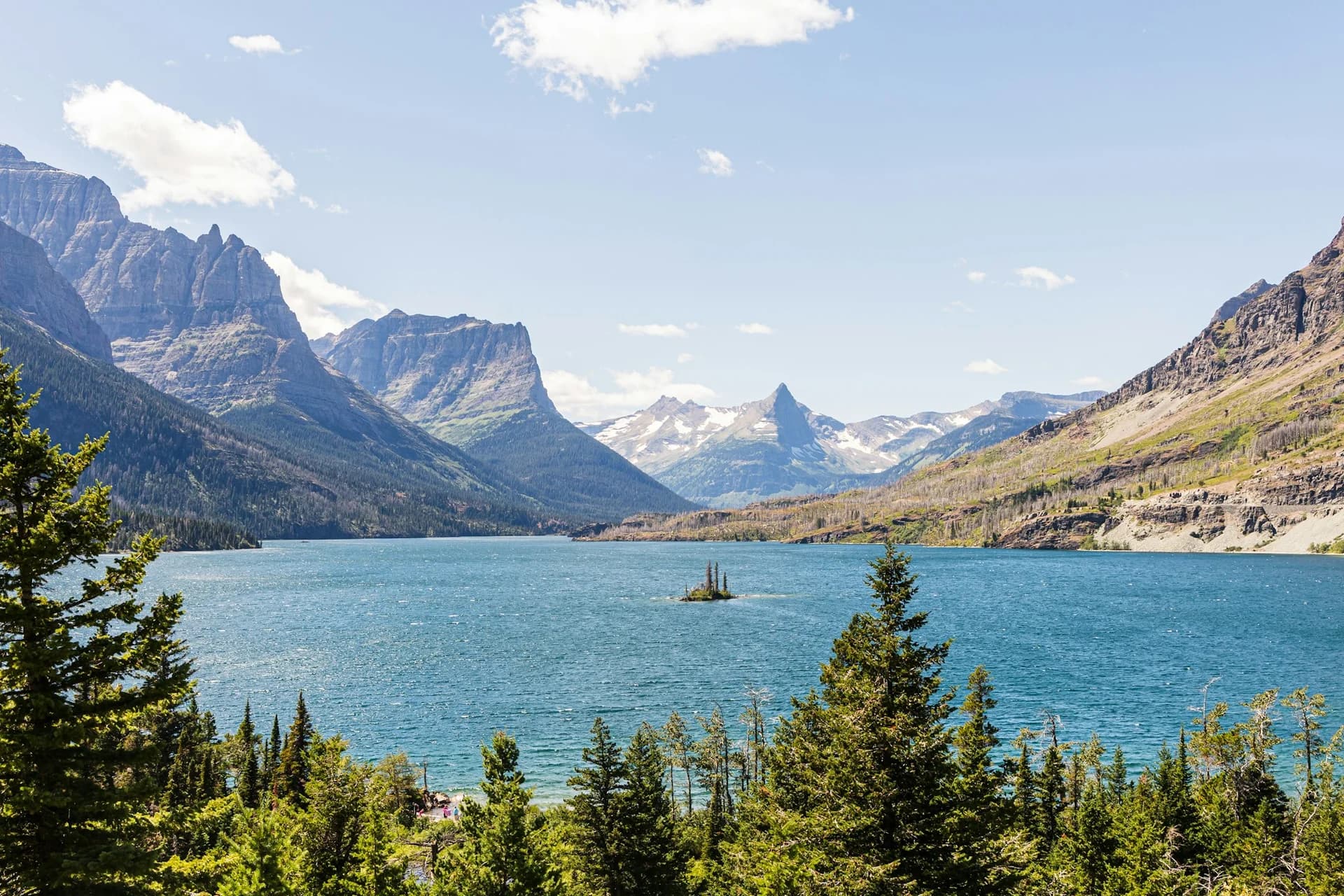
10. Catch Sunrise at Wild Goose Island Overlook
The most photographed spot on the east side is a tiny tree-topped island floating in St. Mary Lake, framed by peaks. Everyone's seen the shot; far fewer have seen it at dawn with the water dead calm and the crowds still asleep.
The pullout is right on Going-to-the-Sun Road near St. Mary. While you're on this stretch, add the short walk into Sunrift Gorge and the easy loop out to Sun Point for big lake views without a big effort.
11. Watch for Wildlife (and Eat All the Huckleberries)
Glacier is grizzly and black bear country, plus mountain goats, bighorn sheep, moose, and marmots. Dawn and dusk in the meadows of Many Glacier and Logan Pass are your best odds — bring binoculars and always carry bear spray where you can reach it. Keep your distance; a 400mm lens beats a close call.
And yes, chase the huckleberries. The wild purple berries ripen in late summer and end up in pie, ice cream, lemonade, and taffy across every lodge and gateway town. The huckleberry milkshake at Eddie's Café in Apgar is a rite of passage.
Pro Tips Before You Go
- Book everything early. Vehicle reservations, boat tours, red bus seats, and in-park lodging open months ahead and vanish fast for July and August.
- Season matters. Going-to-the-Sun Road usually fully opens between late June and early July and closes with the first heavy snows in October — check the plowing status before you plan around it.
- Start at sunrise, rest at midday. Trailhead lots fill by 7–8 AM. Hit your big hike early, then nap or picnic through the crowded midday hours.
- Layer up. It can be 80°F at Lake McDonald and snowing at Logan Pass on the same afternoon. Pack a warm layer and a rain shell no matter the forecast.
- Download offline maps. Cell service is nonexistent across most of the park, so grab your routes and reservations before you lose signal at the entrance.
Glacier isn't a park you rush. Pick four or five of these, build in the early mornings, and let the rest be an excuse to come back.
Related Articles
 Travel Guides
10 Things to Do in the Maasai Mara That Aren't Just the River Crossing
 Travel Guides
12 Best Things to Do in Luxor: A Both-Banks Hit List for Ancient Thebes
 Travel Guides