
214 Metres Above the Atlantic: An Evening Walk Along the Edge of Ireland
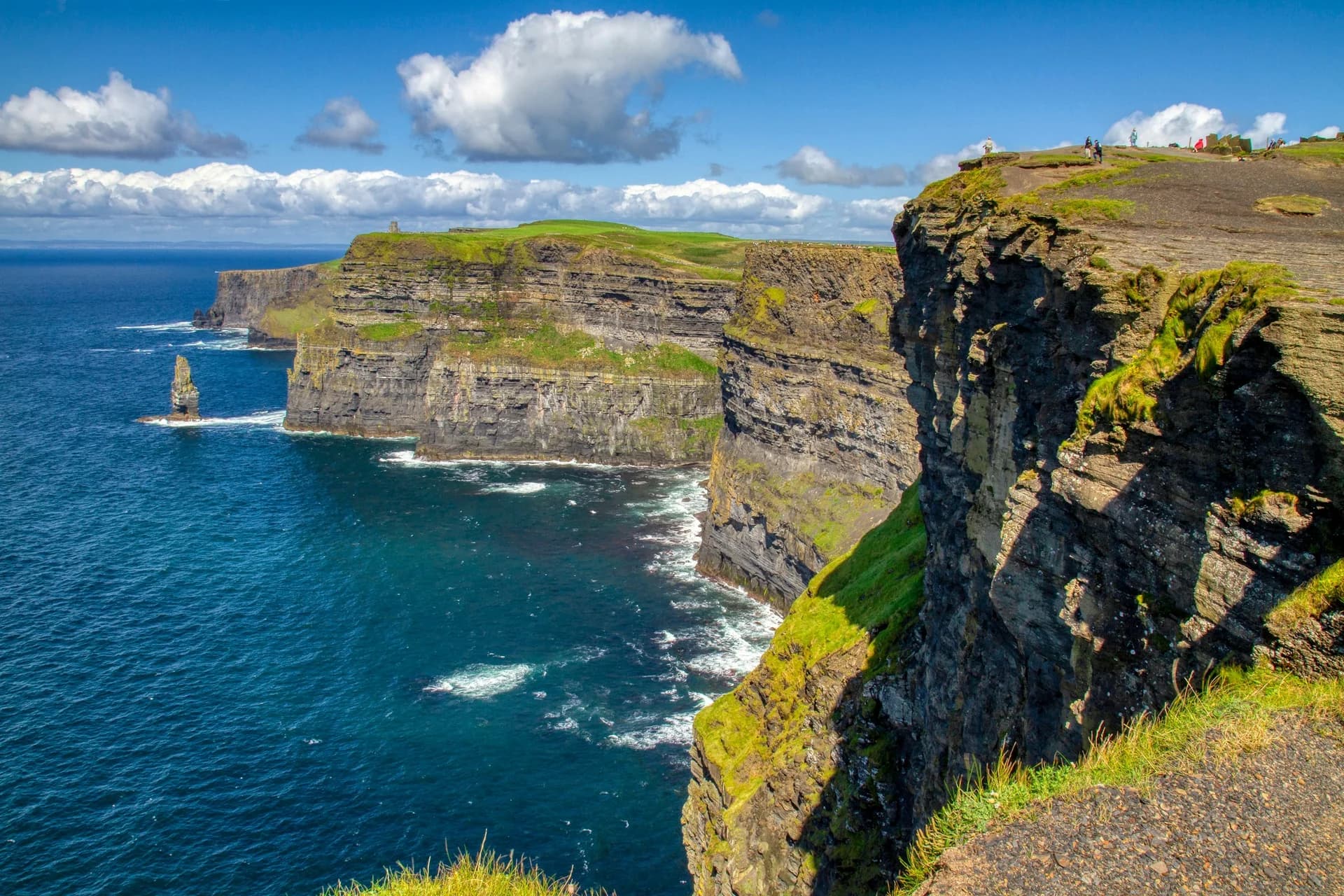
Walk out past the last railing and the whole Atlantic opens up 214 metres below you.
The ground just stops. One moment there's a paved path and a low stone wall at your hip; the next the wall is behind you and there's nothing between your boots and the ocean but air and a fraying green edge — the kind of undefended drop you otherwise only meet on the volcanic sea cliffs of the Canary Islands. This is the Cliffs of Moher at the end of the day — after the coaches have pulled out of the car park and the light has gone to honey — and this is the hour the cliffs finally feel like they belong to you.
You came for the view. You'll leave thinking about the sound.
First, the noise
It reaches you before you reach the edge. Not a crash — a low, continuous roar, the Atlantic working the base of the rock 700 feet down, so constant you stop hearing it and then suddenly hear it again. Over the top of it: the birds. Thousands of them. Kittiwakes and guillemots stacked on the ledges, calling and answering, so the whole cliff face seems to breathe with the movement — the same seabird cities you'll find on the Azores out in the mid-Atlantic.
Lean into the wind — carefully, well back from the drop — and it holds you up. It comes off three thousand miles of open ocean with nothing to slow it down, and it smells of salt and rain and cold stone.
Behind you, the hill
The building you walked out from barely counts as a building. The Cliffs of Moher Visitor Experience is dug into the hillside — a grass-roofed dome that all but vanishes into the slope so it won't compete with the view, which is exactly right. Inside there are exhibits on the geology and the seabird colonies. Admission runs about €12 (roughly $13) and covers the car park and the platforms. Book a timed ticket online before you come; it's cheaper than the gate, and if you aim for after 4PM you'll pay less and arrive just as the crowds are draining away. That's the trade this hour rewards.
The tower
Behind you, at the highest point of the whole 14-kilometre run of cliffs, stands O'Brien's Tower — squat, round, built of grey stone in 1835 by a local landlord who wanted somewhere grand to bring visitors. Climb it (about €4, roughly $4.30) and on a clear evening the view unspools north to Galway Bay and, out across the water, to the low grey backs of the Aran Islands. By day this is the most crowded, most photographed spot on the site. At this hour there might be three people up there. It's a different tower.
The path south
Turn your back on the tower and the domed centre and walk south, and everything changes.
The paved sections give way to a dirt trail worn into the clifftop grass. The crowds thin to nothing inside ten minutes. This is the walk toward Hag's Head — part of the longer 8-kilometre coastal route that runs all the way from Doolin in the north — and it's where the cliffs stop being a photo opportunity and start being a place. There's no barrier out here. Just the warning signs, the wind, and your own good sense, which you should listen to: the edge is undercut and eroding, and the drop is straight and final. Stay back from it. The best views never require standing on the lip.
Look back the way you came and the cliffs reveal their real shape — a great curving amphitheatre of black and ochre rock, banded with 320-million-year-old layers of sandstone and shale, streaked white with birds and their nests. Somewhere in the water below sits An Branán Mór, the huge free-standing sea stack, and if it's late spring its ledges are dotted with puffins coming and going from their burrows.
The far end
Keep going and the ruined Moher Tower at Hag's Head comes into view, a broken Napoleonic-era stub of stone on the southern promontory. From out here the whole cliff face lines up behind you, wave after wave of headland folding into the haze. Hardly anyone makes it this far. Most turn back at the second platform. Their loss — this is the quietest, most honest view of the lot, and the walk back with the sun at your shoulder is the best part of the day.
The light
Wait for it. The whole reason to be here at day's end is the way the sun drops toward the water and rakes across the cliff face, and every ridge and gully throws a long shadow, and the sea turns from grey to hammered gold to something almost pink. Photographers call it golden hour. Out here it's more like the cliffs switching on.
The wind usually eases a little as the sun goes. The birds get louder. And the far horizon does the thing the horizon only does over open ocean — goes on and on until you can almost see the curve of the world.
Down in Doolin
When the cold finally wins, follow the road ten minutes north to Doolin, a scatter of brightly painted houses — as cheerful as the wharfside rows of Bergen's painted waterfront — that happens to be one of the great homes of Irish traditional music. The village has three legendary session pubs — Gus O'Connor's, McGann's and McDermott's — and most nights the music starts around 9PM: fiddle, bodhrán, tin whistle, a box accordion, musicians who wandered in, sat down, and haven't left. It's free. Buy a pint, order the seafood chowder with brown bread (about €9, roughly $10), find a seat, and don't talk over the tunes.
This is the rhythm of the place. Wild cliffs by day, warm rooms and old songs by night, the Atlantic doing its endless work in the dark outside.
The close
Most people give the Cliffs of Moher an hour. They park, they walk to the platform, they take the photograph everyone takes, and they climb back on the bus. Don't be most people. Come late, when the light is long and the buses are gone. Walk out past the last railing — but not past your own good sense — and give the place the evening it's owed.
The Atlantic will still be roaring 214 metres down. The birds will still be wheeling. And for one long hour, the most famous view in Ireland will be almost entirely yours.


