
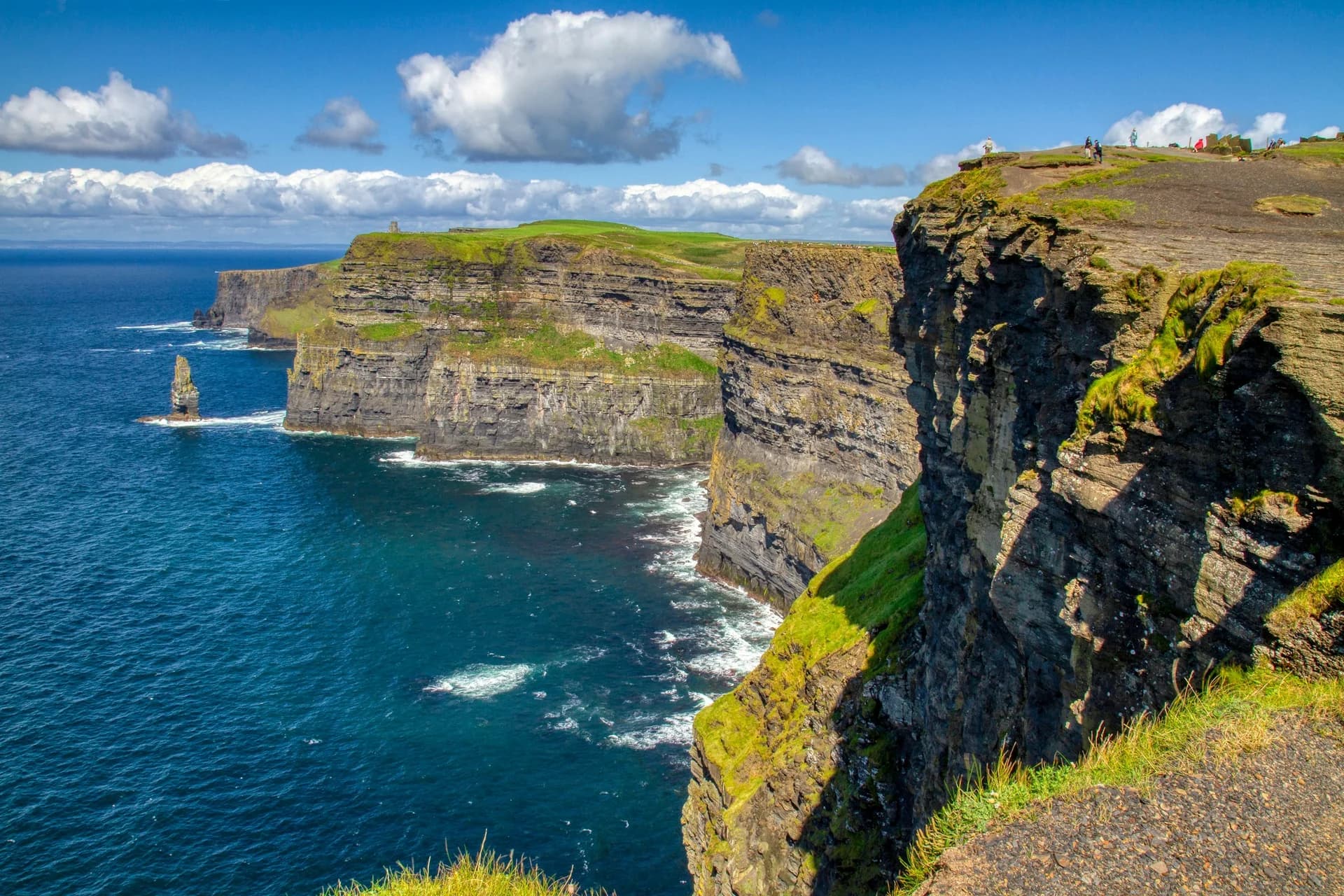
Spring at the Cliffs of Moher: Puffins, Empty Trails and the Year's Best Light
There's a window — roughly mid-April into late May — when the Cliffs of Moher hit a sweet spot most people never plan around. The coaches haven't fully arrived yet. The puffins have. And the light on this 14-kilometre wall of rock does something in spring that the flat glare of high summer can't touch.
This is shoulder season on the County Clare coast — the same off-peak sweet spot that rewards spring travellers on Portugal's Algarve cliffs. And it might be the smartest time of the whole year to stand 214 metres above the Atlantic.
Why spring is the move
The Cliffs are Ireland's most-visited natural attraction, and by July the car park at the Cliffs of Moher Visitor Experience is thick with tour buses out of Galway and Dublin before you've finished breakfast. Come in April or May and you slip past most of it. The coastal walk from Doolin to Hag's Head — 8 km of unfenced clifftop trail, and still the best free thing you can do in Clare — has long, quiet stretches where it's just you, the gorse, the sheep, and that enormous roar coming up from below.
Skip the instinct to save the Cliffs for a big summer road trip. Do them in spring instead. Same cliffs, better light, thinner crowds, and a real shot at the birds.
The puffins are back
Atlantic puffins return to breed on the sea stacks under the cliffs from around April through July, which puts spring right in the heart of the action. Look for them on An Branán Mór, the huge free-standing sea stack you'll see rising straight out of the water, and on the grassy ledges just off the main viewing platforms. Bring binoculars — from the clifftop they're small orange-and-black specks wheeling in off the sea.
The single best way to see them, though, is from the water. The Cliffs of Moher cruise from Doolin Pier (roughly €25-35, about $27-38, running March to October, around an hour) takes you right under the full 214-metre face and past the stacks where the colonies nest. Razorbills, guillemots, kittiwakes and the odd peregrine falcon share the rock — the same North Atlantic seabird cast that packs the sea cliffs of the Azores. Boats can be lively in a spring swell — pack for spray and don't wear your good coat.
The weather: pack for all of it
Here's the honest version of Clare in spring. It's temperate, oceanic, and completely unpredictable — the kind of restless fjord weather around Bergen that Atlantic Europe specialises in. Daytime temperatures sit around 8-15°C (46-59°F), with steady Atlantic wind and showers that blow through in twenty minutes and then hand you a rainbow. You can get four seasons before lunch. That's not a warning so much as the whole personality of the place.
The wind matters more than the rain. Gusts along the cliff edge are strong enough to knock you off balance, and the trail beyond the walled platforms runs along crumbling, unfenced drops of 200 metres. Stay well behind the warning signs, keep kids and dogs close, and never — ever — climb a barrier for a photo. People die here every year doing exactly that.
What to pack
- A proper waterproof jacket with a hood (an umbrella is useless in this wind — leave it home)
- Layers you can peel off and add back: base layer, fleece, shell
- Waterproof walking shoes or boots with grip; the trail gets muddy and slick
- A hat and gloves for the cruise — it's noticeably colder out on the water
- Binoculars for the puffins and the seabird colonies
- Your phone with Google Maps and an offline map downloaded (signal drops out on the back roads)
Spring food in Clare
Cool weather is chowder weather, and Clare does it as well as anywhere in Ireland. Order the seafood chowder with brown bread at Gus O'Connor's in Doolin (around €9, about $10) after a windy morning on the trail. For something more of an event, Vaughan's Anchor Inn in Liscannor, ten minutes back toward the cliffs, is a seafood institution — the Liscannor crab claws and the daily fish special (around €15-25, about $16-27) are the reason to book ahead. Spring also brings the first of the new-season lamb and the early oysters up the coast.
Beating the crowds (and the price)
Two rules, and they both save you money and hassle:
Arrive before 11AM or after 4PM. You dodge the coach-tour rush AND the highest peak-pricing tiers.
Admission to the Visitor Experience is charged per person (around €12, about $13) and includes the car park. Book a timed online ticket in advance — it's cheaper than paying at the gate, and it locks in an early slot. In spring the late-afternoon option is a gift: after 4PM the buses pull out, the entry price drops, and the low western sun sets the whole cliff face alight. That last hour before sunset is the one to build your whole day around.
Climbing O'Brien's Tower — the stone viewing tower built in 1835 at the cliffs' highest point — costs about €4 (roughly $4.30) and buys you the classic panorama toward the Aran Islands and Galway Bay. It's the busiest, most-photographed spot on the entire site, so go straight there first thing, before another car has even parked.
A 3-day shoulder-season plan
Day 1 — Ease in. Fly into Shannon Airport (SNN) and pick up a rental car (about €45-70/day, roughly $49-76; reserve an automatic early, most cars here are manual, and remember Ireland drives on the left). Drive the hour and a quarter northwest through Ennis to Doolin. Check in, then take dinner and a free trad-music session at Gus O'Connor's — the music usually starts around 9PM. Don't talk over the musicians, and don't request pop songs.
Day 2 — The Cliffs, early. Be at the Visitor Experience for opening. Climb O'Brien's Tower first, then walk south along the clifftop toward Hag's Head and its ruined Napoleonic-era Moher Tower for the wildest, emptiest views on the whole coast. In the afternoon, take the cruise from Doolin Pier for the puffins and the true under-cliff scale. Trad session number two at McGann's or McDermott's.
Day 3 — Inland and slow. Drive into the Burren, the surreal limestone karst just inland, where spring wildflowers — gentians, wild orchids — push up straight through the bare grey rock. Visit the 5,000-year-old Poulnabrone portal tomb, standing alone on its limestone pavement, then loop back for a last golden hour on the cliff trail after 4PM.
Spring on the Wild Atlantic Way asks for a little flexibility with the weather. Give it that, and County Clare hands back the version of the Cliffs of Moher the summer crowds never get to see.


