
The Complete Atacama Desert Guide: How to Plan the Perfect Trip
The Complete Atacama Desert Guide
The Atacama is the driest nonpolar desert on Earth, and it wastes no time proving it. You'll land at Calama, drive 90 minutes across cracked, rust-colored ground, and roll into San Pedro de Atacama — a one-story adobe town at 2,400 metres where the roads are dirt and the night sky is thicker with stars than anywhere you've ever stood. This little town is the launchpad. From here you reach steaming geyser fields at 4,320 metres, salt lagoons that float you like the Dead Sea, and altiplano lakes the color of a swimming pool dropped into the mountains.
Here's how to plan the whole thing without burning a single day.
When to Go
The short answer: the Atacama works year-round. It almost never rains, and the days stay warm (20–25°C) no matter the month. The smart move is to aim for the shoulder seasons — March to May or September to November — when days are mild, nights are less brutally cold, and the tour buses thin out.
July and August are high season (South American winter break), so book lodging and El Tatio well ahead. And one detail that trips people up: skip the days around a full moon if stargazing is your priority. A full moon washes out the Milky Way completely. Check the lunar calendar before you lock in dates.
Getting There
There's no airport in San Pedro. You fly into Calama (CJC) from Santiago — about a 2-hour hop — then cover the last 100 km by road. Don't grab a taxi at the terminal; they cost triple. Pre-book a Transvip or Licancabur shuttle at the airport counter for around 15,000 CLP (~$16) and settle in for the 90-minute desert crossing.
Once you're in town, you barely need wheels. San Pedro is tiny and walkable — everything orbits the plaza and Caracoles street. Every excursion picks you up at your hotel, so a rental car is optional unless you plan to self-drive to the salt flats.
Where to Stay
Most lodging clusters within a five-minute walk of the plaza:
- Budget: Hostal Sonchek — simple, central, good for solo travelers.
- Mid-range: Hotel Poblado — reliable, walkable, decent breakfast.
- Splurge: Tierra Atacama, on the edge of town, an all-inclusive with its own guides and a pool facing Licancabur volcano.
Book the first night before you arrive. Everything else you can sort on the ground, but you don't want to hunt for a room at 2,400 metres with a headache setting in.
What to Do
Give yourself at least four full days. Three feels rushed; the desert makes you slow down whether you like it or not. Here's the hit list, roughly in the order your body will thank you for:
- Valle de la Luna (Moon Valley) — wind-carved salt ridges 13 km west of town, best two hours before sunset. Entry ~4,000 CLP.
- Laguna Cejar — a hyper-saline sinkhole in the Salar de Atacama where the brine floats you effortlessly. Entry ~30,000 CLP. Bring flip-flops; the salt crust is sharp.
- El Tatio Geysers — one of the world's highest geyser fields at 4,320 m. Tours leave at 4:30 AM because the steam plumes peak in the pre-dawn cold. Entry ~15,000 CLP.
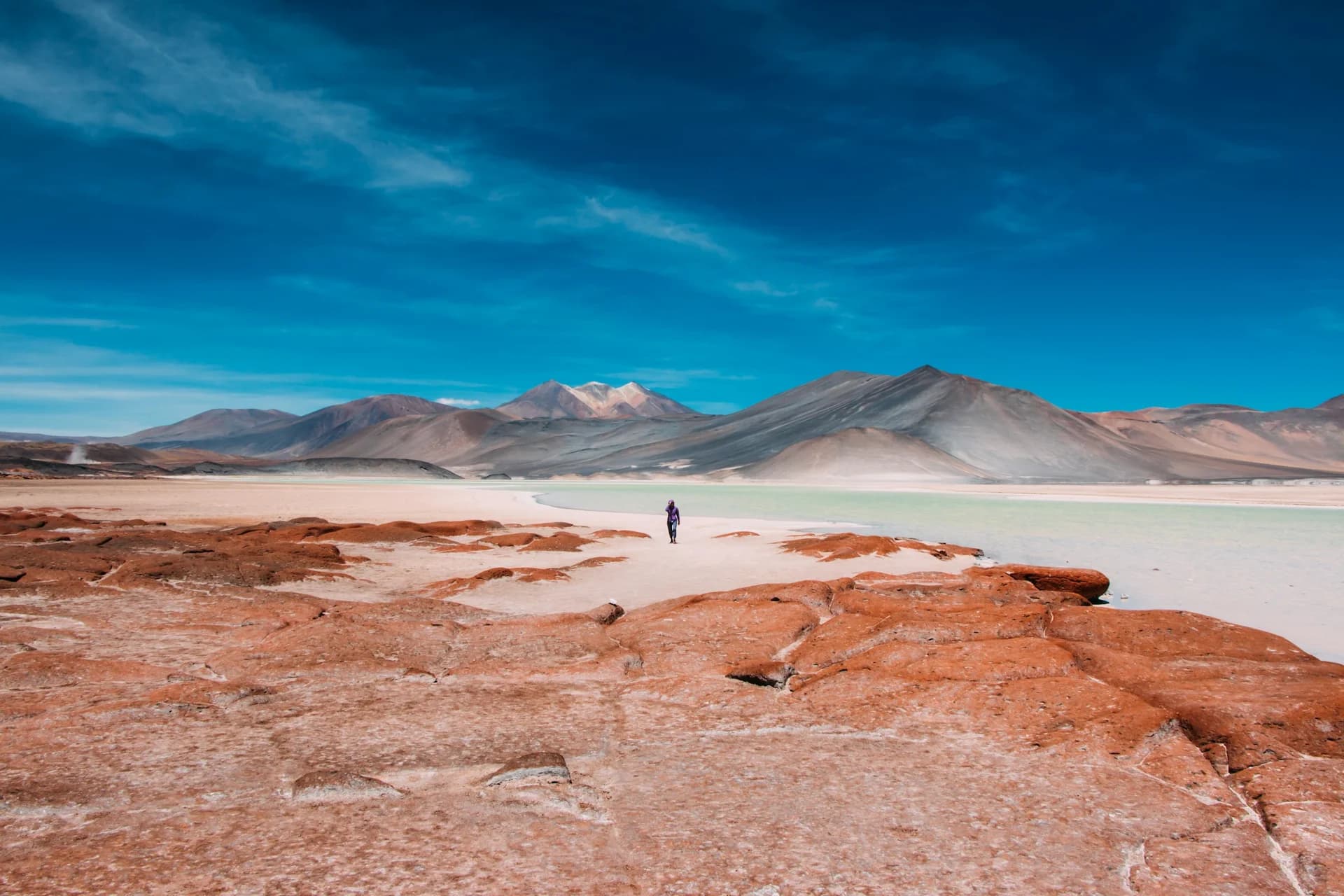
- Piedras Rojas & the altiplano lagoons — iron-red rocks against a turquoise lake at ~4,000 m, a long but jaw-dropping full-day drive (~40,000 CLP with entries).
- Laguna Chaxa — three flamingo species wading a salt flat against volcano backdrops. Los Flamencos Reserve entry ~3,000 CLP.
- Stargazing tour — small-group astronomy with telescopes and astrophotography, ~25,000 CLP.
- Termas de Puritama — eight terraced hot-spring pools in a canyon, ~15,000 CLP in the morning. Save this for a recovery day.
Sequence matters here more than at most destinations. Spend your first day or two on low-altitude sights — the Pukará de Quitor hillfort and Aldea de Tulor ruins make a perfect flat bike ride — before you climb to El Tatio or Piedras Rojas. More on why below.
Where to Eat
San Pedro punches above its size for food. A few worth your pesos:
- Franchutería — a French-run bakery-café on Caracoles. Fresh baguette sandwiches, ~7,000 CLP. Perfect light lunch for a first altitude day.
- Roots Café — fireside quinoa bowls and Andean lamb, ~12,000 CLP.
- Adobe — a long-running favorite with a firepit courtyard and live music; try the grilled trout, ~15,000 CLP.
- Baltinache — warm and romantic, known for Andean tasting plates and pisco cocktails, ~18,000 CLP.
- La Casona — one of the oldest restaurants in town, set in a historic adobe house. Order the Atacameño quinoa risotto, ~16,000 CLP.
What It Costs
The desert isn't cheap, mostly because every sight is a guided excursion. Budget roughly 25,000–40,000 CLP per half-day tour and double that for the big full-day trips. Add lodging, food, and park entries, and a comfortable mid-range day runs $80–120 per person.
One hard rule: carry cash in Chilean pesos. Many agencies, park gates, and small restaurants are cash-only, and San Pedro's handful of ATMs run dry or charge steep fees. Withdraw what you need at Calama airport or in Santiago before you arrive.
Staying Safe — Read the Altitude Part Twice
The Atacama is a Level 1 (generally safe) destination. Crime is barely a concern. The real risk is altitude sickness, and it's the one thing that ruins trips here.
San Pedro sits at 2,400 m, and tours climb past 4,300 m. Give your body 24–48 hours before any high-altitude excursion. Hydrate hard — 3+ litres a day — go easy on alcohol the first two nights, and consider soroche pills or coca tea. Ascend gradually and you'll be fine — and if you want the altitude question tackled head-on, our Atacama Q&A covers it in depth.
The other extremes are sun and cold, often on the same day. UV is savage even when it's cool, so pack SPF 50, a wide-brim hat, and real sunglasses. Then pack a fleece, hat, and gloves for pre-dawn geyser tours that drop well below freezing.
A Few Words of Spanish
English gets you surprisingly far with tour operators, but a little Spanish opens doors:
- Hola / Gracias — Hello / Thank you
- ¿Cuánto cuesta? — How much does it cost?
- ¿A qué hora sale el tour? — What time does the tour leave?
- Agua sin gas — Still water (you'll say this a lot)
- La cuenta, por favor — The check, please
The Bottom Line
The Atacama rewards patience. Land, slow down, let the altitude settle, then let the desert unspool — the salt mirror of Laguna Tebinquiche at sunset, the steam of El Tatio at dawn, the Milky Way so bright it casts a shadow. Give it four or five days (more if you're bookending the trip with the Andean lakes of Bariloche further south), keep cash in your pocket and water in your hand, and you'll leave with the kind of photos people assume are edited. They're not. That's just the Atacama.


