Lamu for Architecture and History Lovers: A Deep Dive into Africa's Oldest Swahili Town
Lamu for Architecture and History Lovers: A Deep Dive into Africa's Oldest Swahili Town
Some travelers cross oceans for buildings that everyone else walks past. If that's you, Lamu Old Town belongs near the top of the list — a UNESCO World Heritage Site since 2001, the oldest continuously inhabited Swahili settlement in East Africa, and one of the finest architectural experiences on the continent.
This isn't about beaches or dhow trips (though those are lovely). This is about the coral stone, the carved doors, the mosque niches, and the extraordinary story of a trading civilization that connected Africa, Arabia, India, and China for centuries.
Why Lamu Matters Architecturally
Swahili architecture is a specific tradition that emerged along the East African coast from roughly the 9th century onward. It blends African building techniques with Arab, Persian, and Indian influences — a physical record of the Indian Ocean trade networks that made this coast wealthy.
Lamu's Old Town is the best-preserved example. Unlike Zanzibar's Stone Town (which was heavily developed under Omani rule) or Mombasa's Old Town (partly demolished), Lamu has changed remarkably little. The street layout, the building heights, the courtyard plans — they're essentially medieval.
The Swahili House
The classic Swahili townhouse follows a specific pattern. Understanding it transforms your walk through the Old Town from "pretty alleys" to an architectural narrative.
The entrance is always modest — a small, plain door opening onto a narrow passage. Wealth is hidden, never displayed outwardly. This reflects Islamic concepts of privacy and the practical need to not advertise valuables in a trading port.
The door itself is where the art lives. Lamu's carved wooden doors are famous — elaborate geometric and floral patterns, sometimes with chains, rosettes, and calligraphic inscriptions. The style of carving indicates the family's origin: Indian-influenced doors have lotus motifs and brass studs; Arab-influenced doors have geometric frames; purely Swahili doors have rope and fish designs. A door is a family's identity card, carved in wood.
There are over 500 historic carved doors in Lamu Old Town. Walking the alleys and reading the doors is like browsing a neighborhood's genealogy.
Inside, the house opens to a courtyard — the women's domain. The public rooms (for male guests) are at the front; the private family rooms are deeper. Plaster niches in the walls (zidaka) display Chinese porcelain, glass, and silver — trade goods that doubled as status symbols. The best-preserved houses have zidaka arrangements that are genuinely beautiful, with arched niches and delicate plasterwork.
Upper floors have screened windows (mashrabiya) that allow women to observe the street without being seen. The rooftop terraces are used for sleeping in hot weather and for drying fish, laundry, and spices.
The Key Sites
Lamu Fort (1821): Built by the Sultan of Oman after the Battle of Shela (1813), using coral stone from demolished buildings. Now the island's main museum, with exhibits on Swahili culture, dhow building, and Lamu's history as a trading port. Entry: 500 KES for non-residents. The rooftop delivers panoramic views of the waterfront. Allow 1 hour.
Riyadha Mosque (1900): The religious center of Lamu, built by Habib Swaleh, the Yemeni scholar who established the Maulidi festival. The mosque's architecture is relatively modern by Lamu standards, but its cultural significance is enormous — it's the heart of the island's religious life.
Lamu Old Town Alleys: No cars. No motorbikes (mostly). Just foot traffic, donkeys, and occasional cats. The alleys are rarely wider than 3 meters. Some are roofed, creating tunnel-like passages between buildings. The coral-stone walls absorb and re-radiate heat, creating a microclimate that's cooler than open spaces.
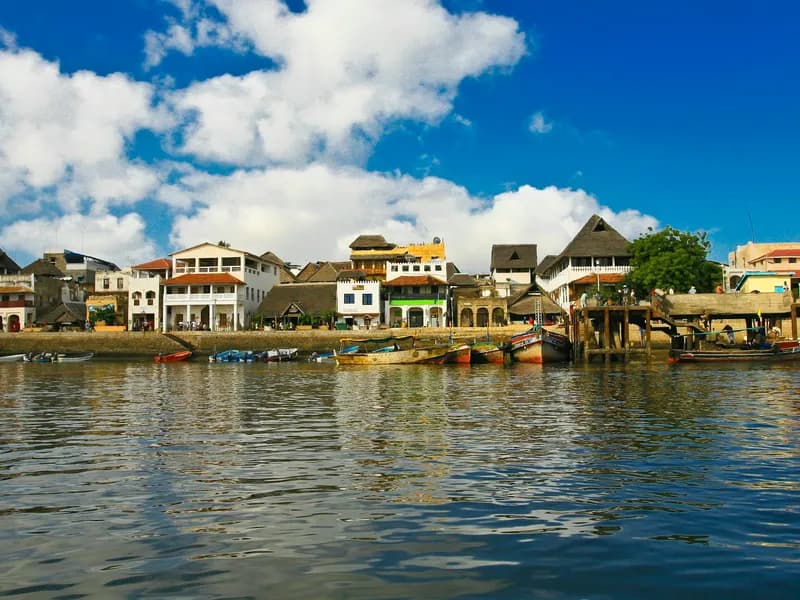
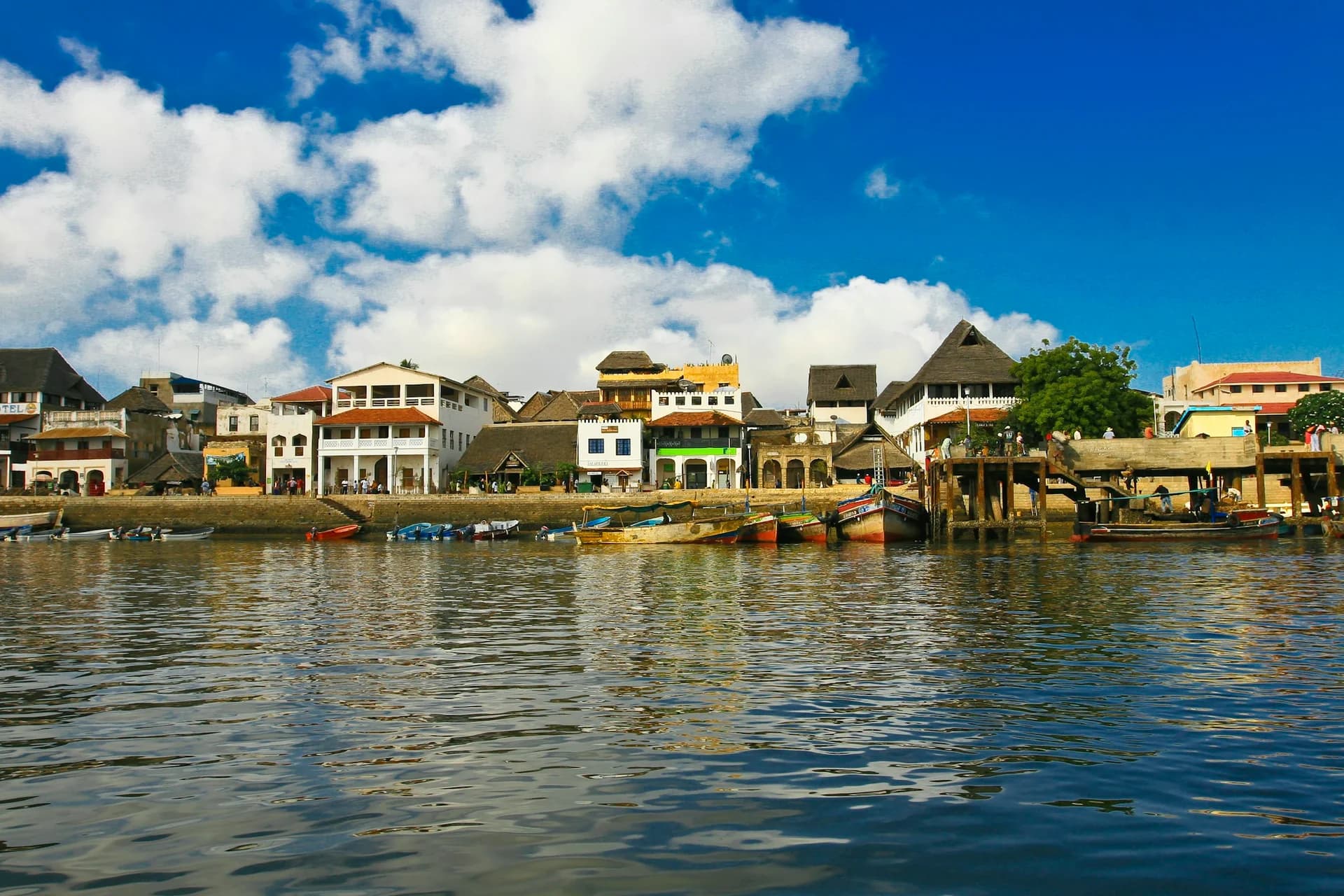
The Waterfront (Mkunguni): The stone seafront was built for trade. Dhows docked here carrying goods from Persia, India, Oman, and China. The buildings facing the waterfront are the grandest — these were the merchants' houses. Several have been converted into guesthouses and restaurants, giving you a chance to sleep inside Swahili architecture.
The Dhow: Architecture That Floats
Lamu's dhow-building tradition is alive. Walk to the northern end of the waterfront and you'll find dhow builders working on the beach — shaping planks by hand, fitting them with wooden pegs (not nails), using techniques that haven't fundamentally changed in 500 years.
A Lamu-built dhow uses mango and mvule wood for the hull, mangrove poles for the mast, and woven palm fronds for caulking. The designs follow patterns passed down orally through generations. Watching a builder shape a hull is watching a form of living architecture.
Getting a Guide
Hire a local guide — emphatically. The architecture is meaningful, but without context, it's just "old buildings." With a guide, every doorway, every niche, every change in wall thickness tells a story.
Guides cost 1,000-1,500 KES for a 2-hour walking tour. Ask for someone who knows the architectural history, not just the tourist highlights. The best guides will take you inside private homes (with the residents' permission) to see the zidaka, the courtyard gardens, and the screened upper-floor windows.
The Conservation Challenge
Lamu Old Town is under threat. Concrete block construction is replacing coral stone. Some carved doors have been sold to collectors. The proposed Lamu Port-South Sudan-Ethiopia Transport (LAPSSET) corridor would bring a massive modern port to the archipelago, potentially overwhelming the island's fragile historic fabric.
UNESCO has expressed concern. Local organizations are fighting to preserve what remains. As a visitor, you contribute by staying in restored historic buildings (rather than new construction), paying for guided tours that support local knowledge keepers, and — this sounds minor but matters — not buying or removing any architectural artifacts.
Where to Stay for Architecture Lovers
Choose a guesthouse in the Old Town. Several restored Swahili houses operate as guesthouses, and sleeping in one is part of the experience. You'll get carved doors, coral-stone walls, rooftop terraces, and courtyard breakfasts.
Budget options in Lamu Town start from 2,000-3,000 KES/night ($15-23). Mid-range Swahili houses run 5,000-10,000 KES. Shela village has upscale boutique stays — 8,000-25,000 KES/night — in restored mansions.
The Bigger Picture
Lamu Old Town is not a museum. It's a living city. 25,000 people live here, pray in the mosques, shop in the markets, and navigate the same alleys their ancestors did centuries ago. The architecture works because it's still being used — the courtyard houses still shelter extended families, the mosques still call the faithful, the waterfront still receives dhows.
That's what makes it extraordinary. This isn't Pompeii. It's not ruins behind rope barriers. It's a medieval Swahili trading port that kept going. And every carved door you photograph, every coral-stone wall you run your fingers along, is simultaneously ancient and alive.
That combination is rare — and worth protecting.
For the seasonal perspective, our monsoon season guide explains why off-season is magical. Our 14-question FAQ covers the practical details. And Mozambique's Ilha de Mozambique offers another UNESCO island with Swahili-era heritage.