The Long Road to Lake Malawi: A Journey to Cape Maclear and the Islands Beyond
The Long Road to Lake Malawi: A Journey to Cape Maclear and the Islands Beyond
The lake doesn't announce itself. You'll spend hours on the road out of Lilongwe — windows down, dust in your teeth, a crate of somebody's mangoes wedged under the seat in front of you — and then the hills fall away and there it is. Water to the horizon. It looks like the sea. It moves like the sea. But cup a handful and it's fresh, and that small shock is the first of many the lake has lined up for you.
Get the shape of the place clear before you go, because it changes how you plan. Lake Malawi runs about 580 kilometres north to south — Africa's third-largest lake, deep and blue and holding more fish species than any lake on Earth. Locals call it the Lake of Stars, and they mean it two ways: the mirror of the night sky, and the lanterns of fishermen scattered across black water like a second constellation. Malawi itself goes by the Warm Heart of Africa. Spend two days on the shore and you'll read that less as a slogan than a friendly warning.
The friction is the road
Nobody quite warns you about the getting-there, and then everyone's surprised. Reaching the lake takes effort, and that effort is the whole point.
Most travelers fly into Kamuzu International Airport in Lilongwe — often on Ethiopian Airlines by way of Addis Ababa — or into Blantyre further south. From Lilongwe it's four to five hours by road to Cape Maclear on the Nankumba Peninsula. You can do it the local way — a minibus to Monkey Bay, then a matola (a shared pickup, bodies and bags and the occasional chicken) bouncing down the last stretch of red dirt into the village. Or you can arrange a private transfer through your lodge for somewhere around $80–120, which buys you air-con and a fixed arrival time. Both get you there. Only one gives you a story.
A few things smooth the trip. Grab a SIM from the Airtel or TNM kiosk at the airport before you leave the terminal — it's cheaper and quicker than hunting for one later. Download your maps offline, because the signal thins out the moment you leave the tar. Carry cash in Malawian Kwacha; ATMs cluster in the towns and vanish along the shore. And build in slack — buses leave when they're full, not when the clock says, so a '9am departure' is really a suggestion. Lean into it. The road is half the reward.
Chembe Village, where the water comes to your ankles
Cape Maclear is really Chembe Village — a long ribbon of sand and fishing homes set inside Lake Malawi National Park, the first freshwater national park in the world and a UNESCO World Heritage Site. There's no resort gate, no manicured strip. There's a working village that happens to sit on one of the prettiest beaches in Africa.
Wade in up to your shins and stand still. Within a minute they arrive — cichlids, the little jewel-fish the lake is famous for, hundreds of species found nowhere else, nipping curiously at your ankles. The mbuna flash electric blue and yellow against the rocks. Fish eagles wheel overhead and drop like thrown stones. Kids skim past in dugout canoes carved from a single trunk. And every evening the sun slides down behind Thumbi Island and turns the whole bay the colour of a struck match.
Base yourself right on the sand. Mgoza Lodge, Gecko Lounge, and Cape Mac Lodge all put you a barefoot walk from the water, with rooms across the budget range. Eat chambo — the lake's prized tilapia, grilled whole and served with nsima, the maize staple you scoop with your fingers. A plate runs a few dollars at a village kitchen. Order it lakeside, watch the fishermen haul in the day's catch, and you'll understand why people who come for three nights stay for ten.
The payoff floats offshore
Here's the confident move: don't try to see the lake from the beach. Get on the water.
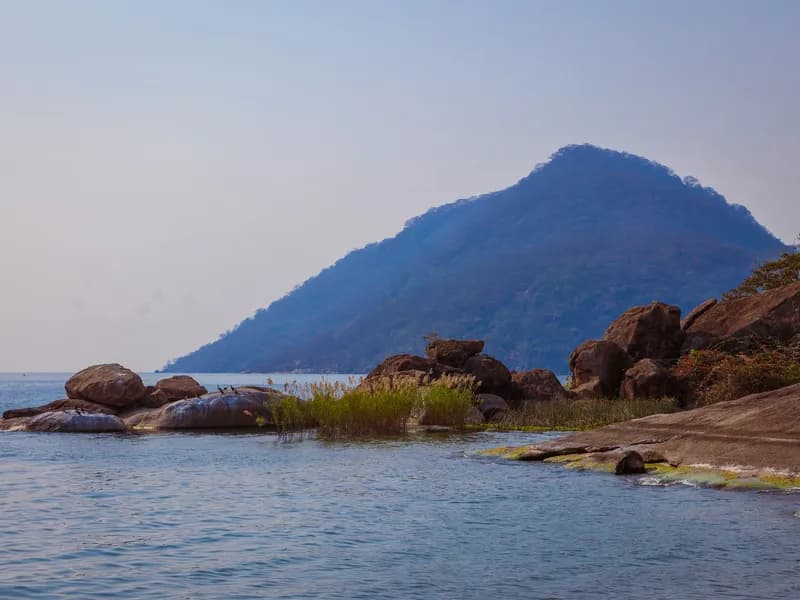
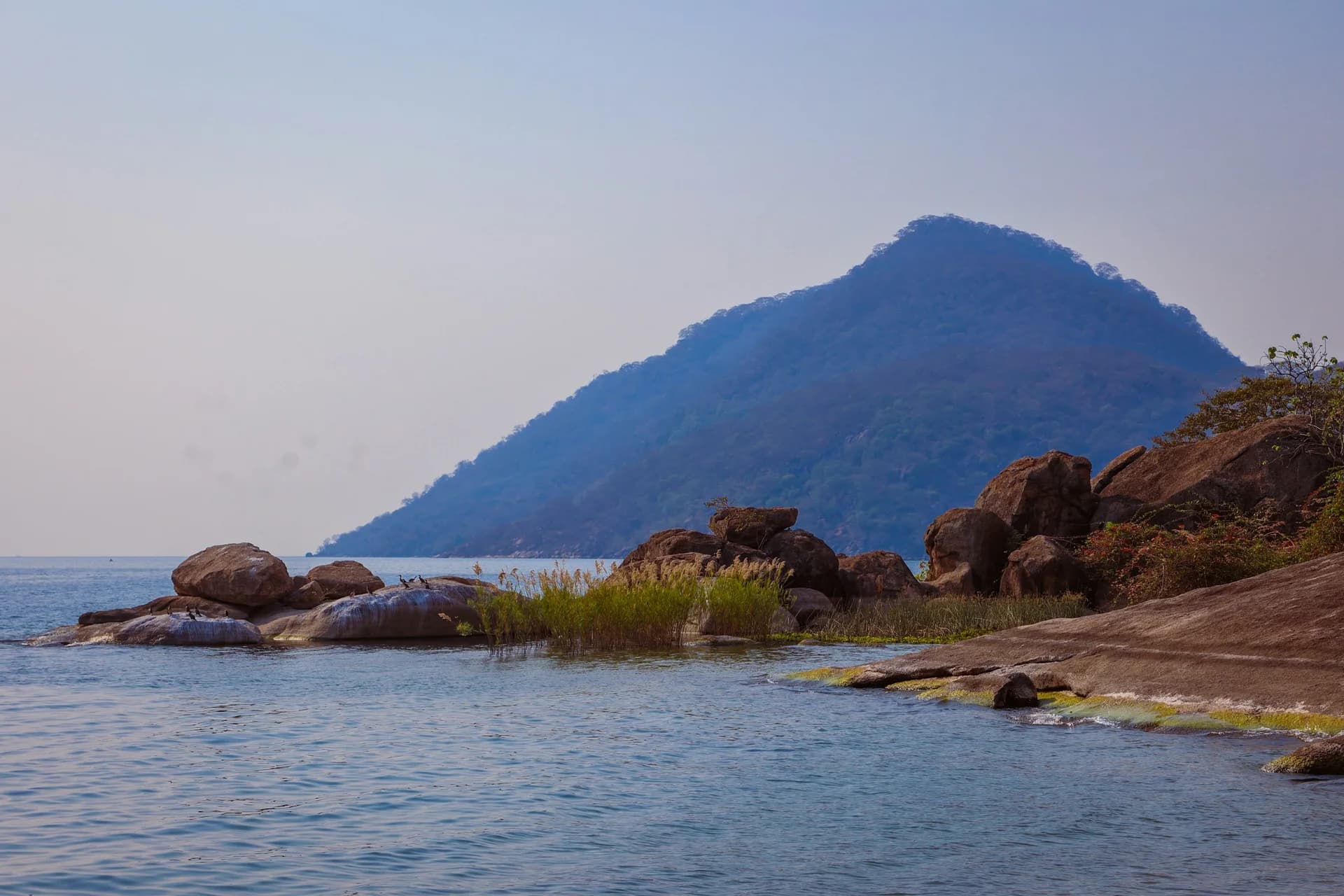
The best of Lake Malawi sits just offshore, on the uninhabited islands you paddle out to reach. Kayak Africa runs trips from Cape Maclear to Domwe and Mumbo Islands — granite domes rising out of the blue, ringed by boulders and fig trees, with simple eco-camps and not a road in sight. A guided kayak day-trip is worth every kwacha; an overnight on Mumbo, falling asleep to water lapping stone, is the kind of thing you'll describe badly for years because there aren't good enough words — and if freshwater islands leave you craving the salt-water kind, the white-sand cays of the Bazaruto Archipelago run the same magic up Mozambique's Indian Ocean coast.
Even a half-day pays off. Snorkel the drop-offs at Otter Point or off Thumbi Island West, where the rock gardens fall away into clear, warm water and the fish don't care that you're there. Visibility is often better than the sea, with none of the salt sting. Bring your own mask if you can — rentals in the village work, but they leak, and you don't want to spend the world's best freshwater snorkel clearing your goggles.
The slow boat north
If you've got the days, the great overland-by-water adventure of Malawi is the MV Ilala, the passenger ferry that has chugged up and down the lake for decades. It runs roughly weekly, calling at Monkey Bay, Nkhotakota, Nkhata Bay, and the offshore islands. Book a first-class ticket and you get the top deck — a plastic chair, the wind, and a night sky so heavy with stars it feels close enough to touch. It's slow. It's frequently late. It is one of the great journeys left in Africa.
Ride it north to Likoma Island and you'll meet the lake's strangest surprise: St Peter's Cathedral, a stone church the size of a small European minster, dropped by missionaries onto an island you can cross on foot in an afternoon. Built in the early 1900s, it seats hundreds where hundreds seem impossible — stained glass, baobabs at the door, goats on the path outside. Stay at Kaya Mawa if the budget stretches, or a village guesthouse if it doesn't.
Further up the shore, Nkhata Bay slows the pace even more — a laid-back harbour town of steep green hills and swimming coves, the kind of place travelers write off as a one-night stop and leave a week later.
Give the lake time
Plan a week here, minimum — two if you want to fold in a safari, since the lake pairs neatly with the northern circuit out of Arusha, across the border in Tanzania. Rush it and you'll see a nice beach and a lot of dirt road. Give it room and the sequence works its quiet magic — the long haul in, the water at your ankles, the paddle to an empty island, the ferry deck under the stars.
You'll come for the fish and the beaches. You'll leave talking about the fishermen who waved you in, the kid who taught you to steer a dugout, the church that shouldn't exist. The Warm Heart of Africa earns its name on the shore of a lake most of the world can't find on a map. Which, honestly, is the best possible reason to go now.