
Lucerne for Nature Lovers: Mountains, Lakes, and the Trails In Between
Lucerne for Nature Lovers: Mountains, Lakes, and the Trails In Between
Lucerne has a medieval old town, covered wooden bridges, and world-class museums. Most guides lead with those. But the reason Lucerne exists — the reason 82,000 people live here and millions visit — is the landscape. The city sits where four mountain ranges meet a fjord-shaped lake, creating a natural amphitheater so dramatic it feels engineered.
If nature is what moves you, Lucerne might be the most rewarding small city in Europe.
Why Lucerne Is Special for Nature
Swiss cities generally have good access to mountains. Lucerne's access is extraordinary. Within 30 minutes of the train station, you can be on three different mountains — each with a distinct character — or on a historic steamboat crossing a lake that has 13 other lakes visible from its peaks. The infrastructure (cogwheel railways, cable cars, boat terminals) is seamlessly integrated with public transport. With a Swiss Travel Pass, most of it is free or 50% off.
The nature here isn't wilderness — it's the most accessible Alpine scenery in Switzerland.
Top 10 Nature Experiences
1. Mount Pilatus Golden Round Trip
The signature Lucerne experience. Take a boat from Lucerne to Alpnachstad (1 hour across the lake). Board the world's steepest cogwheel railway (48% gradient, CHF 72 round trip from Alpnachstad). Ascend to 2,132m. Walk the summit trails. Descend by gondola and aerial cableway to Kriens. Bus back to Lucerne.
The full Golden Round Trip costs CHF 115 (50% off with Swiss Travel Pass). Allow 5-6 hours. The cogwheel railway alone — climbing through vertical meadows and rock faces — is worth the trip.
At the top: panoramic views, easy summit trails (30-60 minutes), and a restaurant. On clear days, visibility stretches to the Black Forest in Germany.
2. Lake Lucerne Steamboat Cruise
Lake Lucerne (Vierwaldstättersee — "Lake of the Four Forested Cantons") is shaped like a twisted cross, with mountain-ringed arms extending in four directions. The cruise fleet includes five historic paddle steamers (the oldest from 1901) alongside modern motor vessels.
A 1-hour cruise costs from CHF 28. The full route to Flüelen takes 5 hours (CHF 67). Free with Swiss Travel Pass. Depart from the terminal next to the train station.
The steamers are the way to go — the rhythmic chug of the paddle wheels, the brass fittings, the dining room serving rösti with a lake view. These are floating history.
3. Mount Rigi
The "Queen of the Mountains" (1,798m) — Europe's first mountain tourism destination (the cog railway opened in 1871). Reachable by cogwheel train from Vitznau (CHF 72 round trip) or cable car from Weggis. Free with Swiss Travel Pass.
Panoramic views of 13 lakes, the Alps from Säntis to Titlis, and on extremely clear days, the Black Forest. Hiking trails for all levels at the top. The Rigi Kaltbad spa (designed by Mario Botta) has an outdoor mineral bath with Alpine views.
Combine with a Lake Lucerne cruise: boat to Vitznau, cog rail up Rigi, cable car down to Weggis, boat back. A perfect day.
4. Chapel Bridge at Dawn
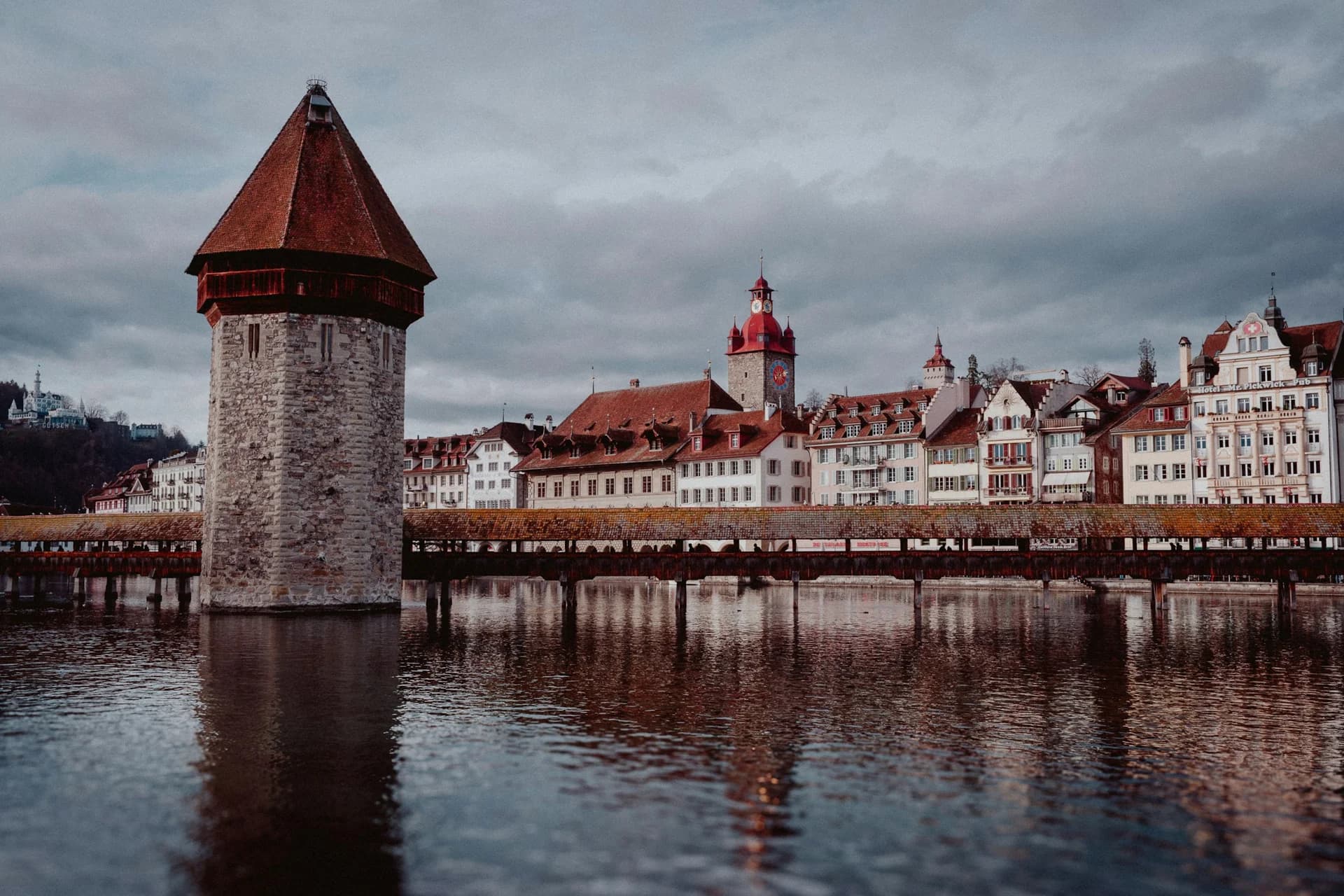
Yes, it's in the town. But the Chapel Bridge (Kapellbrücke) — Europe's oldest covered wooden bridge, built in 1333 — crosses the Reuss River where it flows out of the lake. At dawn, the bridge, the Water Tower, Mount Pilatus, and the lake form a single composition. In summer, flower boxes line the bridge. The 17th-century painted panels in the rafters tell the story of Lucerne.
Free. Best at 6-7AM when the light is soft and the bridge is empty.
5. Bürgenstock Resort Cliff Walk
A luxury resort on a cliff 500m above Lake Lucerne, accessible by boat and funicular from Lucerne (45 min total). The Felsenweg (cliff path) is a 30-minute walk along the cliff edge with glass-floored viewpoints and a 152m elevator (the Hammetschwand Lift — Europe's highest outdoor elevator, free for resort guests, CHF 5 for others).
The views down to the lake are vertigo-inducing and spectacular. Restaurant prices at the resort are extreme, but the path and elevator are affordable.
6. Musegg Wall Walk
Nine medieval towers connected by walls above the old town. Three towers are climbable (free, April-November). The walk along the wall gives rooftop views of the old town, the lake, and the mountains. Total wall walk: 45 minutes.
This is a quieter, less-touristed perspective than the lakefront. The Männli Tower has a clock that's allowed to chime one minute before every other clock in the city — a 600-year-old privilege.
7. Stanserhorn CabriO
The world's first convertible cable car — an open-top upper deck that carries you to 1,898m with the wind in your hair and the Alps at eye level. Located in Stans, 15 minutes from Lucerne by train.
CHF 78 round trip (50% with Swiss Travel Pass). The summit has a rotating restaurant and hiking trails. On clear days, the 360-degree view spans 100 km.
8. Swimming in the Lake
Lake Lucerne has excellent swimming from June to September. Water temperature reaches 20-23°C in summer. The Lido (public beach and pool complex, CHF 8) is a 20-minute walk from the station. Free swimming spots exist along the lakefront promenade.
The water is clean enough to drink (literally — Lucerne's tap water comes from the lake). Bring a towel and expect the initial plunge to be refreshing.
9. Entlebuch UNESCO Biosphere Reserve
Swiss Alps wilderness 30 minutes from Lucerne by train. Moorland, peat bogs, and karst landscapes with marked hiking trails. Less touristed than the main peaks. The Schrattenfluh limestone plateau is dramatic and unusual. Free to access.
Best for experienced hikers who want something beyond the groomed summit trails.
10. Titlis Cliff Walk
Mount Titlis (3,238m) — the highest excursion mountain near Lucerne — has Europe's highest suspension bridge at 3,041m. The bridge sways 500m above a glacier. The Titlis Rotair cable car is the world's first revolving gondola.
CHF 96 round trip from Engelberg (30 min by train from Lucerne). 50% off with Swiss Travel Pass. Allow half a day.
Best Time for Nature
June to September: Clear skies, warm temperatures (18-28°C in town, 5-15°C on peaks), all mountain railways running, lake swimming possible. Late summer (August-September) has the clearest visibility.
December to February: Skiing at nearby resorts (Engelberg/Titlis). Snow-covered peaks. Lake cruises run year-round. The town is atmospheric but mountain railways may close in bad weather.
Budget for Nature
| Experience | Cost | With Swiss Travel Pass |
|---|---|---|
| Pilatus Golden Round Trip | CHF 115 | CHF 57.50 |
| Lake cruise (1 hr) | CHF 28 | Free |
| Mount Rigi round trip | CHF 72 | Free |
| Stanserhorn CabriO | CHF 78 | CHF 39 |
| Titlis round trip | CHF 96 | CHF 48 |
| Lido swimming | CHF 8 | CHF 8 |
| Musegg Wall | Free | Free |
The Swiss Travel Pass (from CHF 244/3 days) pays for itself within two mountain trips. Buy before arriving — only available to non-Swiss residents.
Practical Tips
- Check mountain webcams (pilatus.ch, rigi.ch) before buying tickets — fog can ruin a CHF 70+ excursion
- Morning is generally clearest; clouds build in afternoon
- Sunscreen is essential at altitude — UV radiation at 2,000m+ is significantly stronger
- Temperatures drop ~6°C per 1,000m — bring a warm layer even on hot days
- Tap water is excellent and free — refill bottles from any tap or public fountain
- Groceries at Coop or Migros supermarkets are much cheaper than restaurants (budget CHF 15-20 for a supermarket lunch vs. CHF 30-45 at a restaurant)
Lucerne concentrates Switzerland's best natural features into a single manageable destination. You don't need a car, you don't need advanced hiking skills, and you don't need a week. Three days with a Swiss Travel Pass gives you a mountain, a lake cruise, and a medieval town — the essential Switzerland, without the rest of Switzerland's driving distances.
For budget strategies, our 17 Lucerne tips cover the Swiss Travel Pass and free attractions. Choosing between Swiss cities? Our Lucerne vs. Interlaken comparison breaks it down. For mountain-and-lake beauty at friendlier prices, Salzburg is the Austrian alternative. Lucerne remains Switzerland's best all-rounder.


