
17 Lucerne Tips That'll Save You Hundreds of Swiss Francs
17 Lucerne Tips That'll Save You Hundreds of Swiss Francs
Switzerland is the most expensive country in Europe for travelers. A restaurant lunch costs CHF 25-40. A coffee is CHF 5-6. A beer is CHF 7-9. And a mountain excursion can cost CHF 70-115 per person. Lucerne is no exception — if anything, the tourist-heavy old town inflates prices further.
The good news: the city rewards travelers who plan. Value here isn't about skipping the experience — it's about knowing which francs actually buy something. Here's how.
Transport & Passes
1. The Swiss Travel Pass Is Non-Negotiable
This is the single biggest money-saving tool in Switzerland. The Swiss Travel Pass (from CHF 244/3 days, CHF 380/4 days) covers:
- All trains, buses, and boats (including Lake Lucerne cruises)
- City public transport
- Free entry to 500+ museums (including the Swiss Transport Museum)
- 50% off most mountain railways (Pilatus, Rigi, Titlis)
Rigi is completely free with the pass. A single Rigi round trip costs CHF 72 without it. The pass pays for itself within one day of heavy sightseeing. Buy online before arriving — it's only sold to non-Swiss residents.
2. Check Mountain Webcams Before You Go Up
Pilatus, Rigi, and Titlis all have live webcams on their websites. Check them every morning. If the peaks are socked in with fog — which happens even on sunny days in the valley — skip the mountain and do the old town, museum, or lake cruise instead. Don't spend CHF 70+ on a white wall.
Morning is generally clearest. Late summer (August-September) has the best visibility.
3. Do the Pilatus Golden Round Trip in One Direction
The full Golden Round Trip (boat → cog rail → gondola → bus) costs CHF 115. But you can save by taking the cog rail from Alpnachstad and returning the same way (CHF 72 round trip). The boat ride to Alpnachstad is free with Swiss Travel Pass anyway.
4. Walk, Don't Bus, in the Old Town
Lucerne's old town is tiny — 15 minutes end to end. Don't spend SL bus tickets on in-town trips. Walk along the lake promenade instead. The views are better than any bus window.
Food & Drink
5. Eat at Manora (Self-Service Restaurant)
The Manor department store on Weggisgasse has a self-service restaurant called Manora on the top floor. Hot meals (pasta, schnitzel, salads) cost CHF 12-18 — roughly half what you'd pay at a sit-down restaurant. Views of the old town rooftops. Open daily. No tips expected.
6. Buy Lunch at Coop or Migros
Switzerland's two main supermarket chains sell ready-made sandwiches (CHF 5-8), salads (CHF 6-9), and sushi (CHF 8-12). Grab lunch and eat by the lake. Budget CHF 10-15 for a supermarket lunch vs. CHF 30-45 at a restaurant.
7. Specify "Hahnenwasser" for Water
Swiss tap water is among the cleanest in the world. In restaurants, always say "Hahnenwasser" (tap water). Otherwise you'll get bottled water at CHF 5-8. Tap water is free and tastes perfectly fine.
Refill your bottle from any public fountain (unless marked "kein Trinkwasser" — which is rare).
8. Beer at the Rathaus Brauerei, Not Tourist Cafés
The Rathaus Brauerei on Unter der Egg brews their own beer and charges CHF 6-7 for a half liter — cheaper than most old town bars (CHF 8-10). The brewery is in a historic building on the river. The food is solid Swiss pub fare (rösti, sausages) at fair-for-Switzerland prices.
9. Morning Bakeries Beat Hotel Breakfast
Hotel breakfast buffets in Lucerne often cost CHF 25-35 extra. Skip it. Walk to a bakery (Heini is a local chain) and get a coffee and pastry for CHF 6-8. Spend the savings on a mountain.
Sightseeing
10. The Chapel Bridge and Lion Monument Are Free
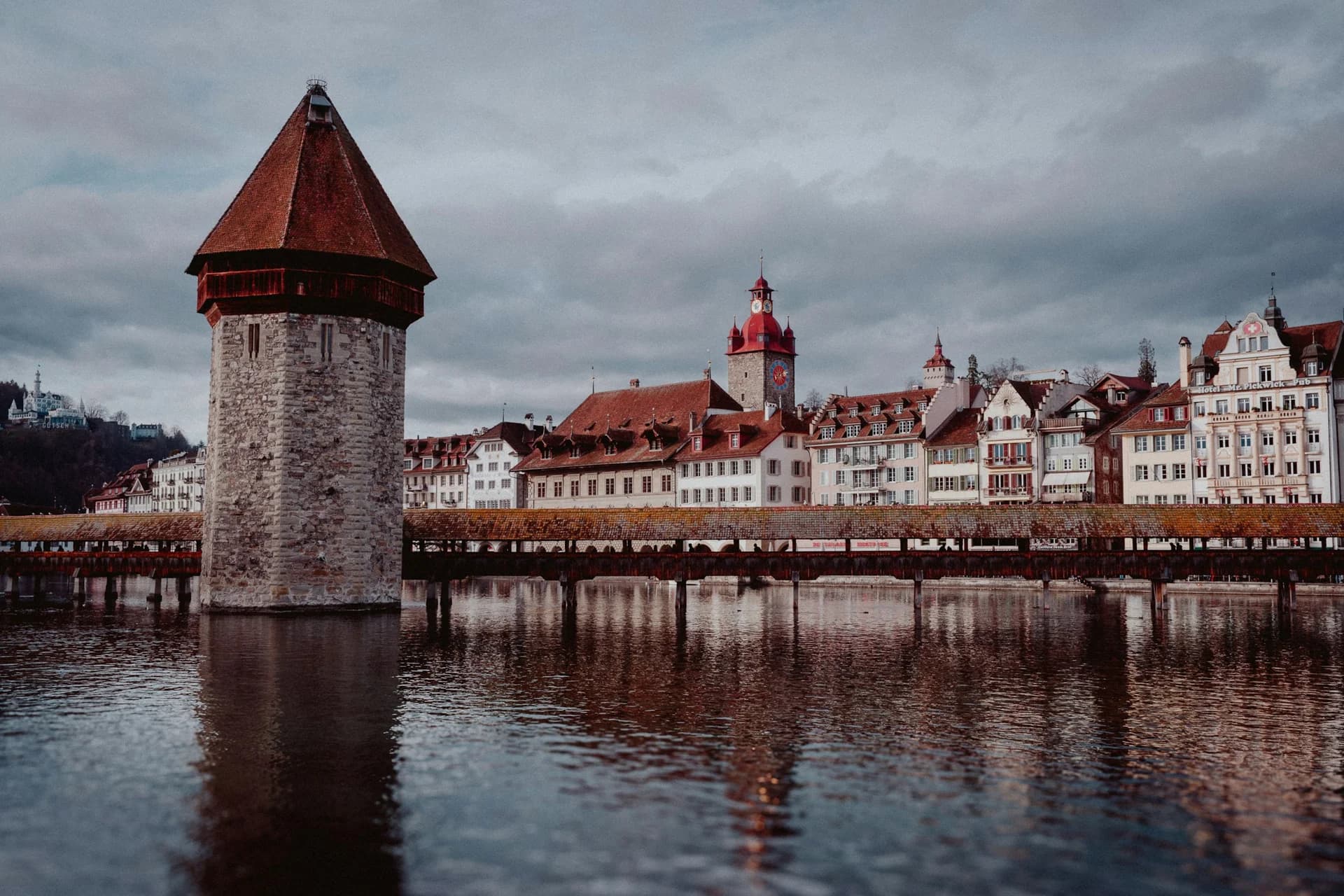
Two of Lucerne's most iconic attractions cost nothing. Chapel Bridge (1333) is open 24/7. The Lion Monument (Mark Twain's "saddest piece of stone in the world") sits in a public park, free to visit anytime. Don't let anyone try to charge you.
11. Climb the Musegg Wall for Free
Three of the nine medieval towers on the Musegg Wall are open for climbing (April-November). Free entry. The views rival any paid viewpoint, and the wall walk takes 30-45 minutes. Start from the Schirmerturm on the east end.
12. The Swiss Transport Museum Is Half-Price with Swiss Travel Pass
Entry drops from CHF 36 to CHF 18 with the pass. The museum is genuinely excellent — trains, planes, cars, a planetarium — and keeps kids (and adults) entertained for 2-3 hours.
13. Take the Spreuer Bridge Instead of Chapel Bridge
The Chapel Bridge is famous and crowded. The Spreuer Bridge, 200 meters upstream, is another covered medieval bridge (1408) with a striking series of "Dance of Death" paintings in the rafters. Same experience, fewer people, more interesting art.
Budget & Logistics
14. Stay Outside the Old Town
Old town hotels charge a premium. Hotels near the train station or in adjacent neighborhoods (Tribschen, Hirschmatt) are 20-30% cheaper and still within a 10-minute walk of everything. The Swiss Travel Pass covers city buses, so even slightly farther locations work.
15. Visit in Shoulder Season
June and September have the best combination of good weather and manageable prices. July-August is peak season — hotel rates jump 30-50% and the old town is thick with tour groups. May is cheaper but mountain railways may not be running yet.
16. The Lucerne Visitor Card Covers Local Transport
Many hotels provide a free Lucerne Visitor Card at check-in, which covers unlimited local public transport. Ask at your hotel. This saves CHF 8-12/day on bus tickets.
17. Budget Template
| Category | Budget Strategy | Cost/Day |
|---|---|---|
| Accommodation | Book outside old town, 3-star | CHF 120-180 |
| Breakfast | Bakery | CHF 6-8 |
| Lunch | Supermarket or Manora | CHF 12-18 |
| Dinner | Modest restaurant or self-catering | CHF 20-35 |
| Mountain/attraction | 1 per day with Swiss Travel Pass | CHF 0-60 |
| Daily total | CHF 160-300 |
Without the Swiss Travel Pass, the same day costs CHF 250-420. The pass saves CHF 70-120/day. Over 3-4 days, that's CHF 200-500 in savings.
What Your Francs Actually Buy
Lucerne is expensive, and no amount of optimizing turns it cheap. A three-day trip runs CHF 500-1,000 per person on a budget, CHF 800-1,500 mid-range. That's Switzerland, plainly stated.
Here's what that money buys: a train system that runs to the second, tap water cleaner than most bottled, mountains with maintained trails and real safety infrastructure, and a level of quality in everything — food, hotels, public spaces — that's hard to find anywhere else.
Switzerland costs what it does because everything works. That's the trade. Buy the Swiss Travel Pass, eat your supermarket sandwich by the lake with the swans working the shoreline, and climb a mountain. The view from the summit is the same whether the day cost CHF 150 or CHF 500.
For the full nature experience, our Lucerne nature guide covers Mount Pilatus, Rigi, and the lake. Deciding between Swiss destinations? Our Lucerne vs. Interlaken comparison helps you choose. And for Alpine beauty at a fraction of Swiss prices, Salzburg offers fortress views and beer gardens without the CHF sticker shock.


