
Lucerne vs. Interlaken: Which Swiss Alpine City Deserves Your Trip?
Lucerne vs. Interlaken: Which Swiss Alpine City Deserves Your Trip?
Give each a week and the pattern becomes obvious. Both will empty your wallet with the efficiency only Switzerland can manage. Both will leave you staring at mountains with your mouth slightly open. The similarities end there.
Lucerne is a city that happens to be near mountains. Interlaken is a mountain base camp that happens to have a town. The distinction matters more than you'd think.
The Vibe
Lucerne is a city of 82,000 people with a medieval old town, a lake, and mountains visible from every street. It has museums, covered bridges, frescoed buildings, and a cultural life that exists independently of tourism. You could visit Lucerne, never go up a mountain, and still have a full trip.
Interlaken is smaller (~6,000 in town proper, ~24,000 in the wider area) and exists primarily as a gateway to the Jungfrau region. The town itself has a main street of adventure sports shops and souvenir stores. The magic is above — Jungfraujoch, Schilthorn, Lauterbrunnen valley.
Winner: Depends on what you want. Lucerne if you want a city with mountains. Interlaken if you want mountains with a town.
The Mountains
Lucerne has three major peaks accessible by cog railways and cable cars:
- Mount Pilatus (2,132m): The world's steepest cogwheel railway (48% gradient). The Golden Round Trip (boat to Alpnachstad, cog rail up, gondola down to Kriens) costs CHF 115 and is one of the best half-day experiences in Switzerland
- Mount Rigi (1,798m): The "Queen of the Mountains." Panoramic views of 13 lakes. Free with Swiss Travel Pass
- Mount Titlis (3,238m): The highest, with a rotating cable car and glacier. CHF 96 round trip. 45 min from Lucerne
Interlaken has the Jungfrau trio:
- Jungfraujoch (3,454m): The "Top of Europe." Train through the Eiger to a high-altitude station with ice caves and a Sphinx observation deck. CHF 247 round trip (CHF 148.20 with Swiss Travel Pass)
- Schilthorn (2,970m): The James Bond mountain (On Her Majesty's Secret Service). Rotating restaurant. CHF 105 round trip
- Harder Kulm (1,322m): Quick funicular ride with a viewing platform between the two lakes. CHF 34 round trip
Winner: Interlaken, narrowly. Jungfraujoch is a bucket-list experience that Lucerne's peaks can't quite match. But Lucerne's Pilatus Golden Round Trip is more varied and half the price.
The Lake
Lake Lucerne (Vierwaldstättersee) is a fjord-like lake surrounded by steep mountains. Paddle steamers from 1901 still cruise it. The 5-hour route to Flüelen costs CHF 67 (free with Swiss Travel Pass). The shape of the lake — multiple arms extending between mountains — means the scenery constantly changes.
Lake Thun and Lake Brienz flank Interlaken (that's literally what "Interlaken" means — "between lakes"). Both are beautiful. Lake Brienz is the bluer, wilder one. Boat cruises on both are included with Swiss Travel Pass.
Winner: Lucerne. Lake Lucerne is one of the most beautiful lakes in Europe, and the historic steamboat experience is unique.
The Town Itself
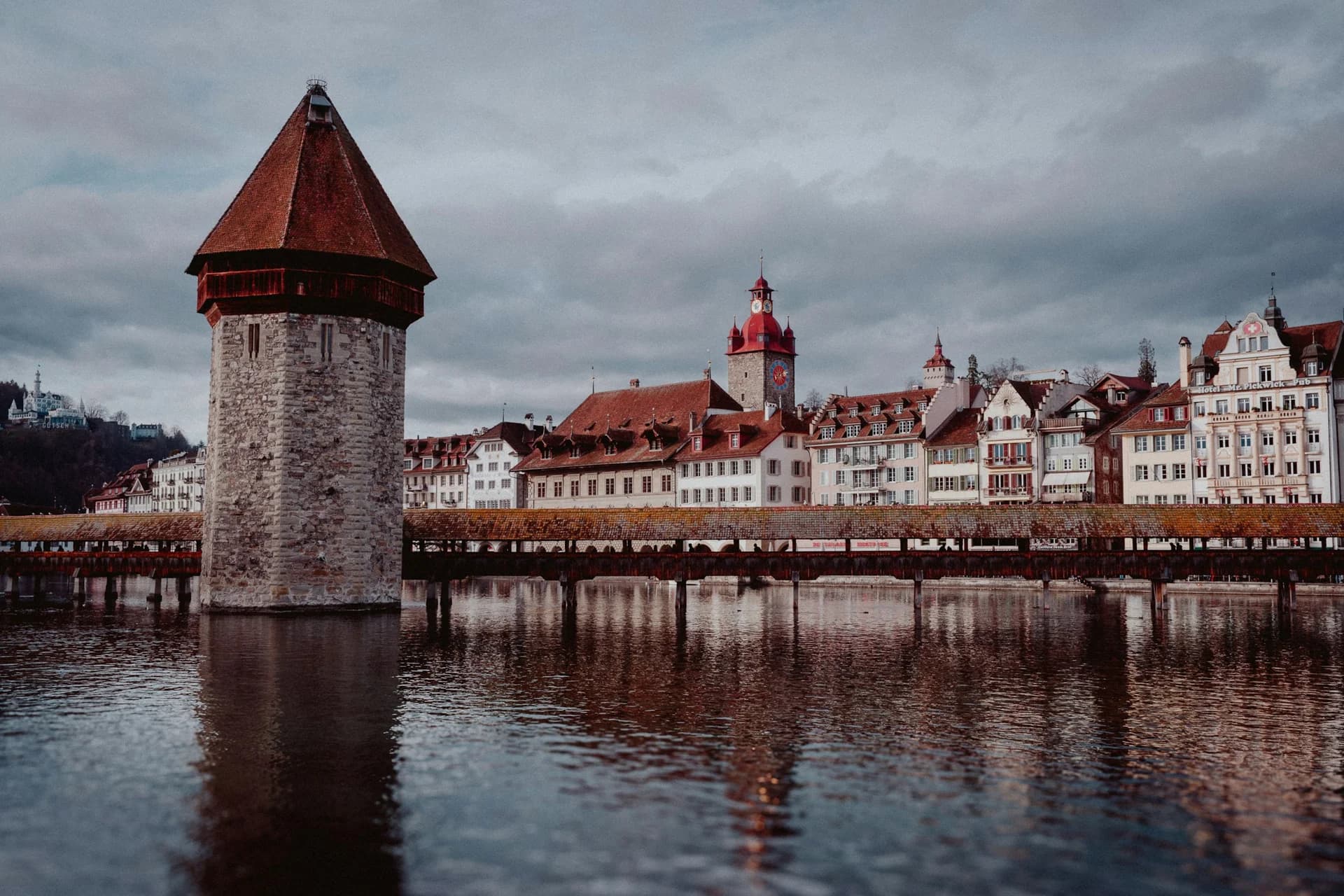
Lucerne's old town has the Chapel Bridge (Kapellbrücke, 1333 — Europe's oldest covered wooden bridge), the Spreuer Bridge (another covered medieval bridge), frescoed buildings on the Weinmarkt, and the Musegg Wall with 9 towers (3 climbable, free). The Lion Monument — a dying lion carved into rock, which Mark Twain called "the saddest piece of stone in the world" — is free to visit and worth the few quiet minutes it asks of you.
The Swiss Transport Museum (CHF 36, or CHF 18 with Swiss Travel Pass) is one of Europe's best interactive museums. The KKL Luzern concert hall (designed by Jean Nouvel) hosts world-class performances.
Interlaken's town is functional rather than fascinating. The Höhematte park has views of the Jungfrau. The main street (Höheweg) has chocolate shops and adventure sports booking offices. But there's not much to do in town itself — the attractions are all above or beside it.
Winner: Lucerne, decisively. It's a real city with real depth.
Adventure Sports
Lucerne: Hiking on Pilatus and Rigi, lake swimming, cycling paths around the lake.
Interlaken: Paragliding (from CHF 170), skydiving (CHF 395), canyoning, white-water rafting, bungee jumping, hang gliding. Interlaken is the adventure capital of Switzerland — possibly of Europe. If you want to jump off or out of things, this is your city.
Winner: Interlaken, completely. The adrenaline infrastructure is unmatched.
Cost Comparison
| Category | Lucerne | Interlaken |
|---|---|---|
| Hotel (mid-range) | CHF 180-280/night | CHF 150-250/night |
| Mountain excursion | CHF 72-115 | CHF 105-247 |
| Restaurant meal | CHF 25-45 | CHF 22-40 |
| Daily budget | CHF 200-350 | CHF 200-400 |
Both are expensive. Switzerland is expensive. The Swiss Travel Pass (from CHF 244/3 days) is essential for either — it covers trains, boats, city transport, museum entry, and 50% off mountain railways.
Winner: Roughly even. Interlaken's Jungfraujoch ticket tips the scale, but Lucerne's in-town attractions add up too.
So Which One?
Choose Lucerne if you:
- Want a city experience alongside the mountains
- Love medieval architecture and museums
- Prefer lake cruising and scenic train rides
- Want variety without extreme sports
- Are visiting Switzerland for the first time
Choose Interlaken if you:
- Want world-class mountain scenery as the main event
- Love adventure sports (paragliding, skydiving, canyoning)
- Plan to visit Jungfraujoch or Lauterbrunnen valley
- Don't need much from the town itself
- Prioritize dramatic Alpine landscapes
Choose both: Lucerne to Interlaken by train takes 2 hours through stunning scenery (via the Golden Pass route). A week split between both gives you the complete Swiss experience — city, lake, and extreme Alps.
The house pick? Lucerne. The Chapel Bridge at dawn, the steamboat on the lake, and the Pilatus Golden Round Trip add up to a fuller day than any single mountain in Interlaken delivers. But the case for Jungfraujoch stands on its own: standing at 3,454m above sea level looking at the Aletsch Glacier is hard to argue with.
Bring the Swiss Travel Pass regardless. For a nature-focused deep dive, our Lucerne nature guide covers every mountain and lake experience. Budget-conscious? Our 17 money-saving tips explain how to cut costs. If you love Alpine scenery at friendlier prices, Salzburg delivers a similar mountain-meets-city combination. Bring sunscreen for altitude. And bring a credit card with a high limit. Switzerland doesn't do budget travel — it does value travel, where the value is that the train is on time, the water is drinkable from any tap, and the views are free.


