
Your 15 Biggest Questions About Salar de Uyuni, Answered by Someone Who's Been Three Times
Your 15 Biggest Questions About Salar de Uyuni, Answered by Someone Who's Been Three Times
Three trips to Salar de Uyuni — one in rainy season for the mirror effect, one in dry season for the hexagonal patterns, one on a 3-day tour that continued south into the Eduardo Avaroa National Reserve — turn up the same fifteen questions again and again. Here are the honest answers.
Getting There
Q: How do you get to Uyuni?
A: Three options, ranked by comfort:
-
Fly from La Paz — Boliviana de Aviacion or Amaszonas operate flights (~$80-150 one way, 1 hour). The airport is tiny, flights are sometimes cancelled due to weather, and luggage occasionally arrives on the next flight. But it's fast.
-
Overnight bus from La Paz — 10-12 hours, $10-20 USD. The road is paved most of the way now. Semi-cama buses are uncomfortable but functional; budget for roughly four hours of real sleep out of ten. If you're arriving overland from Peru via Lake Titicaca and Copacabana, La Paz is where you pick this bus up.
-
Bus from Sucre — 7 hours, daytime, scenic through mountain villages. The route to choose, because Sucre earns a stop on its own and the drive is beautiful.
The train from Oruro is atmospheric — old-school rails across the altiplano — but the schedule is erratic and it only runs a few times per week.
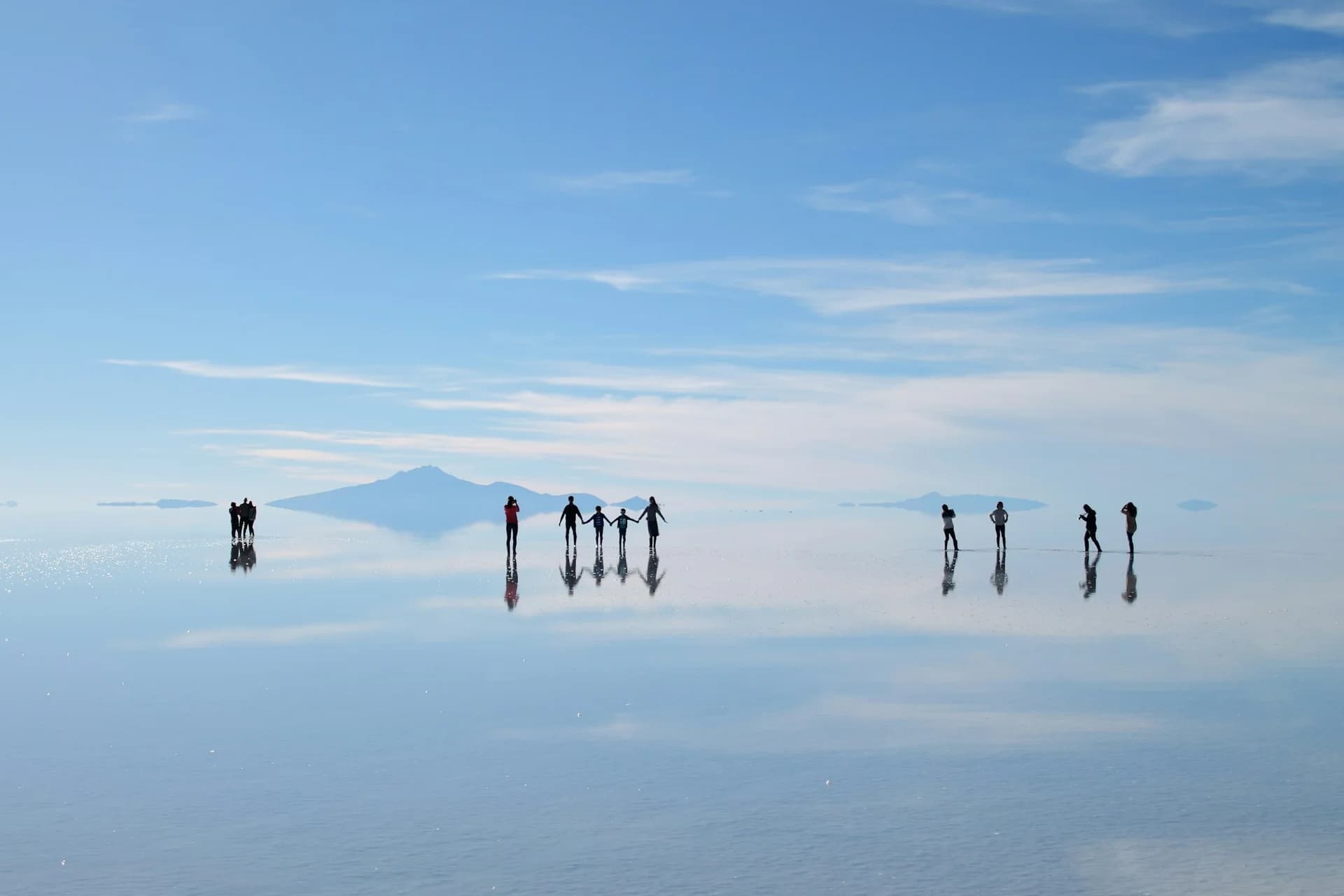
Q: When should you go for the mirror effect?
A: December to April (rainy season) for the famous mirror photos. But timing matters within that window:
- January-February has the most water and the best mirror conditions. But some areas become inaccessible because the water is too deep for vehicles, and tours may be shortened.
- Late March to early April is the sweet spot — enough water for stunning reflections, fewer access problems, and slightly smaller crowds.
- Dry season (May-November) gives you the white hexagonal salt patterns, perspective photography on the dry flat, and easier vehicle access. No mirror effect, but the dry salar has its own stark beauty.
Q: What's the altitude situation?
A: The salar sits at 3,656 meters. Arriving from La Paz (3,640m) means you're already acclimatized. Flying in directly from sea level means planning 2-3 days in La Paz or Sucre first — the same acclimatization buffer you'd want on the high road to Machu Picchu. Altitude sickness at this elevation causes headaches, nausea, and shortness of breath. Coca tea helps. Sorojchi pills ($1 at any pharmacy) help more.
The 3-day tour goes higher — up to 4,800 meters at the Sol de Mañana geysers. At that altitude, walking 50 meters feels like running a mile. Sol de Mañana sits close to the Chilean border, and plenty of people finish the tour by crossing into Chile's Atacama Desert rather than looping back to Uyuni.
Tours and Safety
Q: Is a tour necessary, or can you go independently?
A: Tour. Exclusively. There are no roads on the salt flat — drivers navigate by landmarks, sun position, and experience. There is zero cell coverage. Getting lost on 10,582 square kilometers of featureless white surface is a genuine survival risk.
All tours depart from Uyuni town.
Q: How much do tours cost?
A:
- 1-day tour: $25-40 USD per person
- Sunset/sunrise tour: $30-50 USD
- 3-day tour (salar + Eduardo Avaroa Reserve): $150-200 USD all-inclusive (transport, food, accommodation, guide)
The 3-day tour is the definitive Uyuni experience — it continues south through colored lagoons, flamingo colonies, geysers, hot springs, and the surreal desert landscape of southwest Bolivia. If that high-desert surrealism is what draws you, Peru's oasis town of Huacachina scratches a similar itch at a far gentler altitude.
Q: Are the cheap tours really dangerous?
A: Yes. This isn't alarmism — fatal accidents have happened with budget operators. The cheapest tours ($30-40/day for 3-day trips) often mean:
- Poorly maintained vehicles with bald tires
- Drivers who drink during the trip (this is documented, not rumor)
- No spare tire, no first aid kit, no satellite phone
- Cramming 7 people into a vehicle designed for 6
Spend $50-70/day with reputable operators. Red Planet, Quechua Connection, and Salar Expeditions have good track records. Before departing, physically check that the vehicle has a spare tire, first aid kit, and working heating. If anything seems off, switch operators. Your life is worth more than $20/day in savings.
Q: Is there cell service on the salar?
A: Zero. None. Not even the Bolivian carriers get signal out there. Your driver is your lifeline. Carry a charged power bank, a whistle, and emergency food/water in case of vehicle breakdown. If your vehicle breaks down, stay with it — do not wander. Other tour vehicles pass regularly.
The Experience
Q: How does the perspective photography work?
A: The dry salar is perfectly flat and featureless — no trees, no buildings, no reference points. This creates natural conditions for forced-perspective trick photos. Tour guides carry props: toy dinosaurs, Pringles cans, bottles. The classic shots are someone "standing on" a Pringles can or being "eaten" by a dinosaur.
The trick works because without reference points, your brain can't judge scale from a photo. Guides know the exact angles and distances. It's silly, it's fun, and the photos are genuinely impressive.
Q: Is Incahuasi Island worth the stop?
A: Absolutely. It's a rocky island in the middle of the salt flat covered with giant cacti — some over 12 meters tall and 1,200 years old. Hike to the summit for 360-degree views of endless white in every direction — the island feels as improbably marooned as the Galápagos archipelago, just stranded in a white sea instead of a blue one. Entry is about $4 USD. Allow 1 hour.
Bring sunscreen. The salt reflects UV so intensely that you can burn the underside of your chin.
Q: What about the Train Cemetery?
A: The Cementerio de Trenes is a collection of abandoned steam locomotives from the 1940s, rusting 3 km outside Uyuni. It's the first stop on most tours. It's mildly interesting for 20 minutes — good for photos, especially at golden hour. Don't expect a museum-quality experience. It's rusting trains in a desert.
Q: Are the salt hotels real?
A: Yes. Walls, floors, beds, tables — all carved from salt blocks. Palacio de Sal and Luna Salada are the most established ($80-150/night). The walls feel rough and grainy under your hand. The furniture is heavy. The room smells faintly saline. It's a genuinely unique stay, though the heating can be erratic at 3,656m altitude where nighttime temperatures drop to -10°C.
Don't lick the walls. Everyone asks. Yes, they taste like salt. Everyone insists they didn't try it. Everyone tried it.
Packing and Preparation
Q: What should you bring?
A:
- Sunscreen SPF 50+ — the salt reflects 70% of UV. Second-degree sunburns happen out here.
- Sunglasses — not optional. The glare is physically painful without them.
- Warm layers — temperatures swing from 25°C at midday to -10°C at night. Bring a puffy jacket, thermal base layer, warm hat, and gloves for the 3-day tour.
- Headlamp — essential for nighttime at accommodation stops.
- Toilet paper — seriously. Facilities on the 3-day tour are... basic.
- Cash — there are no ATMs on the salt flat or along the 3-day route. Bring enough bolivianos for tips, extra water, and small purchases.
- Snacks — tour-provided food is adequate but basic. Bring chocolate, trail mix, and electrolyte tabs.
Q: Is the stargazing really that good?
A: Words undersell it. Zero light pollution. 3,656 meters of altitude. Dry air. The Milky Way isn't a faint smear — it's a solid white band stretching from horizon to horizon. Individual stars come out that you won't have seen from anywhere else — the high desert across the Chilean border is the only place that comes close, and our Atacama planning guide covers that stretch in detail.
During rainy season, the Milky Way reflects in the water layer on the salt flat. You stand between two skies.
Some tours offer overnight camping on the flat with mattresses in the 4x4. If it's offered, take it. Sleeping under that sky, in total silence except for the occasional creak of cooling salt, is profoundly disorienting and beautiful.
Q: Is it worth going back?
A: Twice over. The third trip was the 3-day tour, which is the right way to do it — the salar alone is impressive for half a day, but the journey south through Eduardo Avaroa is where Bolivia's landscape goes from extraordinary to extraterrestrial. Laguna Colorada with thousands of flamingos standing in red water, Sol de Mañana geysers hissing steam at 4,800m, hot springs at sunrise with condors circling overhead — raw natural theatre to rival even Iguazú Falls a couple of borders east.
If you're stringing Uyuni into a longer South American route, the high-altitude Sacred Valley around Cusco is the logical next leg — the acclimatization you earn here carries straight over the border.
For the human side of the continent rather than the scenery, our conversation with a lifelong Santa Marta local is the kind of slow, place-rooted story that the altiplano inspires too.
Bolivia's tourist infrastructure is rough. The roads are bad. The cold is harsh. The altitude hurts. And you'll start planning the next trip before this one ends.


