
5 Days in San Miguel de Allende: A Travel Diary From Mexico's Most Beautiful Town
5 Days in San Miguel de Allende: Mexico's Most Beautiful Town, Day by Day
Arrive skeptical. Every travel magazine has, at some point, named San Miguel de Allende the "best city in the world" — a title that usually signals a place optimized for tourist consumption. Pretty but hollow. Instagram-ready but lacking substance.
Set those expectations aside. San Miguel is the real thing.
Day 1: Arrival and the Jardin
Fly into Leon/Bajio (BJX). The private shuttle to San Miguel ($900 MXN, about $50 USD, 1.5 hours) winds through the high desert of the Bajio region — dry hills, agave fields, small towns. The altitude will surprise you: 1,900 meters (6,234 feet), similar to Denver. Your head will feel it.
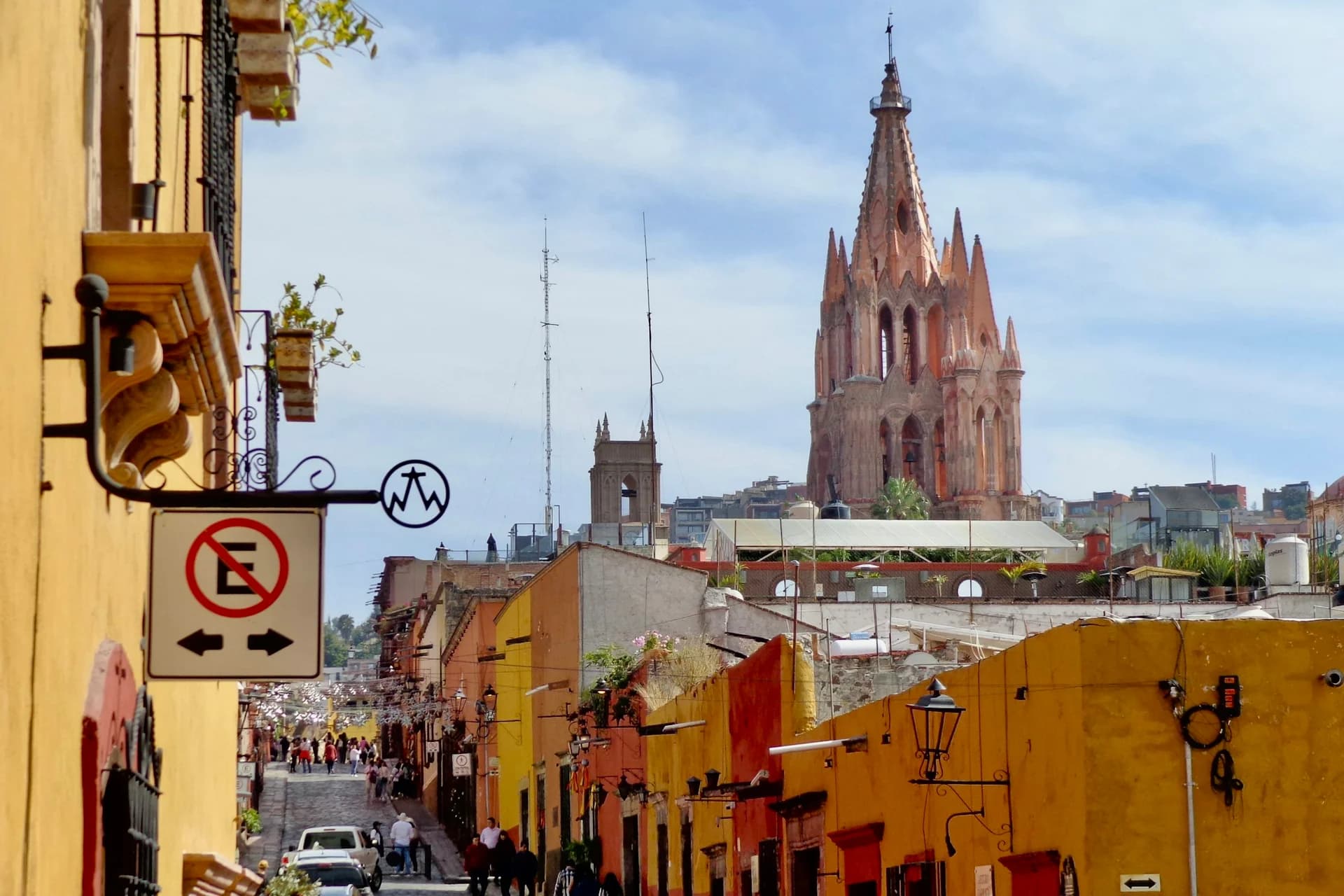
Base yourself in Centro. A converted colonial house here comes with a courtyard, tile floors, and a rooftop terrace framing a direct Parroquia view — around $1,800 MXN/night ($100 USD). In any European equivalent, that room runs $300 and up.
Walk to the Jardin Principal, the tree-shaded main plaza, in the late afternoon, when the Parroquia's pink spires catch the light. Mariachi bands set up for the evening. Vendors sell elotes (grilled corn, $30 MXN) and paletas (fruit popsicles, $25 MXN). Claim a wrought-iron bench and watch the plaza fill with families, couples, tourists, and kids chasing each other.
For dinner, book Luna Rooftop Tapas Bar — the best Parroquia view in town. Cocktails run $150 MXN, tapas $80–150 MXN each. Lit up at night, the church is stunning against the dark sky.
Day 2: La Gruta Hot Springs and Fabrica La Aurora
Take a taxi ($120 MXN) to La Gruta hot springs, 10 km outside town. Arrive at 8AM and the pools are nearly empty. Entry: $200 MXN ($11 USD).
The main pool is pleasant enough, but the cave pool is extraordinary. Wade through a narrow tunnel into a vaulted stone grotto filled with hot mineral water and steam. Light filters through openings in the rock above. The water holds at 38°C, and the echo of dripping water fills the space.
Give it two hours. Floating on your back in a cave pool, watching steam curl toward the light, ranks among the most surreal experiences travel offers.
Spend the afternoon at Fabrica La Aurora — a converted textile factory housing 40+ art galleries and studios. Free entry. The spaces range from contemporary painting to sculpture to folk art. Set aside a couple of hours to browse, and consider a small ceramic piece ($400 MXN) from a studio where the artist works at the wheel in front of you.
Dinner belongs at the Mercado, in the upstairs food stalls: enchiladas mineras (a Guanajuato specialty with potatoes, carrots, and cheese, $70 MXN), a tamal verde ($30 MXN), and an agua de Jamaica ($20 MXN). Total: $120 MXN ($6.60 USD) for a full, excellent meal.
Day 3: Walking the Streets and the Sanctuary
Give the morning no agenda. Just walk. San Miguel's streets are a maze of cobblestones, painted walls, and wrought-iron balconies dripping with bougainvillea. Every corner offers a different color combination — terracotta next to cobalt blue next to sun-faded pink. The doors alone could fill a photography book.
You'll find the murals and hand-painted tiles that appear on random walls throughout Centro. No maps. No signs. Just wandering.
In the afternoon, take a taxi ($150 MXN) to the Sanctuary of Atotonilco, 14 km north. This church is called the "Sistine Chapel of Mexico," and it's not hyperbole. The ceilings and walls are covered — every inch — in 18th-century frescoes and folk art murals depicting biblical scenes. The quality is extraordinary and the scale is overwhelming.
Expect almost no tourists and free entry, which means entire rooms to yourself. The drive through the countryside is beautiful — dry hills, cactus, quiet.
Day 4: Art Class and El Mirador Sunset
Sign up for a 3-hour ceramics workshop at the Bellas Artes cultural center ($500 MXN, about $28). The instructor works mostly in Spanish with some English. You'll leave with a lopsided bowl and hands still dusted with clay — and the hours spent shaping it inside a courtyard-centered colonial building are worth far more than the bowl.
For lunch, head to Cafe de la Parroquia — chilaquiles verdes ($90 MXN), fresh-squeezed orange juice ($40 MXN), and the kind of coffee strong enough to change your afternoon plans.
Late afternoon, walk to El Mirador viewpoint on the north side of town, a 15–20 minute uphill climb through residential streets. The panorama from the top shows the entire town — a sea of terracotta rooftops, church spires, and colonial facades, all backed by the rolling Bajio hills.
Sunset from El Mirador turns the sky orange and pink, and the Parroquia's spires catch the last light. Settle onto a bench with a paleta ($25 MXN) and stay until the stars appear.
Day 5: Last Morning and Departure
Spend the final morning at the Jardin. Coffee at a sidewalk cafe runs $40 MXN. Watch the town wake up — shopkeepers opening doors, school children in uniforms walking to class, old men settling onto benches.
Take home a box of cajeta (goat milk caramel, $80 MXN) and a hand-painted tile ($150 MXN) as souvenirs.
Then the shuttle back to BJX airport. The drive through the desert feels different leaving than arriving — and by the time you reach the airport, you'll already be planning the return.
The Verdict
San Miguel de Allende earns its reputation. This is no tourist fabrication. The colonial architecture is real and lived-in. The art scene is genuine — working artists, not just galleries selling to tourists. The food is exceptional and absurdly affordable. The hot springs are world-class.
But the pace is what stays with you. San Miguel runs on its own clock. Lunch lasts two hours. Sunsets are community events. People sit in plazas and talk to each other. The cobblestones force you to slow down — you literally can't rush.
In a world that's constantly accelerating, San Miguel de Allende is the rare place that invites you to stop. And when you do, you realize how much you've been missing.
Go once, and you'll be scanning rental listings before the plane home even lands.


