After Dark at Okaukuejo: The Patient Payoff of an Etosha Waterhole
After Dark at Okaukuejo: The Patient Payoff of an Etosha Waterhole
The first thing Etosha does is test your nerve. You roll through Andersson Gate a little after opening — tank full, cooler packed — expecting Africa to put on a show before the dust settles behind you. It doesn't. The road runs arrow-straight toward a horizon the color of old bone, and for the first hour the biggest thing moving is the heat. Shimmer coming off the gravel. A lone springbok flicking its tail. And off to your right, the great white pan, sitting there like a frozen sea that forgot to become water.
Give it time. That's the whole secret of this park, and nobody hands it to you at the gate.
The long, quiet middle
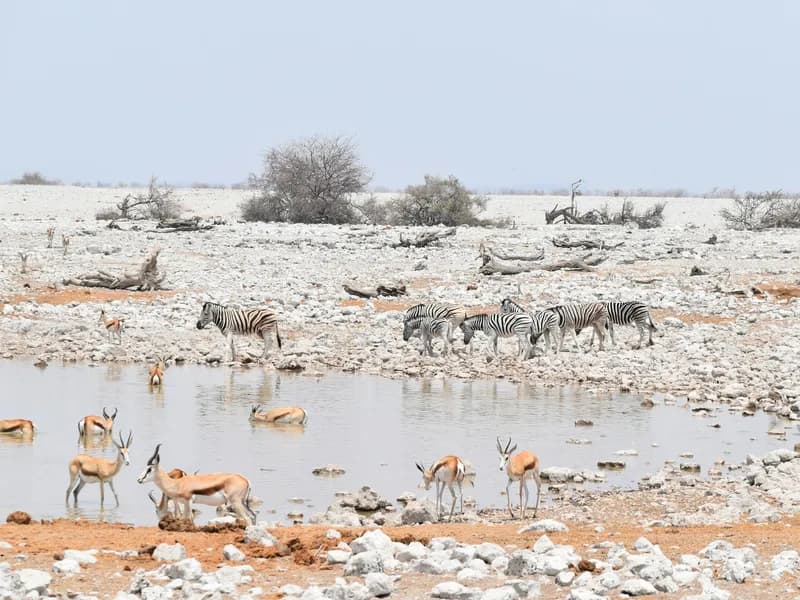
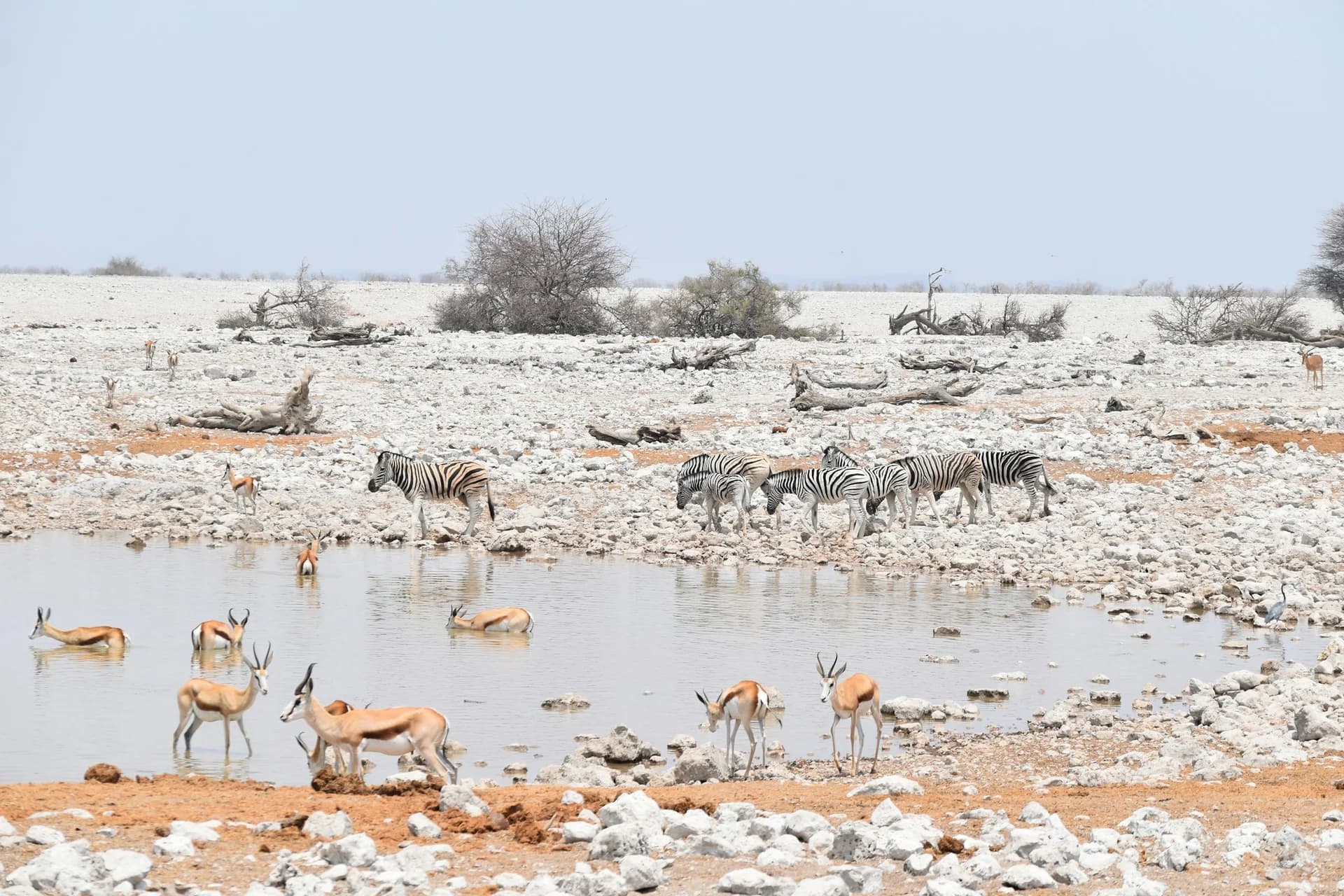
Etosha is not a place that rewards impatience. The speed limit is 60 km/h, and you should treat it as a favor rather than a rule — the slower you crawl between waterholes, the more the landscape gives up. You'll stop at Nebrownii and find nothing but a shimmering pool and three ostriches pretending you don't exist. You'll swing past Gemsbokvlakte, then Olifantsbad, and get more of the same. Zebra dozing. A gemsbok standing so still it looks carved. The horizon doing its slow, hypnotic wobble.
Somewhere around midday, in the heat, you'll start to wonder if you've read this all wrong. Don't. This is the part everyone forgets to warn you about — the middle stretch where Etosha quietly asks whether you actually want it. The animals aren't hiding. They're waiting, same as you, for the sun to loosen its grip.
Guides who've worked these roads for years will tell you the same thing: the wildlife runs on the water's clock, not yours.
So you keep moving. Salvadora, out on the pan's edge, where the grass gives lions somewhere to lie up. Rietfontein, a reliable stage in the dry months. You hold a loose loop in mind and keep your eyes on the tree lines and the water, because in Etosha the drama almost never comes to the road — you drive to where it's about to happen, and then you wait.
Beat the gate
Here's the hard rule that shapes your whole day: you have to be inside a rest camp by sunset. The gates close, and they close firmly — no negotiating with a padlock in the dark. So by late afternoon you point the nose back toward Okaukuejo and time your run so you're through the boom with light to spare.
And this is the part you actually came for. Not the daytime roads — the daytime roads are the price of admission. You came for what Okaukuejo does after dark.
The floodlit waterhole
Okaukuejo's waterhole sits just beyond the camp's perimeter wall, ringed by low stone tiers where people gather and — this is the remarkable bit — go quiet. Voices drop to a murmur without anyone asking. The floodlights come up soft and gold over the water. You find a spot on the wall, pull a jacket over your shoulders (the desert night turns cold faster than you'd believe), and you settle in.
Then you wait some more. Twenty minutes. Forty. A pair of jackals trots through, all business. Sandgrouse clatter in for a drink. And just when the wall of quiet strangers has half given up, the acacia shadows on the far side shift — and a black rhino walks into the light.
It's hard to describe what that does to a crowd. Nobody speaks. This is one of the last strongholds on earth where you can watch black rhino, wild and unbothered, come to drink under lights — and Okaukuejo is the place they turn up most reliably. The animal moves like it owns the hour. Drinks. Lifts its head at some sound only it can hear. Stands guard over the water as if deciding who else gets a turn.
Later, the elephants arrive — and if you've spent the day out on the pan roads, you'll recognize them instantly. They come in dusted pale grey-white, ghost-colored from rolling in the park's calcrete mud. Etosha's white elephants. They file down to the water in a loose line, the little ones tucked between legs, and they drink and spray and shove until the rhino decides the night has gotten too crowded and melts back into the dark.
Why this beats a dozen daytime sightings
You can spend a full day chasing movement across Etosha and come back with a good tally — zebra, springbok in their thousands, a giraffe splayed awkwardly over a waterhole, maybe a lioness if the timing's kind. All of it worth the drive — the same restless, chase-the-sighting rhythm that a classic game drive out of Arusha is built on. But the floodlit vigil at Okaukuejo is a different kind of memory. It's slow. It's earned. You sat through the empty middle of the day, and the payoff came to you, on its own schedule, close enough to hear it breathe.
If you want more of it, the park gives you two other stages. Halali, in the center, has Moringa — a smaller, more intimate floodlit waterhole tucked behind the camp, and on a good night it delivers rhino and elephant with half the audience. Namutoni, over in the east near the old German fort, is your base for Fisher's Pan and the Chudop and Klein Namutoni waterholes. Three camps, three moods. If you can swing it, spend a night at each and let the park unspool at its own pace — and if you're stitching together a longer southern-Africa run, Cape Town makes a natural bookend to the drive.
Make it easy on yourself
A few things worth knowing before you point the car at the gate:
- Come in the dry season. May through October is when the bush thins out and the animals have nowhere to drink but the waterholes. That's when the odds tip hard in your favor.
- Book the waterhole-facing camp early. Okaukuejo's chalets and camping run through Namibia Wildlife Resorts, and the spots within earshot of the water go first — reserve months ahead in peak season.
- Budget for the entry. Foreign visitors pay roughly N$150 per adult per day (about US$8), plus a small vehicle fee — carry some Namibian dollars, though cards work at the camp receptions.
- Bring warm layers. The days scorch and the nights bite. A fleece and long trousers make the difference between staying for the rhino and giving up early.
- Let the lights do the work. You don't need your own torch at the waterhole — the floods handle it, and a phone screen or headlamp just annoys everyone around you. Sit still, stay quiet, and let the night come to you.
That's the whole shape of an Etosha day: a hard, bright, patient stretch of empty road, and then a slow gold hour at the water's edge that pays it all back with interest. Give the park your patience. It has a way of returning the favor after dark.