The Complete Normandy Travel Guide: D-Day Beaches, Chalk Cliffs, and a Tidal Island Abbey
The Complete Normandy Travel Guide: D-Day Beaches, Chalk Cliffs, and a Tidal Island Abbey
Normandy is a region, not a city. Get that straight before you book anything, because it changes everything. This is 80 kilometres of D-Day coast, a tidal island abbey in the far southwest, chalk cliffs on the north shore, and apple country in the middle — and no single base covers all of it. The reward for accepting that? One of the most varied road trips in France. Cliffs Monet painted eighty times. Beaches that carry code names the whole world knows. Cheese so good it has its own laws.
Here's how to do it properly.
Overview
Normandy sits on France's northwest coast, about two hours west of Paris. Its two big cities — Rouen (~110,000) and Caen (~105,000) — anchor either end, with Bayeux, Honfleur, Étretat and Mont-Saint-Michel strung between them. The region trades in apples, not grapes (too far north for wine) — cider and Calvados country, a world away from the vineyards of Bordeaux — and in a coastline that has drawn painters, pilgrims and armies for a thousand years. It's very safe, easy to drive, and far cheaper than the capital.
Language is French, though English is spoken freely around the D-Day sites. Currency is the euro.
Best Time to Visit
May to September. That's the window — long days, mild sea air (18-23°C), and every abbey, garden and museum open. Giverny's gardens and Monet's house shut solid from early November to April, so a winter trip loses one of the region's headline acts entirely.
June 6 is the D-Day anniversary, and the coast fills with veterans' families, motorcades and ceremonies. It's significant and it's mobbed — for milestone years, book a year out or skip that week. Spring and early autumn hit the sweet spot: everything's open, the coaches thin out, and the light on the cliffs is at its best. Rain is possible in any month. Pack a shell.
Getting There
Most people fly into Paris Charles de Gaulle (CDG), 200 km east, then drive or train in. There are small regional airports at Caen-Carpiquet (CFR) and Deauville-Normandie (DOL) if the schedules line up.
By train: SNCF trains run from Paris Saint-Lazare — Rouen in about 1h15, Caen in 2h, Bayeux in 2h15. Book on SNCF Connect; fares climb as seats sell, so lock them in early. Rouen, Caen and Bayeux all have car-rental desks at the station, which is the smart way to combine train-in with drive-around.
By car — and this is the part that matters: rent one. The D-Day beaches span 80 km with almost no public transport between them, and none at all to Pointe du Hoc. A car is effectively mandatory unless you commit to a day tour. Expect €45-70 (about $49-76) a day, and ask for the smallest chassis on the lot — Norman villages were laid out for ox carts, not SUVs. BlaBlaCar works for intercity hops between towns, but it strands you the moment you want a battery or a cemetery. Skip it for the coast.
Where to Stay
You'll want two or three bases, not one. Here's the logic.
Rouen — best for the eastern end: the cathedral Monet painted, Joan of Arc's square, and easy reach of Giverny and Étretat. Stay inside the medieval centre near Place du Vieux-Marché and garage the car; the old town is pedestrianised.
Bayeux — the D-Day base. First French town liberated (7 June 1944), the Germans left without a fight, and not a bomb fell — so the medieval centre is entirely real. Compact, walkable, loaded with good restaurants. Pointe du Hoc, Omaha and Arromanches are all inside 35 minutes.
Honfleur — the prettiest overnight, a slate-fronted harbour where Impressionism basically started. Half a day of sights, but a lovely place to sleep.
On or beside Mont-Saint-Michel — worth one night, for reasons explained below. Rooms are small and dear and completely worth it.
Skip trying to base the whole trip in Caen — it took heavy 1944 bombing and rebuilt in a hurry, so while its Memorial museum is essential, the town itself has less charm than Bayeux 30 minutes west; we weigh the full Bayeux-versus-Caen call in a separate breakdown.
What to Do
Mont-Saint-Michel. The abbey-crowned tidal island, under construction since 708 and never taken by siege. Abbey entry ~€13 (about $14), open daily 9:30AM-6PM (9AM-7PM in summer, last entry an hour before). Park at the Beauvoir barrage 2.5 km back (€15.60/24h); the Passeur shuttle is free, or walk the footbridge in 35 minutes. You cannot drive to the island — full stop. Climb straight to the top and work down, while everyone else grinds upward.
The D-Day beaches. Utah, Omaha, Gold, Juno, Sword — five sectors across 80 km. Don't try all five in a day; you'll get three hours of driving and no time anywhere. Pick two adjacent sectors. The unmissable trio in the centre: Pointe du Hoc (free, cratered and bunkered exactly as 1944 left it), Omaha Beach, and the Normandy American Cemetery at Colleville-sur-Mer (free, 9,388 graves on the bluff above Omaha, photo ID at the gate). Stay for the flag lowering and Taps at closing — it's handled with real dignity, then you move on.
Caen Memorial Museum. ~€20, opens 9AM, closed most of January. Do this before the beaches — every site on the coast assumes the context this museum supplies, and none of them explains it.
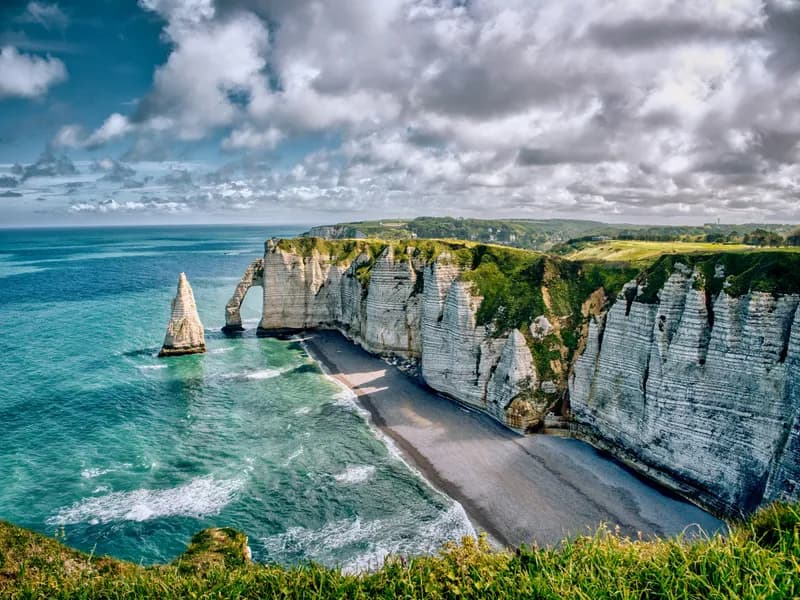
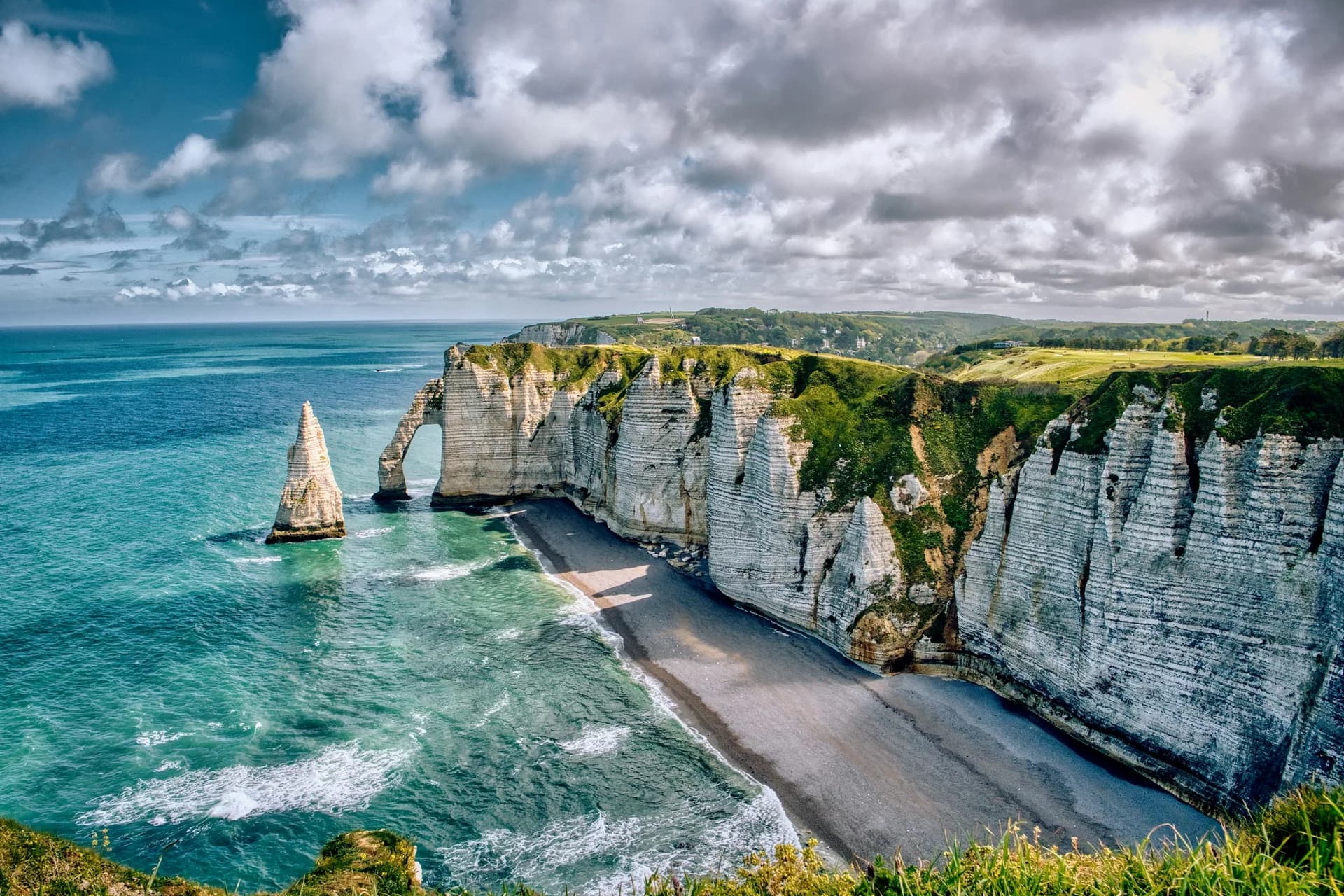
Étretat. Free chalk cliffs and natural arches on the Alabaster Coast that Monet painted more than eighty times. The Falaise d'Aval clifftop loop takes about an hour; parking's ~€5. Check a tide table before setting foot on the beach below — the water reaches the cliff base and cuts off the arches.
Rouen. The Gothic cathedral Monet painted thirty times, a 14th-century astronomical clock, and the square where Joan of Arc was burned in 1431. The Musée des Beaux-Arts is free — a genuine anomaly in France — and hangs a canvas from Monet's cathedral series six minutes' walk from the real facade.
Honfleur and Giverny. Honfleur's Vieux Bassin for the postcard and France's largest timber church; Giverny (~€13, April-November only) for Monet's water-lily pond and Japanese bridge. Arrive at Giverny's 9:30AM opening or at 3PM — the Paris coaches own it from 10 to 2.
Food and Drink
Order cidre — served in a shallow bowl, not a glass — and get the brut, not the sweet doux. Then poiré (perry) and Calvados, the apple brandy; the trou normand is a shot of it taken mid-meal to make room for the next course, and it's a real custom, not a tourist gimmick.
The four AOC cheeses to hunt on any board: Camembert, Livarot, Pont-l'Évêque and Neufchâtel, the heart-shaped one. Buy Camembert de Normandie AOP made au lait cru, moulé à la louche — raw milk, hand-ladled — and supermarket Camembert will never taste the same again; this is butter-and-orchard country, not the pork-and-wine France of Lyon.
Eat moules-frites and galettes on the coast, sole meunière in Rouen (La Couronne on Place du Vieux-Marché has served it since 1345), and pré-salé lamb near Mont-Saint-Michel — the flock grazes the salt marsh and tastes of it. Skip La Mère Poulard's €40 omelette; it's whisked over an open fire for the theatre and it's still just an omelette. Order the lamb instead.
Budget
| Category | Budget | Mid-Range | Splurge |
|---|---|---|---|
| Hotel/night | €60-90 | €110-180 | €250+ |
| Meals/day | €25-40 | €50-80 | €100+ |
| Car rental/day | €45 | €55-70 | €90+ (auto/SUV) |
| Sights | Free cliffs & cemeteries | €12-20 each | Guided tours €50+ |
| MSM parking | €15.60/24h | Same | On-island room €150+ |
Big savings hide in plain sight: the cliffs at Étretat, the D-Day beaches, Pointe du Hoc, all the cemeteries, and Rouen's Beaux-Arts are free. Picnic from Bayeux boulangeries (a proper baguette sandwich runs ~€6) rather than eating at the thin-on-the-ground beach bars.
Safety
Normandy rates Very Safe (Level 1). The real hazards here aren't crime — they're tidal. Mont-Saint-Michel's bay has a range up to 14 m, some of the fastest tides in Europe, and genuine quicksand; people die out there. Never walk onto the sand without a licensed guide. Same discipline at Étretat: read the tide table before any beach walk, because the sea reaches the cliff and the arches cut off the way back. On the road, French toll gates take contactless but keep coins for older barriers, and refuel before returning a rental — airport fuel pricing is a form of theft.
One admin note: since 10 April 2026 the EU Entry/Exit System is live at CDG, so expect a facial scan and fingerprints on first entry instead of a stamp. US, UK, Canadian and Australian passports still get 90 days visa-free. ETIAS isn't required yet — it launches Q4 2026 — so any site selling you one today is a scam.
A Few Phrases
- Bonjour — hello (say it first, always; walking into a shop without it reads as rude)
- Un cidre brut, s'il vous plaît — a dry cider, please
- L'addition, s'il vous plaît — the check, please
- Où est le parking? — where's the parking?
- Merci, au revoir — thanks, goodbye
Learn those five and you'll get warmer service everywhere. Normandy rewards the effort — arrive curious, drive slow, eat the cheese, and let a region that has watched armies and Impressionists come and go show you exactly why they came.
Related Articles
 Travel Guides
10 Things to Do in the Maasai Mara That Aren't Just the River Crossing
 Travel Guides
12 Best Things to Do in Luxor: A Both-Banks Hit List for Ancient Thebes
 Travel Guides