
Your First Day in Busan: From a Dawn Fish Market to a Bridge Lit Like a Diamond
Your First Day in Busan: From a Dawn Fish Market to a Bridge Lit Like a Diamond
The KTX from Seoul drops you at Busan Station a little after sunrise — two hours and forty minutes south of the capital — and the first thing that reaches you is the smell. Salt. Diesel. Grilled fish from a harbor you can't see yet. You're running on no sleep, the coffee kiosks aren't open, and the city doesn't look like the postcards. It looks like a working port that happens to have mountains stacked behind it.
Give it twelve hours.
By the time the Diamond Bridge switches on over Gwangalli tonight, you'll understand why people who book Busan for a weekend end up quietly moving their flights.
Morning: Jagalchi, where the day actually begins
Take Busan Metro Line 1 to Jagalchi Station, leave by exit 10, and follow your nose down to the water. Jagalchi Fish Market is the biggest seafood market in Korea, and at 7 a.m. it is already loud — hoses running, knives working, the Jagalchi ajumma (the women who have run these stalls for decades) calling prices over tanks of live octopus and hagfish.
(Grab a Cashbee transit card from any convenience store and load 20,000 KRW while you're at it — every bus, the metro, and the beach train take it, and you'll use all three before the day is out.)
It's overwhelming at first. The floor is wet, nobody's speaking English, and you have no idea what half the creatures in the tanks are. That's normal. Here's the move: pick a stall downstairs, point at what looks good, agree on a price, then carry it up to the second-floor restaurants where they'll slice and grill it for a small cooking fee. A plate of hoe (raw fish) for two runs around 40,000–50,000 KRW (about $30–37).
Not in the mood for fish before 8 a.m.? Walk two minutes to any dwaeji gukbap shop. This pork-and-rice soup is Busan's hometown dish — milky, deep, served with a side of chives and salted shrimp so you can season it yourself. A bowl is about 9,000 KRW ($6.50), and it will reset your entire nervous system. (Skip the famous-but-mobbed chains; the no-name place with the plastic stools and the line of taxi drivers out front is always better.)
Mid-morning: getting lost in Gamcheon on purpose
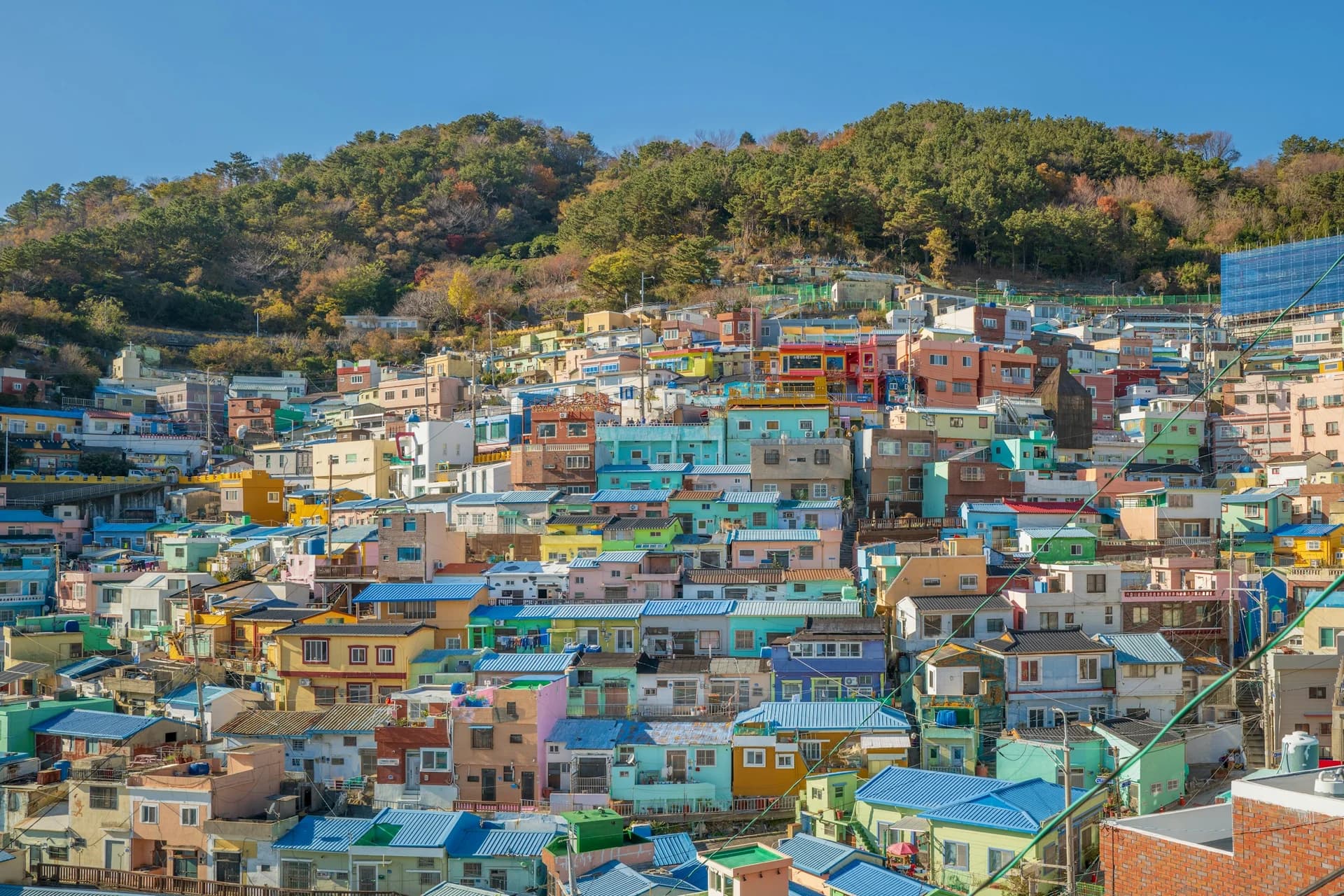
From Toseong Station, hop the little green community bus (1-1 or 2) up the hill to Gamcheon Culture Village — the pastel houses stacked up the mountainside that everyone calls the Santorini of the East. The buses are tiny and steep and packed. Lean into it.
Buy the village map for 2,000 KRW at the entrance; it doubles as a stamp tour and, more importantly, keeps you from rage-quitting when your phone's GPS starts spinning uselessly between the alleys. Because you will get lost. The whole village is a maze of staircases and dead-ends and somebody's actual laundry, and that's the point. Follow the fish-shaped arrows painted on the walls.
The payoff is The Little Prince and the Fox — two statues perched on a wall, looking out over the whole rainbow sprawl of rooftops to the sea. There's almost always a short queue for the photo. Wait for it; it's the one shot from Busan your friends will actually stop scrolling for. Then duck into a rooftop cafe (there are a dozen), order a citron tea, and just sit with the view for twenty minutes.
Early afternoon: out to the temple on the sea
Now go to the opposite end of the city. Haedong Yonggungsa sits on the northeastern coast near Gijang, and it's one of the rare Korean temples built right on the water instead of tucked into a mountain — nothing like the sprawling inland temple plains of Bagan. Take bus 181 from Haeundae, or the metro to Osiria and a short taxi.
The entrance is a gauntlet of food stalls and a crowd, and then you descend the 108 steps — one for each of the human worldly desires, the monks will tell you — and the sea opens up in front of you. Gold shrines, gray rock, waves slamming the base of the cliffs and throwing spray over the prayer lanterns. Entry is free, and it's open from before dawn until sunset. Come on a weekday morning if you can; by mid-afternoon on weekends the main bridge gets shoulder-to-shoulder. Worth it anyway.
Late afternoon: Haeundae and the pastel train
Loop back to Haeundae Beach, the wide arc of sand that put Busan on the map. You could just walk it. But the smart splurge is the Sky Capsule on the Haeundae Blue Line Park — candy-colored two- and four-person pods that glide along the old coastal rail line between Mipo and Cheongsapo, hanging right over the water. It's about 30,000–44,000 KRW for two depending on the route, and it sells out, so book a slot online before you leave Gamcheon.
If the capsules are full, the open-air beach train runs the same coast for a fraction of the price, and the breeze off the East Sea on a warm afternoon is its own reward.
Night: street food in Nampo, then the bridge
Head back toward Nampo-dong as the light drops. BIFF Square — birthplace of the Busan International Film Festival, with directors' handprints set into the pavement — turns into a wall of street-food carts after dark, the kind of after-dark eating you'd cross town for in Bangkok, here with a heavy seafood accent.
Two things you don't skip here:
- Ssiat hotteok — Busan's own version of the sweet griddle pancake, split open and packed with sunflower and pumpkin seeds. About 2,000 KRW ($1.50). It is gloriously messy.
- Eomuk — fish cake on a skewer, with a paper cup of the hot broth it sat in. Busan basically invented the good version; Samjin Eomuk has been making it here since 1953.
Then end the night at Gwangalli Beach. Order something cold at a beachfront bar, put your feet in the sand, and watch the Gwangan Bridge — the Diamond Bridge — light up across the bay. On weekend nights there's often a drone show over the water that the whole beach turns to watch in something close to silence.
Why the day works
Here's what Busan does that the early morning never warns you about: it stops feeling like a port and starts feeling like the most relaxed big city in Korea. Seoul impresses you. Beijing overwhelms you. Busan loosens your shoulders.
The arc is the trick. Start grubby and early at the fish market while you've still got the energy to be confused. Climb Gamcheon mid-morning before the heat and the crowds arrive. Save the sea temple and the beach for once you've found your feet. And let the bridge be the last thing you see.
Do it in this order and the city that looked like nothing at 6 a.m. will have completely won you over by midnight — which is exactly how Busan likes to do it.


