First Day in La Paz: Thin Air, a Little Friction, and the Moment the City Clicks
First Day in La Paz: Thin Air, a Little Friction, and the Moment the City Clicks
The plane banks over the Altiplano and drops toward El Alto, and the first thing that gets you is the light — hard, white, high-altitude light that makes the snowcap of Illimani look close enough to lean on. El Alto International sits at 4,061 meters, 13,325 feet, the highest international airport anywhere. You feel it the second you stand to pull your bag from the overhead bin. Your head goes swimmy. The walk up the jet bridge feels like a flight of stairs.
That's the deal with La Paz. It greets you by reminding you that you're a sea-level creature in a city that plays by different rules. Lean into that first hour instead of fighting it, and you get one of the great arrivals anywhere in South America.
The drop into the canyon
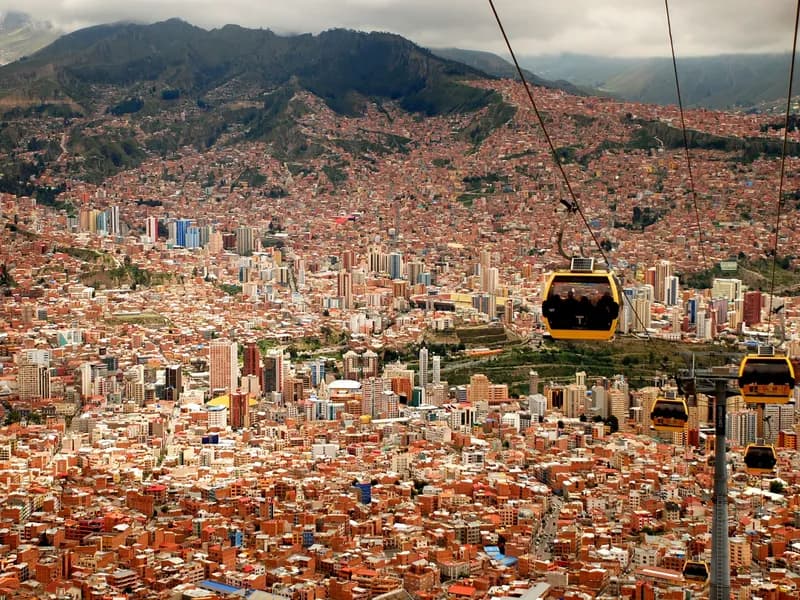
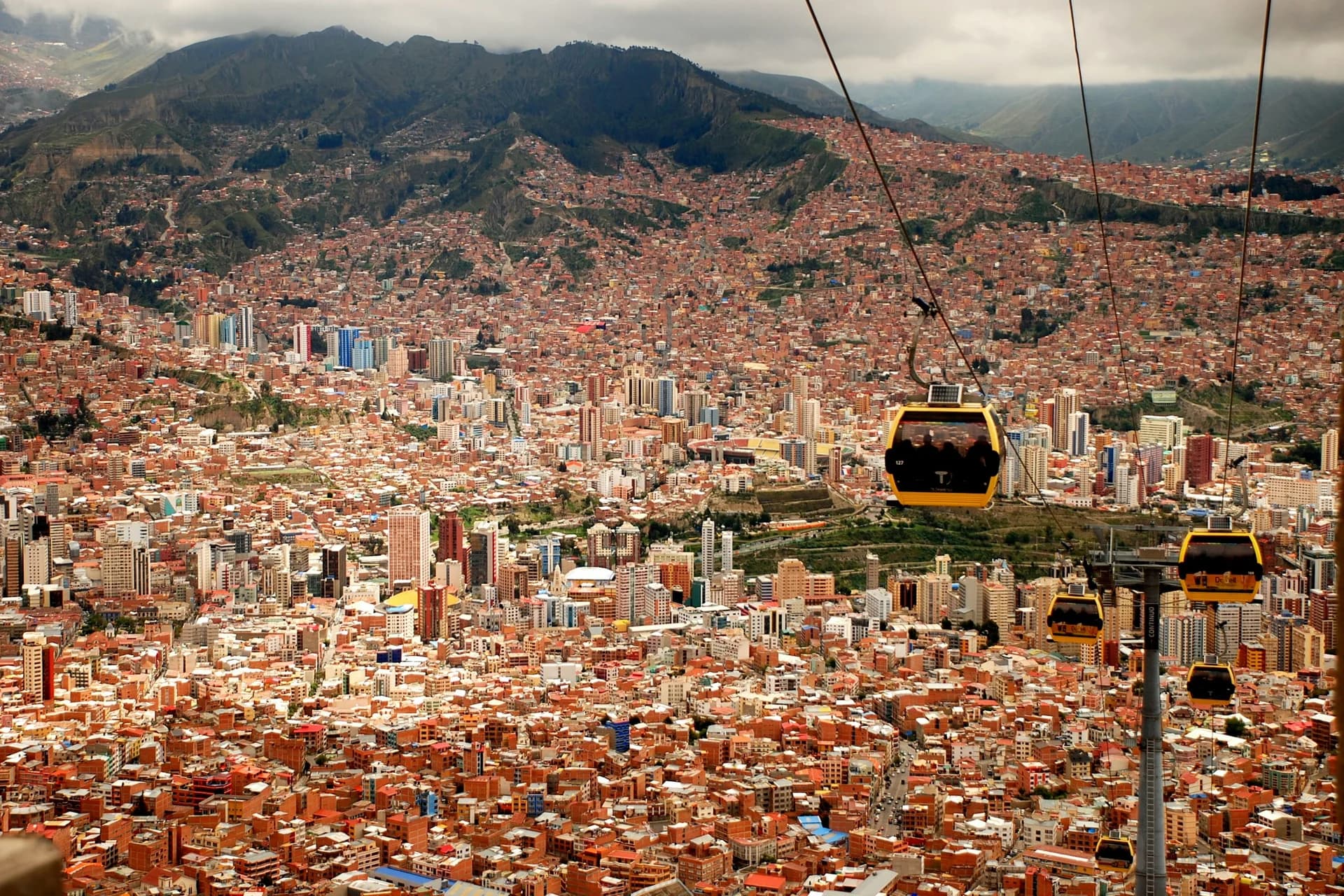
Grab an official taxi from the arrivals queue — the ride down to the center runs about 70–80 Bolivianos (roughly $10–12). Then comes the part no photo prepares you for. El Alto is flat and endless, and then the road hits a lip and the whole bowl of La Paz falls away beneath you: red-brick houses climbing the canyon walls, church towers, glass office blocks in the Zona Sur far below, and Illimani hanging over all of it at 6,438 meters. The center sits near 3,600 meters — about 500 meters lower than the airport — so the descent itself hands you your first real breath of thicker air.
Hour one, do the counterintuitive thing: almost nothing. Check in, drop the bag, and let someone pour you a cup of mate de coca, the coca-leaf tea locals swear by for soroche (altitude sickness). Sip it. Walk slowly. If your head pounds, the pharmacies on Calle Sagárnaga sell Sorojchi pills for a few Bolivianos. The travelers who struggle here are almost always the ones who landed at noon and tried to hike to a viewpoint by two — it's the same discipline that pays off in the thin-air streets of Bogotá, too.
The friction is the point
Because you will want to sprint. La Paz is loud and steep and immediately fascinating, and every instinct says go. Resist it on day one. The stairs outside your hotel will leave you puffing like you ran a mile. The minibuses — battered vans with a kid hanging out the door shouting the route — swarm the arteries around Plaza San Francisco, and crossing the street feels like a contact sport. Calle Sagárnaga runs uphill at a grade that would be a warm-up at sea level and feels like a summit push at 3,600 meters.
This is the friction, and it's worth naming, because on the other side of it is the good part. Give the altitude a full day. Drink more water than feels reasonable. Skip the beer the first night — alcohol hits like a truck up here. By the next morning the swimmy feeling fades, the stairs get easier, and the city stops testing you and starts rewarding you.
Where it starts to turn
Your reward for slowing down is your first salteña. Find a counter — El Hornito on Calle Comercio, or any place with a mid-morning line out the door — and order one hot. It's a baked pastry crimped like an empanada, filled with a soupy, slightly sweet stew of meat, potato, and a whole olive, and there's a technique: bite the top corner, tip it up, and drink the juice before it runs down your wrist. Two of them and a coffee cost under 20 Bolivianos ($3). Salteñas are a morning thing here — most stands sell out by early afternoon, so don't save it for lunch.
Now you're ready for the Witches' Market. Climb the cobbles of Calle Linares, just above Sagárnaga, and you're among stalls hung with dried herbs, amulets, sweets for burning, and the dried llama fetuses that Aymara families bury beneath new houses as an offering to Pachamama, the earth mother. None of it is staged for tourists — these are working ritual goods. Buy a small bundle of incense or a woven charm if you like, but the real value is standing there and realizing how deep the indigenous world runs beneath the Spanish colonial surface.
The moment it clicks
Late afternoon, go find the cable car. Mi Teleférico is a genuine urban gondola network — ten color-coded lines strung across the canyon — and a single ride costs 3 Bolivianos, about 45 cents. Skip the taxi and take the Yellow Line (Línea Amarilla) or the Red Line (Línea Roja) as the sun drops. The city falls away under your feet, the brick and tin roofs turn gold, and Illimani lights up pink on the horizon. It's the best-value view in Bolivia and, honestly, one of the best public-transit rides on the continent. Go around 5 to 6 p.m. in the dry season and you'll catch the whole valley glowing. If you'd rather stand still for it, the Mirador Killi Killi delivers a similar sweep over the rooftops for free.
That's the moment the friction pays off. The airport made you gasp; the teleférico hands the whole city back to you, silent and gold, from above.
Give it a second act
One evening — Thursday or Sunday — save room for Cholitas Wrestling up in El Alto. Aymara women in bowler hats and layered pollera skirts body-slam each other in a lucha libre ring while the crowd howls, and it lands as equal parts sport, theater, and cultural statement. Tour packages run about 50–70 Bolivianos and usually include the ride up, which is the smart way to do it after dark.
By day two or three you'll have your footing, and that's when the bigger stuff opens up. Take the Green Line teleférico toward the Zona Sur and a short taxi out to Valle de la Luna in Mallasa — eroded clay spires that really do look lunar, with a walking loop and a 15-Boliviano entry. If your lungs and nerve are both feeling brave, this is where the legendary Death Road (the North Yungas Road) comes in: full-day mountain-biking tours drop 3,500 meters from La Cumbre at 4,650 meters down to the green edge of the Amazon at Coroico, and reputable operators like Gravity run it for around $100–130 with good bikes and guides. It's a bucket-list descent — just book a company that doesn't cut corners on brakes. If it leaves you hungry for more high country, the lake-and-summit country around Bariloche is where a lot of Andes travelers head next.
Between the big days, wander Calle Jaén, a single restored colonial lane of ochre and blue houses and pocket-sized museums. Stand on Plaza Murillo among the pigeons and the government palaces and look up at the congress building's clock — it runs backwards on purpose, a cheeky reminder to look south. Eat cheap and well at Mercado Lanza near the San Francisco church: api (a hot, sweet purple-corn drink) with a fried pastel, or an anticucho skewer off the grill for a handful of Bolivianos. And if you want one proper splurge, Gustu down in Calacoto turns Bolivian ingredients into a tasting menu that rivals anywhere on the continent.
Why it wins you over
La Paz doesn't do the soft-focus welcome. It hands you thin air, steep streets, and a first day that leaves you flat on the hotel bed by nine. But that arc — arrival, friction, payoff — is exactly why it stays with you. Give it the slow start it demands, and by the time you're floating over the canyon in a gondola with Illimani going pink, you'll understand it: this is the highest city you'll ever love, and it earns every meter.
Come for the altitude story. Stay for the moment it turns into your favorite view in South America.