Five Days in Hamburg: A Day-by-Day Plan for the Harbour City
Five Days in Hamburg: A Day-by-Day Plan for the Harbour City
Hamburg is a city that makes sense once you climb something tall and look down at it. So that's where this plan starts — up high, getting your bearings — before working through the warehouse district, a dawn fish market and a full day on the water. Five days, mapped out, with the bookings and the alarms flagged where they matter — if you want the case for each stop, it's in our twelve best things to do in Hamburg. Start on a Thursday and the Sunday Fischmarkt lands neatly on Day 4.
Here's the plan.
Day 1: Land, settle in, and climb Der Michel
Land at HAM and take the S1 straight into town — 25 minutes, €3.90 (about $4.25), no taxi. The station sits right under Terminals 1 and 2, so it's a four-minute walk to the platform. Base yourself around the Neustadt, between the Michel and Gänsemarkt: 15 minutes to Speicherstadt, quiet at night, and away from the blocks behind Hauptbahnhof.
Drop your bag and go straight up St. Michaelis — "der Michel" — the sailors' church at Englische Planke 1. It's €8 for the lift to the 82m platform, or 452 steps if you're feeling it. This is the one sight that makes the whole city legible: container cranes and the Elbe to the south, the two Alster lakes to the north, Speicherstadt's brick in between. Do it first and every later day has a map behind it. If you're up there at 10:00 or 21:00, a trumpeter plays a chorale to all four compass points.
Thirty seconds away, duck into Krameramtsstuben (Krayenkamp 10), a two-metre-wide lane of 1670s almshouses. Then have dinner across the street at Old Commercial Room (Englische Planke 10), serving since 1795. Order the Labskaus (~€21) — corned beef, potato and beetroot mashed to an alarming pink under a fried egg — and drink an Astra with it. It tastes far better than it looks, and they hand you a certificate to prove you survived.
Day 2: Speicherstadt, Miniatur Wunderland and the Elphi
Today needs one advance booking, so do it before you leave home: grab the first Miniatur Wunderland slot of the day (Kehrwieder 2-4, ~€20). It sells out completely, and no, it's not the naff model railway you're bracing for — 1,600 m² covering Scandinavia with real water, Rio, and a Knuffingen Airport where the aircraft genuinely take off. Stand at the airport for one full day-night cycle.
Afterwards, everything's within 1.5 km on foot. Get a coffee two doors down at Speicherstadt Kaffeerösterei (Kehrwieder 5), a working roastery inside a warehouse arch. Then walk the Speicherstadt canals — start at St. Annenufer, cross to Kannengießerort, follow the Wandrahmsfleet — and look up at the hoist beams on every floor. Work west to the Elbphilharmonie and ride the free Plaza escalator to the 37m terrace. Walk the full 360° lap.
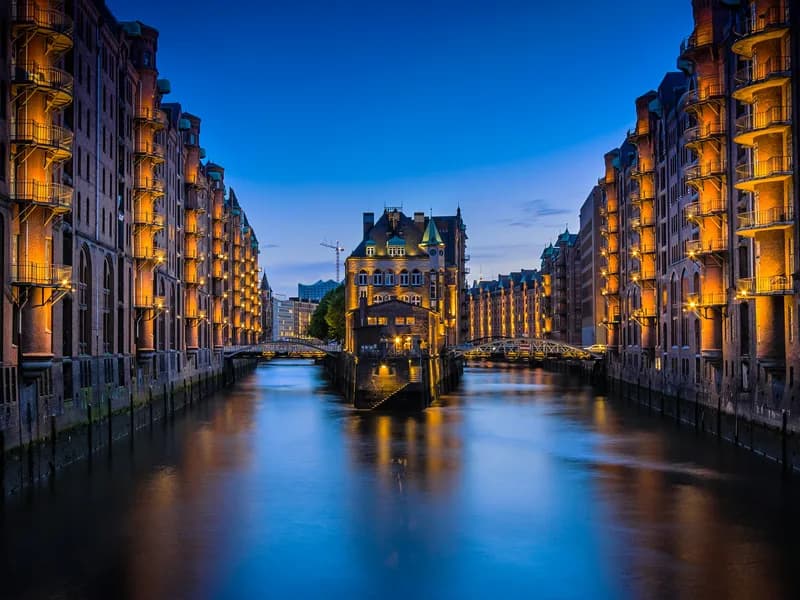
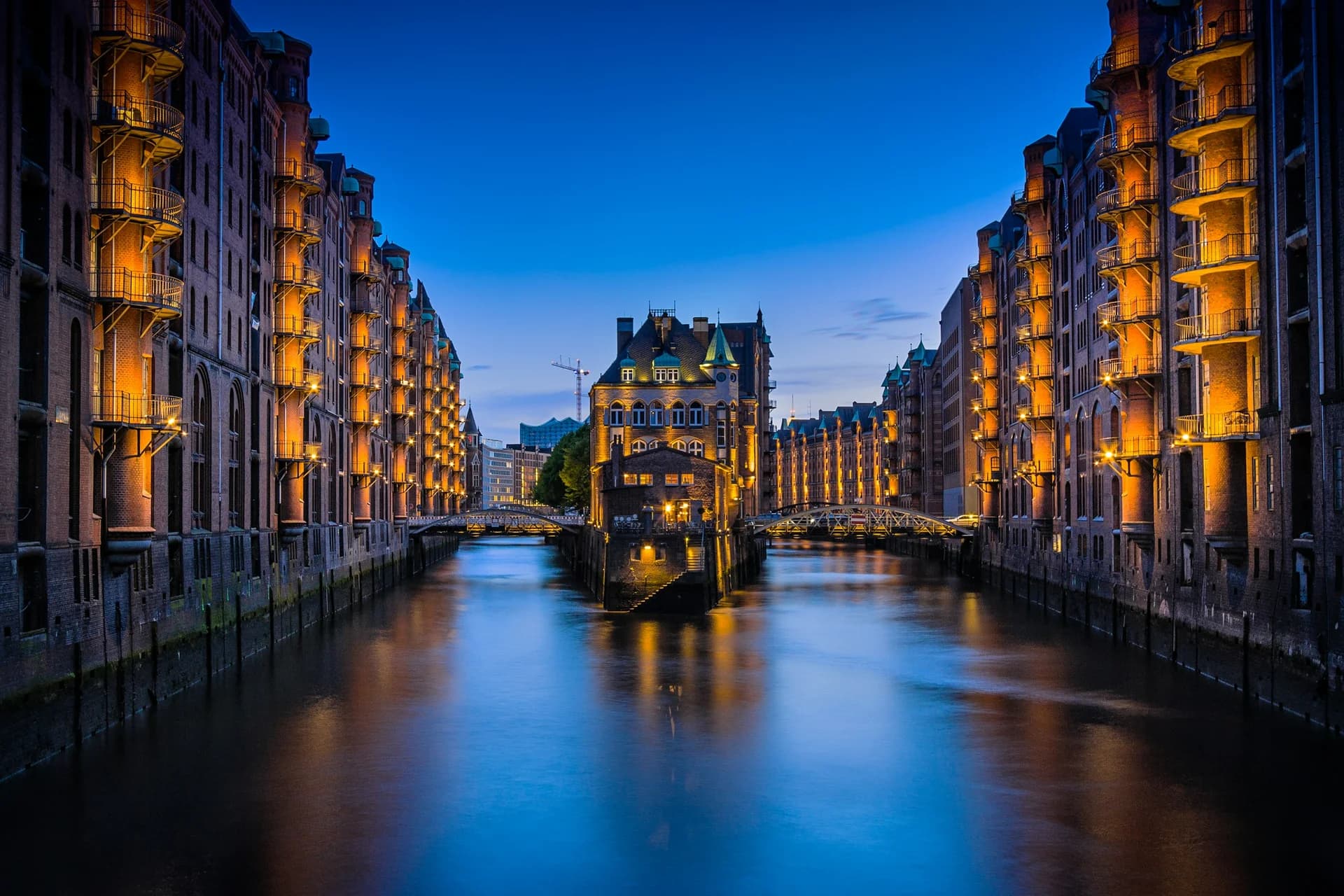
Time the walk back through Speicherstadt for blue hour. Head to Poggenmühlen-Brücke about 20 minutes before dusk — the little turreted Wasserschloss mid-canal, floodlights coming on, warehouses reflecting on both sides. That's the shot. For dinner, book Vlet in der Speicherstadt (Am Sandtorkai 23-24), up in a warehouse loft with the original beams; mains €28-38. Cheaper alternative two minutes away: the leaning brick hut of Oberhafen-Kantine.
Day 3: The Rathaus, the brick ships, and the Reeperbahn
Spend the morning in the Altstadt. Start with the Rathaus (Rathausmarkt 1, €5, roughly hourly English tours) — 647 rooms on some 4,000 oak piles, finished in 1897 to prove a point to Berlin. Walk the white Alsterarkaden along the Kleine Alster and out onto Jungfernstieg for the Binnenalster and its 60m fountain. Then find the Chilehaus (Fischertwiete 2), Fritz Höger's 1924 office block of 4.8 million bricks with a corner shaped like a ship's prow — stand at the Pumpen/Niedernstraße junction for the angle. It's UNESCO-listed and free.
Lunch at Cafe Paris (Rathausstraße 4), a Belle Époque brasserie under a tiled ceiling that survived the war — croque monsieur or steak frites, €14-24, no bookings, so go at 12:00 or 14:30. If you've got the afternoon, the Hamburger Kunsthalle (Glockengießerwall 5, €16, closed Mondays, open till 21:00 Thursdays) has Caspar David Friedrich's Wanderer above the Sea of Fog, smaller than you expect and hung where everyone whispers.
Evening's for St. Pauli. Start at Beatles-Platz, paved like a vinyl record, then walk up Große Freiheit — No. 64 is the Indra, where the Beatles played their first Hamburg night on 17 August 1960; No. 36 is the Kaiserkeller. Roughly 280 nights here turned five kids into a band. When you want a drink, skip the tout-lined main strip and turn into Hamburger Berg — Zum Silbersack (Silbersackstraße 9) for an Astra and a jukebox. One hard rule: no photography on Herbertstraße. It's enforced on the spot.
Day 4: Fischmarkt at 5 AM, then deliberately nothing
Alarm at 04:30, or simply don't go to bed. The Fischmarkt (Große Elbstraße) runs 5:00 to 9:30 AM sharp on Sundays and then stops dead. Be in position by 7:00 for the Marktschreier — auctioneers who'll leave you carrying a €10 crate of bananas you can't possibly eat. Then step inside the Fischauktionshalle for the live band that's been going since 5:00; that's the real point, and most visitors miss it. Walk ten minutes east for a Fischbrötchen at Brücke 10 (~€5.50), eaten at the rail.
Now do nothing on purpose. Every shop in Germany is shut on Sunday anyway, so go back and sleep for a few hours. This isn't a joke — you've been up since 04:30, and it's the single most useful thing you'll do today.
In the afternoon, head to Planten un Blomen (free, U1 Stephansplatz) for the Japanese garden, the free tropical greenhouses (till 16:45), and a beer in a deckchair at Café Schöne Aussichten. From May to September, stay for the Wasserlichtkonzerte at the Parksee — illuminated fountains choreographed live by an organist, 22:00 May to August, 21:00 in September, free. Sit on the far grass bank; the crowd packs the near one.
Day 5: Under the Elbe, Ferry 62, and beer on the sand
The whole day runs on the €8.90 ticket in your pocket — the full HVV ticket rundown explains why one fare also buys the ferries. Start at the Alter Elbtunnel (western end of Landungsbrücken, free, open 24 hours) — walk the 426.5m tiled tunnel 24m beneath the river, take the spiral stairs down, and look for the ceramic rat and lost boot set into the walls. Cross to the south bank, turn around, and collect the skyline shot almost no visitor bothers with.
Then the day's centrepiece: public ferry line 62 from Landungsbrücken Brücke 3 to Finkenwerder and back, every 15 minutes, covered by your ticket. Past the dry docks, the container terminals and the Elphi, 25 minutes each way. Sit outside at the stern, upper deck. Do not buy the harbour cruise — this is the same water for a fraction of the price. On the way back, hop off at Neumühlen/Övelgönne to walk among the free-to-board historic ships at the Museumshafen.
Finish in the sand at Strandperle (Övelgönne 60), a beach kiosk running since 1978 — beer about €4, container ships passing close enough to read. Nobody swims; everybody drinks. Stay for sunset, when the light comes straight back up the river. For a last proper dinner, walk 20 minutes east to Fischereihafen Restaurant (Große Elbstraße 143) for pan-fried Scholle done the way it should be, €26-40. Book ahead.
Why this plan works
Five days in Hamburg works because the city is built around water, and this plan follows it — up the Michel to read the harbour, out on Ferry 62 to feel it, and down to the Fischmarkt at the hour the whole place is most itself. You never fight the crowds, because the best things here (the Plaza, the canals, the beach, the fountains) are free and open when the tour groups aren't.
Got a sixth day? Take the 45-minute regional train north to Lübeck for Brick Gothic and marzipan — the medieval capital of the Hanseatic League, and the city Hamburg spent 400 years beating, whose trading network reached all the way to the wharves of Bergen. Otherwise, save your last Fischbrötchen at Brücke 10 for the walk to the S1. It's the correct way to say goodbye to this city.