
Hamburg
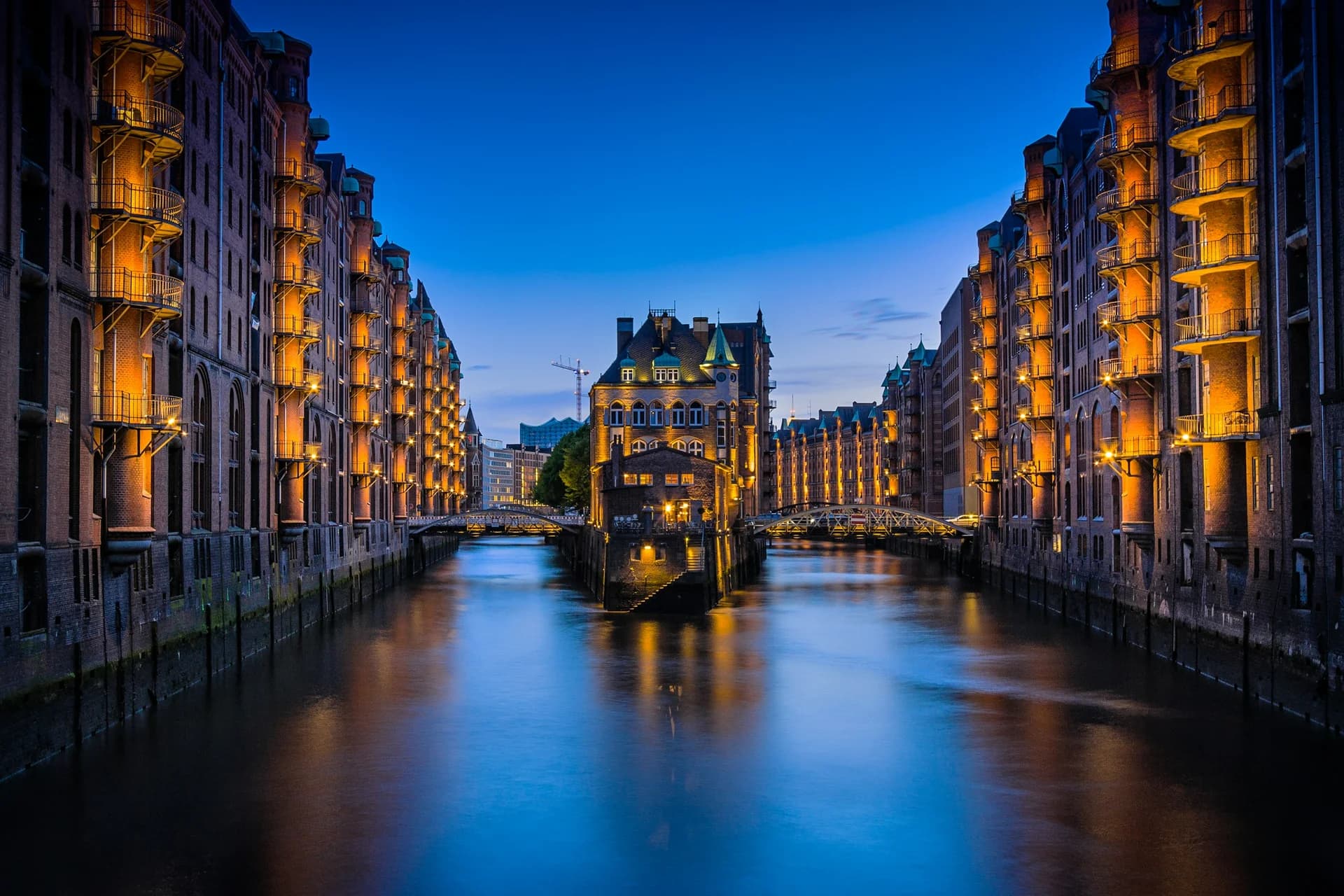
Photo: Claudio Testa / Unsplash
Key Facts
Best Time to Visit
May to September for harbour life and beer gardens; December for the Christmas markets
Language
German; English widely spoken
Currency
Euro (EUR)
Time Zone
CET (UTC+1), CEST (UTC+2) in summer
Airport
Hamburg Airport (HAM), 8.5 km north — S1 S-Bahn to Hauptbahnhof in 25 min (~€3.90)
Population
1.9 million (city proper), 5.4 million (metro region) — Germany's second-largest city
Climate
Oceanic — mild summers (17-23°C), cool wet winters (0-5°C), wind and rain year-round
Safety Rating
Generally Safe (Level 1)
UNESCO Status
Speicherstadt and the Kontorhaus district with Chilehaus inscribed since 2015
Top Highlights

Elbphilharmonie
Herzog & de Meuron's glass wave dropped onto a 1960s brick warehouse. The Plaza viewing level at 37m is FREE — collect a timed ticket at the box office or online, then ride the 82m curved escalator that cannot see its own end. Allow 1h for a full lap of the outdoor terrace. Concert tickets sell out months ahead.

Speicherstadt
The largest warehouse district in the world — 1.5 km of neo-Gothic red brick standing on oak piles driven into the marsh, threaded with canals. Free to walk, and best after dark when it is floodlit. Allow 1-2h. Poggenmühlen-Brücke is the photo everyone comes for; go at blue hour.

Miniatur Wunderland
The largest model railway on earth, 1,600 m² of it, inside a Speicherstadt warehouse — and far better than that sounds. Entry ~€20. Book online several days ahead; it regularly sells out entirely. Allow 2-3h. Open late on some nights, and early morning or late evening are markedly quieter.
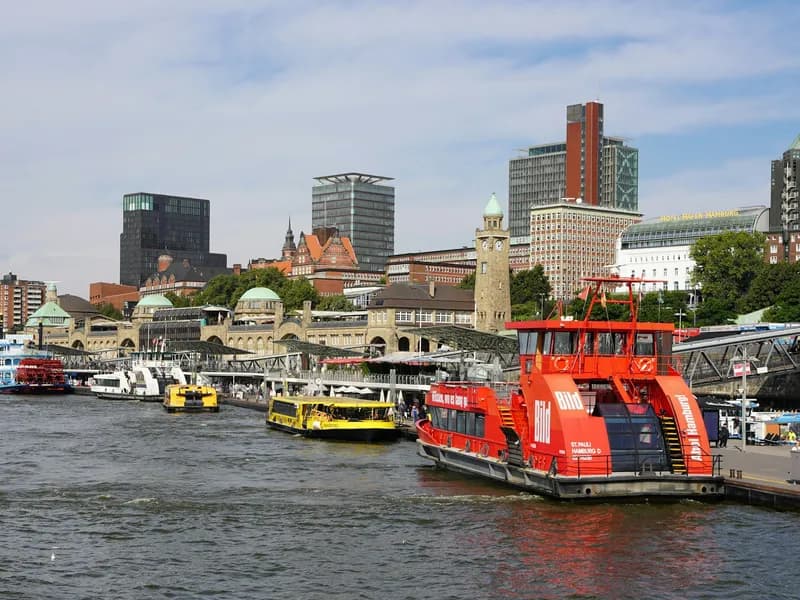
Harbour Ferry Line 62
The local hack: public ferry 62 from Landungsbrücken to Finkenwerder runs on a standard HVV ticket (~€3.90) past the container terminals, the dry docks and the Elbphilharmonie. It is the same water and much the same view as a €20+ harbour cruise. Allow 1h round trip. Sit outside at the back.
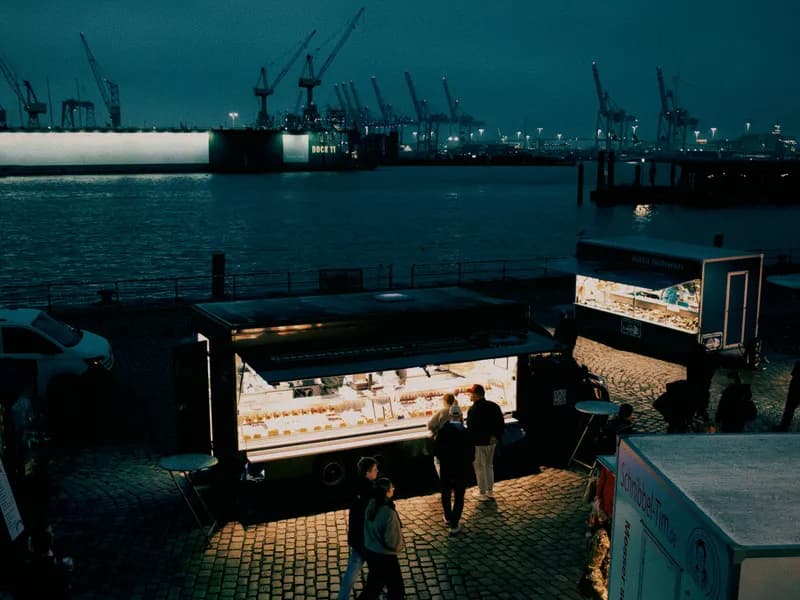
Fischmarkt
Trading since 1703. Sundays only, 5AM-9:30AM (from 7AM in winter), free. Auctioneers sell fish, fruit and entire crates of unidentifiable goods by patter, a live band plays in the Fischauktionshalle, and the crowd is half early risers and half people who have not yet been to bed. It stops dead at 9:30.

St. Michael's Church (Der Michel)
Hamburg's Baroque landmark and the sailors' church. The 132m tower has a platform at 82m, reached by lift or 452 steps. Entry ~€8. Allow 1h. The best orientation view in the city — harbour, Alster and Elbe all legible at once. Go here first and everything else makes sense.
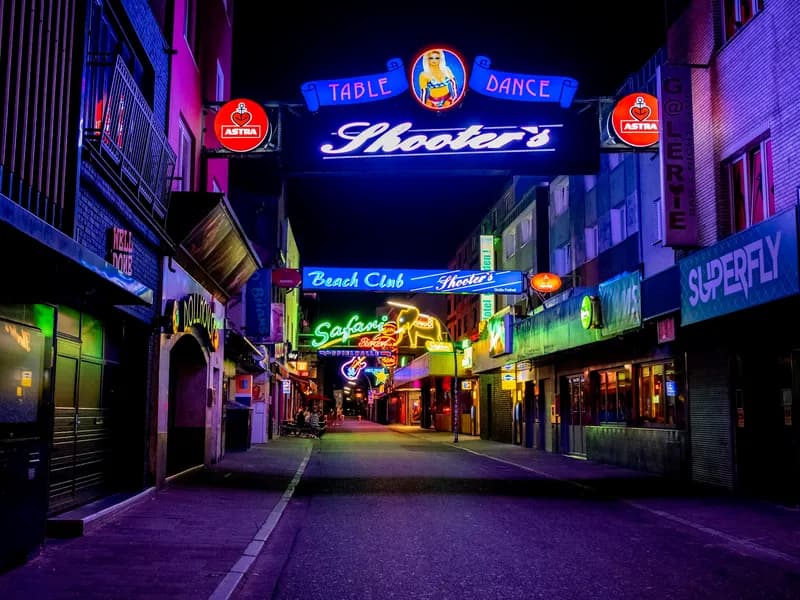
Reeperbahn & St. Pauli
Europe's most famous nightlife strip, where the Beatles played some 280 nights between 1960 and 1962 and turned into a band. Free to walk. Beatles-Platz marks the corner. Herbertstraße is screened off at both ends and, by long custom, closed to women and minors.

Alter Elbtunnel
The 1911 pedestrian tunnel running 24m beneath the Elbe, reached by the original car lifts that still lower vehicles by cable. Free for pedestrians. Allow 45 min. Walk to the south bank and turn around for the postcard view of the skyline that most visitors never bother to collect.
Planned Itinerary
7-Day Hamburg Itinerary
Arrival & Der Michel — Orientation from 82 Metres
Land at HAM and take the S1 straight into town — 25 minutes, €3.90, no taxi required. Check in around the Neustadt, then go directly up St. Michaelis. The sailors' church is the one sight that makes the rest of the city legible: do it first and every later day has a map behind it. Start the trip on a Thursday and the Sunday Fischmarkt lands on day 4, exactly where you want it.
S1 from Hamburg Airport to Hauptbahnhof(25 minutes)
€3.90 on the same HVV ticket that covers the harbour ferries. The station sits directly under Terminals 1 and 2 — follow the S-Bahn signs, four minutes' walk. Board the front three carriages: the train splits at Ohlsdorf and the rear half goes to Poppenbüttel.
Check in around the Neustadt(1 hour)
Base yourself between the Michel and Gänsemarkt — 15 minutes' walk to Speicherstadt, 20 to the Reeperbahn, and quiet at night. Vier Jahreszeiten on Neuer Jungfernstieg if you're splurging; the Henri Hotel in the Kontorhausviertel or Superbude St. Pauli if not. Avoid the blocks immediately behind Hauptbahnhof.
Climb the tower of St. Michaelis(1 hour)
Englische Planke 1. €8 for the lift, or take all 452 steps. The platform is at 82m of a 132m tower and lays the whole city out flat — container cranes and the Elbe to the south, the two Alster lakes to the north, Speicherstadt's brick in between. A trumpeter plays a chorale from the balcony at 10:00 and 21:00 daily, in all four compass directions.
Krameramtsstuben lane(20 minutes)
Krayenkamp 10, thirty seconds from the Michel and easy to walk straight past — a 2m-wide lane of 1670s almshouses built for the widows of shopkeepers. One house is kept as a furnished museum room, free to look in.
Dinner at Old Commercial Room(1.5 hours)
Englische Planke 10, directly opposite the Michel, serving since 1795. Order the Labskaus (~€21): corned beef, potato and beetroot mashed to an alarming pink, topped with a fried egg, rollmops and a gherkin. It tastes far better than it looks and they hand you a certificate. Drink an Astra with it.
Speicherstadt, Miniatur Wunderland & the Elbphilharmonie
The UNESCO day, and the one that needs booking in advance. Take the first Miniatur Wunderland slot before the school groups arrive, then work slowly west on foot through the warehouse district, up onto the Elbphilharmonie Plaza at 37m, and time the walk back through Speicherstadt for blue hour when the floodlights come on. Everything today is within 1.5 km — no transport needed.
Miniatur Wunderland, first slot of the day(3 hours)
Kehrwieder 2-4, ~€20, and book online several days ahead — it sells out completely, and no, it is not the naff model railway you're bracing for. 1,600 m² covering Scandinavia (with real water), Switzerland, Rio, Provence and Knuffingen Airport, where the aircraft genuinely take off. Stand at the airport for one full day/night cycle: 15 minutes, and worth every second.
Coffee at Speicherstadt Kaffeerösterei(45 minutes)
Kehrwieder 5, two doors along — a working roastery inside a warehouse arch. Green beans still come in through the loading hatch. Ask what came off the drum this morning.
Walk the Speicherstadt canals(1.5 hours)
1.5 km of neo-Gothic red brick standing on oak piles driven into the marsh, free and permanently open. Start at St. Annenufer, cross to Kannengießerort, follow the Wandrahmsfleet. Look up: every floor has a hoist beam and hatch and no lift — for a century everything went up on ropes, hauled by hand.
Elbphilharmonie Plaza(1 hour)
Free timed ticket from the ground-floor box office, or €2 to reserve a slot online if you want certainty. The Tube escalator is 82m and curves so you never see the far end — 2.5 minutes of gentle disorientation. The Plaza is the open-air terrace at 37m where Kallmorgen's 1963 brick warehouse stops and Herzog & de Meuron's glass wave starts. Walk the full 360° lap. Open till midnight.
Blue hour at Poggenmühlen-Brücke(45 minutes)
The photo everyone comes for: the little turreted Wasserschloss sitting mid-canal with warehouses reflecting on both sides. The floodlights come on around dusk. Arrive 20 minutes early — it's a narrow bridge and there will already be tripods.
Dinner at Vlet in der Speicherstadt(2 hours)
Am Sandtorkai 23-24, up in a warehouse loft with the original beams overhead, doing northern German cooking without irony. Book ahead. Mains €28-38. Cheaper alternative two minutes away: Oberhafen-Kantine, a tiny tilted brick hut from 1925 that leans because the ground does.
Rathaus, the Brick Ships of the Kontorhausviertel & the Reeperbahn
Altstadt in the morning — the Rathaus, the brick-expressionist office district and Caspar David Friedrich at the Kunsthalle — then a deliberately long dinner before St. Pauli. Saturday night on the Kiez sets up tomorrow's 5AM alarm perfectly: a good half of the Fischmarkt crowd simply never goes to bed.
Rathaus guided tour(45 minutes)
Rathausmarkt 1, €5, tours roughly hourly in English. 647 rooms, standing on around 4,000 oak piles, finished in 1897 in a hurry to prove a point. Look for the Phoenix carved above the entrance — the city announcing it had rebuilt itself after the Great Fire of 1842.
Alsterarkaden and the Binnenalster(30 minutes)
The white Venetian arcade along the Kleine Alster, then out onto Jungfernstieg for the inner lake and its 60m fountain, which runs March to October. This is also where you appreciate the bridge count: Hamburg has around 2,500, more than Venice, Amsterdam and London combined.
Chilehaus and the Sprinkenhof courtyards(1 hour)
Fischertwiete 2. Fritz Höger's 1924 office block, 4.8 million bricks, with an eastern corner deliberately shaped like a ship's prow — stand at the Pumpen/Niedernstraße junction, that's the angle. Then walk through the Sprinkenhof's linked courtyards next door. UNESCO-listed alongside Speicherstadt since 2015, and entirely free.
Lunch at Cafe Paris(1 hour)
Rathausstraße 4 — a Belle Époque tiled ceiling that somehow survived the war, over a proper brasserie. Croque monsieur or steak frites, €14-24. Loud, brisk, worth it. No bookings at lunch; go at 12:00 or 14:30.
Hamburger Kunsthalle(2 hours)
Glockengießerwall 5, €16, closed Mondays, open till 21:00 on Thursdays. Go for Caspar David Friedrich's Wanderer above the Sea of Fog — smaller than you expect, hung in a room where everyone instinctively whispers. Also Runge and Menzel. Skip the Galerie der Gegenwart wing if you're flagging; you'll get more from the Deichtorhallen another time.
Beatles-Platz and Große Freiheit(1 hour)
The roundabout at Reeperbahn/Große Freiheit, paved black and laid out like a vinyl record, with steel silhouettes standing in it. Then walk up Große Freiheit: No. 64 is the Indra, where they played their first Hamburg night on 17 August 1960; No. 36 is the Kaiserkeller; the Star-Club at No. 39 is now a plaque beside a car park. They slept behind the screen at the Bambi Kino on Paul-Roosen-Straße. Roughly 280 nights here turned five kids into a band.
Kiez night on Hamburger Berg, not Große Freiheit(3 hours)
Turn off the tout-heavy strip into Hamburger Berg — one short street of honest dives where locals actually drink. Zum Silbersack (Silbersackstraße 9) for Astra and a jukebox; Zur Ritze (Reeperbahn 140) still has a boxing gym in the basement. One hard rule anywhere near here: no photography on Herbertstraße. It is not a quaint custom — it's enforced on the spot, and people have had drinks thrown over their cameras.
Fischmarkt at 5AM, Then Deliberately Nothing
Alarm at 04:30, or simply don't go to bed. The Fischmarkt runs 05:00-09:30 sharp (from 07:00 November to March) and then stops dead — the cleaning trucks are immediate. After that, German law shuts the entire country: shops, supermarkets, everything. So the rest of today is engineered to be empty. A nap, then a park. This is your rest day and you will need it.
Fischmarkt, Große Elbstraße(2.5 hours)
Free, Sundays only, trading here since 1703. Be in position by 07:00 for the Marktschreier — auctioneers who sell eels, fruit and entire crates of unidentifiable goods by pure patter, and you will end up carrying a €10 box of bananas you cannot possibly eat. Bring cash and a hooded jacket; the wind comes straight off the Elbe.
The live band in the Fischauktionshalle(1 hour)
This is the actual point, and most visitors miss it standing outside among the stalls. A band has been going inside the old auction hall since 05:00 — free to walk in, and the crowd is half early risers cradling coffee and half people still running on Saturday night. Breakfast buffet around €20 if you want a table rather than a wall to lean on.
Fischbrötchen at Brücke 10(20 minutes)
Landungsbrücken, Brücke 10, a ten-minute walk east. A Bismarckbrötchen or Matjes for about €5.50, eaten standing at the rail. The Krabbenbrötchen is nearer €8 and worth the jump: North Sea shrimp, hand-peeled, and you can taste the difference.
Sleep(3 hours)
Not optional and not a joke. You have been awake since 04:30 and every shop in Germany is shut anyway. This is the single most useful thing you will do today.
Planten un Blomen(2 hours)
Free, always open, U1 Stephansplatz. The Japanese garden and teahouse, the tropical greenhouses (free, till 16:45), and paths landscaped so cleverly you cannot hear Dammtor station 200m away. Beer and a deckchair at Café Schöne Aussichten.
Wasserlichtkonzerte(45 minutes)
Free, at the Parksee — 22:00 May to August, 21:00 in September. Illuminated fountains choreographed live by an organist sitting in a booth by the water. It is unashamedly 1953 and completely wonderful. Sit on the grass bank on the far side; the crowd all packs the near one.
Under the Elbe, Ferry 62 and Beer on the Sand
An entire day on the water for the price of a €8.90 day ticket. Walk under the river through the 1911 tunnel and collect the skyline shot almost no visitor bothers with, then ride public ferry 62 to Finkenwerder and back — the same water, the same view, as a €25 harbour cruise — and finish with a beer in the sand at Övelgönne while container ships pass close enough to read.
Alter Elbtunnel(45 minutes)
Free for pedestrians, open around the clock, at the western end of Landungsbrücken. 426.5m long, 24m under the Elbe, opened 1911, and the original cable-driven lifts still lower cars by the ton. Take the spiral stairs down instead. Look for the ceramic reliefs set into the tiled walls — fish and crabs, yes, but also a rat and a lost boot, which is a fair inventory of what the river actually gives back. Walk to the south bank, turn around: that's the postcard.
U3 from Baumwall to Landungsbrücken(5 minutes)
One stop, and the best two minutes on any U-Bahn in Germany. The line runs elevated along the harbour edge — sit on the left. Costs nothing extra on the day pass.
Ferry 62 to Finkenwerder and back(1 hour)
The local hack and the thing everyone regrets skipping. Leaves Landungsbrücken Brücke 3 every 15 minutes; it is public transport, so a normal HVV ticket (~€3.90) or your day pass covers it. Past the dry docks, the container terminals and the Elbphilharmonie, 25 minutes each way. Sit outside at the stern, upper deck. Do not buy the harbour cruise.
Hop off at Neumühlen/Övelgönne(20 minutes)
Get off the 62 on the way back. The Museumshafen here keeps a dozen working historic ships afloat — steam tugs, a lightship, wooden ketches — free to walk among, no ticket, no fence.
Beer on the sand at Strandperle(2.5 hours)
Övelgönne 60, a kiosk on a genuine Elbe beach, running since 1978. Order at the hatch (beer ~€4), sit in the sand. Container ships pass close enough to read the hull lettering. Nobody swims — the currents and the suction off the ships are genuinely lethal, and locals know it — everybody drinks. Stay for sunset; the light comes back up the river straight at you.
Dinner at Fischereihafen Restaurant(2 hours)
Große Elbstraße 143, a 20-minute walk east along the water. White tablecloths, big Elbe windows, and pan-fried Scholle or Pannfisch done the way it should be, €26-40. Helmut Schmidt ate here for decades and there is a chair to prove it. Book.
Day Trip: Lübeck, Brick Gothic and Marzipan
45 minutes north by regional train puts you in the medieval capital of the Hanseatic League — the city Hamburg spent 400 years competing with. Do the Holstentor and the Marienkirche in the morning, eat marzipan you will grudgingly admit is better than expected, and be back on the Elbe for a last proper dinner in Ottensen.
RE train, Hamburg Hbf to Lübeck Hbf(45 minutes)
~€15.60 single, twice an hour, no reservation needed. If you're taking three or more regional day trips, buy the Deutschland-Ticket instead (~€63/month, cancellable monthly): it covers this train plus Lüneburg, Stade, Bremen and every HVV ferry and U-Bahn, and you stop counting.
Holstentor(30 minutes)
The fat twin-towered gate of 1478 that used to be on the back of the 50-Mark note. It leans visibly — they built it on peat and it has been sinking ever since. €8 gets you inside to a model of the medieval town; honestly the outside is the whole point, and it's five minutes from the station.
Marienkirche(45 minutes)
Brick Gothic at its most vertical — the tallest brick vault in the world at 38.5m, and the template half of northern Europe copied. In the south tower chapel the bells lie smashed into the floor exactly where they fell during the Palm Sunday raid of 1942; they were deliberately left there. Outside on the corner sits a small bronze devil with a very good story attached.
Niederegger Marzipan-Salon and café(1 hour)
Breite Straße 89. The museum on the second floor is free and takes fifteen minutes; the café downstairs is the real business. Nusstorte with the marzipan layer, ~€5.50, plus a coffee. Buy a Marzipanbrot to take home — it keeps for months and beats every fridge magnet in the city.
Petrikirche tower(30 minutes)
€5 for the lift to 50m. The only place you see all seven Lübeck spires and the whole island town at once, and it takes ten minutes. Everyone else is queuing at the Holstentor.
Late lunch at Schiffergesellschaft(1.5 hours)
Breite Straße 2 — the 1535 seafarers' guild house, long oak benches, ship models hanging from the ceiling, and lighting levels that also date from 1535. It's touristy and it does not matter one bit. Labskaus or the Trave fish, €18-28.
Dinner in Ottensen(2 hours)
Back in Hamburg by early evening — S1/S3 to Altona, then walk. Ottensen is where locals actually eat: Otto's Burger on Bahrenfelder Straße, or Bok at Spritzenplatz for Asian. Finish at Fabrik (Barnerstraße 36) if there's a gig on — live music in a converted propeller factory since 1971.
Schanze Morning, Bunker Rooftop & Home
A slow last morning in the Schanzenviertel — a Franzbrötchen, one final coffee, the small shops on Marktstraße — then a last panorama from the flak-tower rooftop before the S1 back to HAM. Allow 25 minutes on the train plus check-in; the airport station sits under the terminals, so it's a four-minute walk to the desk.
Franzbrötchen in the Schanze(45 minutes)
Hamburg's own pastry: flattened, caramelised, cinnamon-buttered, like a croissant that lost a fight and improved. Herr Max (Schulterblatt 12) does a theatrical version; any Nur Hier bakery does the honest one for about €1.60. Eat it walking down Schulterblatt past the Rote Flora, the squatted theatre that has been an argument since 1989.
Marktstraße, Karolinenviertel(1 hour)
Two minutes from the Schanze and a different city — a single street of small independent shops selling things actually made here. Better souvenirs in 200m than the whole of Mönckebergstraße. Most open at 11:00, not before.
Rooftop of the St. Pauli Bunker(45 minutes)
Feldstraße, U3. The 1942 flak tower, now wearing five storeys of planted terraces with a free public path spiralling up the outside to 58m. Opened 2024 and still mostly locals. Last look at the harbour, the Michel, and the Heiligengeistfeld where the DOM funfair sets up three times a year.
Last Fischbrötchen at Landungsbrücken(20 minutes)
If the timing works. Brücke 10, ~€5.50, standing at the rail with the ferries coming and going. Better than anything you'll eat airside.
S1 to Hamburg Airport(25 minutes)
€3.90 from Hauptbahnhof, trains every 10 minutes; from Landungsbrücken change at Hbf. The airport station is directly under Terminals 1 and 2. Leave 2 hours before a Schengen flight, 2.5 otherwise — HAM's security queues are unpredictable in summer.
14-Day Hamburg Itinerary
Arrival & Der Michel — Orientation from 82 Metres
Land at HAM and take the S1 straight into town — 25 minutes, €3.90, no taxi required. Check in around the Neustadt, then go directly up St. Michaelis. The sailors' church is the one sight that makes the rest of the city legible: do it first and every later day has a map behind it. Start on a Thursday and the Sunday Fischmarkt lands on day 4, exactly where you want it.
S1 from Hamburg Airport to Hauptbahnhof(25 minutes)
€3.90 on the same HVV ticket that covers the harbour ferries. The station sits directly under Terminals 1 and 2. Board the front three carriages: the train splits at Ohlsdorf and the rear half goes to Poppenbüttel.
Buy the Deutschland-Ticket on arrival(10 minutes)
~€63 a month, cancellable monthly, bought in the DB app in three minutes. On a fortnight here it is the single best financial decision of the trip: it covers every U-Bahn, S-Bahn, bus and harbour ferry in Hamburg plus every regional train to Lübeck, Lüneburg, Stade, Bremen — and, remarkably, the whole three-hour Marschbahn ride to Sylt. Stop buying day passes.
Check in around the Neustadt(1 hour)
Base yourself between the Michel and Gänsemarkt — 15 minutes' walk to Speicherstadt, 20 to the Reeperbahn, quiet at night. Vier Jahreszeiten on Neuer Jungfernstieg if you're splurging; the Henri Hotel in the Kontorhausviertel or Hotel Wedina in St. Georg if not. Avoid the blocks immediately behind Hauptbahnhof.
Climb the tower of St. Michaelis(1 hour)
Englische Planke 1. €8 for the lift, or take all 452 steps. The platform at 82m of a 132m tower lays the city out flat — container cranes and the Elbe south, the two Alster lakes north, Speicherstadt's brick between. A trumpeter plays a chorale from the balcony at 10:00 and 21:00 daily, in all four compass directions.
Krameramtsstuben lane(20 minutes)
Krayenkamp 10, thirty seconds from the Michel and easy to miss — a 2m-wide lane of 1670s almshouses built for the widows of shopkeepers. One house is kept as a furnished museum room.
Dinner at Old Commercial Room(1.5 hours)
Englische Planke 10, opposite the Michel, serving since 1795. Order the Labskaus (~€21): corned beef, potato and beetroot mashed to an alarming pink under a fried egg, rollmops and a gherkin. Better than it looks, and they hand you a certificate. Astra to drink.
Speicherstadt, Miniatur Wunderland & the Elbphilharmonie
The UNESCO day, and the one that needs booking ahead. Take an early Miniatur Wunderland slot before the school groups, then work slowly west on foot through the warehouse district, up onto the Elbphilharmonie Plaza at 37m, and time the walk back through Speicherstadt for blue hour when the floodlights come on. Everything today sits inside 1.5 km — no transport needed.
Miniatur Wunderland, first slot of the day(3 hours)
Kehrwieder 2-4, ~€20, book online several days ahead — it sells out completely, and no, it is not the naff model railway you're bracing for. 1,600 m² covering Scandinavia (with real water), Switzerland, Rio, Provence and Knuffingen Airport, where the aircraft genuinely take off. Stand at the airport for one full day/night cycle: 15 minutes, and worth all of them.
Coffee at Speicherstadt Kaffeerösterei(45 minutes)
Kehrwieder 5, two doors along — a working roastery inside a warehouse arch, green beans still coming in through the loading hatch. Ask what came off the drum this morning.
Speicherstadtmuseum(45 minutes)
St. Annenufer 2, ~€5, and the sleeper of the district. One preserved warehouse floor showing how the thing actually worked: coffee sacks, tea chests, the sampling knives, and the Quartiersmann whose entire job was knowing which sack was where. Ten minutes here rewrites the walk you're about to take.
Walk the Speicherstadt canals(1.5 hours)
1.5 km of neo-Gothic red brick standing on oak piles driven into the marsh, free and permanently open. St. Annenufer, across to Kannengießerort, then the Wandrahmsfleet. Look up: every floor has a hoist beam and a hatch and no lift — for a century everything went up on ropes, hauled by hand.
Elbphilharmonie Plaza(1 hour)
Free timed ticket from the ground-floor box office, or €2 to reserve a slot online if you want certainty. The Tube escalator is 82m and curves so you never see the end — 2.5 minutes of gentle disorientation. The Plaza is the open-air terrace at 37m where Kallmorgen's 1963 brick warehouse stops and the glass wave starts. Full 360° lap. Open till midnight.
Blue hour at Poggenmühlen-Brücke(45 minutes)
The photo everyone comes for: the little turreted Wasserschloss mid-canal, warehouses reflecting on both sides. Floodlights come on around dusk. Arrive 20 minutes early — narrow bridge, existing tripods.
Dinner at Vlet in der Speicherstadt(2 hours)
Am Sandtorkai 23-24, a warehouse loft with the original beams, doing northern German cooking without irony. Book. Mains €28-38. Cheaper alternative two minutes away: Oberhafen-Kantine, a tiny brick hut from 1925 that leans because the ground does.
Rathaus, the Brick Ships of the Kontorhausviertel & the Reeperbahn
Altstadt in the morning — the Rathaus, the brick-expressionist office district and Caspar David Friedrich at the Kunsthalle — then a long dinner before St. Pauli. Saturday night on the Kiez sets up tomorrow's 5AM alarm perfectly: a good half of the Fischmarkt crowd simply never goes to bed.
Rathaus guided tour(45 minutes)
Rathausmarkt 1, €5, roughly hourly in English. 647 rooms on about 4,000 oak piles, finished 1897 in a hurry to prove a point to Berlin. Look for the Phoenix above the entrance — the city announcing it had rebuilt itself after the Great Fire of 1842.
Alsterarkaden and the Binnenalster(30 minutes)
The white Venetian arcade along the Kleine Alster, out onto Jungfernstieg for the inner lake and its 60m fountain (running March to October). This is where the bridge statistic lands: around 2,500 of them here, more than Venice, Amsterdam and London combined.
Chilehaus and the Sprinkenhof courtyards(1 hour)
Fischertwiete 2. Fritz Höger's 1924 office block, 4.8 million bricks, eastern corner deliberately shaped like a ship's prow — stand at the Pumpen/Niedernstraße junction for the angle. Then through the Sprinkenhof's linked courtyards next door. UNESCO-listed with Speicherstadt since 2015, and entirely free.
Lunch at Cafe Paris(1 hour)
Rathausstraße 4 — a Belle Époque tiled ceiling that somehow survived the war, over a proper brasserie. Croque monsieur or steak frites, €14-24. Loud and brisk. No lunch bookings; go at 12:00 or 14:30.
Hamburger Kunsthalle(2 hours)
Glockengießerwall 5, €16, closed Mondays, open till 21:00 Thursdays. Go for Caspar David Friedrich's Wanderer above the Sea of Fog — smaller than you expect, in a room where everyone instinctively whispers. Runge and Menzel too. Leave the contemporary wing; you'll get more from the Deichtorhallen later in the trip.
Beatles-Platz and Große Freiheit(1 hour)
The roundabout at Reeperbahn/Große Freiheit, paved black and shaped like a vinyl record, steel silhouettes standing in it. Then up Große Freiheit: No. 64 is the Indra, first Hamburg night on 17 August 1960; No. 36 the Kaiserkeller; the Star-Club at No. 39 is a plaque beside a car park. They slept behind the screen at the Bambi Kino on Paul-Roosen-Straße. Roughly 280 nights here turned five kids into a band.
Kiez night on Hamburger Berg, not Große Freiheit(3 hours)
Turn off the tout-heavy strip into Hamburger Berg — one short street of honest dives where locals actually drink. Zum Silbersack (Silbersackstraße 9) for Astra and a jukebox; Zur Ritze (Reeperbahn 140) still has a boxing gym in the basement. One hard rule: no photography on Herbertstraße. Not a quaint custom — it's enforced on the spot, and people have had drinks thrown over their cameras.
Fischmarkt at 5AM, Then Deliberately Nothing
Alarm at 04:30, or simply don't go to bed. The Fischmarkt runs 05:00-09:30 sharp (from 07:00 November to March) and then stops dead — the cleaning trucks are immediate. After that German law shuts the entire country: shops, supermarkets, everything. So the rest of today is engineered to be empty. A nap, then a park. Your first proper rest day, and you'll need it.
Fischmarkt, Große Elbstraße(2.5 hours)
Free, Sundays only, trading here since 1703. In position by 07:00 for the Marktschreier — auctioneers who sell eels, fruit and entire crates of unidentifiable goods by pure patter, until you're carrying a €10 box of bananas you cannot possibly eat. Cash, and a hooded jacket: the wind comes straight off the Elbe.
The live band in the Fischauktionshalle(1 hour)
The actual point, and most visitors miss it standing outside among the stalls. A band has been going inside the old auction hall since 05:00 — free to walk in, and the crowd is half early risers cradling coffee and half people still running on Saturday night. Breakfast buffet around €20 if you want a table rather than a wall.
Fischbrötchen at Brücke 10(20 minutes)
Landungsbrücken, Brücke 10, ten minutes' walk east. Bismarckbrötchen or Matjes for about €5.50, eaten standing at the rail. The Krabbenbrötchen is nearer €8 and worth the jump: North Sea shrimp, hand-peeled.
Sleep(3 hours)
Not optional and not a joke. You've been up since 04:30 and every shop in Germany is shut. The single most useful thing you'll do today.
Planten un Blomen(2 hours)
Free, always open, U1 Stephansplatz. Japanese garden and teahouse, the tropical greenhouses (free, till 16:45), and paths landscaped so well you cannot hear Dammtor station 200m away. Beer and a deckchair at Café Schöne Aussichten.
Wasserlichtkonzerte(45 minutes)
Free, at the Parksee — 22:00 May to August, 21:00 in September. Illuminated fountains choreographed live by an organist in a booth by the water. Unashamedly 1953 and completely wonderful. Sit on the far grass bank; the crowd packs the near one.
Under the Elbe, Ferry 62 and Beer on the Sand
An entire day on the water for the price of the ticket you already own. Walk under the river through the 1911 tunnel and collect the skyline shot almost no visitor bothers with, then ride public ferry 62 to Finkenwerder and back — the same water, the same view, as a €25 harbour cruise — and finish with a beer in the sand at Övelgönne while container ships pass close enough to read.
Alter Elbtunnel(45 minutes)
Free for pedestrians, open around the clock, at the western end of Landungsbrücken. 426.5m long, 24m under the Elbe, opened 1911, and the original cable-driven lifts still lower cars by the ton. Take the spiral stairs down. Look for the ceramic reliefs in the tiled walls — fish and crabs, but also a rat and a lost boot, a fair inventory of what the river gives back. Walk to the south bank and turn round: that's the postcard.
U3 from Baumwall to Landungsbrücken(5 minutes)
One stop, and the best two minutes on any U-Bahn in Germany — the line runs elevated along the harbour edge. Sit on the left. Costs nothing extra.
Ferry 62 to Finkenwerder and back(1 hour)
The local hack and the thing everyone regrets skipping. Landungsbrücken Brücke 3, every 15 minutes; it is public transport, so your normal ticket covers it. Past the dry docks, the container terminals and the Elbphilharmonie, 25 minutes each way. Outside, at the stern, upper deck. Do not buy the harbour cruise.
Hop off at Neumühlen/Övelgönne(20 minutes)
Get off the 62 on the way back. The Museumshafen keeps a dozen working historic ships afloat — steam tugs, a lightship, wooden ketches — free to walk among, no ticket, no fence.
Beer on the sand at Strandperle(2.5 hours)
Övelgönne 60, a kiosk on a genuine Elbe beach, running since 1978. Order at the hatch (beer ~€4), sit in the sand. Container ships pass close enough to read the hull lettering. Nobody swims — the currents and the suction off the ships are lethal and locals know it — everybody drinks. Stay for sunset: the light comes back up the river straight at you.
Dinner at Fischereihafen Restaurant(2 hours)
Große Elbstraße 143, 20 minutes' walk east along the water. White tablecloths, big Elbe windows, pan-fried Scholle or Pannfisch done properly, €26-40. Helmut Schmidt ate here for decades and there's a chair to prove it. Book.
The Alster, Isemarkt and the Green North
Hamburg's other half, and the one visitors skip: two lakes in the middle of the city with an entire leisure culture built round them. Tuesday is deliberate — the Isemarkt only runs Tuesdays and Fridays. Row a boat, walk the shore, eat in Eppendorf, and finish with a beer on the grass at a kiosk locals have been using for decades.
Isemarkt(1.5 hours)
U3 Hoheluftbrücke or Eppendorfer Baum. Tuesdays and Fridays only, 08:30-14:00. Roughly a kilometre of stalls strung out beneath the elevated U-Bahn viaduct — reputedly Europe's longest open-air market, and unmistakably a place where people do their actual shopping. Trains rumble overhead every four minutes. Fish, cheese, flowers, and a Fischbrötchen stall two-thirds of the way along.
Row a boat on the Außenalster(1.5 hours)
Segelschule Pieper, An der Alster 47a, on the Atlantic Steg in front of the Hotel Atlantic. Family-run since 1880. Rowing boat about €20/hour, sailing dinghy nearer €28 if you can prove you can sail. The lake is entirely artificial — a 1235 mill dam on the Alster river that the city never took down.
Walk the Krugkoppelbrücke stretch(1 hour)
The full Alster circuit is 7.4 km and about 1h45; if you only do one section, do the north end. Stand on Krugkoppelbrücke looking south: the lake, then the whole spire line of the city behind it. The swans on the water belong to the city and have since 1664 — they get rounded up every November and wintered on the Eppendorfer Mühlenteich, and Schwanenvater is a real municipal job title.
Lunch and shops in Eppendorf(2 hours)
Eppendorfer Landstraße — moneyed, low-rise, entirely un-touristed. Cornelia Poletto at No. 80 for a serious Italian lunch (€30-45), or coffee and cake in any of a dozen places on Mühlenkamp in Winterhude next door. Elbgold on Mühlenkamp roasts its own.
Sunset beer at Alsterperle(1.5 hours)
Fährdamm, on the eastern shore — a kiosk, a Bratwurst, a beer and a patch of grass, cash only. Everyone from students to bankers sits on the bank here at sunset with the whole lake in front of them, and there is nothing else to it. That's the point.
Altona, Ottensen & the Blankenese Stairs
West along the river, through the district that was Danish until 1864 and still doesn't quite consider itself Hamburg. Morning in Altona and Ottensen, then the S1 out to Blankenese, where a former fishing village clings to a sand cliff via 4,864 steps and one very small bus. Finish with dinner looking down the Elbe.
Altonaer Balkon and the Dockland roof(1 hour)
S1/S3 to Altona. The Balkon is a terrace park on the bluff above the river with the container terminal laid out opposite. Then walk down to Dockland (Van-der-Smissen-Straße 9) — the wedge-shaped office block that looks like a ship's bow. There's a public external staircase to the roof, free, open 24 hours, and almost nobody uses it.
Altonaer Museum(1.5 hours)
Museumstraße 23, ~€8.50, closed Tuesdays. Northern German folk culture, which sounds like a threat and isn't: the room of ship figureheads — dozens of them, staring — is genuinely arresting, and the reconstructed farmhouse rooms explain what the coast was before the port.
Lunch in Ottensen(1.5 hours)
Ottenser Hauptstraße and Spritzenplatz. Otto's Burger on Bahrenfelder Straße, or Bok for Asian. The Zeisehallen a block away is a 19th-century ship's-propeller factory now containing an arthouse cinema, with the original machinery still bolted in place around the foyer.
S1 to Blankenese, then the Bergziege(45 minutes)
12 minutes on the S1 from Altona. From the station take bus 48 — the 'Bergziege', mountain goat — a deliberately tiny bus that grinds up lanes no normal vehicle fits. Ride it to the top and walk down; the alternative is climbing.
Walk down the Treppenviertel(2 hours)
4,864 steps threading between the white captains' houses on the cliff, and no through roads at all — the postman does this on foot. There is no correct route. Head generally downhill and westward toward Strandweg and you'll come out on the beach; take a wrong turn and you'll find a better view. Süllberg at the top has the terrace everyone photographs.
Dinner at Sagebiels Fährhaus(2 hours)
Blankeneser Hauptstraße 107, an inn since 1868, with a terrace looking straight down the widening Elbe toward the North Sea. Fish, €22-34. Then S1 back into town, 20 minutes.
Day Trip: Lübeck, Brick Gothic and Marzipan
45 minutes north by regional train (free on your Deutschland-Ticket) puts you in the medieval capital of the Hanseatic League — the city Hamburg spent 400 years competing with, and mostly beat. Holstentor and Marienkirche in the morning, the merchants' courtyards in the afternoon, marzipan in between.
RE train, Hamburg Hbf to Lübeck Hbf(45 minutes)
Twice an hour, no reservation, covered by the Deutschland-Ticket. Otherwise ~€15.60 single, or the Schleswig-Holstein-Ticket at €29 for one person plus €4 per extra head, up to five.
Holstentor(30 minutes)
The fat twin-towered gate of 1478 that used to be on the back of the 50-Mark note. It leans, visibly — built on peat and sinking ever since. €8 for the model of the medieval town inside; the outside is the point, and it's five minutes from the station.
Marienkirche(45 minutes)
Brick Gothic at its most vertical — the tallest brick vault in the world at 38.5m, and the template half of northern Europe copied. In the south tower chapel the bells lie smashed into the floor exactly where they fell in the Palm Sunday raid of 1942; deliberately left. Outside on the corner sits a small bronze devil with a very good story attached.
Niederegger Marzipan-Salon and café(1 hour)
Breite Straße 89. Free museum on the second floor, fifteen minutes; the café downstairs is the real business. Nusstorte with the marzipan layer, ~€5.50. Buy a Marzipanbrot to take home — it keeps for months and beats every fridge magnet in the north.
The Gänge und Höfe(1.5 hours)
The bit day-trippers never find. Lübeck has around 90 surviving alley-courtyards squeezed behind the merchant houses, built for workers when the town ran out of room in the 1600s. Füchtingshof (Glockengießerstraße 25) and Glandorps Gang next door are the finest — walk through the low arched doorway and the city noise stops in one step. Residents live here; keep your voice down.
Petrikirche tower(30 minutes)
€5 for the lift to 50m. The only place you see all seven Lübeck spires and the whole island town at once, and it takes ten minutes. Everyone else is queuing at the Holstentor.
Dinner at Schiffergesellschaft(1.5 hours)
Breite Straße 2 — the 1535 seafarers' guild house, long oak benches, ship models overhead, lighting levels that also date from 1535. Touristy and it does not matter. Labskaus or the Trave fish, €18-28. Last trains back to Hamburg run late.
Day Trip: Lüneburg's Leaning Salt Town & the Heath
Thirty minutes south on the metronom and you're in a town that made its fortune on salt and is now visibly sinking into the holes it left. Morning in Lüneburg, afternoon in the Lüneburg Heath — the last of it, a landscape kept alive by sheep. Honest warning: doing both by public transport is a long day. A hire car makes it painless, and in August, when the heather is out, the heath deserves the priority.
metronom, Hamburg Hbf to Lüneburg(30 minutes)
~€12, or free on the Deutschland-Ticket, roughly twice an hour. The town centre is a ten-minute walk from the station.
Am Sande and the sinking streets(1 hour)
Start on Am Sande, the long brick-gabled square, then walk to Auf dem Meere. This is the strange bit: the houses lean drunkenly against each other because a thousand years of brine extraction hollowed out the ground beneath them. It is not picturesque decay, it's subsidence, and it is still happening. St. Johannis's tower is 2.2m out of true and they simply built the spire to compensate.
Deutsches Salzmuseum(1 hour)
Sülfmeisterstraße 1, ~€8, in the last working saltworks, closed 1980. Lüneburg's salt salted the herring that fed the whole Hanseatic League — this town paid for Lübeck. They boil a pan of brine down for you; the salt you scrape off is yours.
Alter Kran and the Stintmarkt(45 minutes)
The old harbour on the Ilmenau. The wooden treadwheel crane dates from 1332 and was worked by men walking inside the drum. The waterfront row behind it is now solidly bars, and at lunch it's local rather than touristic. Mälzer Brauhaus (Heiligengeiststraße 43) brews on site.
Into the Heide via Undeloh(3 hours)
Train to Buchholz (Nordheide), then bus to Undeloh; in summer the Heide-Shuttle links the villages. From Undeloh you cannot drive further — Wilsede is car-free, and you go the last 4 km on foot or by horse cart (Kutsche, ~€12 each way, they wait at the edge of the village). Walk on to the Wilseder Berg, 169m and the highest point in all of northern Germany, which tells you everything about northern Germany.
Totengrund and the heather(1 hour)
A dry valley below Wilsede that is the classic view of the Heide. Mid-August to mid-September the whole thing turns purple and the region fills up; outside that window it is a quiet brown-green moor with Heidschnucken sheep on it, and you'll have it to yourself. The sheep aren't decoration — the heath survives only because they eat the tree seedlings.
Slow Saturday: Flohschanze, Karolinenviertel & a Kiez Gig
No trains, no tickets, no schedule. Saturday is flea market day in the Schanze, the small-shop streets of the Karolinenviertel are two minutes away, and the evening is a proper Hamburg gig rather than the Reeperbahn's tout-lined main strip. A day for wandering 800m in six hours.
Flohschanze flea market(2 hours)
Neuer Kamp 30, in the old cattle-market halls, Saturdays 08:00-16:00. Real flea market, not a curated vintage pop-up: crates of junk, GDR crockery, bicycle parts, and someone selling a single ski. Haggle, in cash. Go before 10:00 for the dealers or after 14:00 for the desperate.
Breakfast at Herr Max(1 hour)
Schulterblatt 12. A patisserie with a sense of theatre — the cakes look like objects rather than food. Get a Franzbrötchen (Hamburg's own pastry: flattened, caramelised, cinnamon-buttered, like a croissant that lost a fight and improved) and take it out to the Piazza.
Rote Flora and Schulterblatt(45 minutes)
The graffitied hulk halfway down Schulterblatt is a former theatre, squatted since 1989, and the reason this district still argues with itself every May. Read the walls; they update faster than any newspaper.
Marktstraße, Karolinenviertel(1.5 hours)
Two minutes from the Schanze and a completely different register — one street of small independent shops selling things actually made here. Better souvenirs in 200m than the whole of Mönckebergstraße. Most open at 11:00.
Rooftop of the St. Pauli Bunker(1 hour)
Feldstraße, U3. The 1942 flak tower, now wearing five storeys of planted terraces, with a free public path spiralling up the outside to 58m. Opened 2024 and still mostly locals. Harbour, Michel and the Heiligengeistfeld below, where the DOM funfair sets up three times a year.
Dinner at Bullerei, then a gig at Molotow(4 hours)
Bullerei (Lagerstraße 34b) is Tim Mälzer's place in a former cattle hall — grill-heavy, loud, €24-38, book. Then Molotow (Nobistor 14) for whatever's on: a small, sweaty, genuinely important indie club that has been evicted and rebuilt more than once and keeps going. Tickets €15-25 on the door.
Day Trip: Bremen, the Roland and the Town Musicians
An hour southwest and a different Hanseatic city entirely — smaller, older, stranger. Sunday is a deliberate choice: everything closed here is closed in Hamburg too, but Bremen's Marktplatz, its expressionist arcade and its medieval quarter don't care what day it is. Rathaus tours run on Sundays.
Train from Hamburg Hbf to Bremen Hbf(1 hour)
ICE in ~55 minutes (€20-30 booked ahead), or the metronom regional service in ~1h20, free on the Deutschland-Ticket. The Marktplatz is a 10-minute walk from the station.
Marktplatz: Rathaus and Roland(1 hour)
Both UNESCO-listed since 2004, together, as a pair — the Roland statue of 1404 is a 5.5m stone bodyguard declaring the city's independence, facing the cathedral on purpose. Rathaus tours run Sundays (about €7.50); the Upper Hall has model ships hanging from the ceiling because of course it does.
The Bremen Town Musicians(15 minutes)
Round the west side of the Rathaus. Gerhard Marcks's 1953 bronze of the donkey, dog, cat and cockerel. The rule is both front hooves at once, with both hands, or the wish doesn't count — which is why the donkey's legs are polished to gold and everything above them is black.
Böttcherstraße(1 hour)
A 100m street rebuilt in the 1920s by the coffee millionaire who invented decaf, in expressionist brick that the Nazis loathed and preserved as an example of degeneracy. The Glockenspiel of Meissen porcelain bells plays several times a day. The Paula Modersohn-Becker Museum here (~€10) was the world's first museum devoted to a woman artist, and she's worth the hour.
Schnoorviertel(1 hour)
The medieval fishermen's and shipbuilders' quarter — lanes so narrow you can touch both walls, houses from the 1400s that survived because nobody rich ever wanted them. It's souvenir-heavy now; go anyway, and go along the back lanes rather than the main run.
Bremer Ratskeller(1.5 hours)
Under the Rathaus, a wine cellar since 1405 holding what is claimed as the oldest cask wine in Germany — a 1653 Rüdesheimer that nobody has drunk in living memory. German wine only, by statute, for 600 years. Eat down here (€20-32) and get the tour of the Rose Cellar if it's running.
Stade, the Altes Land Orchards & Willkomm-Höft
The best loop in the region and almost nobody does it: S-Bahn to a half-timbered Swedish garrison town, hired bike through 10 million apple trees along the dike, ferry back across the Elbe, and a stop at the strange, wonderful station that greets every ship entering Hamburg by playing its national anthem. Flat the whole way. Ferry runs April-October.
S3 from Hamburg to Stade(1 hour 5 minutes)
Direct from Hauptbahnhof or Altona, half-hourly. Stade is at the far edge of the HVV area — the Deutschland-Ticket covers it, otherwise you need a Gesamtbereich ticket (~€10.60 single), not the standard day pass.
Stade's Alter Hafen and the treadwheel crane(1.5 hours)
A ten-minute walk from the station. The old harbour is a rectangle of water ringed by half-timbering, with a reconstructed wooden treadwheel crane at one end — men walked inside the drum to lift the cargo. Stade was Swedish for most of the 1600s and the Schwedenspeicher Museum (Wasser West 39, ~€8) is built into their supply warehouse; the Bronze Age wheeled cauldron in there is the single best object in the region.
Hire a bike and ride the dike to Jork(2.5 hours)
Rental at Stade station, ~€12/day. Head for Jork, roughly 25 km, and ride it on top of the Elbe dike: river and container ships on one side, orchards on the other, dead flat, wind behind you if you're lucky. This is the Altes Land, Europe's largest contiguous fruit-growing region — around 10.7 million apple trees, planted on marsh drained by Dutch engineers in the 1100s.
Herzapfelhof Lühs, Jork(1 hour)
Osterjork 102. A working apple farm you can walk into — the Apfelgarten costs a couple of euros, the farm shop is free and sells cloudy Apfelsaft you'll wish you could carry home. Late April to early May the whole region is white with blossom and the roads fill with Hamburgers; September and October is harvest, and better. Look at the farmhouse gates as you ride — the Prunkpforten, carved and dated, were how a farmer told you what he was worth.
Lühe-Schulau ferry across the Elbe(25 minutes)
From Lühe, ~€3.50 with a bike, roughly hourly, April to October. Twenty minutes across the working river, ocean-going ships passing in both directions. Check the last sailing before you set off — miss it and the detour is enormous.
Willkomm-Höft at Schulauer Fährhaus(1.5 hours)
Parnaßstraße 29, Wedel, on the far bank. Since 1952, every ship over 500 GT entering or leaving Hamburg gets greeted here: the station dips the German flag, raises the ship's own national flag, and plays its national anthem over loudspeakers while announcing her name, tonnage and home port. The ships answer by dipping their flags back. It runs 08:00-sunset, April-October, and it is completely free. Have a beer on the terrace and wait for a big one. S1 from Wedel back into town, 35 minutes.
The Harbour's Back Rooms & a Night in the Grand Hall
A free morning, then the south side of the river — the emigration halls where five million people left Europe, and a four-masted barque that came home in 2020 after eighty years away. Both are twenty minutes from the centre and neither has a queue. In the evening, the thing you booked months ago: an actual concert in the Elbphilharmonie.
Free morning(3 hours)
Lie in. Twelve days deep, this is the right call. If it's raining — and it will be at some point; Hamburgers call it Schmuddelwetter and simply ignore it — Chocoversum (Meßberg 1, ~€19, 90 minutes, you make your own bar) or Dialog im Dunkeln (Alter Wandrahm 4, ~€22, 90 minutes in total darkness led by blind guides) are both within ten minutes of Speicherstadt.
BallinStadt Emigration Museum(2 hours)
Veddeler Bogen 2, S3/S31 to Veddel, ~€15. The rebuilt emigration halls where the HAPAG line processed around five million people between 1901 and 1934 — fed, deloused, quarantined and shipped to New York, because Albert Ballin worked out that keeping them healthy in Hamburg was cheaper than having them refused at Ellis Island. The passenger-list terminals are free to search and people find their great-grandparents on them, regularly, and cry.
The Peking at the Hafenmuseum(1.5 hours)
Hansahafen, Schuppen 50A — bus 256 from Veddel, or ferry 73 to Argentinienbrücke. A 1911 four-masted steel barque that rounded Cape Horn 34 times carrying nitrate, spent decades as a school ship on the Hudson, and was towed home to Hamburg in 2020 and restored. About €10. The Hafenmuseum around her is the old port working itself: cranes, sheds, a steam winch someone still fires up.
Ferry 73 back to Landungsbrücken(20 minutes)
Another public ferry, another free harbour cruise on the ticket in your pocket. This one runs through the working docks the 62 doesn't reach.
Concert in the Elbphilharmonie Grand Hall(2.5 hours)
The reason to plan a Hamburg trip around a date. Tickets from about €20 to €100+ and they go on sale months ahead — set an alert and pounce; the good nights vanish in an hour. 2,100 seats wrapped vineyard-style around the stage, no seat more than 30m from the conductor, and 10,000 individually milled gypsum-fibre panels — the 'White Skin' — scattering the sound. Yasuhisa Toyota tuned the room. €866 million and ten years late, and the moment the first note lands you stop caring.
Late drink at Carls(1 hour)
Am Kaiserkai 69, at the foot of the building. A brasserie that stays open after the concerts empty out and is full of people arguing about what they just heard.
Last Franzbrötchen and Home
A slow final morning: one last coffee, one last pastry, one last Fischbrötchen at the rail, and the S1 back to HAM. Allow 25 minutes on the train plus check-in; the airport station is under the terminals, four minutes' walk to the desk. If it's a Sunday, remember nothing is open — buy your gifts today.
Breakfast at Cafe Gnosa(1 hour)
Lange Reihe 93, St. Georg. A Hamburg institution since 1935, all chrome and cake counters, gay-run and everyone's, and the Torten are absurd. Ten minutes' walk from Hauptbahnhof, which makes it the right last breakfast.
Last shopping on Lange Reihe(1 hour)
St. Georg's spine, and better than the department stores: coffee from a roaster, Fritz-Kola to carry home, and small shops rather than chains. Note that if today is a Sunday, every one of them is shut — German law, no exceptions, and the Hauptbahnhof shops are your only option.
Last Fischbrötchen at Landungsbrücken(30 minutes)
Brücke 10, ~€5.50, standing at the rail with the ferries coming and going and the Elbtunnel entrance behind you. Better than anything airside, and the correct way to say goodbye to this city.
S1 to Hamburg Airport(25 minutes)
€3.90 from Hauptbahnhof, every 10 minutes; from Landungsbrücken change at Hbf. The station sits directly under Terminals 1 and 2. Leave 2 hours before a Schengen flight, 2.5 otherwise — HAM's security queues are unpredictable in summer.
21-Day Hamburg Itinerary
Arrival & Der Michel — Orientation from 82 Metres
Three weeks is enough time to do Hamburg slowly and still reach the North Sea and Berlin, so start the way the shorter trips do: land at HAM, take the S1 straight into town, and go directly up St. Michaelis before the jet lag lands. The sailors' church is the one sight that makes the rest of the city legible — do it first and every later day has a map behind it. Start on a Thursday and the Sunday Fischmarkt falls on day 4, exactly where you want it, with the second free Sunday saved for a day trip.
S1 from Hamburg Airport to Hauptbahnhof(25 minutes)
€3.90 on the same HVV ticket that covers the harbour ferries. The station sits directly under Terminals 1 and 2, a four-minute walk from arrivals. Board the front three carriages: the train splits at Ohlsdorf and the rear half goes to Poppenbüttel. Base yourself in the Neustadt between the Michel and Gänsemarkt — quiet at night, 15 minutes from Speicherstadt, and the right side of the Hauptbahnhof.
Buy the Deutschland-Ticket on arrival(10 minutes)
~€63 a month, cancellable monthly, bought in the DB app in three minutes — and on a trip this long it is the single best financial decision you will make. It covers every U-Bahn, S-Bahn, bus and harbour ferry in Hamburg, every regional train to Lübeck, Lüneburg, Bremen and Stade, the whole three-hour Marschbahn ride to Sylt, and — remarkably — the U-Bahn, S-Bahn and buses in Berlin once you get there. It does not cover the ICE between cities; that you book separately.
Climb the tower of St. Michaelis(1 hour)
Englische Planke 1. €8 for the lift, or take all 452 steps. The platform at 82m of a 132m tower lays the whole city out flat — container cranes and the Elbe to the south, the two Alster lakes to the north, Speicherstadt's brick between. A trumpeter plays a chorale from the balcony at 10:00 and 21:00 daily, in all four compass directions. Come back on your first clear evening; it stays open late in summer.
Krameramtsstuben lane(20 minutes)
Krayenkamp 10, thirty seconds from the Michel and easy to walk straight past — a 2m-wide lane of 1670s almshouses built for the widows of shopkeepers, timber-framed and leaning. One house is kept as a furnished museum room, free to look in, and the wine bar at the end has been there so long it feels load-bearing.
Dinner at Old Commercial Room(1.5 hours)
Englische Planke 10, opposite the Michel, serving since 1795. Order the Labskaus (~€21): corned beef, potato and beetroot mashed to an alarming pink under a fried egg, rollmops and a gherkin. It tastes far better than it looks and they hand you a certificate to prove you ate it. Drink an Astra with it, the local pilsner from St. Pauli.
Speicherstadt, Miniatur Wunderland & the Elbphilharmonie
The UNESCO day, and the one that needs booking ahead. Take an early Miniatur Wunderland slot before the school groups, then work slowly west on foot through the warehouse district, up onto the Elbphilharmonie Plaza at 37m, and time the walk back through Speicherstadt for blue hour when the floodlights come on. Everything today sits inside 1.5 km — no transport needed, which after a travel day is the point.
Miniatur Wunderland, first slot of the day(3 hours)
Kehrwieder 2-4, ~€20, and book online several days ahead — it sells out completely, and no, it is not the naff model railway you're bracing for. 1,600 m² covering Scandinavia (with real water), Switzerland, Rio, Provence and Knuffingen Airport, where the aircraft genuinely take off. Stand at the airport for one full day/night cycle: 15 minutes, and worth every second of them.
Speicherstadt canals and the Kaffeerösterei(1.5 hours)
1.5 km of neo-Gothic red brick standing on oak piles driven into the marsh, free and permanently open. Start at St. Annenufer, cross to Kannengießerort, follow the Wandrahmsfleet. Look up: every floor has a hoist beam and hatch and no lift — for a century everything went up on ropes, hauled by hand. Break at Speicherstadt Kaffeerösterei (Kehrwieder 5), a working roastery inside a warehouse arch where the green beans still come in through the loading hatch.
Elbphilharmonie Plaza(1 hour)
Free timed ticket from the ground-floor box office, or €2 to reserve a slot online if you want certainty. The Tube escalator is 82m and curves so you never see the far end — 2.5 minutes of gentle disorientation. The Plaza is the open-air terrace at 37m where Kallmorgen's 1963 brick warehouse stops and Herzog & de Meuron's glass wave starts. Walk the full 360° lap; note the ticket window while you're here, because you'll want a concert seat before the trip ends.
Blue hour at Poggenmühlen-Brücke(45 minutes)
The photo everyone comes for: the little turreted Wasserschloss sitting mid-canal with warehouses reflecting on both sides. The floodlights come on around dusk. Arrive 20 minutes early — it's a narrow bridge and there will already be tripods lined up along the rail.
Dinner at Vlet in der Speicherstadt(2 hours)
Am Sandtorkai 23-24, up in a warehouse loft with the original beams overhead, doing northern German cooking without irony. Book ahead. Mains €28-38. Cheaper alternative two minutes away: Oberhafen-Kantine, a tiny tilted brick hut from 1925 that leans because the ground does.
Rathaus, the Brick Ships of the Kontorhausviertel & the Reeperbahn
Altstadt in the morning — the Rathaus, the brick-expressionist office district and Caspar David Friedrich at the Kunsthalle — then a long dinner before St. Pauli. Saturday night on the Kiez sets up tomorrow's 5AM alarm perfectly: a good half of the Fischmarkt crowd simply never goes to bed.
Rathaus guided tour, then the Alsterarkaden(1.5 hours)
Rathausmarkt 1, €5, tours roughly hourly in English. 647 rooms on about 4,000 oak piles, finished 1897 in a hurry to prove a point to Berlin. Look for the Phoenix above the entrance — the city announcing it had rebuilt itself after the Great Fire of 1842. Walk out through the white Venetian Alsterarkaden to Jungfernstieg and the Binnenalster with its 60m fountain (March to October). This is where the bridge statistic lands: around 2,500 of them here, more than Venice, Amsterdam and London combined.
Chilehaus and the Sprinkenhof courtyards(1 hour)
Fischertwiete 2. Fritz Höger's 1924 office block, 4.8 million bricks, with an eastern corner deliberately shaped like a ship's prow — stand at the Pumpen/Niedernstraße junction, that's the angle. Then walk through the Sprinkenhof's linked courtyards next door. UNESCO-listed alongside Speicherstadt since 2015, and entirely free. Lunch nearby at Cafe Paris (Rathausstraße 4), a Belle Époque tiled brasserie that somehow survived the war — croque monsieur or steak frites, €14-24, no bookings, go at 12:00 or 14:30.
Hamburger Kunsthalle(2 hours)
Glockengießerwall 5, €16, closed Mondays, open till 21:00 on Thursdays. Go for Caspar David Friedrich's Wanderer above the Sea of Fog — smaller than you expect, hung in a room where everyone instinctively whispers. Also Runge and Menzel. Leave the contemporary Galerie der Gegenwart wing for another day; you'll get more from the Deichtorhallen's photography halls later in the trip.
Beatles-Platz and Große Freiheit(1 hour)
The roundabout at Reeperbahn/Große Freiheit, paved black and laid out like a vinyl record, with steel silhouettes standing in it. Then up Große Freiheit: No. 64 is the Indra, where they played their first Hamburg night on 17 August 1960; No. 36 is the Kaiserkeller; the Star-Club at No. 39 is now a plaque beside a car park. They slept behind the screen at the Bambi Kino on Paul-Roosen-Straße. Roughly 280 nights here turned five kids into a band.
Kiez night on Hamburger Berg, not Große Freiheit(3 hours)
Turn off the tout-heavy strip into Hamburger Berg — one short street of honest dives where locals actually drink. Zum Silbersack (Silbersackstraße 9) for Astra and a jukebox; Zur Ritze (Reeperbahn 140) still has a boxing gym in the basement. One hard rule anywhere near here: no photography on Herbertstraße. It is not a quaint tradition — it's enforced on the spot, and people have had drinks thrown over their cameras.
Fischmarkt at 5AM, Then Deliberately Nothing
Alarm at 04:30, or simply don't go to bed. The Fischmarkt runs 05:00-09:30 sharp (from 07:00 November to March) and then stops dead — the cleaning trucks are immediate. After that German law shuts the entire country: shops, supermarkets, everything. So the rest of today is engineered to be empty. A nap, then a park. Your first proper rest day, and on a three-week trip you should take it seriously.
Fischmarkt, Große Elbstraße(2.5 hours)
Free, Sundays only, trading here since 1703. Be in position by 07:00 for the Marktschreier — auctioneers who sell eels, fruit and entire crates of unidentifiable goods by pure patter, until you're carrying a €10 box of bananas you cannot possibly eat. Bring cash and a hooded jacket; the wind comes straight off the Elbe and an umbrella will invert within a block.
The live band in the Fischauktionshalle(1 hour)
The actual point, and most visitors miss it standing outside among the stalls. A band has been going inside the old auction hall since 05:00 — free to walk in, and the crowd is half early risers cradling coffee and half people still running on Saturday night. Breakfast buffet around €20 if you want a table rather than a wall to lean on.
Fischbrötchen at Brücke 10(20 minutes)
Landungsbrücken, Brücke 10, a ten-minute walk east. A Bismarckbrötchen or Matjes for about €5.50, eaten standing at the rail. The Krabbenbrötchen is nearer €8 and worth the jump: North Sea shrimp, hand-peeled, and you can taste the difference — useful calibration for the far better ones you'll eat on Sylt in two weeks.
Sleep(3 hours)
Not optional and not a joke. You have been awake since 04:30 and every shop in Germany is shut anyway. This is the single most useful thing you will do today, and the reason you can keep this pace for three weeks.
Planten un Blomen and the Wasserlichtkonzerte(3 hours)
Free, always open, U1 Stephansplatz. The Japanese garden and teahouse, the tropical greenhouses (free, till 16:45), and paths landscaped so cleverly you cannot hear Dammtor station 200m away. Beer and a deckchair at Café Schöne Aussichten. Stay for the Wasserlichtkonzerte at the Parksee — illuminated fountains choreographed live by an organist in a booth by the water, 22:00 May to August, 21:00 in September, free, and unashamedly 1953. Sit on the far grass bank; the crowd packs the near one.
Under the Elbe, Ferry 62 and Beer on the Sand
An entire day on the water for the price of the ticket already in your pocket, and a good Monday choice — the museums are shut but the river never is. Walk under the Elbe through the 1911 tunnel and collect the skyline shot almost no visitor bothers with, then ride public ferry 62 to Finkenwerder and back, and finish with a beer in the sand at Övelgönne while container ships pass close enough to read.
Alter Elbtunnel(45 minutes)
Free for pedestrians, open around the clock, at the western end of Landungsbrücken. 426.5m long, 24m under the Elbe, opened 1911, and the original cable-driven lifts still lower cars by the ton. Take the spiral stairs down instead. Look for the ceramic reliefs set into the tiled walls — fish and crabs, yes, but also a rat and a lost boot, a fair inventory of what the river actually gives back. Walk to the south bank, turn around: that's the postcard.
Ferry 62 to Finkenwerder and back(1 hour)
The local hack and the thing everyone regrets skipping. Leaves Landungsbrücken Brücke 3 every 15 minutes; it is public transport, so your Deutschland-Ticket covers it. Past the dry docks, the container terminals and the Elbphilharmonie, 25 minutes each way. Sit outside at the stern, upper deck. Do not, under any circumstances, buy the €25 harbour cruise — this is the same water.
Hop off at Neumühlen/Övelgönne(30 minutes)
Get off the 62 on the way back. The Museumshafen here keeps a dozen working historic ships afloat — steam tugs, a lightship, wooden ketches — free to walk among, no ticket, no fence. The white lightship Elbe 3 is the oldest still afloat in Germany.
Beer on the sand at Strandperle(2.5 hours)
Övelgönne 60, a kiosk on a genuine Elbe beach, running since 1978. Order at the hatch (beer ~€4), sit in the sand. Container ships pass close enough to read the hull lettering. Nobody swims — the currents and the suction off the ships are genuinely lethal, and locals know it — everybody drinks. Stay for sunset; the light comes back up the river straight at you.
Dinner at Fischereihafen Restaurant(2 hours)
Große Elbstraße 143, a 20-minute walk east along the water. White tablecloths, big Elbe windows, and pan-fried Scholle or Pannfisch done the way it should be, €26-40. Helmut Schmidt ate here for decades and there's a chair to prove it. Book.
The Alster, Isemarkt and the Green North
Hamburg's other half, and the one visitors skip: two lakes in the middle of the city with an entire leisure culture built round them. Tuesday is deliberate — the Isemarkt only runs Tuesdays and Fridays. Row a boat, walk the shore, eat in Eppendorf, and finish with a beer on the grass at a kiosk locals have been using for decades.
Isemarkt(1.5 hours)
U3 Hoheluftbrücke or Eppendorfer Baum. Tuesdays and Fridays only, 08:30-14:00. Roughly a kilometre of stalls strung out beneath the elevated U-Bahn viaduct — reputedly Europe's longest open-air market, and unmistakably a place where people do their actual shopping. Trains rumble overhead every four minutes. Fish, cheese, flowers, and a Fischbrötchen stall two-thirds of the way along.
Row a boat on the Außenalster(1.5 hours)
Segelschule Pieper, An der Alster 47a, on the Atlantic Steg in front of the Hotel Atlantic. Family-run since 1880. Rowing boat about €20/hour, sailing dinghy nearer €28 if you can prove you can sail. The lake is entirely artificial — a 1235 mill dam on the Alster river that the city never took down.
Walk the Krugkoppelbrücke stretch(1 hour)
The full Alster circuit is 7.4 km and about 1h45; if you only do one section, do the north end. Stand on Krugkoppelbrücke looking south: the lake, then the whole spire line of the city behind it. The swans on the water belong to the city and have since 1664 — they get rounded up every November and wintered on the Eppendorfer Mühlenteich, and Schwanenvater is a real municipal job title.
Lunch and shops in Eppendorf(2 hours)
Eppendorfer Landstraße — moneyed, low-rise, entirely un-touristed. Cornelia Poletto at No. 80 for a serious Italian lunch (€30-45), or coffee and cake in any of a dozen places on Mühlenkamp in Winterhude next door. Elbgold on Mühlenkamp roasts its own.
Sunset beer at Alsterperle(1.5 hours)
Fährdamm, on the eastern shore — a kiosk, a Bratwurst, a beer and a patch of grass, cash only. Everyone from students to bankers sits on the bank here at sunset with the whole lake in front of them, and there is nothing else to it. That's the point.
Altona, Ottensen & the Blankenese Stairs
West along the river, through the district that was Danish until 1864 and still doesn't quite consider itself Hamburg. Morning in Altona and Ottensen, then the S1 out to Blankenese, where a former fishing village clings to a sand cliff via 4,864 steps and one very small bus. Finish with dinner looking down the widening Elbe toward the North Sea you'll reach next week.
Altonaer Balkon and the Dockland roof(1 hour)
S1/S3 to Altona. The Balkon is a terrace park on the bluff above the river with the container terminal laid out opposite. Then walk down to Dockland (Van-der-Smissen-Straße 9) — the wedge-shaped office block that looks like a ship's bow. There's a public external staircase to the roof, free, open 24 hours, and almost nobody uses it.
Altonaer Museum(1.5 hours)
Museumstraße 23, ~€8.50, closed Tuesdays — which is why today is a Wednesday. Northern German folk culture, which sounds like a threat and isn't: the room of ship figureheads, dozens of them staring, is genuinely arresting, and the reconstructed farmhouse rooms explain what the coast was before the port.
Lunch in Ottensen(1.5 hours)
Ottenser Hauptstraße and Spritzenplatz. Otto's Burger on Bahrenfelder Straße, or Bok for Asian. The Zeisehallen a block away is a 19th-century ship's-propeller factory now containing an arthouse cinema, with the original machinery still bolted in place around the foyer.
S1 to Blankenese, then the Bergziege(45 minutes)
12 minutes on the S1 from Altona. From the station take bus 48 — the 'Bergziege', mountain goat — a deliberately tiny bus that grinds up lanes no normal vehicle fits. Ride it to the top and walk down; the alternative is climbing.
Walk down the Treppenviertel, dinner at Sagebiels(3 hours)
4,864 steps thread between the white captains' houses on the cliff, with no through roads at all — the postman does this on foot. There is no correct route; head generally downhill and west toward Strandweg. Dinner at Sagebiels Fährhaus (Blankeneser Hauptstraße 107), an inn since 1868, with a terrace looking straight down the widening Elbe. Fish, €22-34. S1 back into town, 20 minutes.
Day Trip: Lübeck, Brick Gothic and Marzipan
45 minutes north by regional train (free on your Deutschland-Ticket) puts you in the medieval capital of the Hanseatic League — the city Hamburg spent 400 years competing with, and mostly beat. Holstentor and Marienkirche in the morning, the merchants' hidden courtyards in the afternoon, marzipan in between.
RE train, Hamburg Hbf to Lübeck Hbf(45 minutes)
Twice an hour, no reservation, covered by the Deutschland-Ticket. The Altstadt is an island ringed by the Trave, a five-minute walk from the station across the Puppenbrücke.
Holstentor and Marienkirche(1.5 hours)
The Holstentor is the fat twin-towered gate of 1478 that used to be on the back of the 50-Mark note — it leans visibly, built on peat and sinking ever since. Then the Marienkirche: Brick Gothic at its most vertical, the tallest brick vault in the world at 38.5m, and the template half of northern Europe copied. In the south tower chapel the bells lie smashed into the floor exactly where they fell in the Palm Sunday raid of 1942, deliberately left. On the corner outside sits a small bronze devil with a very good story attached.
Niederegger Marzipan-Salon and café(1 hour)
Breite Straße 89. The museum on the second floor is free and takes fifteen minutes; the café downstairs is the real business. Nusstorte with the marzipan layer, ~€5.50, plus a coffee. Buy a Marzipanbrot to take home — it keeps for months and beats every fridge magnet in the north.
The Gänge und Höfe(1.5 hours)
The bit day-trippers never find. Lübeck has around 90 surviving alley-courtyards squeezed behind the merchant houses, built for workers when the town ran out of room in the 1600s. Füchtingshof (Glockengießerstraße 25) and Glandorps Gang next door are the finest — walk through the low arched doorway and the city noise stops in one step. Residents live here; keep your voice down. Climb the Petrikirche tower afterwards (€5, lift to 50m) for all seven spires at once.
Dinner at Schiffergesellschaft(1.5 hours)
Breite Straße 2 — the 1535 seafarers' guild house, long oak benches, ship models hanging from the ceiling, and lighting levels that also date from 1535. It's touristy and it does not matter one bit. Labskaus or the Trave fish, €18-28. Last trains back to Hamburg run late.
Day Trip: Lüneburg's Leaning Salt Town & the Heath
Thirty minutes south on the metronom and you're in a town that made its fortune on salt and is now visibly sinking into the holes it left. Morning in Lüneburg, afternoon in the Lüneburg Heath — the last of it, a landscape kept alive by sheep. Honest warning: doing both by public transport is a long day. In August, when the heather is out, give the heath the priority.
metronom, Hamburg Hbf to Lüneburg(30 minutes)
Free on the Deutschland-Ticket, roughly twice an hour. The town centre is a ten-minute walk from the station.
Am Sande and the sinking streets(1 hour)
Start on Am Sande, the long brick-gabled square, then walk to Auf dem Meere. This is the strange bit: the houses lean drunkenly against each other because a thousand years of brine extraction hollowed out the ground beneath them. It's not picturesque decay, it's subsidence, and it's still happening. St. Johannis's tower is 2.2m out of true and they simply built the spire to compensate.
Deutsches Salzmuseum(1 hour)
Sülfmeisterstraße 1, ~€8, in the last working saltworks, closed 1980. Lüneburg's salt salted the herring that fed the whole Hanseatic League — this town paid for Lübeck. They boil a pan of brine down for you; the salt you scrape off is yours to keep.
Alter Kran and the Stintmarkt(1.5 hours)
The old harbour on the Ilmenau. The wooden treadwheel crane dates from 1332 and was worked by men walking inside the drum. The waterfront row behind it is now solidly bars, and at lunch it's local rather than touristic. Mälzer Brauhaus (Heiligengeiststraße 43) brews on site — a good place to sit before the heath.
Into the Heide via Undeloh and Wilsede(3 hours)
Train to Buchholz (Nordheide), then bus to Undeloh; in summer the Heide-Shuttle links the villages. From Undeloh you cannot drive further — Wilsede is car-free, reached on foot or by horse cart (~€12 each way). Walk on to the Wilseder Berg, 169m and the highest point in all of northern Germany, then down to Totengrund, the dry valley that is the classic view. Mid-August to mid-September the whole moor turns purple; the Heidschnucken sheep that graze it are the only reason it isn't forest.
Slow Saturday: Flohschanze, Karolinenviertel & a Kiez Gig
No trains, no tickets, no schedule. After a run of long day trips, park in one district and stay there. Saturday is flea-market day in the Schanze, the small-shop streets of the Karolinenviertel are two minutes away, and the evening is a proper Hamburg gig rather than the Reeperbahn's tout-lined main strip. A day for wandering 800m in six hours.
Flohschanze flea market(2 hours)
Neuer Kamp 30, in the old cattle-market halls, Saturdays 08:00-16:00. A real flea market, not a curated vintage pop-up: crates of junk, GDR crockery, bicycle parts, and someone selling a single ski. Haggle, in cash. Go before 10:00 for the dealers or after 14:00 for the desperate.
Breakfast at Herr Max(1 hour)
Schulterblatt 12. A patisserie with a sense of theatre — the cakes look like objects rather than food. Get a Franzbrötchen (Hamburg's own pastry: flattened, caramelised, cinnamon-buttered, like a croissant that lost a fight and improved) and take it out to the Piazza to eat while the market winds up.
Rote Flora and Schulterblatt(45 minutes)
The graffitied hulk halfway down Schulterblatt is a former theatre, squatted since 1989, and the reason this district still argues with itself every May. Read the walls; they update faster than any newspaper. Then two minutes into Marktstraße in the Karolinenviertel — one street of small independent shops selling things actually made here, better souvenirs in 200m than the whole of Mönckebergstraße. Most open at 11:00.
Rooftop of the St. Pauli Bunker(1 hour)
Feldstraße, U3. The 1942 flak tower, now wearing five storeys of planted terraces, with a free public path spiralling up the outside to 58m. Opened 2024 and still mostly locals. Harbour, Michel and the Heiligengeistfeld below, where the DOM funfair sets up three times a year.
Dinner at Bullerei, then a gig at Molotow(4 hours)
Bullerei (Lagerstraße 34b) is Tim Mälzer's place in a former cattle hall — grill-heavy, loud, €24-38, book. Then Molotow (Nobistor 14) for whatever's on: a small, sweaty, genuinely important indie club that has been evicted and rebuilt more than once and keeps going. Tickets €15-25 on the door.
Day Trip: Bremen, the Roland and the Town Musicians
An hour southwest and a different Hanseatic city entirely — smaller, older, stranger. Sunday is a deliberate choice: everything closed here is closed in Hamburg too, but Bremen's Marktplatz, its expressionist arcade and its medieval quarter don't care what day it is, and the Rathaus tours run on Sundays.
Train from Hamburg Hbf to Bremen Hbf(1 hour)
ICE in ~55 minutes (€20-30 booked ahead), or the metronom regional service in ~1h20, free on the Deutschland-Ticket. The Marktplatz is a 10-minute walk from the station.
Marktplatz: Rathaus, Roland and the Town Musicians(1.5 hours)
The Rathaus and the Roland are UNESCO-listed since 2004, together, as a pair — the Roland statue of 1404 is a 5.5m stone bodyguard declaring the city's independence, facing the cathedral on purpose. Rathaus tours run Sundays (~€7.50); the Upper Hall has model ships hanging from the ceiling. Round the west side stands Gerhard Marcks's 1953 bronze of the donkey, dog, cat and cockerel — grip both front hooves at once, with both hands, or the wish doesn't count, which is why the legs are polished to gold.
Böttcherstraße(1 hour)
A 100m street rebuilt in the 1920s by the coffee millionaire who invented decaf, in expressionist brick that the Nazis loathed and kept as an example of degeneracy. The Glockenspiel of Meissen porcelain bells plays several times a day. The Paula Modersohn-Becker Museum here (~€10) was the world's first devoted to a woman artist, and she's worth the hour.
Schnoorviertel(1 hour)
The medieval fishermen's and shipbuilders' quarter — lanes so narrow you can touch both walls, houses from the 1400s that survived because nobody rich ever wanted them. It's souvenir-heavy now; go along the back lanes rather than the main run.
Dinner at the Bremer Ratskeller(1.5 hours)
Under the Rathaus, a wine cellar since 1405 holding what is claimed as the oldest cask wine in Germany — a 1653 Rüdesheimer that nobody has drunk in living memory. German wine only, by statute, for 600 years. Eat down here (€20-32) and get the tour of the Rose Cellar if it's running, then the regional train back to Hamburg.
Stade, the Altes Land Orchards & Willkomm-Höft
The best loop in the region and almost nobody does it: S-Bahn to a half-timbered Swedish garrison town, hired bike through 10 million apple trees along the dike, ferry back across the Elbe, and a stop at the strange, wonderful station that greets every ship entering Hamburg by playing its national anthem. Flat the whole way, and the last calm day before you head for the coast. The ferry runs April-October.
S3 from Hamburg to Stade(1 hour 5 minutes)
Direct from Hauptbahnhof or Altona, half-hourly, and at the far edge of the HVV area — covered by the Deutschland-Ticket, otherwise you'd need a Gesamtbereich ticket (~€10.60), not the standard day pass.
Stade's Alter Hafen and the treadwheel crane(1.5 hours)
A ten-minute walk from the station. The old harbour is a rectangle of water ringed by half-timbering, with a reconstructed wooden treadwheel crane at one end. Stade was Swedish for most of the 1600s; the Schwedenspeicher Museum (Wasser West 39, ~€8) is built into their supply warehouse and holds a Bronze Age wheeled cauldron that is the single best object in the region — though note it's closed Mondays, so on a Monday the harbour and the bike ride carry the day.
Hire a bike and ride the dike to Jork(2.5 hours)
Rental at Stade station, ~€12/day. Head for Jork, roughly 25 km, on top of the Elbe dike: river and container ships on one side, orchards on the other, dead flat. This is the Altes Land, Europe's largest contiguous fruit-growing region — around 10.7 million apple trees, planted on marsh drained by Dutch engineers in the 1100s.
Herzapfelhof Lühs, Jork(1 hour)
Osterjork 102. A working apple farm you can walk into — the Apfelgarten costs a couple of euros, the farm shop is free and sells cloudy Apfelsaft you'll wish you could carry home. Late April to early May the whole region is white with blossom; September and October is harvest, and better. Look at the farmhouse gates as you ride — the carved and dated Prunkpforten were how a farmer told you what he was worth.
Willkomm-Höft at Schulauer Fährhaus(2 hours)
Take the Lühe-Schulau ferry across the Elbe (~€3.50 with a bike, roughly hourly, April-October — check the last sailing) to Parnaßstraße 29 in Wedel. Since 1952, every ship over 500 GT entering or leaving Hamburg gets greeted here: the station dips the German flag, raises the ship's own, and plays her national anthem while announcing name, tonnage and home port. The ships answer by dipping their flags. Free, 08:00-sunset. Have a beer on the terrace and wait for a big one, then the S1 from Wedel back into town, 35 minutes.
North Sea I: Across the Hindenburgdamm to Sylt
Pack a small bag — leave the rest at your Hamburg hotel if it will hold it — and go where the Marschbahn ends: Sylt, a thin sandbar of a barrier island 40 km off the mainland, all dunes, thatch and North Sea light. The three-hour train ride is half the experience. Two nights here buys you a proper mudflat walk, the northern tip, and a slow trip back through the marshes. Check in at Westerland, then head straight for the Red Cliff at Kampen for the first sunset.
Marschbahn from Hamburg-Altona to Westerland(3 hours)
The RE runs roughly hourly from Altona via Itzehoe, Heide and Husum to Niebüll, then out across the Hindenburgdamm — an 11 km causeway of 1927 that is the only land link to the island, with the open Wadden Sea on both sides and sheep grazing the dike. Free on the Deutschland-Ticket, and the one train ride worth doing for its own sake. Cars can't drive it; drivers load onto the Sylt Shuttle auto-train at Niebüll, which is why you'll see a queue of them from the window.
Check in at Westerland(1 hour)
Westerland is the island's capital and transport hub — the station, the big beach, the Musikmuschel bandstand and the promenade all here. Sylt is Germany's most expensive real estate and the room rates make no secret of it; Hotel Stadt Hamburg (Strandstraße 2) is the grand old dame, Long Island House the design option, and there are simpler Pensionen inland if you book ahead. Drop the bag and take the local bus north.
Kampen: the Rotes Kliff and the Uwe-Düne(2 hours)
Bus 1 north from Westerland. The Rotes Kliff is a 4 km reddish moraine cliff dropping to the beach, and at sunset it does exactly what the name promises. Climb the wooden boardwalk stairs up the Uwe-Düne (52.5m, the highest natural point on the island) for a 360° view of a place barely wide enough to hold you — Wadden Sea on one flank, open North Sea on the other.
Kampen village and the Kupferkanne(1.5 hours)
Kampen is thatched, hedged and improbably wealthy — the Strönwai is nicknamed the Whisky-Meile for the money that drinks there. The Kupferkanne (Stapelhooger Wai 24) is the antidote: a rambling café inside a former WWII bunker, with a dune garden and slabs of apple cake and Friesentorte the size of a hand. Cash-friendly, unpretentious, and the one Kampen address that isn't about being seen.
Dinner at Sansibar or in Westerland(2 hours)
Sansibar (Hörnumer Straße 80, out in the Rantum dunes) is the island legend — a weathered wooden shack with a serious kitchen, a cellar of thousands of wines and a pirate skull for a logo, reachable on foot across the sand. Book weeks ahead or you will not get in. If it's full, Gogärtchen in Kampen or a plate of North Sea plaice back in Westerland does the job with no reservation drama.
North Sea II: The Wadden Sea, List and the Ellenbogen
The full Sylt day, spent entirely in the north so you're never doubling back. A guided walk out onto the seabed at low tide — the Wadden Sea is UNESCO World Heritage and the largest unbroken tidal flat system on earth — then up to List, the northernmost town in Germany, for the wild sand spit, the seals, the oysters and the fish stall that started a chain. Watch the tide tables; on the Watt they are not a suggestion.
Guided Wattwanderung on the Wadden Sea(2.5 hours)
Book a certified Wattführer for a low-tide walk from Königshafen near List (~€12-18); never go out alone, because the flood comes back fast and across a flat you cannot outrun it. Barefoot in warm grey mud, you'll find lugworm casts, tiny mud snails, shore crabs and cockles, and the guide will hold up a fistful of seabed and explain why 10,000 birds are standing behind you. It is the strangest landscape in Germany and it disappears twice a day.
List and the Ellenbogen(2.5 hours)
List is as far north as Germany goes. Beyond it the Ellenbogen curls out into the sea — a private sand spit with a small toll (~€6 per car, free on foot or bike), two lighthouses from the 1850s, and grey seals hauled out in Königshafen bay. The dunes here genuinely wander; some are marked with the year they last moved. Wind, marram grass, and almost no one.
Sylter Royal oysters at Dittmeyer's Austern-Compagnie(45 minutes)
List harbour. Germany's only oyster farm, growing Sylter Royals in the Wadden Sea just offshore. Half a dozen with a glass of Riesling, eaten looking at the water they came out of — around €2.50-3 apiece, and about as local as seafood gets in this country.
Gosch — Germany's northernmost fish stall(45 minutes)
Also List harbour. Jürgen Gosch started here in 1972 with a single stall and the slogan 'Deutschlands nördlichste Fischbude'; it's a nationwide chain now, but this is the original. A Backfischbrötchen or a paper cone of North Sea shrimp, eaten at a stand-up table with the fishing boats behind you.
Sunset back at Wenningstedt or Westerland(1.5 hours)
Bus south for the evening. Wenningstedt's Weststrand or the Westerland promenade both face straight into a North Sea sunset — the whole west coast of Sylt is one long beach, so wherever you stop, the sun goes down over open water. A last Friesentorte and an early night; tomorrow is a slow travel day.
North Sea III: Keitum, Husum and Back to the Elbe
A deliberately gentle day — the return leg, broken in two. Morning in Keitum, Sylt's green old captains' village, then the Marschbahn back south with a two-hour stop in Husum, Theodor Storm's 'grey town by the sea', before rolling into Hamburg by evening. This counts as a rest day; the train does the work.
Morning in Keitum(2 hours)
A short bus or bike from Westerland to the island's quiet eastern side. Keitum was the capital when Sylt lived off whaling and shipping, and it looks it — thatched captains' houses under old trees, brick garden walls, and the Romanesque St. Severin church of around 1216 on a low rise. Take Friesian tea in a Teestube the correct way: rock sugar (Kluntje) in the glass, tea over it, a spoon of cream slid down the side and not stirred. The Sylter Heimatmuseum fills in the whaling money.
Marschbahn back, stop at Husum(2 hours)
Retrace the causeway and dike, this time getting off at Husum on the mainland (all covered by the Deutschland-Ticket). It's roughly two hours from Westerland; check the connection so you're not stranded between trains at Niebüll.
Husum, the grey town by the sea(2 hours)
Theodor Storm was born here and called it 'die graue Stadt am Meer', and on a wet North Frisian afternoon you'll see his point and love it anyway. Walk the Binnenhafen where the fishing cutters tie up, the market square under the Marienkirche, and the Schlosspark — in March its lawns vanish under some four million wild crocuses, one of the great spring sights in the north. The Storm-Haus (Wasserreihe 31, ~€5) is the poet's actual house.
Lunch on the Husum harbour(1 hour)
The Binnenhafen quay is lined with places doing North Sea plaice, Krabben (the little brown shrimp, hand-peeled) and Matjes. Eat looking at the boats, then it's a short walk back to the station.
Regional train Husum to Hamburg(2 hours 15 minutes)
The Marschbahn continues south to Hamburg-Altona; free on the Deutschland-Ticket. Back on the Elbe by evening — a quiet dinner on Lange Reihe in St. Georg (Cox at No. 68, or a Vietnamese on the same street) and an early night, because the city half of the trip resumes tomorrow.
HafenCity, the Spice Road & a Free Afternoon
A slow re-entry into Hamburg after the coast, and the day to read the harbour rather than ride it. A walk through HafenCity — the largest inner-city redevelopment in Europe, built on the drained old free-port — then the two small museums that explain what all those warehouses actually held, and then, genuinely, nothing. Sixteen days in, an empty afternoon is a feature, not a gap.
HafenCity architecture walk(2 hours)
Start at the Magellan- and Marco-Polo-Terrassen and walk east through Überseequartier toward Baakenhafen and the Lohsepark. This whole quarter is 25 years and counting of new city rising on old dock land — the Marco Polo Tower's twisting balconies, the curved Unilever Haus, the driverless U4 line, and, half-finished on the eastern skyline, the Elbtower: David Chipperfield's 245m spike that stopped dead when the developer Signa collapsed in 2023 and has stood as a very expensive stump ever since. Locals will point it out with a certain grim satisfaction.
Spicy's Gewürzmuseum(45 minutes)
Am Sandtorkai 32, in a Speicherstadt warehouse, ~€5 — the only spice museum in the world, and hands-on: 50 spices in open sacks you're meant to crush, smell and guess, plus the old sampling tools of the trade this district was built on. Small, fragrant, and a good fifteen-minute cure for a grey morning. The Deutsches Zollmuseum a few doors away (~€2) tells the smuggling half of the free-port story if you want more.
A genuinely free afternoon(3 hours)
No agenda. A long coffee at Public Coffee Roasters (Wexstraße 30) or Elbgold, a walk with no destination, a nap. You've done the coast and you have Berlin ahead; this is the seam in the middle where you let the trip breathe. If it rains — and it will; Hamburgers call it Schmuddelwetter and simply ignore it — Chocoversum (Meßberg 1, ~€19, you make your own bar) is ten minutes away and undemanding.
Deichtorhallen — Haus der Photographie(1.5 hours)
Deichtorstraße 1-2, ~€12-16, closed Mondays. Two vast former market halls, one of them Europe's largest exhibition space for photography, always showing something serious. Optional, and only if the afternoon's rest has left you wanting one more thing before dinner.
Relaxed dinner near the water(1.5 hours)
Nothing ambitious. Störtebeker at the foot of the Elbphilharmonie (Magellan-Terrassen 1) does honest northern plates and its own brewery's beer with the harbour outside the glass, or the Oberhafen-Kantine's leaning brick hut for Frikadelle and Bratkartoffeln. Early to bed — the ICE to Berlin leaves in the morning.
Berlin Hop I: Museum Island and the Reichstag Dome
Two nights in the capital, an easy ICE hop away, because a three-week trip in northern Germany that skips Berlin is a strange sort of trip. Today is the classic centre — Museum Island, the Brandenburg Gate, the Reichstag dome — done on foot and by U-Bahn. If a big-city detour genuinely doesn't appeal, Schwerin makes the gentler swap: a fairytale palace on a lake an hour east, UNESCO-listed in 2024, free on the Deutschland-Ticket and back the same evening.
ICE from Hamburg Hbf to Berlin Hbf(1 hour 50 minutes)
Roughly hourly, ~1h50, and the fast part of the trip. Crucially, the Deutschland-Ticket does NOT cover the ICE — book a Sparpreis in the DB app days ahead for €20-40, or pay €70+ on the day. Once you arrive, though, the same Deutschland-Ticket does cover Berlin's entire U-Bahn, S-Bahn, tram and bus network, so you need buy nothing more to get around the city.
Check in around Mitte(1 hour)
Base yourself near Rosenthaler Platz or Hackescher Markt — central, walkable, well-connected. The Circus Hotel (Rosenthaler Straße 1) is the reliable mid-range favourite, Amano nearby the design pick, and Prenzlauer Berg one U-Bahn stop north if you want cafés over sights. Drop the bag and walk south to the river.
Museumsinsel — the Neues Museum(2 hours)
The Pergamonmuseum, the island's headline act, is shut for a full renovation until at least 2027, so make for the Neues Museum instead (~€14): Nefertiti — Nofretete — holds her own small room, 3,300 years old and still the most composed face in the building. The Alte Nationalgalerie next door adds Friedrich and Menzel if you want to close the loop from the Hamburg Kunsthalle.
Brandenburg Gate, the Holocaust Memorial and the Reichstag dome(2 hours)
Ten minutes' walk chains them together. The Brandenburger Tor, then Peter Eisenman's Memorial to the Murdered Jews of Europe — 2,711 concrete stelae you walk down into until the city vanishes and the ground tilts. Then the Reichstag: Norman Foster's glass dome is free but you must register online days in advance with passport details, no walk-ups. The spiral ramp inside looks down into the debating chamber, on purpose.
Dinner and a Berlin evening(2.5 hours)
Mitte for the first night. Clärchens Ballhaus (Auguststraße 24) is a 1913 dance hall still serving dinner under the chandeliers, or keep it street-level with a currywurst — the invention Berlin claims and Hamburg quietly resents. Drinks in the bars off Torstraße afterwards; the city genuinely does not close.
Berlin Hop II: The Wall, Mauerpark and Kreuzberg
The divided-city day, and a Sunday, which in Berlin is when the whole thing comes out to play rather than shutting down. The Wall in the morning — where it's remembered honestly and where it's painted over — the great Sunday flea market and open-air karaoke at midday, and Kreuzberg for the evening. Nothing here needs booking; just a day pass you already own.
Berlin Wall Memorial, Bernauer Straße(1.5 hours)
Free, and the one Wall site that tells the truth. A preserved stretch keeps the full width — outer wall, death strip, patrol road and watchtower — on the street where people jumped from windows in 1961 and where the tunnels were later dug. The documentation centre and the viewing platform make the geometry of the thing appallingly clear. Start here before the painted, cheerful version.
East Side Gallery(1 hour)
S-Bahn to Warschauer Straße or Ostbahnhof. 1.3 km of the Wall left standing along the Spree and painted by artists in 1990 — the longest surviving stretch. Dmitri Vrubel's Brezhnev-and-Honecker kiss and Birgit Kinder's Trabant bursting through the concrete are the two everyone photographs. It's a monument and a selfie wall at once, which is very Berlin.
Mauerpark: flea market and Bearpit Karaoke(2 hours)
Sundays only, and the reason to do this day on a Sunday. The flea market sprawls across the old death strip with vinyl, junk and street food. Then at around 15:00, down in the park's stone amphitheatre, the Bearpit Karaoke fills up: a rented sound system, a bicycle full of gear, and hundreds of strangers cheering other strangers through whatever they dare to sing. Free, gloriously chaotic, and pure Berlin.
Konnopke's Imbiss(30 minutes)
Under the U2 viaduct at Eberswalder Straße, ten minutes' walk from Mauerpark. A currywurst stand since 1930 and an East Berlin institution — the family kept serving through the GDR from this exact spot. Currywurst with or without skin, chips, a Berliner Weisse if you must. This is the reference version; everything else in the city is measured against it.
Kreuzberg evening(3 hours)
U1 south. Bergmannstraße for cafés and the covered Marheineke market hall, Görlitzer Park's edges for the buzz, and Markthalle Neun (Eisenbahnstraße 42-43) or the small Turkish and Levantine kitchens around Kottbusser Tor for dinner. Late drinks along the Landwehrkanal. Last U-Bahn back to Mitte, or on a Berlin Sunday, they run all night.
Berlin Hop III: A Slow Morning, Then Back to the Elbe
A short, unhurried last morning in Berlin — a courtyard, a café, one Monday-proof museum — then the ICE north and an easy evening back in Hamburg. Most of Berlin's state museums close on Mondays, so today is built around the ones that don't, and around not rushing.
Hackesche Höfe and a Prenzlauer Berg café(1.5 hours)
The Hackesche Höfe (Rosenthaler Straße 40-41) are eight linked Art Nouveau courtyards from 1906, restored tile by tile, full of small shops and quiet after the weekend crowds. Walk up into Prenzlauer Berg — Kollwitzplatz, the water tower, and any of a dozen cafés — for a slow breakfast. This is the city at its most liveable, which is a good last impression to leave on.
DDR Museum(1.5 hours)
Karl-Liebknecht-Straße 1, on the Spree opposite the cathedral, ~€13.50, and open every day including Monday — the reason it fits here. Interactive to a fault: sit in a Trabant, open the cupboards of a reconstructed Plattenbau flat, read the surveillance files. A brisk, tactile counterweight to yesterday's Wall, and it fills the gap the closed art museums leave.
Lunch before the train(1 hour)
One last Berlin plate near the Hauptbahnhof or en route — a proper döner (Berlin's other great contested invention), a bowl at a Vietnamese canteen in Mitte, or Curry 36 if you passed through Kreuzberg. Then to the station in good time; ICE seats fill on Monday afternoons.
ICE back to Hamburg Hbf(1 hour 50 minutes)
Book this leg ahead too — separate from the Deutschland-Ticket, ~€20-40 on a Sparpreis. Watch the Mark Brandenburg flatten into the Lüneburg marshes on the way; you'll recognise the country now.
Easy evening in St. Georg(2 hours)
Back on the Elbe by early evening. Nothing planned: unpack, a Franzbrötchen from the bakery on the corner, dinner on Lange Reihe (Cox at No. 68, or a plate of pasta at one of the Italians), and an early night. Two big days left, and the first of them is the one you booked a concert ticket for.
The Harbour's Back Rooms & a Night in the Grand Hall
Your last full day, and the one that closes the loop. The morning goes to the south bank — the emigration halls where five million people left Europe, and a four-masted barque that came home in 2020 after eighty years away — a last panorama from the flak-tower roof at dusk, and then the thing you planned the whole trip around: an actual concert inside the Elbphilharmonie.
BallinStadt Emigration Museum(2 hours)
Veddeler Bogen 2, S3/S31 to Veddel, ~€15. The rebuilt emigration halls where the HAPAG line processed around five million people between 1901 and 1934 — fed, deloused, quarantined and shipped to New York, because Albert Ballin worked out that keeping them healthy in Hamburg was cheaper than having them turned back at Ellis Island. The passenger-list terminals are free to search, and people find their great-grandparents on them, regularly, and cry.
The Peking at the Hafenmuseum(1.5 hours)
Hansahafen, Schuppen 50A — bus 256 from Veddel, or ferry 73 to Argentinienbrücke, another free harbour cruise on the ticket in your pocket. The Peking is a 1911 four-masted steel barque that rounded Cape Horn 34 times carrying nitrate, spent decades as a school ship on the Hudson, and was towed home and restored in 2020. About €10. The Hafenmuseum around her is the old working port itself: cranes, sheds, a steam winch someone still fires up.
Rooftop of the St. Pauli Bunker at dusk(1 hour)
Feldstraße, U3. The 1942 flak tower now wears five storeys of planted terraces, with a free public path spiralling up the outside to 58m. Time it for dusk on your last evening: the harbour cranes, the Michel, the Elbphilharmonie catching the low light, and the whole city you've spent three weeks learning to read, laid out one more time.
Concert in the Elbphilharmonie Grand Hall(2.5 hours)
The reason to plan a Hamburg trip around a date, and the finale of this one. Tickets run from about €20 to €100+ and go on sale months ahead — you'll have booked back on day 2. 2,100 seats wrapped vineyard-style around the stage, no seat more than 30m from the conductor, and 10,000 individually milled gypsum-fibre panels — the 'White Skin' — scattering the sound, tuned by Yasuhisa Toyota. €866 million and ten years late, and the moment the first note lands you stop caring.
Late drink at Carls(1 hour)
Am Kaiserkai 69, at the foot of the building. A brasserie that stays open after the concerts empty out and fills with people arguing about what they just heard. One last glass with the harbour dark outside — the right way to end three weeks.
Last Franzbrötchen and Home
A slow final morning: one last coffee, one last pastry, one last Fischbrötchen at the rail, and the S1 back to HAM. Allow 25 minutes on the train plus check-in; the airport station is under the terminals, four minutes' walk to the desk. If it's a Sunday, remember nothing is open — buy your gifts today.
Breakfast at Cafe Gnosa(1 hour)
Lange Reihe 93, St. Georg. A Hamburg institution since 1935, all chrome and cake counters, gay-run and everyone's, and the Torten are absurd. Ten minutes' walk from Hauptbahnhof, which makes it the right last breakfast in the city.
Last shopping on Lange Reihe(1 hour)
St. Georg's spine, and better than the department stores: coffee from a roaster, Fritz-Kola to carry home, a Marzipanbrot if Lübeck's is already gone, and small shops rather than chains. Note that if today is a Sunday, every one of them is shut — German law, no exceptions — and the Hauptbahnhof concourse is your only option.
Last Fischbrötchen at Landungsbrücken(30 minutes)
Brücke 10, ~€5.50, standing at the rail with the ferries coming and going and the Elbtunnel entrance behind you. Better than anything airside, and the correct way to say goodbye to this city.
S1 to Hamburg Airport(25 minutes)
€3.90 from Hauptbahnhof, trains every 10 minutes; from Landungsbrücken change at Hbf. The airport station sits directly under Terminals 1 and 2. Leave 2 hours before a Schengen flight, 2.5 otherwise — HAM's security queues are unpredictable in summer. Cancel the Deutschland-Ticket in the app before the month turns over.
Travel Tips
Visa & Entry
Schengen Entry: EES Now, ETIAS Later
Germany is in the Schengen area — US, UK, Canadian and Australian passport holders get 90 days visa-free in any 180. The EU Entry/Exit System (EES) has been fully operational at all Schengen external borders since 10 April 2026: expect a facial scan and fingerprints on first entry instead of a passport stamp. ETIAS is NOT yet required — it launches in Q4 2026 and only becomes mandatory around April 2027, at EUR 20 (free under 18 and over 70). The official portal is not open yet, so any site selling you an ETIAS today is a scam.
transport
One HVV Ticket Covers the Ferries
A single HVV ticket covers the U-Bahn, S-Bahn, buses AND the harbour ferries — they are public transport, not tours. A day pass (~€8.90) pays for itself in three rides and effectively hands you a free harbour cruise on line 62. The S1 from the airport is on the same system.
Budget
How Much of Hamburg Is Free
The Elbphilharmonie Plaza (free timed ticket), Speicherstadt, the Alter Elbtunnel, the Fischmarkt, the Alster paths and Planten un Blomen all cost nothing — and from May to September the park's Wasserlichtkonzerte, an organ-and-fountain light show, runs nightly for free. Two or three paid sights is plenty here.
Local Customs
Sunday Is a Closed Day (Except the Fish)
German law shuts the shops on Sundays — supermarkets included — so buy food on Saturday or you will be eating at the station, one of the few exceptions. The great irony is that the one thing reliably open at 5AM Sunday is the Fischmarkt, which then closes at 9:30AM sharp. Arrive by 7AM for the auctioneers.
Schmuddelwetter — Dress for the Wind
Hamburgers have a word for the grey drizzle, 'Schmuddelwetter', and simply ignore it. Rain comes in sideways off the Elbe, so an umbrella is useless and will invert within a block — bring a hooded waterproof in any month, including July. Locals will be out in it regardless, and so should you be.
Safety
The Reeperbahn After Midnight
Well-policed but it attracts pickpockets and pushy touts late; Große Freiheit and Hans-Albers-Platz get rowdiest. The firm rule: no photography on Herbertstraße. It is not a quaint tradition — locals enforce it directly, and people have had drinks thrown over their cameras. Put the phone away on that street.
Related Articles
StoriesFive Days in Hamburg: A Day-by-Day Plan for the Harbour City
Your ready-made five-day Hamburg plan — start high on the Michel for orientation, book Miniatur Wunderland and the Elphi, set a dawn alarm for the Fischmarkt, and spend a full day on the water for the price of one ticket.
Travel GuidesHamburg Travel Questions, Answered: HVV Tickets, the Elphi, the Fischmarkt and More
The practical answers you actually need for Hamburg — airport transfers, how many days, whether the Elbphilharmonie is worth it, the real Fischmarkt hours, Reeperbahn safety, and why every shop is shut on Sunday.
Travel Guides12 Things You'll Want to Do in Hamburg — From the 5AM Fischmarkt to Ferry 62
Hamburg won't sell itself to you — so here's the good stuff, ranked. The free Elbphilharmonie deck, the Sunday fish market at dawn, beer in the sand, and the harbour ferry the cruise touts don't want you to know about.