"Sunday Is Sacred Here. If You Don't Understand That, You Don't Understand Samoa." — A Local Hotelier Shares the Real Samoa
"Sunday Is Sacred Here. If You Don't Understand That, You Don't Understand Samoa." — A Local Hotelier Shares the Real Samoa
Tala Muagututia runs a small pension on Upolu's south coast — eight beach fales and a restaurant turning out some of the best coconut cream cooking in the Pacific. Fifteen years of hosting international guests have given her sharp, well-earned opinions about what visitors get right and wrong about Samoa. Here's what she wants you to know.
The Pension, and How It Started
Tala's family has owned this land for more generations than anyone bothers to count. She left young — university in Auckland, hospitality studies — and came back because home needed her.
The pension started small: three fales, her mother doing the cooking. Today it's eight fales, a proper kitchen, and six people employed from the village. Most guests arrive through word of mouth or travel blogs. There's no Booking.com listing here — the commission runs too high, and Tala would rather that money stay in the community.
What a Beach Fale Is Actually Like
Picture a wooden platform on the beach, raised about a meter off the sand, with a thatched roof and no walls. That's it. No walls. The ocean breeze is your air conditioning. The sound of waves is your white-noise machine. You sleep on a mattress under a mosquito net, and you wake to sunrise over the Pacific.
The first time most travelers see a fale, they panic. Where's the door? Where's the lock? There is no door. There is no lock. In Samoa, neighbors are trusted, and nothing gets stolen — fifteen years, and not a single guest here has lost a thing.
Expect to pay 100-200 WST ($36-73) per person per night, dinner and breakfast included. You won't find better value in the South Pacific.
Pack earplugs — not for the ocean, for the roosters. And the dogs. Samoan dogs have opinions about everything, and they share them loudly at 4 AM.
What Tourists Misunderstand About Samoa
The biggest one? Fa'a Samoa — the Samoan way of life. It isn't a slogan on a brochure. It's how the country actually lives.
Sunday is sacred. Not "the shops are closed" sacred — "the entire country stops" sacred. Most villages hold a sa from 6-7 PM, when you stop walking, stop driving, and stay still. Everyone attends church. Walk through a village during sa without pausing and you're being deeply disrespectful — and people will tell you so.
Some travelers find this restrictive. The truer way to see it: one day a week, a whole country breathes.
About Those Village Fees
This is the one thing that reliably generates complaints, and it shouldn't. Most of Samoa's natural attractions — beaches, waterfalls, caves, ocean trenches — sit on communal village land. The village maintains them, cleans them, and charges a small fee: 5-20 WST ($2-7) per person.
You'll occasionally see tourists argue over paying 10 tala ($3.60) to reach a waterfall. This is the community's land, and they're sharing it with you. The fee keeps up the path, the toilets, the parking. It goes straight to families.
Never try to slip into a site without paying, and never go hunting for a "back way in." It's disrespectful, and you will be noticed.
The Places You Shouldn't Miss
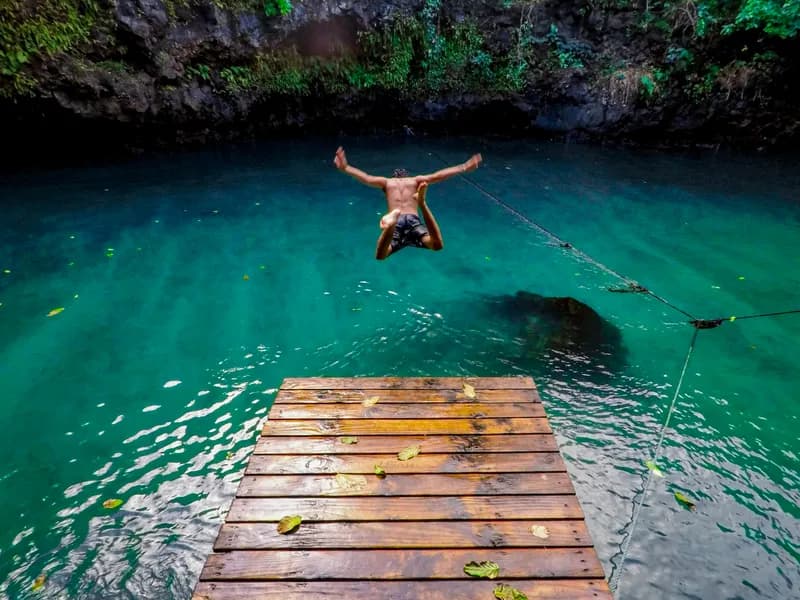
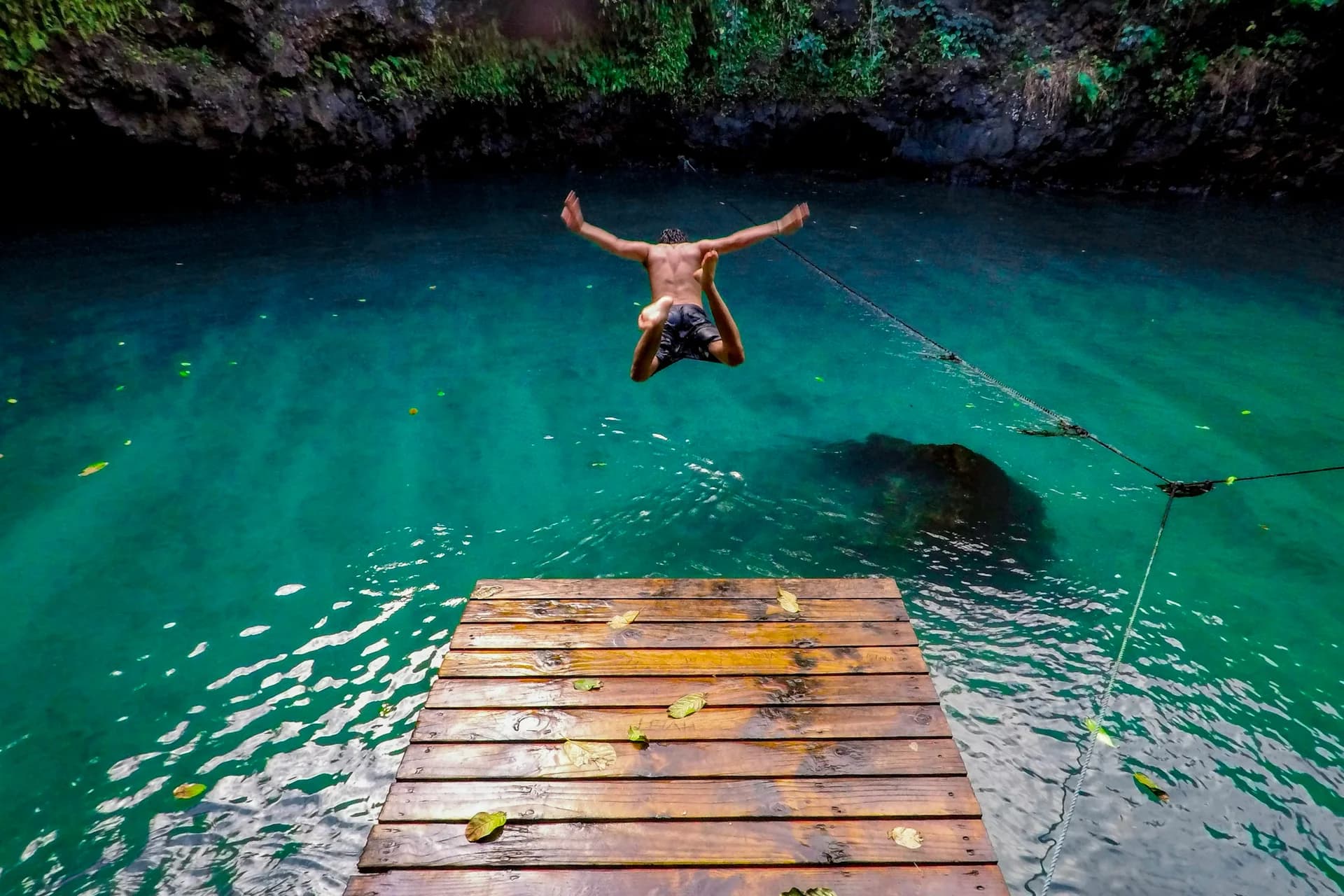
To Sua Ocean Trench, every time. A 30-meter-deep natural swimming hole linked to the ocean by a lava tube, ringed by manicured gardens. You climb down a steep ladder into a surreal turquoise pool and swim in water the tide keeps refreshing.
Entry is 20 WST (~$7). Arrive before 10 AM to beat the cruise-ship crowds; after that, it fills up. Early morning, it's just you, the water, and the birds.
Then there's Savai'i. Everyone stays on Upolu because the airport is here, but Savai'i — the larger island — is wilder, quieter, more traditional. The Alofaaga Blowholes, where seawater shoots 20 meters through lava tubes, are at their most powerful at high tide. The Taga Blowholes, too. And the lava fields from the 1905-1911 eruptions are eerie and unforgettable.
The ferry between Upolu and Savai'i runs two to four times daily and takes two hours — 12 WST ($4.50) per passenger, around 100 WST to bring your rental car.
Samoan Food
Coconut goes into everything here. Oka (Samoa's version of poisson cru — raw fish in coconut cream, lime, and onions), palusami (taro leaves baked in coconut cream), fa'alifu (any vegetable or seafood in coconut cream), and the umu, the Samoan earth oven.
The umu is the special one. On Sundays, after church, every family fires one up. Taro, breadfruit, banana, pork, chicken, fish — wrapped in banana leaves, cooked over heated rocks. The whole village smells of smoke and coconut. If you're ever invited to a Sunday umu, go. It's the most authentic food experience in Samoa.
At the pension, dinner is whatever the fishing boats brought in, cooked in coconut cream with taro and breadfruit. No menu. No choices. You eat what the family eats — and most guests call it the best meal of the trip.
Is Samoa Safe for Solo Travelers?
Very. Solo female travelers stay here often, and Samoan culture is protective by instinct — if someone's bothering you, the whole village steps in. Crime against tourists is extremely rare, and the matai system of village chiefs keeps community policing effective.
The real risks are natural: strong ocean currents (swim only at designated beaches), tropical sun that burns fast, and roads that are narrow, potholed, and shared with wandering animals. Drive slowly and carefully.
The Fire Knife Dance
Siva Afi — the fire knife dance — was born in Samoa. It's uniquely Samoan. Dancers spin and toss flaming machetes at impossible speed, and it's one of the most dramatic performances in the Pacific.
The Samoa Cultural Village in Apia runs free shows Tuesday through Thursday. It's operated by the tourism authority, and the performers are the real thing — not a resort act. Aggie Grey's Hotel puts on excellent cultural evenings, too.
At the pension, Tala's cousin's son performs fire knife; he's been practicing since he was 12. Watch him on the beach at night, flames spinning against the stars — that's Samoa.
Travelers exploring the South Pacific often combine Samoa with Fiji, which offers more resort infrastructure.
For a splurge after Samoa's simplicity, the lagoons of Bora Bora are a stunning counterpoint.
French Polynesia's main island, Tahiti, offers black sand beaches and the Pacific's best food trucks.
A Few Last Things
Wear a lavalava (sarong) into villages — it covers your knees and signals respect. Slip off your shoes before stepping into a fale. Don't eat or drink while walking through a village. If you're offered kava (ava), accept it — sip slowly, don't chug.
And come with patience. Things run on island time here. The bus might be late. The restaurant might not be ready. The ferry might take an extra hour. If you need everything on schedule, Samoa will frustrate you. If you can breathe and wait, it gives you something most places can't.
Peace. The actual kind.