12 Things You'll Want to Do in Hamburg — From the 5AM Fischmarkt to Ferry 62
12 Things You'll Want to Do in Hamburg — From the 5AM Fischmarkt to Ferry 62
Hamburg won't sell itself to you. It's a working port — Germany's second city, laced with more bridges than Venice, Amsterdam and London put together — and it sort of assumes you'll find the good parts yourself. So here they are, ranked and ready.
Two things before the list. Most of what makes Hamburg great costs nothing, or close to it. And the smartest €8.90 (about $10) you'll spend all trip is an HVV day pass, because it covers the U-Bahn, the S-Bahn, the buses — and, the part nobody mentions, the harbour ferries. That last detail turns a €25 tourist cruise into a free ride. Hold that thought. Now, the list.
1. Climb Der Michel first — before anything else
Go up St. Michaelis on day one. Locals just call it "der Michel," and it's the sailors' church: Baroque, copper-green, 132 metres tall, with a viewing platform at 82m. Take the lift for €8 (about $9), or grind up all 452 steps if your knees are feeling ambitious.
Here's why it goes first. The view lays the whole city out flat. Container cranes and the Elbe to the south. The two Alster lakes to the north. Speicherstadt's red brick sitting in between. Do this before anything else and every later day has a map behind it.
Time it right and you'll catch the trumpeter — someone plays a chorale from the balcony at 10:00 and 21:00 daily, turning to all four points of the compass. The address is Englische Planke 1. Thirty seconds away sits Krameramtsstuben, a two-metre-wide lane of 1670s almshouses you'd walk straight past if you didn't know.
2. Ride the free escalator inside the Elphi
The Elbphilharmonie — everyone calls it the "Elphi" — is Herzog & de Meuron's glass wave dropped onto an old brick warehouse. And the best part is free. The Plaza viewing deck at 37m costs nothing: grab a timed ticket at the ground-floor box office, or pay €2 online if you want a guaranteed slot.
Getting up there is half the fun. The Tube escalator runs 82m and curves so gently you never see the far end — call it two and a half minutes of pleasant disorientation. Up top, walk the full 360° lap of the terrace where the 1963 warehouse stops and the glass starts.
Concerts in the Grand Hall are a separate thing entirely, and they sell out months ahead. Great if you can plan around a date. But the Plaza alone, open till midnight, is worth the trip.
3. Book Miniatur Wunderland before you leave home
Yes, it's a model railway. No, that's not what it feels like. Miniatur Wunderland is the largest on earth — 1,600 square metres of it inside a Speicherstadt warehouse — and it's genuinely one of the best things in the city. Entry runs about €20 ($22).
Book online several days ahead. It regularly sells out completely, and turning up on spec is how you end up disappointed. Grab an early slot, before the school groups land.
When you're in, plant yourself at Knuffingen Airport and wait for one full day-to-night cycle — the aircraft actually take off. Fifteen minutes, and worth every one of them.
4. Chase blue hour through Speicherstadt
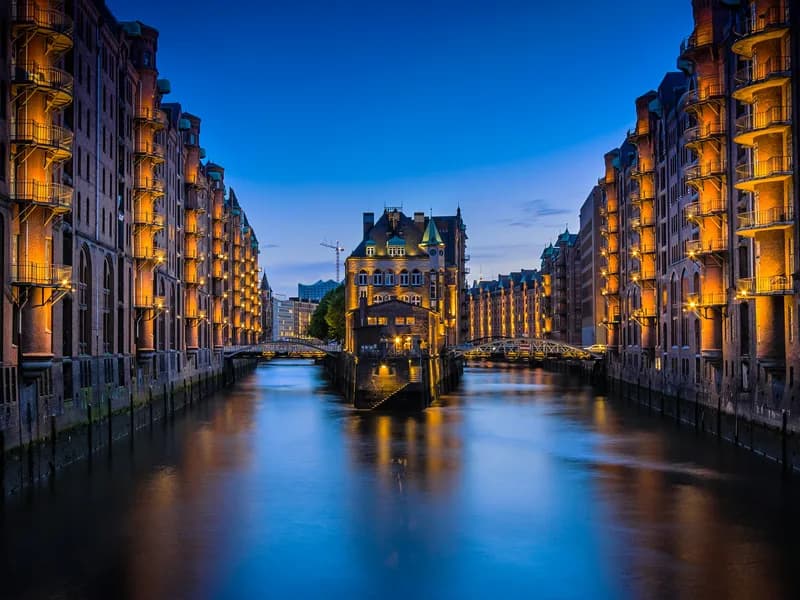
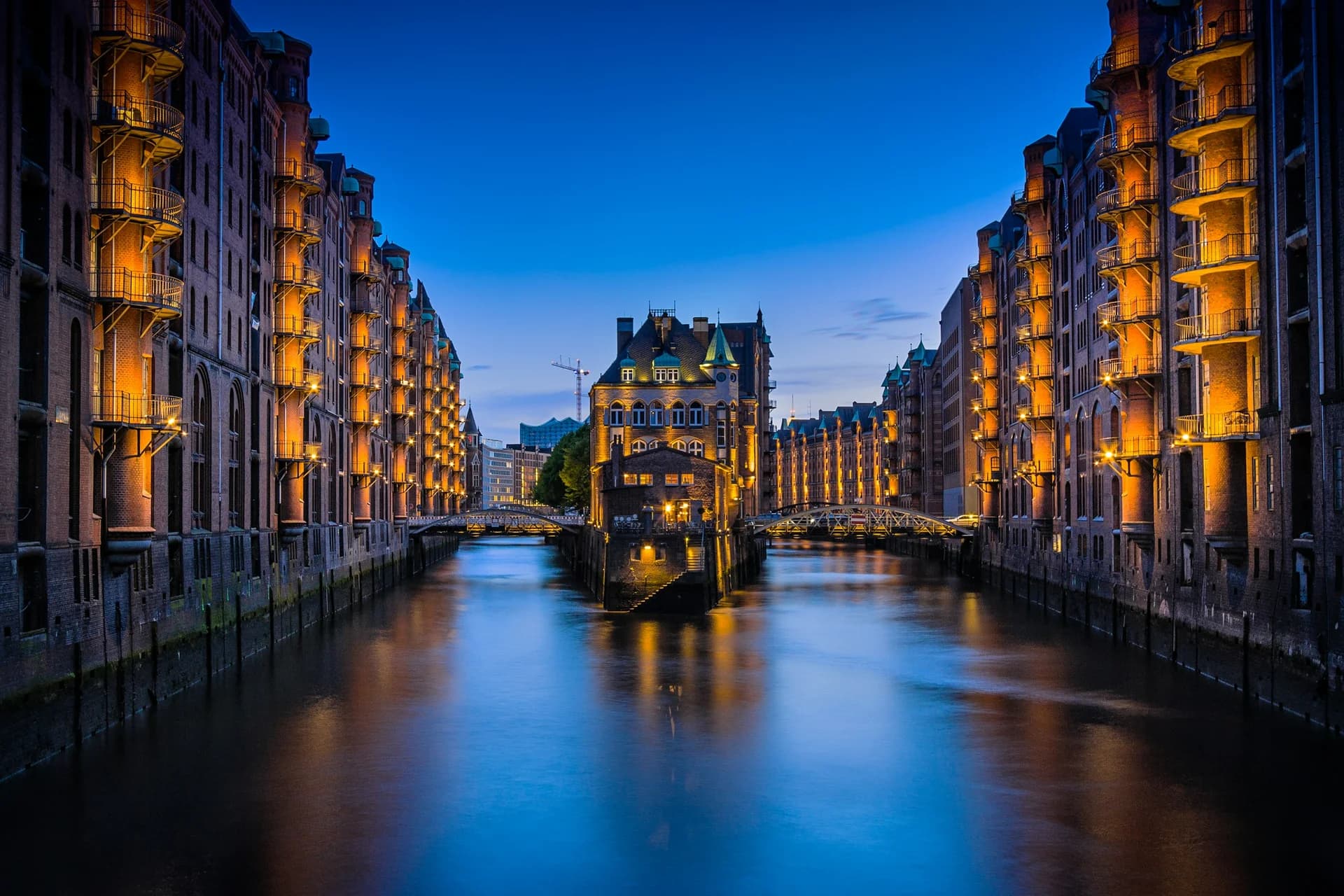
Speicherstadt is the biggest warehouse district in the world: 1.5 km of neo-Gothic red brick standing on oak piles driven into the marsh, threaded with canals. It's free, always open, and best after dark when the floodlights come on.
Head for Poggenmühlen-Brücke at dusk. That's the shot everyone comes for — the little turreted Wasserschloss sitting mid-canal, warehouses reflecting on both sides. Get there 20 minutes early. It's a narrow bridge, and there'll already be tripods.
Look up as you walk. Every floor has a hoist beam and a hatch and no lift. For a century, everything went up on ropes, hauled by hand — the same warehouse trade that raised Bergen's old Hanseatic wharves far to the north.
5. Take Ferry 62 — skip the harbour cruise
Here's the local hack, and it's the one everybody regrets skipping. Public ferry line 62 leaves Landungsbrücken (Brücke 3) every 15 minutes and runs out to Finkenwerder past the dry docks, the container terminals and the Elphi. It's public transport — so your ~€3.90 HVV ticket or day pass covers the whole thing, the same way a standard transit ticket covers Oslo's island ferries.
It's the same water and much the same view as a €20-plus cruise. Sit outside, at the stern, on the upper deck. Twenty-five minutes each way.
Skip the guys selling harbour cruises at the piers — take Ferry 62 instead. On the way back, hop off at Neumühlen/Övelgönne, where a dozen working historic ships sit afloat at the Museumshafen, free to wander among.
6. Set a 4:30 alarm for the Fischmarkt
The Fischmarkt has traded since 1703, and it happens Sundays only, 5:00 to 9:30 AM sharp (from 7:00 in winter) — we cover the rest of the timing and ticket questions in our Hamburg travel FAQ. Then it stops dead — the cleaning trucks move in on the dot. It's on Große Elbstraße, and it's free.
Be in position by 7:00 for the Marktschreier — auctioneers who sell eels, fruit and entire crates of unidentifiable goods by sheer patter until you're somehow carrying a €10 box of bananas you cannot possibly eat.
But the real move is inside. A live band has been going in the Fischauktionshalle since 5:00, and most visitors miss it standing out among the stalls. The crowd's half early risers cradling coffee, half people who simply never went to bed. Bring cash and a hooded jacket — the wind comes straight off the Elbe.
7. Eat a Fischbrötchen at Brücke 10
A Fischbrötchen is a fish roll, and Hamburg runs on them. The place to have one is Brücke 10 at Landungsbrücken — a Bismarckbrötchen or Matjes for about €5.50 ($6), eaten standing at the rail with the ferries coming and going.
Spend the extra on the Krabbenbrötchen if it's there — nearer €8, packed with hand-peeled North Sea shrimp, and you can taste the difference. It beats anything you'll eat near the airport, guaranteed.
8. Walk under the river through the Alter Elbtunnel
The Alter Elbtunnel opened in 1911 and runs 426.5m at 24m beneath the Elbe. It's free for pedestrians and open around the clock, at the western end of Landungsbrücken — Antwerp built a near-identical walk under the Scheldt two decades later. The original cable-driven lifts still lower cars by the ton — but take the spiral stairs down.
Look for the ceramic reliefs set into the tiled walls: fish and crabs, sure, but also a rat and a lost boot, which is a fair inventory of what the river actually gives back. Walk to the south bank and turn around. That's the skyline postcard most visitors never bother to collect.
9. Do the Beatles trail right — then drink where locals do
The Reeperbahn is Europe's most famous nightlife strip, and it's where five kids turned into the Beatles across roughly 280 nights in 1960-62. Start at Beatles-Platz, paved black and shaped like a vinyl record. Then walk up Große Freiheit: No. 64 is the Indra (their first Hamburg night, 17 August 1960), No. 36 the Kaiserkeller, and the old Star-Club at No. 39 is now a plaque beside a car park.
When it's time for a drink, turn off the tout-lined main strip into Hamburger Berg — one short street of honest dives where locals actually drink. Zum Silbersack (Silbersackstraße 9) for an Astra and a jukebox.
One hard rule anywhere near here: no photography on Herbertstraße. It's not a quaint tradition — it's enforced on the spot, and people have had drinks thrown over their cameras. Put the phone away on that street.
10. Drink a beer in the sand at Strandperle
Strandperle is a kiosk on a genuine Elbe beach at Övelgönne 60, running since 1978. Order at the hatch — beer's about €4 — and sit in the sand while container ships pass close enough to read the hull lettering.
Nobody swims. The currents and the suction off the ships are genuinely lethal, and locals know it, so everybody just drinks instead. Stay for sunset; the light comes straight back up the river at you.
11. Franzbrötchen in the Schanze, then the bunker rooftop
The Franzbrötchen is Hamburg's own pastry — flattened, caramelised, cinnamon-buttered, like a croissant that lost a fight and improved. Herr Max (Schulterblatt 12) does a theatrical version; any Nur Hier bakery does the honest one for about €1.60.
Work it off two minutes away at the St. Pauli Bunker on Feldstraße (U3). The 1942 flak tower now wears five storeys of planted terraces, with a free public path spiralling up the outside to 58m. It opened in 2024 and is still mostly locals — a last, quiet look at the harbour and the Michel.
12. Catch the free fountain light show at Planten un Blomen
From May to September, the Wasserlichtkonzerte run nightly at the Parksee inside Planten un Blomen — illuminated fountains choreographed live by an organist sitting in a booth by the water. Free. It's at 22:00 May to August, 21:00 in September.
It's unashamedly 1953 and completely wonderful. Sit on the grass bank on the far side; the crowd all packs the near one.
Pro Tip
Buy the €8.90 HVV day pass on the HVV app or a DB Navigator ticket machine the moment you land — it pays for itself in three rides and hands you that free Ferry 62 cruise.
Staying a week or more, or planning day trips to Lübeck? Get the Deutschland-Ticket instead (~€63/month, cancellable monthly) in the DB app — it covers every U-Bahn, S-Bahn, bus and harbour ferry in Hamburg plus the regional trains out to Lübeck, Lüneburg and Bremen, and you stop counting. Prefer to see it all sequenced by day? Our five-day Hamburg plan threads these dozen stops into a single route.
Two more locals-only rules. Sundays shut the entire country — shops, supermarkets, everything — so buy food on Saturday. And Hamburgers have a word for the sideways drizzle, "Schmuddelwetter," which they simply ignore. An umbrella inverts within a block. Pack a hooded waterproof for any month, July included, and go out in it like they do.
Related Articles
 Travel Guides
10 Things to Do in the Maasai Mara That Aren't Just the River Crossing
 Travel Guides
12 Best Things to Do in Luxor: A Both-Banks Hit List for Ancient Thebes
 Travel Guides