
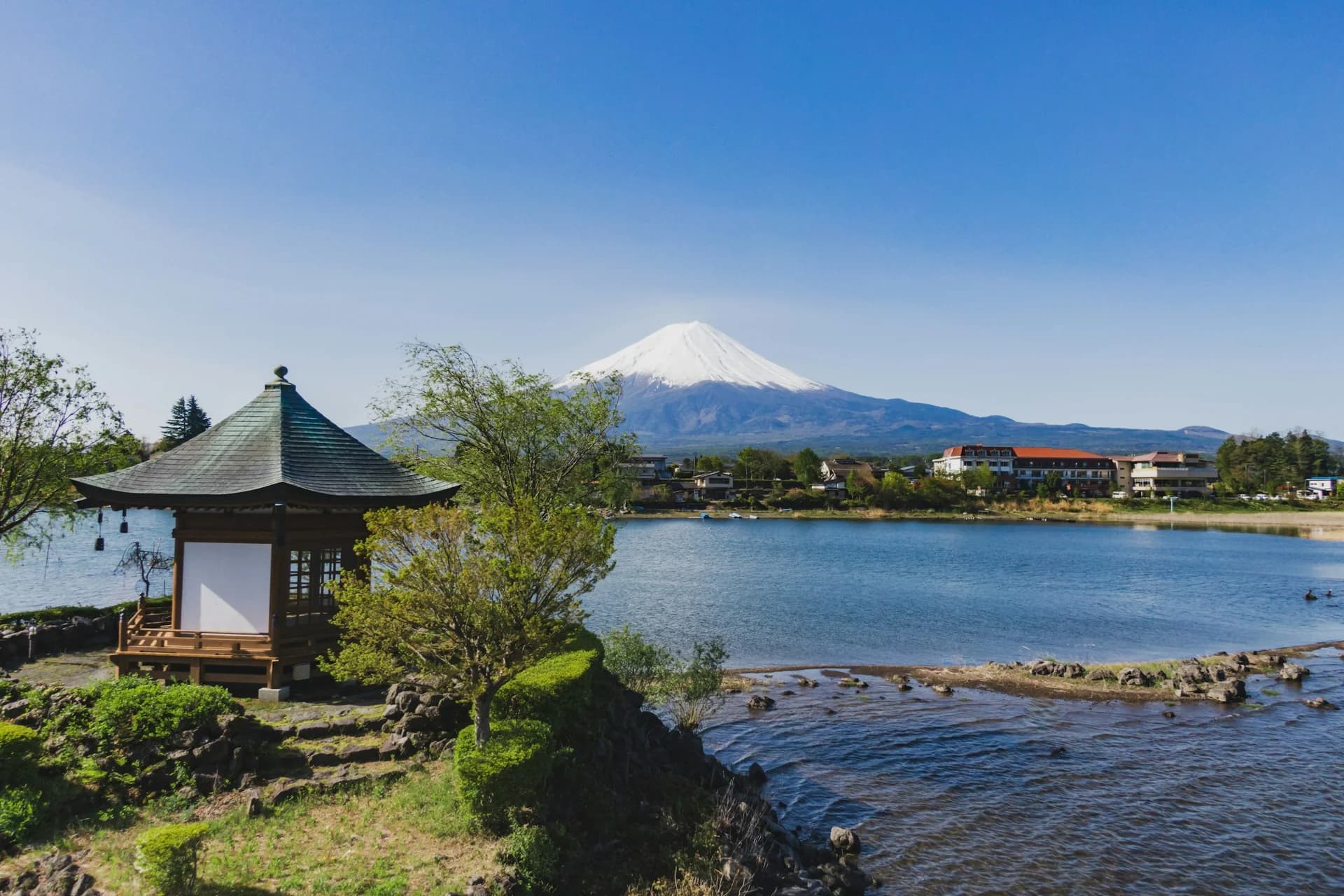
Autumn at Kawaguchiko: The Best Season to See Mount Fuji Framed in Red and Gold
Pick one season for Kawaguchiko and it's autumn. Not spring. Not summer. Autumn.
Here's why the smart move is to plan your Mount Fuji trip for late October into mid-November: this is when the mountain actually shows up. Fuji is a shy giant. It hides behind cloud on warm afternoons, and summer travelers routinely spend three days at the lake without ever seeing the summit. But autumn brings crisp, dry high-pressure mornings — and on those mornings, Fuji stands there sharp and snow-dusted against a hard blue sky. Add the red-and-gold foliage (the momiji the whole country goes a little wild for) and you get the single most photographed version of Japan there is.
Why autumn wins
Kawaguchiko sits at roughly 833 m in the Fuji Five Lakes, high enough that the air turns cool and clear weeks before Tokyo does. The foliage peak usually lands late October to mid-November, though it drifts a week either way depending on the year — check a Japanese koyo (autumn leaves) forecast before you lock dates. When it hits, the maples along the lake's northern shore turn the color of embers — the same fiery momiji that overtakes Kyoto's temple gardens a week or two later.
The headline event is the Momiji Corridor (Momiji Kairo) near Oishi Park on the north shore — a tunnel of fiery maples along a small canal, lit up after dark during the Fuji Kawaguchiko Autumn Leaves Festival (roughly early-to-late November). The evening illumination typically runs until around 9-10pm, and the whole corridor is free to walk. Come at dusk so you catch the maples in daylight and stay for the lights — that half-hour of blue-hour transition, with the canal reflecting both the leaves and the last glow off Fuji, is the shot. Food stalls line the path selling roasted chestnuts, grilled mochi, and hot amazake. Weekends here get shoulder-to-shoulder, so aim for a weekday evening if your dates allow.
The weather, honestly
Expect cold mornings — single digits Celsius at dawn, sometimes near freezing by mid-November — warming to a pleasant 12-18°C by midday. That morning chill is the price of admission, and it's worth every shiver, because dawn is when the water lies glassy and the inverted Sakasa-Fuji reflection appears on the lake surface. The wind picks up as the day warms, so the reflection window closes early. Set an alarm.
Rain does happen. Fuji retreats behind cloud when it does. This is exactly why you stay overnight lakeside instead of day-tripping — two or three mornings gives the mountain multiple chances to cooperate, and it usually does.
What to pack
- Layers. A warm base layer plus a packable down or fleece for dawn, then strip down as the day warms. You'll be peeling off jackets by lunch.
- Grippy shoes. The ~400 steps up to Chureito Pagoda are a lung-burner, and cold mornings leave them slick.
- Gloves and a beanie for those pre-7am reflection shots by the water.
- Cash (yen). Rural Fuji-area shops, buses, and small udon joints often won't take foreign cards. Carry an IC card (Suica/PASMO) too, and top up at a 7-Eleven ATM — those reliably take foreign cards.
- A tripod if you're serious about the dawn reflection or the lit-up Momiji Corridor.
Seasonal food to chase
Autumn is the right time for the region's warming bowls. Order hoto — flat, wide udon simmered with pumpkin and root vegetables in a thick miso broth — at Hoto Fudo (around 1,100 JPY / about $7.50), served in a landmark curved-roof building near the lake. It's the local comfort dish and it tastes ten times better when your fingers are cold.
Then there's Yoshida udon, the famously firm, chewy noodle of nearby Fujiyoshida. Slurp a bowl (600-900 JPY / roughly $4-6) at a family shop along retro Honcho Street, where Fuji rises at the far end of the road like a stage backdrop. Roasted chestnuts and hot sweet amazake from festival stalls round it out.
Crowd levels — the real talk
Autumn is popular. Weekends and the festival nights get busy, and the direct highway bus from Shinjuku sells out. But here's the thing: the crowds cluster at midday and at a handful of spots. Beat them the easy way.
Skip the crowded Chureito Pagoda midday shot — arrive before 7am instead. The tour buses roll in around 9-10am; get there at dawn and you'll have the ~400 steps and the pagoda-and-Fuji frame nearly to yourself, in the best light of the day. Same logic at Oishi Park and Oshino Hakkai — those eight crystal-clear spring ponds fed by Fuji snowmelt turn into a scrum by late morning, so go early or in the late afternoon when the tour groups have moved on.
Travel midweek if you can. Reserve everything — bus seats, ryokan — well ahead for November.
Getting there and where to stay
Two good routes from Tokyo. The direct highway bus from Shinjuku Busta to Kawaguchiko Station runs ~1h45m-2h for around 2,000 JPY (about $13.50) — cheap, easy, and it sells out on autumn weekends, so book online early. Or ride the Fuji Excursion limited-express train straight from Shinjuku: pricier, but faster, more comfortable, and the red Fujikyu carriages roll right up to the mountain as you approach — a fittingly scenic entrance for a foliage trip.
For lodging, the smart autumn play is a lakeside ryokan with a Fuji-facing room and its own onsen. You'll want to be soaking in a mineral bath with the mountain in view at dusk, then be steps from the north shore for the dawn reflection. Day-use baths run ~800-1,500 JPY (about $5.50-10) if your ryokan doesn't have one, but staying somewhere with a private or Fuji-view bath is worth the splurge in peak season.
A sample two-and-a-half day autumn itinerary
Day 1 — Arrive and settle. Take the direct highway bus from Shinjuku Busta to Kawaguchiko Station (~1h45m-2h, ~2,000 JPY / about $13.50; reserve online). Grab the Retro Bus 2-day pass (~1,500 JPY) at the station — its red, green, and blue loop lines cover Oishi Park, the ropeway, Oshino Hakkai, and the Saiko villages. Check into a Fuji-facing lakeside ryokan. Walk the eastern shore toward Kawaguchi Ohashi bridge at sunset, then soak in an onsen before a kaiseki dinner.
Day 2 — The big one. Dawn at Chureito Pagoda (free) for the postcard shot. Yoshida udon lunch on Honcho Street. Afternoon at Oshino Hakkai, then the Momiji Corridor at Oishi Park after dark for the illuminated maples. Cap it with a lakeside onsen soak (day-use ~800-1,500 JPY).
Day 3 — North shore and up high. Early reflection shots at Oishi Park while the water's still. Ride the Mt. Kachi Kachi Ropeway (round trip ~900 JPY) to the Tenjoyama viewpoint at ~1,075 m for the sweeping lake-and-Fuji panorama, best on a clear autumn morning. A last hoto bowl, then the bus back to Shinjuku (reserve your return seat the day before).
That's the season in a nutshell: cold dawns, clear Fuji, blazing maples, warm noodles. Book the flights, aim for that early-November window, and let fairtravels.ai handle the rest of the planning so all you have to do is set the alarm.


