
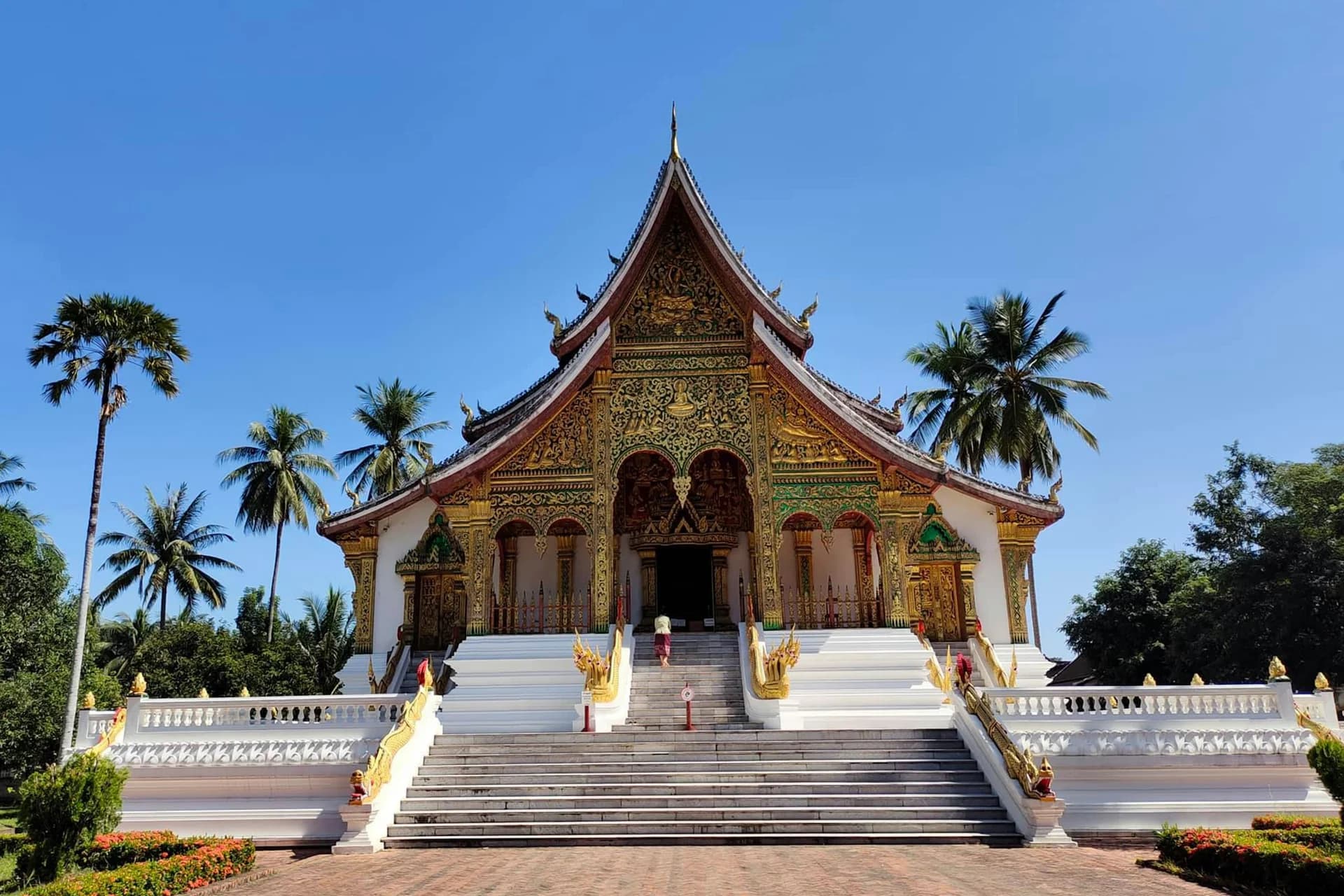
What Luang Prabang Gets Wrong About Tourists (and Right About Everything Else): A Local's Perspective
What Luang Prabang Gets Wrong About Tourists (and Right About Everything Else): A Local's Perspective
Somphone Vongkhamchanh runs a guesthouse three stories above the Mekong, where breakfast is a sticky rice ball pinched into jeow mak len — the smoky tomato dip she'll tell you is the only correct way to start a day in Laos. At 46, she's earned the opinion. Born in Vientiane, she moved to Luang Prabang in 2008 to open the guesthouse after a decade working in Bangkok hotels, raised two kids here, and rode out the tourism boom, the COVID collapse, and the rebuild that followed. She speaks Lao, Thai, French, and enough English to run a business and argue with booking.com customer service.
Ask what tourists get wrong about Luang Prabang and the answer comes fast: almost everything about the alms ceremony. Start there.
On the Morning Alms Ceremony
Q: What do tourists get wrong about the alms ceremony?
Almost everything. The tak bat starts around 5:30–6AM, when monks walk silently through the streets collecting food from local families. It's one of the most sacred daily rituals in Theravada Buddhism — a spiritual practice, not a photo opportunity.
Yet every morning, tourists crouch two feet from the monks with flash cameras, or stand in the middle of the procession blocking the path. Some tour companies sell "alms giving experiences," handing visitors a basket of sticky rice and telling them to kneel on a mat set up on Sakkaline Road. The monks will accept the rice because they can't refuse, but the quality is usually terrible — pre-packaged tourist rice, not freshly steamed.
If you want to watch, stand back. Way back. Skip the flash. Don't touch the monks. And if you want to give, buy your rice from the morning market ladies — the ones up at 4AM steaming it in bamboo baskets. That rice costs about 10,000 LAK ($0.50) per basket, and the monks can actually eat it.
Q: Is it okay to participate at all?
It's complicated. The UNESCO office and the local government ask tourists to observe, not participate. But some families on the route will invite you to join them — that's different. If a local family says "sit with us," that's genuine. If a tour company sets up a mat with your name on it, that's performance.
The honest read: watch from a respectful distance the first time. If you come back and a family invites you in, accept. That's how it should work.
On Where to Eat
Q: Where do locals actually eat?
Not the restaurants on the main street. Those are fine — Tamarind is good, Dyen Sabai is fun for the river setting — but they're priced for tourists. A meal at Tamarind runs 80,000–120,000 LAK ($4–6). A meal at the noodle stalls on Khem Khong Road runs 15,000–20,000 LAK ($0.75–1).
For khao piak sen — thick rice noodle soup, Luang Prabang's comfort food — head to the stall across from the post office on Chao Fa Ngum Road. No name, just a woman and her pot. She starts at 6:30AM and finishes when the pot is empty, usually by 10AM. A bowl is 15,000 LAK ($0.75).
For laap — the spicy minced meat salad — try any of the beer shops along the Mekong south of the old town, the ones with plastic tables and Beerlao signs, the same riverside setup you'll find on the Nam Song in Vang Vieng. Order laap kai (chicken) or laap sin (beef) with sticky rice. The sticky rice arrives in a bamboo container; you eat with your hands — tear off a small ball, press it between your fingers, and use it to pick up the laap.
The night market on Sisavangvong Road has good food stalls at the far end, away from the handicraft sellers. The vegetarian buffet is 15,000 LAK ($0.75) for a plate piled as high as you can manage — the best deal in town.
Q: What about the morning market at Phousi?
This is where locals go at 5:30AM, before the tourists wake. The ladies sell river weed (dried Mekong algae seasoned with sesame — the local answer to seaweed snacks), fresh herbs, buffalo skin, and things you probably won't recognize. It isn't set up for tourists, but nobody minds if you walk through. Just don't photograph people without asking.
On What to Skip and What to Keep
Q: What should you skip?
The tourist boats to Pak Ou Caves. The caves themselves are fine — two caves full of old Buddha statues on a cliff above the Mekong — but the two-hour ride each way on those big tourist boats is boring. You sit on a hard bench and stare at brown water. The caves take 20 minutes.
If you do want Pak Ou, hire a private longboat — about 350,000 LAK ($17) for the whole boat — and stop at the whiskey village (Ban Xang Hai) on the way. The whiskey is lao-lao, rice whiskey with snakes and scorpions in the bottles. You don't have to drink the snake one.
Skip the elephant riding experiences, too. They advertise ethical encounters, but most aren't. The Elephant Conservation Center in Sayaboury (3 hours away) is the real one — no rides. MandaLao (closer to town) is better than most, though the conservation center wins if you have the time.
Q: What should you not skip?
Kuang Si Falls. Everyone calls it touristy and crowded. It is. Go anyway. The water really is that blue-green color — nothing edited about it. Arrive early, 8AM when the park opens, and you'll have the main pools to yourself for about 45 minutes before the tour buses roll in; the same first-hour rule applies to the waterfall pools around Pai in northern Thailand. Entry is 20,000 LAK ($1). Wear water shoes — the rocks are slippery.
And Mount Phousi at sunset. Yes, it's 328 steps. Yes, you'll sweat. But the 360-degree view of the Mekong and Nam Khan rivers meeting below the old town at golden hour is the single best view in Southeast Asia under $1. Entry is 20,000 LAK ($1).
On the Real Luang Prabang
Q: What do tourists never see?
The south side of town past the boat landing. Walk past the confluence point where the Mekong meets the Nam Khan, then keep going south along the unpaved road. There are fishing villages, small temples that never make the guidebooks, and nobody trying to sell you anything.
The weaving villages, too. Ban Xang Khong is the famous one — saa paper and silk textiles, about 3km east of town, reachable by bicycle. But the weavers in Ban Phanom, just across the Nam Khan by boat (5,000 LAK / $0.25), are less visited and do remarkable work. A handwoven silk scarf there costs 200,000–400,000 LAK ($10–20), compared to 500,000+ at the night market. If that handloom work hooks you, the silk-weaving villages around Inle Lake in Myanmar carry the same craft tradition.
Q: Has Luang Prabang changed since UNESCO designation?
Massively. Back in 2008, the old town had maybe 30 guesthouses. Now there are over 300 registered accommodations. The French colonial buildings that were once falling apart are boutique hotels charging $150 a night, and many of the locals who lived in them got bought out and moved to the outskirts — it's the same French-colonial riverside squeeze now playing out in Battambang down in Cambodia.
Some of that is good — the buildings are preserved, the town has money, kids get an education. Some of it is bittersweet — the old town can feel like a stage set on certain days, especially on Sisavangvong Road, where every second building is a souvenir shop, the way the hill-tribe markets of Sapa tipped from trading post to shopfront.
But walk two blocks off the main road in any direction. You'll find a neighborhood temple where monks are studying. A grandmother selling khao piak from a cart. Kids playing football in a dusty lot. That's still the real Luang Prabang.
Q: What's one custom to respect?
Shoes off. Always. Before entering any temple, any home, even some shops. If you see shoes piled by the door, remove yours. This isn't an optional nicety — it's basic respect. Tourists have walked into Wat Xieng Thong in muddy hiking boots; the monks are too polite to say anything, which is exactly why you shouldn't make them.
Q: One last thing before planning a trip?
Stay longer than three days. Everyone does three days — alms, Kuang Si, Pak Ou, leave. That's the checklist version, and Luang Prabang doesn't reveal itself on a checklist — much the way a Wanaka local argues you should skip Queenstown for somewhere slower. Rent a bicycle, ride to the weaving villages, eat at the noodle stalls, sit on the Mekong at sunset with a Beerlao (10,000 LAK / $0.50 from any shop), and let the town be slow.
It's the slowest place in Southeast Asia — only the laid-back Mekong islands of Don Det down south rival its pace. That's not a weakness. That's the entire point.


